Blockchain projects power decentralized networks, enabling secure transactions, smart contracts, and digital assets. Some focus on finance, others on supply chains, identity, or data security. With so many options and risks like hacks or weak adoption, knowing which projects have real value is crucial. Understanding the team, vision, and real-world impact helps in making informed choices. Here, we break down top blockchain projects with deep reviews, expert analyses, and insights into their long-term potential.
What Is Tokenized Water Tokenized water refers to the representation of water rights, allocations, or conservation credits on a blockchain. In traditional systems, water rights are often tied to land ownership or governed through paper-based legal frameworks, which can make trading slow and difficult. Tokenization converts rights into tokens managed through smart contracts, allowing network ...
DeSci (decentralized science) is a broad term for projects and platforms that use blockchain for funding, publication, peer review, and other stages of scientific research. The concept emerged in response to processes that rely on a limited number of institutions and publications. The problems DeSci aims to solve In biomedicine, the “valley of death” refers ...
When people discuss blockchain, the conversation often focuses on finance: Bitcoin, Ethereum, exchanges and DeFi. The association has a historical basis because Bitcoin was the first application to use blockchain architecture. However, the technology has a broader scope. A blockchain functions as a distributed, immutable ledger that every participant can verify. The architecture allows parties ...
When you submit a transaction to Ethereum, the mempool broadcasts it to the network, allowing bots, builders, and validators to see it. When a transaction moves a significant amount of value, such as a large DEX swap, a liquidation, or an NFT bid, participants can extract profit from that visibility before the transaction executes. The ...
The value of real-world assets recorded on blockchain reached $38.54 billion on September 26, 2026, according to rwa.xyz. The figure represents an increase of about 84% from the $21 billion recorded in January. Asset managers use the market’s growth to support projections of $2 trillion by 2028 and $16 trillion by 2030. Another indicator shows ...
A research collaboration among Sei Labs, Mysten Labs, and academic institutions has published Sedna, a user-facing protocol that replaces whole-transaction replication with verifiable, rateless coding for blockchain networks employing multiple concurrent proposer (MCP) consensus. The protocol directly addresses a practical trilemma among censorship resistance, low latency, and reasonable cost that has constrained transaction dissemination in ...
Cocoon operates as a decentralized AI inference marketplace built on The Open Network (TON) blockchain. The network connects GPU providers (Workers) who supply computational resources with developers and applications requiring private AI inference capabilities. Transactions settle in Toncoin (TON) , with payment records and settlement finalized on the TON blockchain. The network implements a three-layer architecture comprising Clients, Proxies, and Work Nodes. Clients submit inference ...
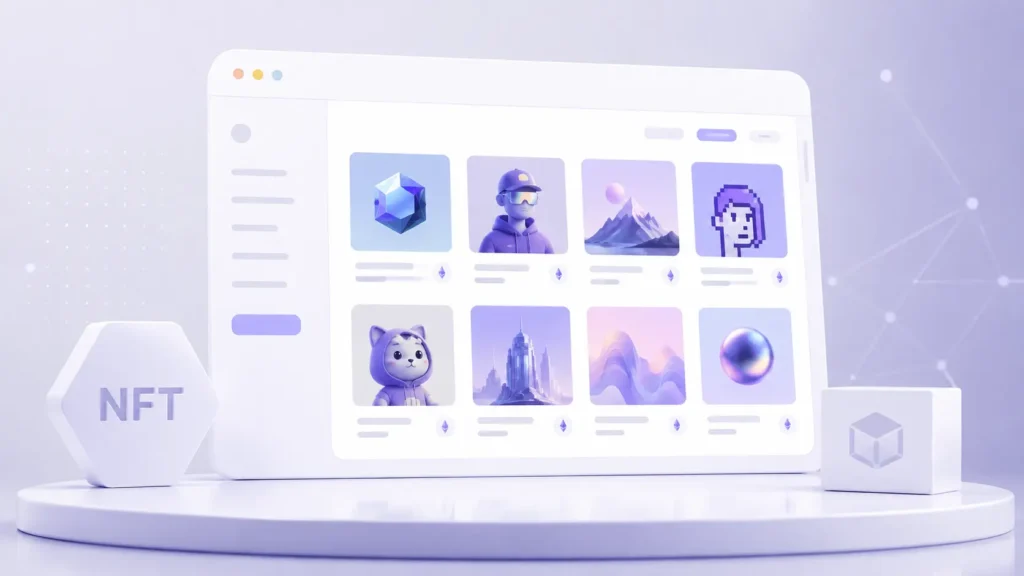
Are you contemplating establishing your own NFT platform? You might want to think again. To create your own NFT marketplace typically costs over $600,000 and can take around eight months of hard work involving a team of people. Therefore, many businesses should go for a ready-made white label NFT marketplace instead of hundreds of thousands ...
According to DappRadar’s third quarter 2025 report, around 18.7 million wallets connect to a decentralized application every day. One of the most popular use cases of decentralized applications is gaming, accounting for 25% of interactions. Others that follow include NFTs at 18.5% and DeFi at 17.9%. In fact, the DeFi sector alone has locked up ...
Metaverse development has become a broad category that covers everything from browser-based virtual spaces to large-scale multiplayer environments, immersive training platforms, digital showrooms, social worlds, and blockchain-enabled ecosystems. That breadth creates an obvious problem for companies looking for a development partner: almost every agency that works with 3D technology, virtual reality, blockchain, or interactive applications ...
To enhance your experience, we use cookies. Consent helps us process data like browsing behavior. Denying may affect site features.
Functional
Always active
The technical storage or access is strictly necessary for the legitimate purpose of enabling the use of a specific service explicitly requested by the subscriber or user, or for the sole purpose of carrying out the transmission of a communication over an electronic communications network.
Preferences
The technical storage or access is necessary for the legitimate purpose of storing preferences that are not requested by the subscriber or user.
Statistics
The technical storage or access that is used exclusively for statistical purposes.The technical storage or access that is used exclusively for anonymous statistical purposes. Without a subpoena, voluntary compliance on the part of your Internet Service Provider, or additional records from a third party, information stored or retrieved for this purpose alone cannot usually be used to identify you.
Marketing
The technical storage or access is required to create user profiles to send advertising, or to track the user on a website or across several websites for similar marketing purposes.