According to DappRadar’s third quarter 2025 report, around 18.7 million wallets connect to a decentralized application every day. One of the most popular use cases of decentralized applications is gaming, accounting for 25% of interactions. Others that follow include NFTs at 18.5% and DeFi at 17.9%. In fact, the DeFi sector alone has locked up a record $237 billion. DApp development allows people to use and interact with the blockchain on a daily basis.
Key Takeaways
- dApp development is the combination of a traditional web frontend and a backend of smart contracts that exist on a peer-to-peer network, instead of a server managed by a company.
- The major difference in development practices compared to Web2: there’s no way to quietly patch deployed contract code; testing and audits must be completed before launch, rather than after receiving a bug report.
- The standard stack in 2026 includes Solidity plusFoundryor Hardhatfor writing and deploying smart contracts,viem or ethers.js plus wagmi for frontend connectivity,IPFS for storage, and The Graph for indexing data.
- Choosing which blockchain to use is more a business-than-technical decision: Ethereum offers maximum security and liquidity; Layer 2s and EVM chains offer low transaction costs; Solana offers high transaction speeds.
- Usability is favored over hype in 2026; account abstraction and gas sponsorship enabled dApps to provide experiences comparable to regular apps, increasing user expectations for every dApp.
Building apps for this many users requires a different mindset than a basic Web3 tutorial would suggest. This is because roughly half of the logic of the app will be executed on infrastructure over which you have no full control and is difficult to modify.
Our guide will explain how a dApp development differs from regular apps
What Is a dApp?
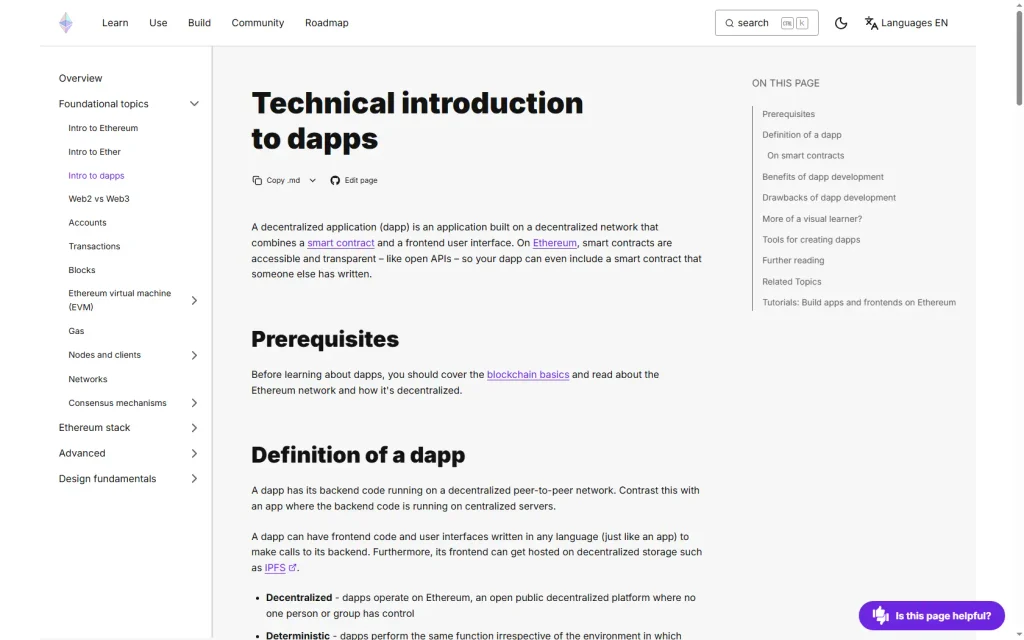
Ethereum’s developer docs say a decentralized app, or dApp, is a software system. This system runs on a peer-to-peer network using at least three computer programs. One program is involved in how the system agrees on things (consensus mechanism), and at least one program can use cryptography to carry out the application’s rules.
The user-facing part of a dApp might look a lot like a regular web or mobile app, built with tools like React or Next.js. But instead of connecting to a private server, it can read from and write to smart contracts. Anyone can check these smart contracts on the blockchain.
This change in how dApps are built is what gives them their key features:
- No single entity in charge
- Resistance to censorship
- Clear rules that anyone can see
- Users having control over their own digital assets
However, this alteration is also the source of the limitations listed quite candidly by the documentation in question. Some of them include complexity in terms of maintenance, performance compromises, and the possibility of reconsolidation through clandestine introduction of logic back into private servers. Excellent dApp development is mainly about the management of these considerations.
| Aspect | Traditional app | dApp |
| Backend | Company-owned servers | Smart contracts on a blockchain |
| Data | Private database | Public on-chain state + decentralized storage |
| Login | Email and password | Wallet connection and cryptographic signing |
| Updates | Deploy anytime | Contracts are immutable; upgrades need patterns like proxies |
| Payments | Payment processor | Native tokens, on-chain, no intermediary |
| Downtime | Server outages possible | Runs as long as the network runs |
dApp Development on Blockchain: The Inner Workings
Creating a dApp on a blockchain means structuring your app into layers that operate under entirely different principles. The ownership of each layer (by you, by a third-party provider, or by the blockchain itself) should be clearly defined in order to make the decisions about all the rest.
Smart Contract Layer
The logic of your application lives in smart contracts, i.e., programs that are deployed on the blockchain and will be executed forever and for everyone. Smart contracts can be written in Solidity (or Vyper) on EVM blockchains, and in Rust on Solana.
The smart contract layer is responsible for updating the blockchain state crucial to your application, including (but not limited to):
- token balances
- ownership history
- game mechanics
- governance rules
Gas fees, which must be paid by the dApp user are required for any transaction attempting to modify the application state.
Because smart contracts act like public APIs accessible to everyone, it is common practice for developers of dApps to compose functionalities with smart contracts from other teams to make existing functionality available. For example, developers could leverage an established DEX with a lending protocol or by employing a common NFT standard in a game.
Connecting the Frontend to the Blockchain
Your website does not communicate with the blockchain, but instead, talks to one of many nodes via the JSON-RPC API. Most developers will use either Alchemy, Infura, or QuickNode services to communicate with a node instead of setting up their own node infrastructure.
To simplify, many developers use software libraries to pick apart the API calls. According to the Consensys developer guide, ethers.js and viem are libraries that receive contract data and produce transaction meta data in JavaScript. Wagmi uses viem to build blockchain connections using React hooks.
The next part is the wallet connect button. This allows the application to see the user’s blockchain wallet address and also allows the user to sign a transaction. Notably, the private key which is required to sign a transaction is kept safe in the wallet and will never be revealed to the application.
As a replacement to usernames and passwords, wallets provide a form of authentication to your application.
Storage and Data Indexing
Storing data directly on the blockchain is computationally expensive, so dApps only keep the most essential information there. Things like media files, extra data, and even the whole user interface are usually stored on decentralized systems like IPFS or Arweave.
Getting data from the blockchain quickly is another hurdle. Looking through the raw history of a blockchain is very slow. That’s why projects like The Graph exist. They take on-chain actions and turn them into easy-to-access APIs. These APIs are then used to build things like dashboards, user activity trackers, and search functions.
dApp Technology Stacks in 2026
After ten years of trying different approaches, a fairly standard set of technologies has emerged for building dApps. While there are many development tools out there, most dApp teams in 2026 use one of these common setups:
| Layer | Standard tools | What it does |
| Smart contracts | Solidity, OpenZeppelin libraries | On-chain logic and audited building blocks (tokens, access control) |
| Dev framework | Foundry, Hardhat | Local chain, compiling, testing, fuzzing, deployment scripts |
| Frontend connectivity | viem / ethers.js, wagmi | Typed contract calls, wallet hooks, transaction handling |
| Wallets | MetaMask, WalletConnect, smart accounts (ERC-4337) | Authentication, signing, gas sponsorship and social login UX |
| Node access | Alchemy, Infura, QuickNode, self-hosted node | JSON-RPC access to the network without running infrastructure |
| Storage | IPFS, Arweave | Media, metadata, and frontend hosting off-chain |
| Indexing | The Graph, custom indexers | Fast queries over on-chain events and history |
Which Blockchain to Use for Your dApp?
Your blockchain choice can affect future expenses, user base, and hiring challenges, making it a very tough choice to change. The Ethereum mainnet is still the industry standard for applications that need the highest level of security and liquidity, and it is easy to interact with current protocols.
However, because it can only process a few thousand transactions per second, most high-frequency DApps are not able to take advantage of its mainnet costs. This restriction can be overcome by Layer 2 solutions like Arbitrum, Optimism, and Base, which provide Ethereum-level security at more affordable prices, allowing use for numerous consumer and gaming applications.
Developers can use the entire Solidity toolchain thanks to a number of EVM-compatible chains, such as Polygon, BNB Chain, and Avalanche. These chains typically give up some degree of decentralization in exchange for lower costs. On the other hand, Solana provides incredibly high throughput at the expense of its own developer tools and programming languages.
Whichever blockchain you choose, make sure you understand the lower-level elements; for instance, the large number of Ethereum clients is a crucial resilience advantage. In 2026, starting development on an L2 where your main user base already exists and seeing multichain deployments as a chance to scale once a dApp is mature is a smart strategic move.
The dApp Development Process Step by Step
- Define the on-chain / off-chain split. Decide what genuinely needs the blockchain (assets, settlement, governance) and what stays conventional (UI, caching, notifications). Over-decentralizing is as costly as under-decentralizing.
- Design and write the smart contracts. Start from audited OpenZeppelin components, keep contracts minimal, and define upgradeability strategy (immutable vs. proxy pattern) consciously.
- Test aggressively on a local chain. Foundry and Hardhat spin up local networks for unit tests, fork tests against real mainnet state, and fuzzing. This phase should consume more time than writing the contracts did.
- Build the frontend. A standard React/Next.js app with wagmi hooks for wallet connection, contract reads, and transaction flows – including the unhappy paths: rejected signatures, pending states, failed transactions.
- Deploy to a testnet and audit. Run the full product on a public testnet, then put the final contract version through an independent audit before mainnet.
- Deploy to mainnet with monitoring. Verify contract source on the block explorer, set up event monitoring and alerting, and have an incident plan – pausability and admin key policy decided in advance.
- Iterate off-chain, extend on-chain. Frontends ship daily like any web app; contract changes are rare, deliberate events with their own audit cycle.
Generic figures don’t mean much because scope swings wildly from project to project. However published cost estimates for one class of dApp, namely marketplaces, run from $20,000–$40,000 for an MVP to $150,000+ for compliance-heavy builds, spanning roughly 2–8 months.
Security: The Part You Cannot Patch Later
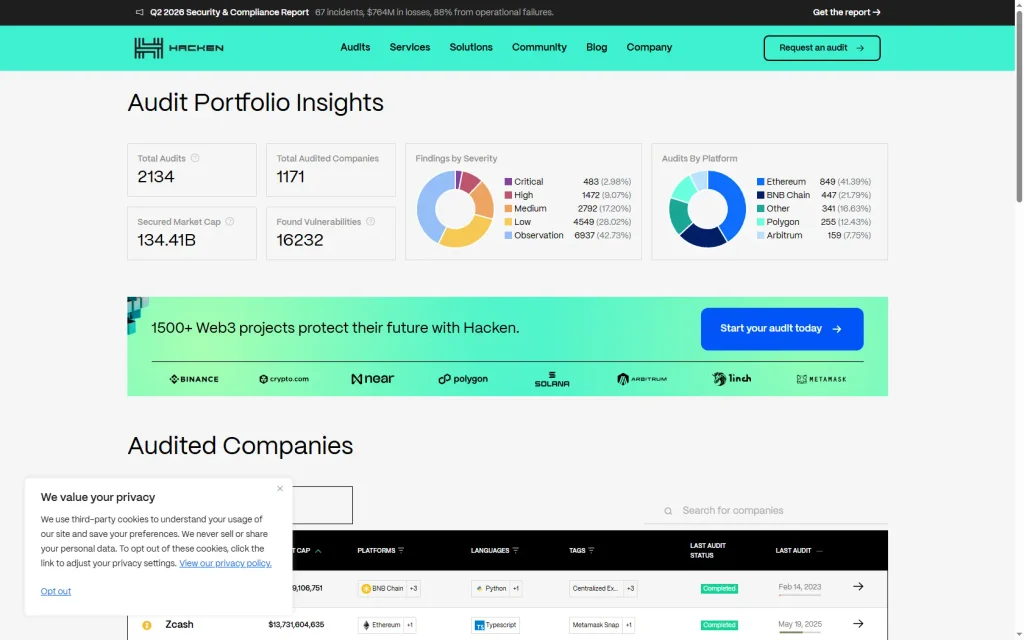
The main disturbance in the dApp development process comes from the fact that you cannot just deploy a contract with assets deposited in it and at the same time fix bugs later on a Friday night. In fact, the same DappRadar report that counts users also states how much it costs to get everything wrong.
In Q3 2025 alone, $434 million was lost due to hacks and exploits. And this was amongst the quietest quarters ever. The main reasons for that were either lack of audits or testing of the logic of the contract, compromised admin keys and dependencies that were not protected enough.
The basic recommendation is to use audited libraries. You can also write testing algorithms that detect any possible economic attack rather than ones that check the correctness of the functions, order independent smart contract audits for the exact bytecode which is going to mainnet, minimize and timelock your admin rights and control your smart contract after the release.
Teams that are in a hurry normally miss one of these points and, as a result, become victims of exploits.
What dApp Users Expect in 2026
People are using applications mostly for practical purposes. Gaming makes up a quarter of all usage. Decentralized finance, or DeFi, has seen its total value locked hit new highs. However, speculative apps like SocialFi are expected to lose users between now and 2025. By 2026, experts believe apps will need to focus on what they actually do to attract users.
Technologies like account abstraction, specifically ERC-4337, make it possible to create smart wallets that can use social logins. Also, apps can cover transaction fees for users, making it seem like there’s no cost involved. Modern blockchains now offer transaction finality in under a second, so people don’t have to wait long for their transactions to go through.
Looking at successful decentralized applications, NFT marketplaces are a good example. These are complete dApps that involve smart contracts, indexing and banking systems, and payment processing. NFT games also show how gaming and blockchain tech can work together.
By 2026, users will be more sophisticated. dApp development won’t be seen as experimental anymore because many standards are already in place.
Frequently Asked Questions
What’s the main difference between a regular app and a dApp?
A standard app utilizes back-end servers owned by a single entity; a dApp, however, relies on a decentralized network of smart contract transactions for its back-end logic. End users connect to it with a cryptocurrency wallet rather than with conventional username/passwords, maintain direct ownership of their digital assets, and can verify any given smart contract logic on-chain.
What programming languages should I use for my dApp project?
On Ethereum and most EVM-compatible chains, Solidity is the primary language for smart contracts, although Vyper is an option; Rust is utilized for Solana. For front-end development, the standard JavaScript/TypeScript with React/Next.js stacks remain popular, alongside web3 libraries like viem, ethers.js, and wagmi.
What is the price of dApp development?
Project scope is the determining factor; industry benchmarks indicate an MVP costs roughly $20,000 – $40,000 to develop, with complex, regulation-heavy solutions ranging anywhere from $80,000 – $150,000+ plus an additional $5,000 – $20,000 for a separate security audit. Basic contract and front-end development is much cheaper; for complex DeFi protocols it can be significantly more costly.
How can I upgrade my dApp smart contract after deployment?
Front-end is straightforward and can be modified freely like any website. By default, smart contract code is immutable; it requires the redeployment of new contracts or the establishment of a pre-arranged upgrade mechanism using proxy patterns to make alterations. Upgradeable contracts offer greater flexibility but also necessitate trust in the holders of upgrade rights – a compromise increasingly scrutinized by users.
Will a traditional backend server be required for my dApp?
More likely than not, yes – specifically for aspects not directly incorporated on-chain, such as notifications, Caching, Search and analytics. However, your server should serve primarily as a complimentary convenience layer rather than as a trust layer; all functions related to the ownership, tracking balances, and core logic MUST remain within the smart contracts, to maintain decentralized integrity.
Is my dApp decentralized?
It is a matter of degree, not a binary state. The majority of dApps still depend on some centralized elements such as RPC providers, web hosting services, and administrator keys – all which represent points of potential centralization. Responsible dApp development necessitates precise awareness and identification of these areas, their minimization wherever appropriate, and transparent communication with end-users about any unavoidable centralizing factors.

Dan is a seasoned crypto writer for Blockchaindose who got his start in the space back in 2019. Over the past four years, he’s built a solid grasp of how the industry moves, focusing heavily on DeFi, NFTs, GameFi, and promising new projects.
Off the clock, you’ll usually find him buried in a good book or kicking back with a movie. His blend of hands-on market experience and straightforward commentary makes him a clear, trusted voice across the platform.