A comparative study of blockchain consensus mechanisms—including Bitcoin, Ethereum, Ripple, and Tendermint—evaluates peer-to-peer networks, native cryptocurrencies, transaction validation, block creation, consensus protocol design, and application development.
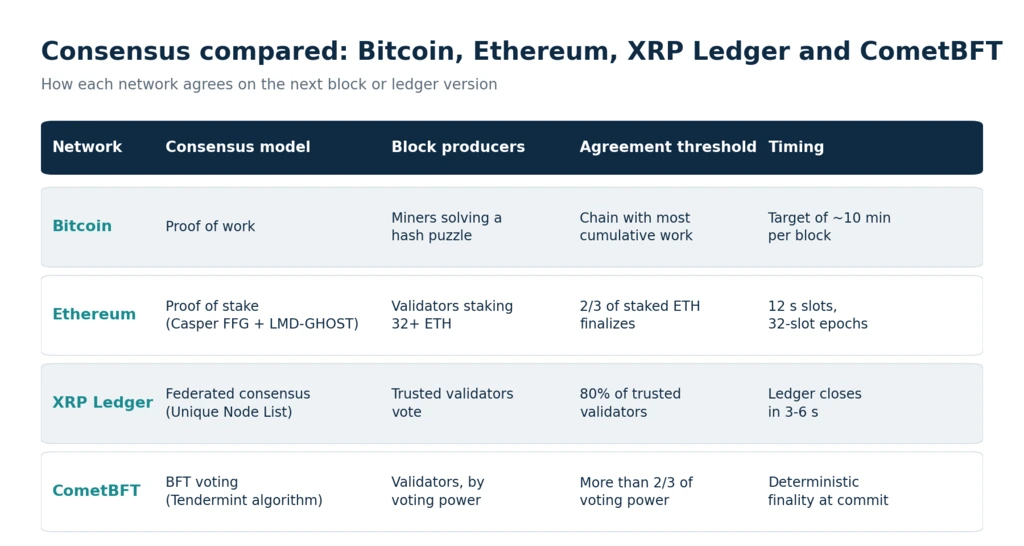
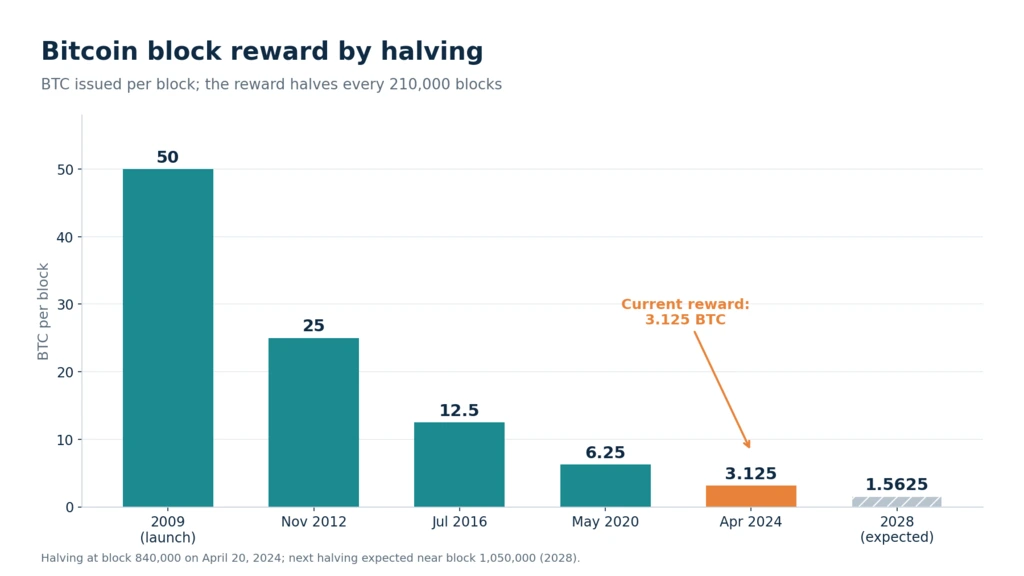
Bitcoin relies on proof of work. Miners hash block headers until the result falls below a difficulty target, and full nodes select the chain with the most cumulative work. Nodes reject blocks carrying timestamps more than two hours ahead. The protocol cut the block reward to 3.125 BTC at block 840,000 in April 2024, and the next halving arrives near block 1,050,000 around 2028. Issuance continues until roughly 2140. Peer discovery runs through DNS seeds, which return addresses of reachable full nodes.
Miners collect transaction fees, calculated as the difference between input and output values, in addition to the subsidy. Transactions follow the UTXO model, and the Script language omits loops.
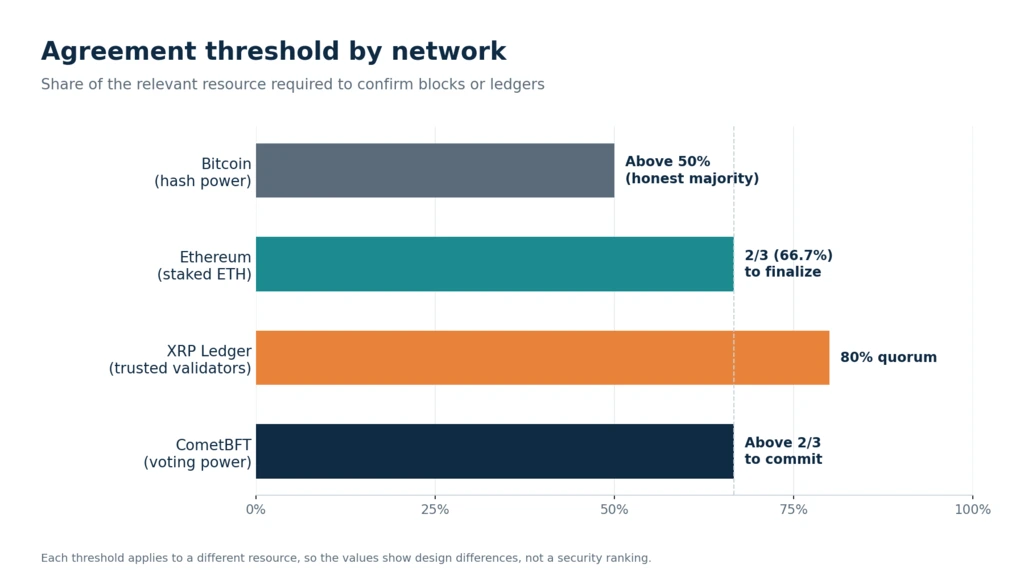
Ethereum completed “The Merge” on September 15, 2022, replacing mining with the “proof of stake” mechanism and reducing energy consumption by approximately 99.95%. Validators deposit at least 32 ETH, propose and attest to blocks in 12-second slots, and group 32 slots into epochs. Casper FFG finalizes checkpoints, and LMD-GHOST selects the fork with the most attestations. Finality requires a two-thirds majority of staked ether, and slashing destroys part of the stake of validators who sign conflicting messages. Accounts hold a nonce, a balance, a storage root and a code hash, and each transaction specifies a gas limit and a gas price.
The XRP Ledger uses a federated consensus protocol. Each server keeps a Unique Node List (UNL) of validators it trusts, and a ledger version validates when at least 80% of trusted validators agree. Ledgers close every three to six seconds. The Negative UNL feature removes unreliable validators from the quorum calculation, which preserves liveness during partial outages. The network started with 100 billion XRP, so it issues no block rewards.
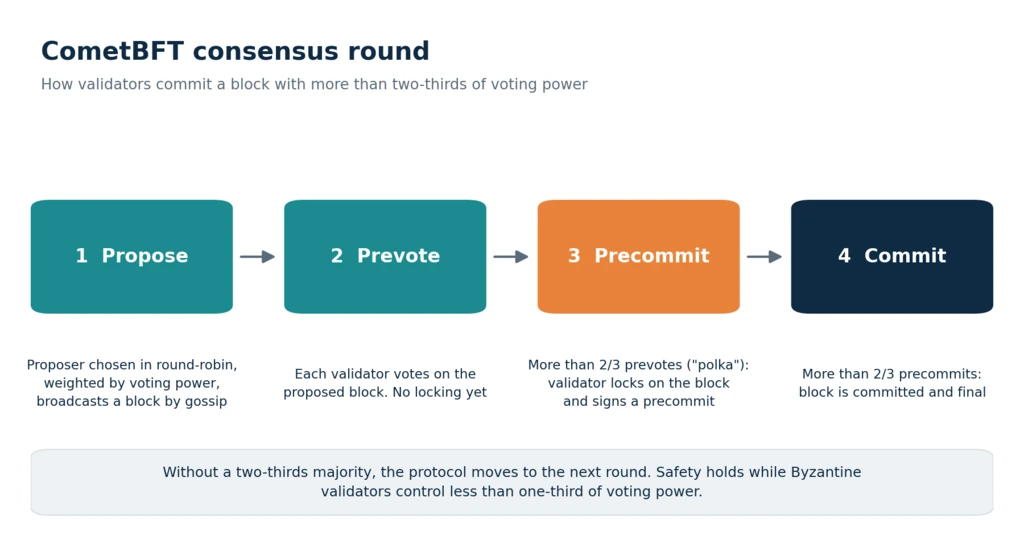
Tendermint operates as CometBFT, a fork formed in 2023 and maintained for the Cosmos ecosystem. Validators weighted by voting power run rounds of propose, prevote and precommit, and a block commits after more than two-thirds of voting power precommits. Safety holds while Byzantine validators control less than one-third of voting power. The Application Blockchain Interface (ABCI) separates the consensus engine from application logic, and developers build chains with the Cosmos SDK. Validators who sign conflicting votes face evidence transactions and lose bonded stake, which gives the protocol fork accountability.
The four designs address the problem of Byzantine fault tolerance that Lamport, Shostak, and Pease formalized in 1982. Proof of Work trades energy expenditure for open participation. Tendermint has a Byzantine fault tolerance of one-third, while Ripple has a tolerance of twenty percent. Proof-of-stake and BFT voting offer deterministic finality but require identifiable validators and penalty rules to counteract the “nothing-at-stake” problem. Financial applications require validators to be identified under “know your customer” regulations, which favors authorized or validator-based models over anonymous mining.
What are blockchain consensus mechanisms?
Blockchain consensus mechanisms are the rules nodes follow to agree on the order and validity of transactions without a central authority. Bitcoin uses proof of work, Ethereum uses proof of stake, the XRP Ledger uses federated consensus, and CometBFT uses Byzantine fault tolerant voting.
How does proof of work differ from proof of stake?
Proof of work selects block producers through computational effort, and nodes follow the chain with the most cumulative work. Proof of stake selects validators through deposited capital, and the protocol penalizes dishonest validators through slashing. Ethereum switched from the first model to the second on September 15, 2022
How does the XRP Ledger reach consensus?
Each server trusts a Unique Node List (UNL) of validators. A ledger version becomes validated when at least 80% of trusted validators agree on it, and ledgers close every three to six seconds.
What is the difference between Tendermint and CometBFT?
CometBFT is the fork of Tendermint Core formed in 2023 and maintained for the Cosmos ecosystem. The consensus algorithm keeps the Tendermint design: prevote and precommit rounds with a two-thirds voting power threshold.
What fault tolerance do BFT-based blockchains provide?
Byzantine fault tolerant protocols stay safe while faulty or malicious validators control less than one-third of voting power. A block reaches finality when more than two-thirds of voting power signs it.

Isai Alexei is a journalist and financial analyst covering cryptocurrency markets and traditional securities for Blockchaindose. He has spent ten years analyzing digital assets, trading activity, and market structure.