


Forced inclusion is the escape route optimistic rollups give users if a sequencer refuses to process their transactions: the user submits a message on Ethereum, waits through a protocol-defined delay, and the L2 must execute the message. The route runs on Ethereum gas, and gas prices respond to anyone willing to pay.
A sequencer operator with capital, batch-posting access and administrative keys can try to raise the cost of a forced exit until small and medium balances stop justifying the fee. Gas griefing does not seize funds. It makes leaving expensive, slow or uncertain, and a user unable to leave remains exposed to every later decision of the operator.
How Forced Inclusion Works on Arbitrum and the OP Stack
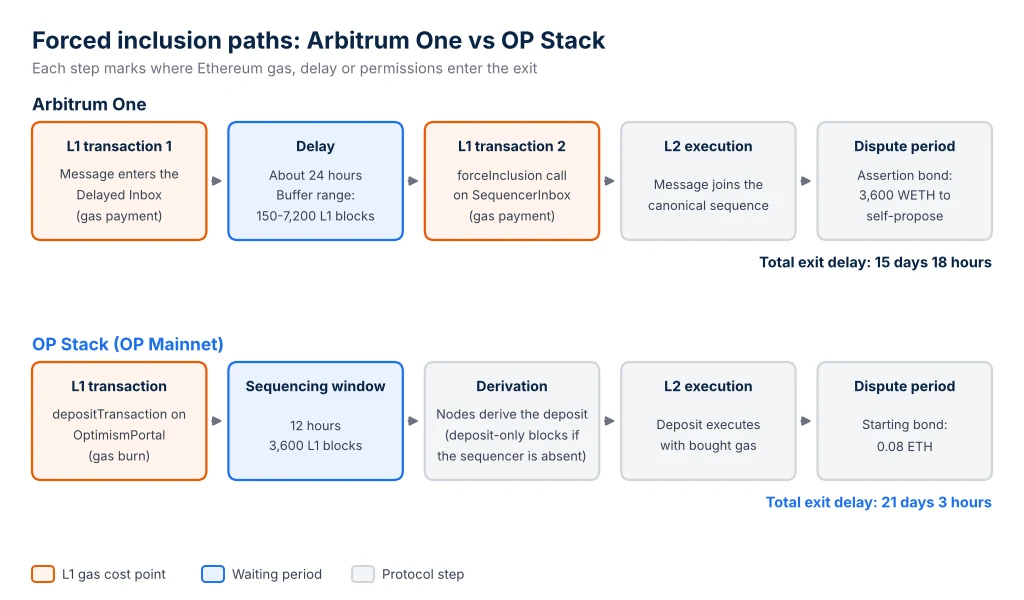
Arbitrum routes forced inclusion messages through the Delayed Inbox on Ethereum, which holds each message until the delay expires. The user sends the message in one L1 transaction, waits, and calls the forceInclusion function on the SequencerInbox in a follow-up L1 transaction.
Arbitrum documentation sets the default delay near 24 hours, and a delay buffer can shorten the wait for individual messages to a range ETHBEAT lists as 150 to 7,200 L1 blocks. Two transactions mean two gas payments separated by hours, and the follow-up payment tracks whatever price Ethereum quotes at the end of the delay.
The OP Stack reduces forced inclusion to one L1 call: users invoke the depositTransaction function on the OptimismPortal contract, and rollup nodes derive the L2 transaction from L1 data.
The sequencing window lasts 12 hours, or 3,600 L1 blocks, and a 30-minute drift limit governs normal deposit inclusion. At expiry of the window, nodes build deposit-only blocks without the sequencer.
A forced withdrawal continues through the dispute period: ETHBEAT, the rollup risk tracker formerly named L2BEAT, lists a total exit delay of 21 days and 3 hours on OP Mainnet and 15 days and 18 hours on Arbitrum One.
Where an Operator Can Raise the Cost of a Forced Exit
Four mechanisms let an operator add cost or delay to forced inclusion, and each acts on a different stage of the path. The deposit gas market on OP Stack chains offers one entry point. The protocol caps the L2 gas bought by deposits at 20 million units per L1 block and prices it with an EIP-1559-style base fee.
The OP Stack specification describes the griefing case directly: an attacker front-runs a victim’s deposit with a purchase large enough to push the victim’s call over the cap, and the victim’s transaction reverts with L1 fees spent on a failed call.
Ethereum block space offers another entry point: the L1 base fee rises up to 12.5% per full block, and the protocol burns the base fee, which means an operator filling blocks pays for every increase.
Timing on Arbitrum adds exposure, because the follow-up L1 transaction executes following a 24-hour wait at the prevailing price, and a user without an ETH reserve for the follow-up payment stalls halfway. Administrative permissions close the list.
ETHBEAT reports the Arbitrum rollup owner can pause the Inbox or enable an allowlist, which blocks new submissions, and an entity holding both the sequencer and owner roles controls the censoring path and the forced inclusion path.
Security warning
A paused Inbox removes the forced inclusion route at any gas price. On Arbitrum, the rollup owner can pause the Inbox or enable an allowlist. Before bridging a large balance, check which entity holds the sequencer role, which entity holds the owner role, and whether the two overlap.
What the Deposit Gas Parameters Imply for an Attacker’s Budget
Default OP Stack parameters set a target of 2 million gas units per L1 block against a cap of 20 million, with a change denominator of 8 and a floor of 1 gwei.
An attacker buying the full cap adds 112.5% of the base fee recorded for the previous block, which multiplies the price by 2.125 per block. From the floor, the deposit base fee reaches about 43 gwei following five full purchases and about 1,880 gwei following ten.
Buying the cap costs roughly 0.02 ETH at the floor, about 0.75 ETH cumulatively across five blocks and about 33 ETH across ten.
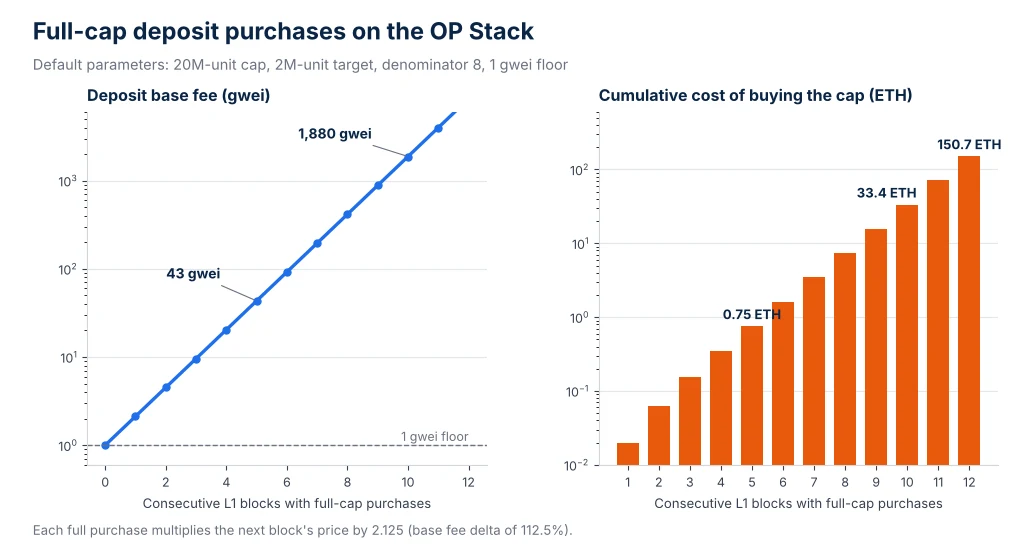
The curve limits how long an attack lasts more than it limits who can start one. A single-block purchase at the floor costs 0.02 ETH and can make a targeted forced inclusion deposit revert, which keeps targeted griefing affordable.
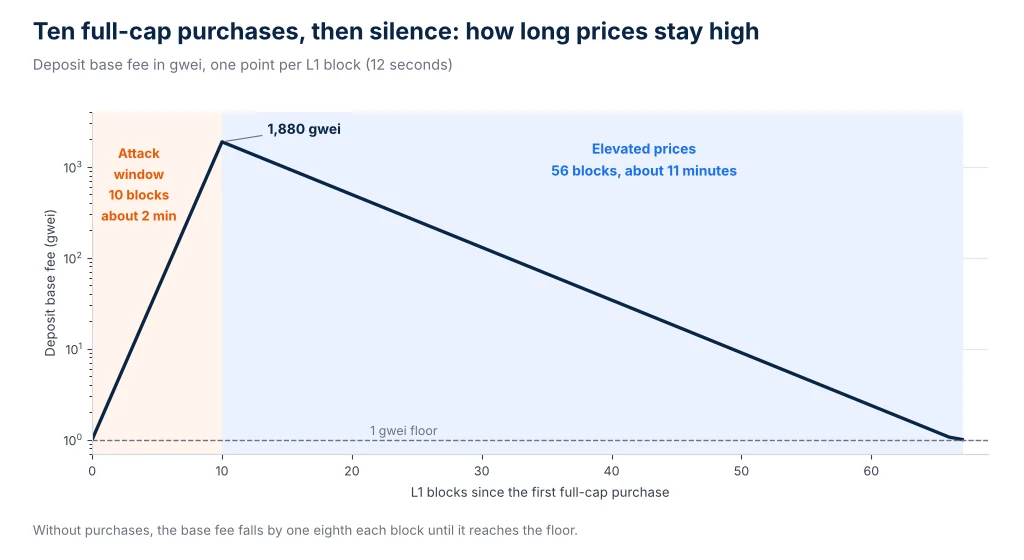
Holding the price reached after ten blocks requires buying at least the 2 million target in each block, about 3.76 ETH per block or roughly 13,500 ETH across a 12-hour sequencing window, and a full-cap purchase in the twentieth block alone would cost near 33,000 ETH. Once purchases stop, the base fee falls 12.5% per empty block, and a ten-block spike decays in about 56 blocks, or 11 minutes.
A budget in the tens of ETH can block deposits for roughly two minutes and leaves prices elevated for another 11, which keeps the 12-hour window intact.
Exit Bonds and Challenge Periods Decide Who Can Afford to Leave
Forced inclusion places the transaction on the L2; a withdrawal needs a state proposal on L1, and the proposer posts a bond.
ETHBEAT lists a 3,600 WETH bond for self-proposing the assertion required for an exit from Arbitrum One, plus refundable bonds of 555 WETH and 79 WETH if a challenger disputes it. The Arbitrum design favors the defender by 6.49 times.
On OP Mainnet the bond starts at 0.08 ETH, and each counterclaim costs 1.09 times the claim it counters, which favors an attacker in a capital-exhaustion contest.
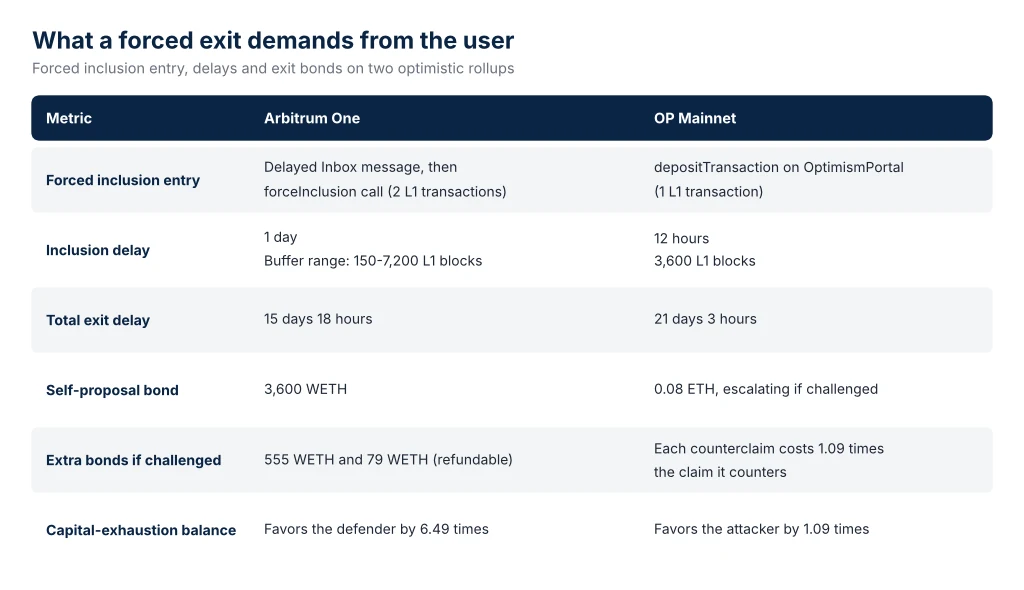
An operator who runs the proposer can combine the mechanisms against forced inclusion: higher L1 prices raise the cost of every transaction in the exit path, and a challenge inflates the bond a single user must commit.
Exits become a capital problem solved by pooled backers and bridge operators in place of individual holders.
Mitigations for Users and Protocol Designers
Users reduce exposure by starting forced inclusion early, holding ETH on L1 for both Arbitrum transactions, and reading the deposit base fee from the OptimismPortal params function prior to submitting.
On Arbitrum, any account can relay a user’s signed L2 transaction through the Delayed Inbox, and any account can call forceInclusion once the delay ends, which lets relayer services carry the L1 gas cost.
Protocol designers have three design tools: a large resource limit paired with a high elasticity multiplier, which the OP Stack specification names as its defense against deposit griefing; the Arbitrum delay buffer, which tightens the allowed delay following repeated holds; and permissionless proposal paths with bonds sized for individual users.
A paused inbox removes the forced inclusion route at any gas price, and the rollup owner role matters as much as the fee parameters, which makes governance permissions the weakest point of the design.
Operators who publish pause conditions, delay buffers and exit bond sizes give users the inputs to price a forced exit ahead of need, and forced inclusion works as a guarantee only if the cost of invoking it stays within reach of the user it protects.
Key takeaways
- Forced inclusion costs two L1 transactions on Arbitrum One and one on the OP Stack.
- Each full-cap deposit purchase multiplies the OP Stack deposit price by 2.125, and a ten-block attack costs about 33 ETH.
- After a ten-block spike, the base fee falls 12.5% per empty block and returns to the floor in about 56 blocks.
- Exit bonds range from 0.08 ETH on OP Mainnet to 3,600 WETH on Arbitrum One, and the OP Mainnet counterclaim ratio of 1.09 favors attackers.
- Governance permissions, including the power to pause the Arbitrum Inbox, remove the route at any gas price.
FAQ
What is forced inclusion in an optimistic rollup?
Forced inclusion is a protocol path for submitting a transaction on Ethereum when a rollup sequencer refuses to process it. The rollup must execute the message after a defined delay: about 24 hours on Arbitrum One and 12 hours on OP Mainnet. The user pays Ethereum gas for the submission.
Can a sequencer operator block a forced exit by raising gas costs?
Gas pricing alone cannot sustain a block. On the OP Stack, each full-cap deposit purchase multiplies the next block’s price by 2.125, so a ten-block attack costs about 33 ETH and blocks deposits for roughly two minutes. Permission controls, including an owner pausing the Arbitrum Inbox, carry a larger risk.
What does a forced exit cost besides gas?
A withdrawal needs a state proposal with a bond. ETHBEAT lists a 3,600 WETH bond for self-proposing on Arbitrum One and a 0.08 ETH starting bond on OP Mainnet, where each counterclaim costs 1.09 times the claim it counters. Individual users can need pooled backers or bridge operators to carry the larger bonds.
How long does a forced exit take on Arbitrum One and OP Mainnet?
ETHBEAT lists a total exit delay of 15 days and 18 hours on Arbitrum One and 21 days and 3 hours on OP Mainnet. The figures cover the inclusion delay plus the worst-case dispute path, and a challenge can extend the dispute period.
How can users lower the cost of a forced exit?
Users can start early, keep ETH on L1 for both Arbitrum transactions, and read the deposit base fee from the OptimismPortal before submitting. On Arbitrum, relayers can submit a signed L2 transaction through the Delayed Inbox and any account can call forceInclusion after the delay, which moves the L1 gas cost to a third party.

Isai Alexei is a journalist and financial analyst covering cryptocurrency markets and traditional securities for Blockchaindose. He has spent ten years analyzing digital assets, trading activity, and market structure.