Crypto guides simplify complex topics, helping you navigate in the blockchain space. Some focus on investing, trading, and mining, breaking down risks and strategies. Others cover staking, yield farming, and airdrops, explaining how to earn passive income. NFTs bring new opportunities but require understanding marketplaces and security. Here, we break down essential crypto guides with expert insights, practical tips, and easy-to-follow explanations.
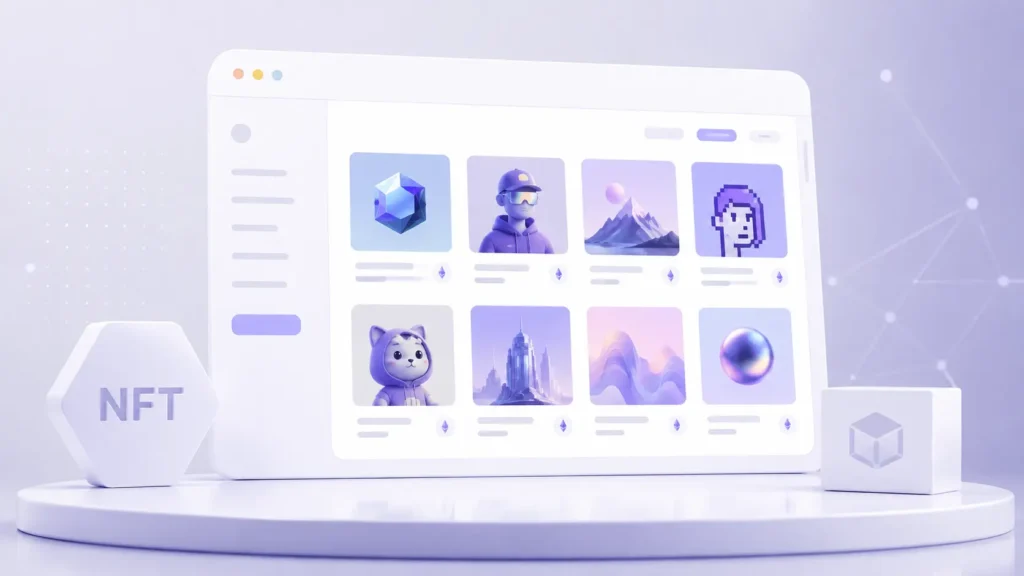
Are you contemplating establishing your own NFT platform? You might want to think again. To create your own NFT marketplace typically costs over $600,000 and can take around eight months of hard work involving a team of people. Therefore, many businesses should go for a ready-made white label NFT marketplace instead of hundreds of thousands ...
The global NFT marketplace market reached $1.675 billion in 2025 and continues its growth trajectory with a compound annual growth rate of 3.40% through the forecast period. The broader NFT market capitalization exceeds $86 billion as of early 2026, with a compound annual growth rate approaching 41.8%. Gaming NFTs generated over $21 billion in the preceding year. These ...
Remember the 2021 NFT boom? In 2026, the NFT market is just a shadow of what it was in 2021. Yet, many NFT marketplace development services continue to ride on the nostalgia of the NFT boom. Key takeaways: NFT data analytics indicated that the trading volumes plunged to merely 823 million in Q2 2025, a ...
Making a token on an existing blockchain is today something that takes minutes and costs cents. Open-source libraries and already-resolved standards eliminated the technical barrier. The result is a market flooded with new tokens: CoinGecko analyzed 18.67 million tokens launched on Pump.fun and found that 68.67% stopped trading on the same day of their creation. Only 4.55% remained active ...
Discover how NFTs serve as the backbone of the metaverse economy. Learn how virtual real estate, digital avatars, and in-game assets create verifiable digital ownership.
Namada blockchain is a Layer-1 network built to make privacy a shared, cross-chain resource rather than a feature locked to one token or one app, joining a small set of privacy blockchains willing to tackle the problem from scratch.. Instead of shielding just its own native asset, Namada lets users shield tokens from Cosmos, Ethereum, ...
Aztec Network Ethereum is the project trying to prove that a public blockchain doesn’t have to choose between privacy and programmability, building what it calls a private world computer as one of the more ambitious zero-knowledge rollups built on Ethereum. Rather than shielding just payments, Aztec lets developers write smart contracts where some data stays ...
Secret Network blockchain was the first public chain to run smart contracts that keep their inputs, outputs, and state fully encrypted, a feature that most privacy blockchains still can’t match. Built on the Cosmos SDK rather than Ethereum, it lets developers add confidentiality to DeFi, NFTs, and even AI workloads without asking users to trust ...
Learning how to become a blockchain developer is less about mastering one language and more about understanding an entirely different execution environment – one where code is public, mistakes are permanent, and smart contracts handle real money the moment they go live. The technical skills are learnable in months; what actually determines whether someone builds ...
NFT bridge security is the difference between cross-chain interoperability and a system vulnerable to multimillion-dollar theft. Bridges have become the central infrastructure connecting every NFT marketplace and chain, and attackers have noticed: bridge exploits are now among the largest thefts in crypto history, and a single mistake in key management can lead to the loss ...
To enhance your experience, we use cookies. Consent helps us process data like browsing behavior. Denying may affect site features.
Functional
Always active
The technical storage or access is strictly necessary for the legitimate purpose of enabling the use of a specific service explicitly requested by the subscriber or user, or for the sole purpose of carrying out the transmission of a communication over an electronic communications network.
Preferences
The technical storage or access is necessary for the legitimate purpose of storing preferences that are not requested by the subscriber or user.
Statistics
The technical storage or access that is used exclusively for statistical purposes.The technical storage or access that is used exclusively for anonymous statistical purposes. Without a subpoena, voluntary compliance on the part of your Internet Service Provider, or additional records from a third party, information stored or retrieved for this purpose alone cannot usually be used to identify you.
Marketing
The technical storage or access is required to create user profiles to send advertising, or to track the user on a website or across several websites for similar marketing purposes.