
ONT ID multi chain identity exists for a specific enterprise fear: locking a company’s entire identity infrastructure into one blockchain that might not be the winning ecosystem five years from now. Ontology built ONT ID from the start as a decentralized digital identity framework that is explicitly not limited to its own chain.
Key Takeaways
- The ONT ID system is W3C-compliant. The identity method itself runs on Ethereum, Binance Smart Chain, and Ontology. Asset and reputation data can reference other chains, including Bitcoin, on top of that.
- OScore adds on-chain reputation: a credit-style score built from transaction history, usable for undercollateralized lending and other trust-dependent services. It runs on the Orange Protocol scoring engine underneath.
- Real partnership history is anchored in 2020–2021. Binance Smart Chain adopted ONT ID for STO identity verification, and Ontology separately built Substrate components toward a Polkadot parachain. Current status on the Polkadot side is unclear.
- ONT Login provides single sign-on based on ONT ID, letting users authenticate once across integrated apps.
- Ontology’s 2026 roadmap folds OScore and related reputation tools into ONTO Wallet, consolidating the product suite into one interface..
How ONT ID’s Multi-Chain Architecture Actually Works
ONT ID is built on W3C recommendations for decentralized identifiers and verifiable credentials, the same open standard every credible identity product in this category uses – but its distinguishing design choice is explicit chain-agnosticism from day one.
Per Ontology’s own developer documentation, the framework supports assets and identity data from multiple chains – Bitcoin, Ethereum, Ontology, and others – under a single identifier, and is not restricted to Ontology’s own network.
The framework identifies more than individual people, too: it can generate cryptographic identities for legal entities, IoT devices, and content, reflecting a broader “who or what needs an identity” scope than most consumer-focused identity products attempt.
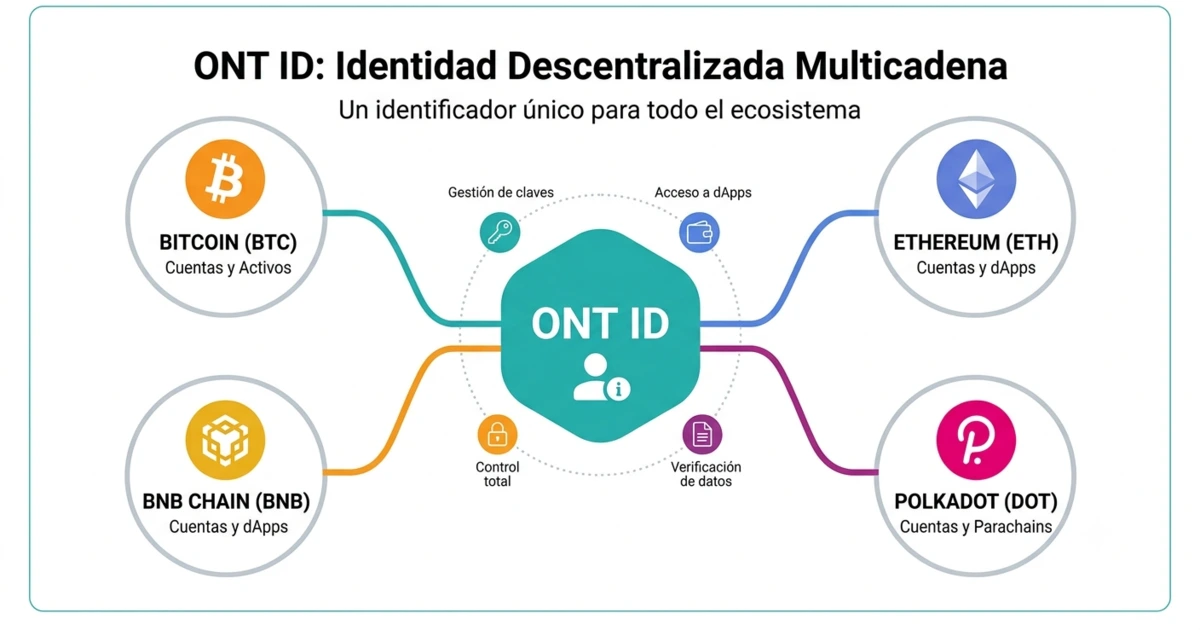
This cross-chain reach is not just architectural theory – it has shipped as real partnerships. Ontology and Binance established a long-running relationship in which ONT ID became integrated into Binance Smart Chain as its identity and KYC verification partner, and Ontology separately built a parachain on Polkadot to extend decentralized identity into that ecosystem, including a DID Substrate pallet.
For an enterprise, this is the practical payoff of multi-chain design: identity infrastructure that follows the business across whichever chains its partners and customers actually use, instead of forcing everyone onto one network.
A fair point of confusion worth addressing directly: ONT ID and a normal wallet address look structurally similar – both are cryptographic identifiers with their own private keys – which has genuinely confused developers evaluating the platform, since it is not obvious why the two need to be separate things at all.
In practice, the distinction has narrowed over time: registering a new wallet through the ONTO wallet app now provisions an ONT ID automatically rather than requiring a manual second setup step, though wallets created before this integration existed still need to link an ONT ID separately.
OScore: Turning On-Chain Behavior Into Reputation
ONT ID’s most distinctive add-on is OScore, an opt-in, on-chain reputation system that assigns a score to an address based on transactional data – asset ownership, smart contract interaction history, and other on-chain behavior.
The concept mirrors a credit score, but built from public blockchain activity rather than a centralized bureau’s private records, and per Ontology’s own OScore documentation, the scoring algorithm itself is customizable per application – a lending platform and a governance DAO can weight on-chain signals completely differently while both drawing on the same underlying ONT ID and transaction history.
The practical use case that made OScore concrete was Wing Finance, Ontology’s decentralized lending protocol, where a higher OScore could unlock undercollateralized loans – a real answer to one of DeFi’s persistent structural problems, where most lending requires over-collateralization because there is no reliable way to assess a borrower’s trustworthiness on-chain. OScore only reads data the user has already made public on-chain, so it does not require submitting new personal information the way a traditional credit check would.
ONT Login and the Universal Sign-On Layer
On top of the identity and reputation layers, ONT Login provides a universal single sign-on component built directly on ONT ID, letting a user authenticate once and reuse that session across every integrated application – conceptually similar in outcome to Sign-In with Ethereum, but designed from the outset to work across Ontology’s multi-chain identity model rather than a single chain.
Combined with ONT TAG (a batch verification solution for checking many credentials efficiently at once), Ontology positions this as a complete product matrix: identity (ONT ID), reputation (OScore), and login (ONT Login) as three pieces of one system rather than three separate integrations.
Why Multi-Chain Matters for Enterprise Identity
|
Approach |
Single-chain identity |
ONT ID multi-chain identity |
|
Ecosystem risk |
Locked into one chain’s fate |
Follows users across chains |
|
Partnership flexibility |
Limited to native ecosystem |
BNB Chain, Polkadot, Ethereum, Bitcoin |
|
Reputation portability |
Siloed per chain |
Cross-chain reputation via OScore |
|
Best fit |
Single-ecosystem-committed projects |
Enterprises hedging against ecosystem risk |
For any enterprise weighing multi-chain products, the argument is straightforward risk management. A company that cannot afford to guess wrong about which chain wins does not have to. ONT ID’s design lets identity and reputation travel with the business rather than being rebuilt every time a new chain becomes strategically important.
Is the Network Still Active?
Given ONT ID’s 2018 origins, the fair question is whether the underlying network still runs. As of February 2026, Ontology reported 898 active nodes and roughly 216 million ONT staked. The network has processed over 20 million total transactions. Community governance cut on-chain gas fees by 80% in January 2026. A 2025 tokenomics reform capped ONG supply at 800 million and burned 200 million tokens. The network is smaller than Ethereum-scale competitors. The activity is real and recent, not a ghost chain running on 2018 momentum.
What is the difference between an Ontology wallet and an ONT ID?
They are structurally similar – both are cryptographic identifiers with their own keys – which is a common source of confusion. A wallet holds assets; an ONT ID carries verifiable credentials and reputation data. Newer ONTO wallets provision both together automatically; older wallets may need an ONT ID linked separately.
Is ONT ID limited to the Ontology blockchain?
No – by design, ONT ID supports identity and asset data across multiple chains, including Bitcoin, Ethereum, and others, not just Ontology’s own network.
What is OScore and how is it calculated?
OScore is an on-chain reputation score built from transaction history and behavioral data, with a scoring algorithm that can be customized per application – a lending platform and a different service can weight the same underlying data differently.
Can ONT ID identify things other than people?
Yes – the framework can assign identities to legal entities, IoT devices, and content, not just individual users, reflecting a broader scope than most consumer identity products.
How does ONT ID connect to Binance Smart Chain?
Ontology and Binance established a partnership in which ONT ID serves as Binance Smart Chain’s identity and KYC verification solution, extending Ontology’s decentralized identity framework into that ecosystem.
What can a high OScore unlock?
On Wing Finance, Ontology’s lending protocol, a higher OScore could unlock undercollateralized loans – better lending terms based on on-chain reputation rather than requiring the usual over-collateralization DeFi lending typically demands.

Isai Alexei is a journalist and financial analyst covering cryptocurrency markets and traditional securities for Blockchaindose. He has spent ten years analyzing digital assets, trading activity, and market structure.