The Sign-In with Ethereum standard replaces the password field with something you already own: a wallet signature. Where most dApp development guides treat wallet login as an implementation detail, SIWE is the actual specification behind that “Connect Wallet” button – and as of 2025, it is no longer a draft.
Key Takeaways
- Sign-In with Ethereum (ERC-4361) lets users authenticate to any service using a signed wallet message instead of a username and password.
- It reached Final status in 2025 after four years of development – a production-ready, stable web standard, not an experimental pattern.
- SIWE uses ERC-191 message signing, not a blockchain transaction, so authenticating costs no gas and requires no confirmation wait.
- It natively supports ENS names via reverse resolution, so a login session can show a readable identity instead of a raw address.
- SIWE is an authentication standard, not a full identity system – it is commonly combined with DIDs and verifiable credentials for richer identity flows beyond simple login.
This guide covers how the SIWE message format works, why its 2025 finalization matters for production dApps, how it compares to “Login with Google,” and what a real implementation looks like.
How the Sign-In with Ethereum Standard Actually Works
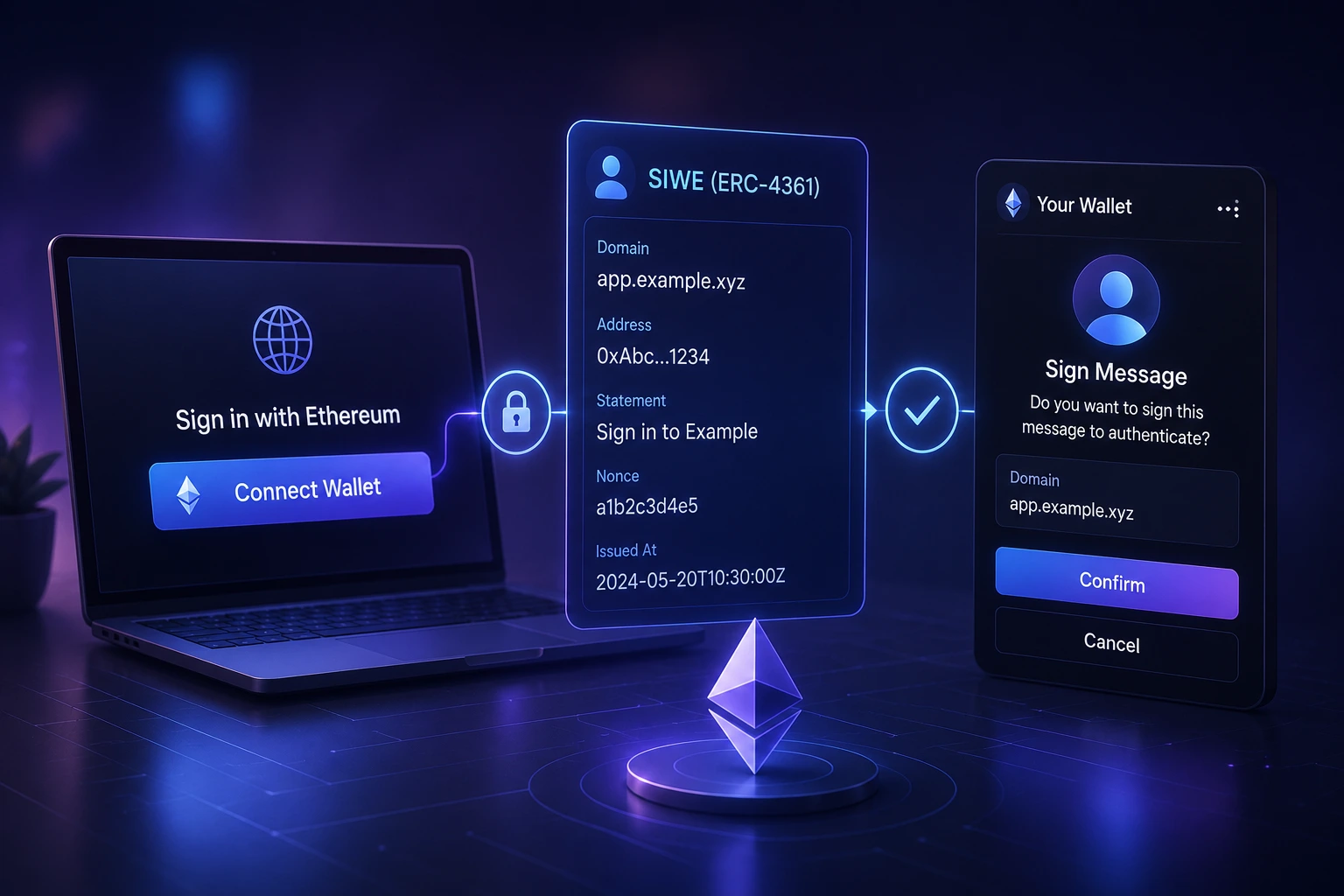
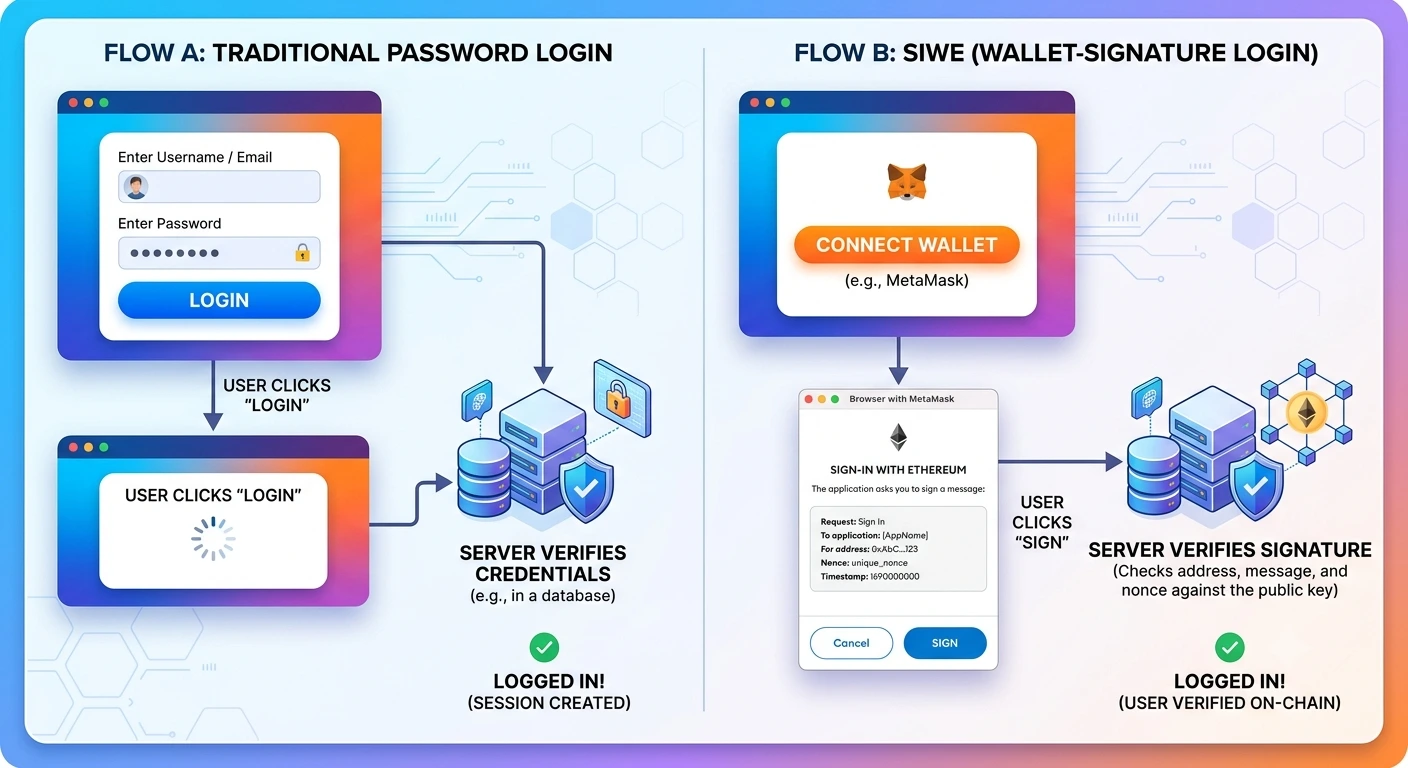
The protocol is simple: a dApp asks a wallet to sign a structured text message. Not a blockchain transaction. Just a signature over a carefully formatted string.
The message contains the domain requesting login, the wallet address, a nonce for replay protection, an issued-at timestamp, and optionally a statement or Terms of Service link. The wallet displays this in plain language before signing—a deliberate design goal from the ERC-4361 spec. Users see human-readable text, not JSON blobs or hex.
Once signed, the server verifies the signature matches the claimed address. It checks that the nonce hasn’t been reused. Then it issues a session, exactly like a traditional password login would. The difference: the “password” is cryptographic proof of wallet ownership that never travels to the server.
The standard chose ERC-191 message signing as its base instead of the more complex EIP-712. ERC-191 already had broad wallet support at the time. Compatibility over elegance. Real-world matters more than theoretical purity.
Why 2025 Finalization Makes SIWE Production-Ready
Standards status matters more than it sounds. A draft EIP can change its message format, break existing integrations, or simply stall – which is exactly the risk profile that keeps cautious engineering teams from shipping on top of it. That changed when ERC-4361: Sign-In with Ethereum officially moved to Final status, four years after Wayne Chang, Gregory Rocco, Brantly Millegan, Nick Johnson, and Oliver Terbu first proposed it in October 2021.
Final status means the message format, signing flow, and verification rules are locked – wallets, libraries, and backend integrations built against it today will not need to chase a moving target.
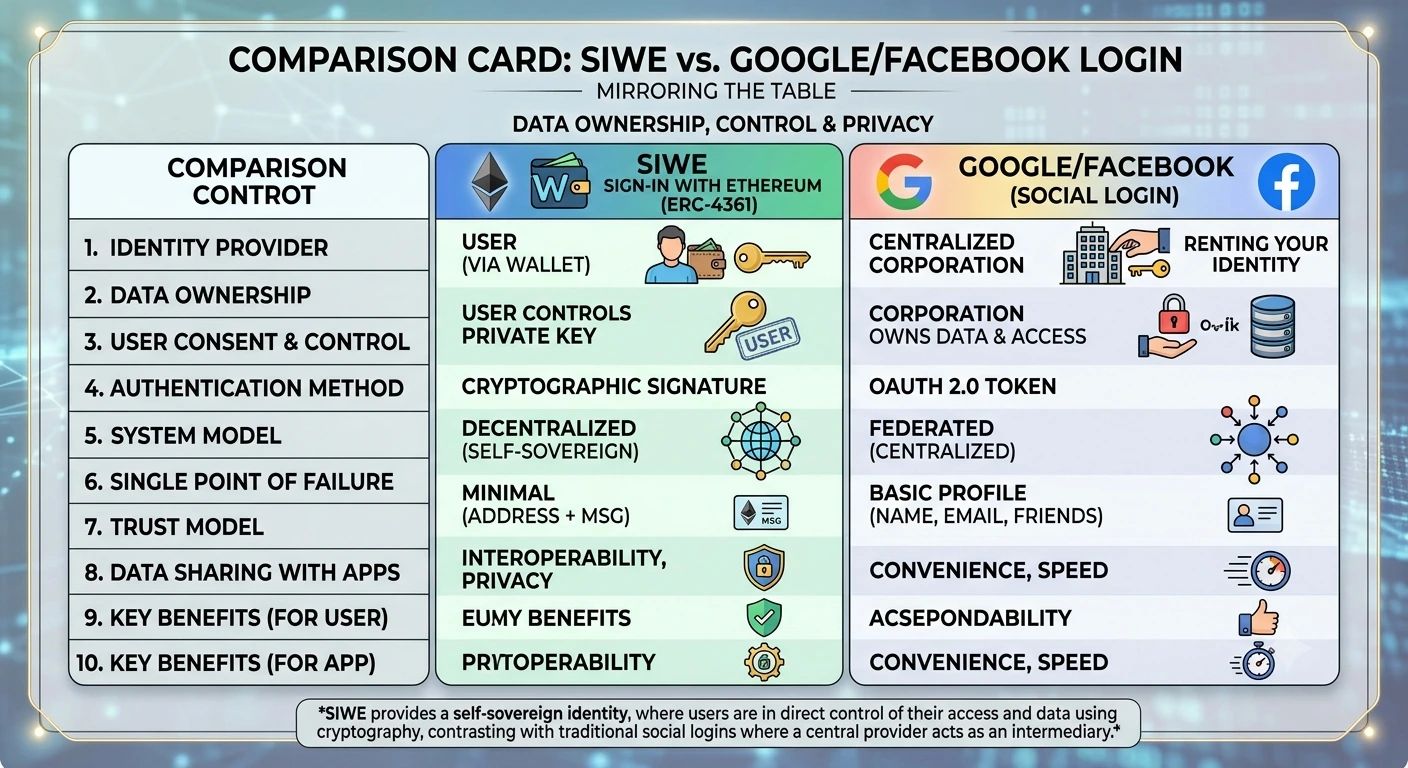
That stability is what turns SIWE from “an interesting pattern” into a genuine replacement for “Login with Google” or “Login with Facebook” buttons on modern dApps. The comparison is direct: both offer one-click authentication without a new password to remember, but SIWE removes the centralized identity provider entirely – no company sits in the middle deciding whether your account exists, and no third party learns which sites you log into.
Reference implementations exist in TypeScript, Rust, Python, and Go, and integrations already reach mainstream identity infrastructure – SIWE shipped as an OpenID Connect provider in the Auth0 (Okta) marketplace, letting conventional enterprise auth stacks accept a wallet signature as a valid login method alongside Google and Facebook.
SIWE vs. Traditional Login: A Direct Comparison
|
Aspect |
Login with Google/Facebook |
Sign-In with Ethereum |
|
Identity provider |
Centralized company |
None – self-custodial wallet |
|
What you present |
OAuth token |
Signed message (ERC-191) |
|
Cost per login |
Free |
Free – no gas, it is off-chain |
|
Data the provider sees |
Every site you log into |
Nothing – no central provider |
|
Account recovery |
Provider-managed |
User’s own wallet/seed backup |
|
Readable identity |
Email/profile name |
ENS name via reverse resolution |
Implementing SIWE: What a Real Integration Looks Like
- Generate a nonce server-side and pass it to the frontend to prevent replay attacks on the signed message.
- Construct the SIWE message with domain, address, statement, URI, chain ID, nonce, and issued-at timestamp, following the exact ERC-4361 field order.
- Request a signature from the connected wallet – MetaMask, WalletConnect-compatible wallets, and most modern crypto wallets all support the underlying ERC-191 signing prompt.
- Verify the signature server-side against the claimed address and confirm the domain in the message matches the requesting site – this check is what prevents phishing attacks where a malicious site relays a signature request to a different domain.
- Issue a session the same way a traditional backend would after any successful login – SIWE only replaces the authentication step, not everything downstream of it.
In practice, few teams build this from scratch. The community converged on tools: login.xyz (the reference implementation), wagmi and RainbowKit (frontend libraries), and thirdweb (wallet abstraction layer). These tools stayed stable for years—a sign teams aren’t rebuilding auth every time a new wallet launches.
One detail for smart-contract wallets: EIP-1271 signature validation lets the standard verify signatures from multisigs and smart contracts, not just simple EOAs..
What “Connect Wallet” Does and Does Not Give a Site Access To
Here is the core confusion driving most SIWE fear: signing a SIWE message grants zero spending power. None. The signature only proves you control an address.
Wallets drain when users separately approve a token allowance or sign a contract interaction on a malicious site. Not from login itself. The sign-in step and the spending approval are two different actions. A malicious site can disguise a spending approval as a sign-in prompt—that is the real risk. Training users to sign without reading what they sign.
The bigger structural risk: losing wallet access locks you out of every service at once. A traditional password forgotten? Email recovery. A lost wallet with no recovery setup? Every dApp that used it becomes inaccessible. There is no “forgot password” flow at the protocol level. Recovery must be designed in advance—either through smart-contract wallet with social recovery or accepting that a single lost seed phrase is a single point of failure for your entire digital identity
SIWE vs. WebAuthn: The Non-Crypto Alternative
WebAuthn/FIDO2 (passkeys) is the other serious password-killer. It works across iOS, Android, macOS, Windows via hardware-backed biometrics or security keys. No blockchain, no wallet required. It already ships as a second factor on major environments.
The honest trade-off: WebAuthn solves passwordless login well. It stays siloed per application. SIWE provides portable identity across services—the same address carries an ENS name, on-chain reputation, and verifiable credentials everywhere it is recognized.
For pure “kill the password” use cases, WebAuthn is more mature and widely adopted today. For anything wanting portable identity beyond login, SIWE does what WebAuthn was never designed to do. They solve overlapping but different problems. Neither replaces the other completely.
What does Sign-In with Ethereum actually sign?
A structured, human-readable text message – not a blockchain transaction. It includes the requesting domain, the wallet address, a nonce, and a timestamp, all displayed in plain language before the user approves it.
Does SIWE cost gas to use?
No. Signing a message is an off-chain cryptographic operation – it never touches the blockchain, so there is no gas fee and no transaction confirmation wait.
Is SIWE only for Ethereum mainnet?
No – SIWE works across Ethereum Layer 2s and other EVM-compatible chains using the same message format, since the chain ID is simply one of the fields in the signed message.
How is SIWE different from a full decentralized identity system?
SIWE solves authentication only – proving you control a wallet. It does not issue or verify credentials on its own, though it is frequently combined with DIDs and verifiable credential systems to build fuller identity flows on top of the login.
Can SIWE replace “Login with Google” for a mainstream app?
Technically, yes – and it already has enterprise-grade integration paths, including an Auth0 (Okta) marketplace listing that lets conventional backends treat a wallet signature as just another OAuth-style login option.
What happens if I lose access to my wallet?
Every service you used SIWE to sign into becomes inaccessible at once – unlike a forgotten password, there is no reset link. Recovery is the wallet’s responsibility, not SIWE’s: smart-contract wallets with social recovery or multisig setups (validated via EIP-1271) offer a real safety net; a plain seed-phrase-only wallet does not.
Is SIWE the same as WebAuthn or passkeys?
No – they solve overlapping but different problems. WebAuthn is a mature, widely-adopted passwordless standard that stays siloed per app; SIWE ties a login to a portable on-chain identity that can carry an ENS name and reputation across services. Neither replaces the other completely.

Isai Alexei is a journalist and financial analyst covering cryptocurrency markets and traditional securities for Blockchaindose. He has spent ten years analyzing digital assets, trading activity, and market structure.