Crypto wallets store digital assets and keep them secure, but choosing the right one depends on security, convenience, and use case. Some, like hardware wallets, offer offline protection, while others, such as mobile wallets, provide easy access for daily transactions. Private keys, recovery phrases, and multi-signature security are key factors. Here, we break down crypto wallets with expert insights & guides.
A Web3 wallet functions as an identity layer, a transaction signer, and the primary interface between users and blockchain-based applications. For development teams, the wallet architecture represents the most risk-sensitive component of the stack—a single vulnerability can result in direct financial loss with no recourse mechanism. This guide examines the technical architecture, security protocols, and ...
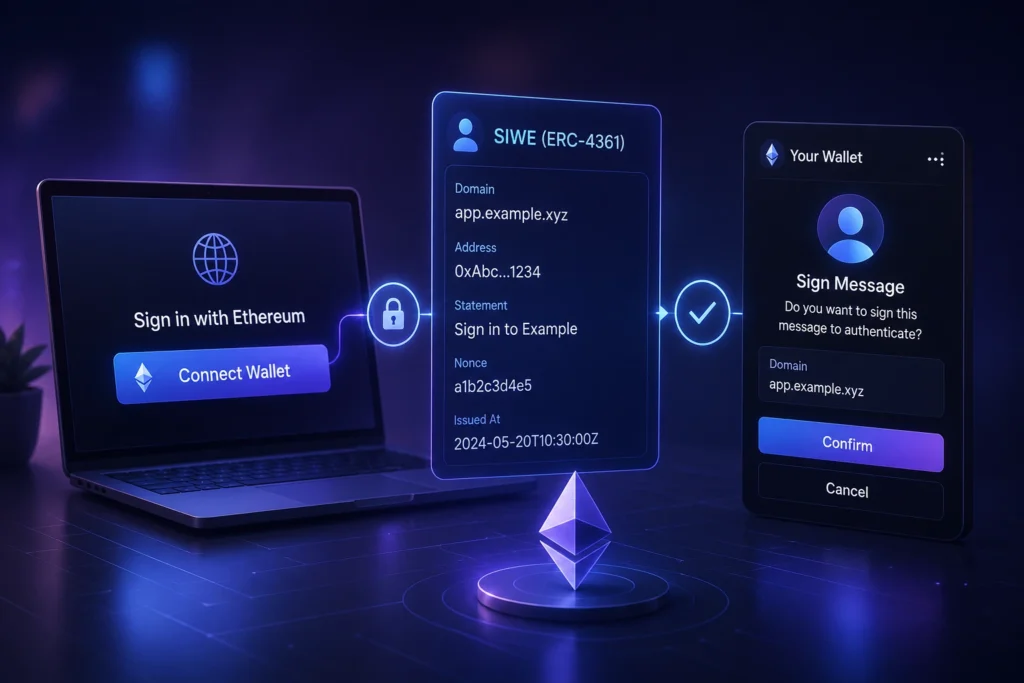
The Sign-In with Ethereum standard replaces the password field with something you already own: a wallet signature. Where most dApp development guides treat wallet login as an implementation detail, SIWE is the actual specification behind that “Connect Wallet” button – and as of 2025, it is no longer a draft. Key Takeaways This guide covers ...
Wallet merging in crypto represents a counterintuitive strategy—one that Adam Weitsman demonstrated on June 20, 2026, when he consolidated four separate cryptocurrency wallets into a single address. His decision occurred mere hours before the NormiesART community snapshot, a moment that would determine allocation for the Zombie NFT collection. In the NFT world, collectors usually do ...
Manage Cookie Consent
To enhance your experience, we use cookies. Consent helps us process data like browsing behavior. Denying may affect site features.
Functional
Always active
The technical storage or access is strictly necessary for the legitimate purpose of enabling the use of a specific service explicitly requested by the subscriber or user, or for the sole purpose of carrying out the transmission of a communication over an electronic communications network.
Preferences
The technical storage or access is necessary for the legitimate purpose of storing preferences that are not requested by the subscriber or user.
Statistics
The technical storage or access that is used exclusively for statistical purposes.The technical storage or access that is used exclusively for anonymous statistical purposes. Without a subpoena, voluntary compliance on the part of your Internet Service Provider, or additional records from a third party, information stored or retrieved for this purpose alone cannot usually be used to identify you.
Marketing
The technical storage or access is required to create user profiles to send advertising, or to track the user on a website or across several websites for similar marketing purposes.