
Maximal extractable value (MEV) has pushed Ethereum to redesign its block production process, according to a primer published in March 2024 by economists Vijay Mohan and Peyman Khezr. The paper, funded by an Ethereum Foundation academic grant, treats block building as a knapsack problem and argues the auction design behind block space determines how much value users, searchers, builders and validators keep.
How Maximal Extractable Value Emerges in Block Production
Maximal extractable value measures the profit available from including, excluding or reordering transactions inside a block, apart from the standard block reward and gas fees. Bots known as searchers monitor the public mempool, the open queue of pending transactions, and submit competing orders with higher fees to secure priority. Mohan and Khezr sort the activity into two groups. Value-diverting MEV, including sandwich attacks and copied arbitrage trades, lowers the payoff of the original sender. Value-creating MEV, including liquidations and back-running trades to restore prices on decentralized exchanges, raises efficiency because it closes pricing gaps.
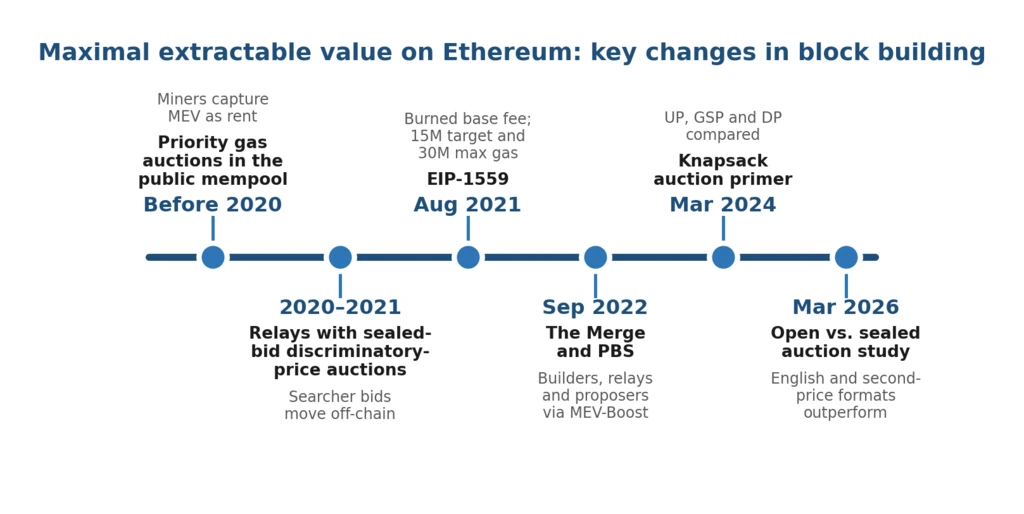
Before 2020, searchers bid through priority gas auctions, open first-price contests held on-chain. Losing bots still paid gas for failed transactions, so the format worked as an all-pay auction, and the extra traffic raised gas costs for other users. Competition pushed searcher margins toward zero, leaving miners with nearly all maximal extractable value as rent.
Block Building as a Knapsack Problem
A block holds a limited amount of data or gas, and the mempool holds more transactions than the block can fit. The producer must select a subset of transactions with different sizes and fees, and each transaction enters whole or stays out. Computer scientists classify the task as a 0-1 knapsack problem, which is NP-hard: no known algorithm solves every instance in polynomial time. Producers rely on the Greedy algorithm, which ranks transactions by fee per unit of size and fills the block in descending order.
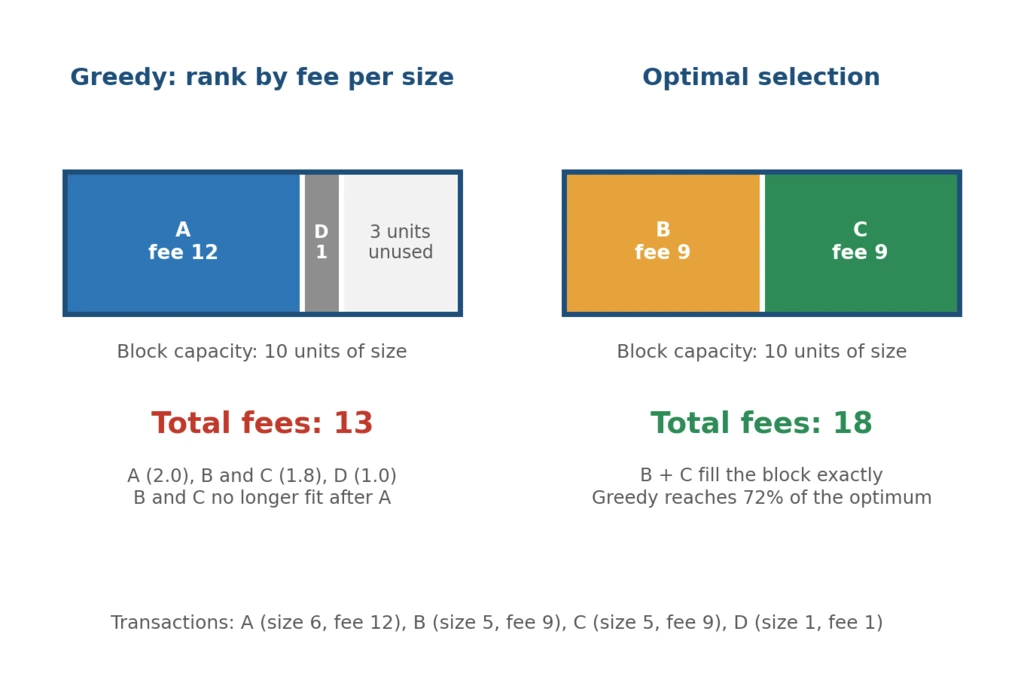
The ranking rule alone can fail when a large, high-value transaction sits below several small ones. Adding a comparison with the highest excluded bid guarantees at least half of the maximum possible surplus. The objective also changes the problem. Maximizing the bytes packed, a subset-sum problem, clears the mempool fastest. Maximizing user value, called allocative efficiency, requires valuations only users know, so the producer needs an auction to elicit bids.
Relays, EIP-1559 and Proposer-Builder Separation
Flashbots introduced relays to move searcher competition off-chain. Searchers submit bids privately in a sealed-bid discriminatory-price auction, which ended the escalation seen in priority gas auctions and removed failed bids from the chain. Users gained private transaction channels, which protect orders from front-running and sandwiching.
EIP-1559, activated in August 2021, split fees into a protocol-set base fee, which the network burns, and an optional priority fee paid to the block producer. The upgrade set a target block size of 15 million gas and a maximum of 30 million gas, so the knapsack constraint binds only when demand pushes blocks to the cap. Burning alters surplus accounting: total surplus equals the value created by transactions plus issuance minus burned fees, and net ETH supply shrinks once burns exceed issuance.
The Merge in September 2022 moved Ethereum to proof-of-stake, and validators adopted proposer-builder separation (PBS) through MEV-Boost. Block builders assemble candidate blocks from public and private transactions, including searcher bundles, and send them to relays. Relays validate each block and pass only the header to the proposer, who signs the most profitable header before the full block is released. Daily issuance fell from about 13,000 ETH under proof-of-work to about 1,700 ETH under proof-of-stake.
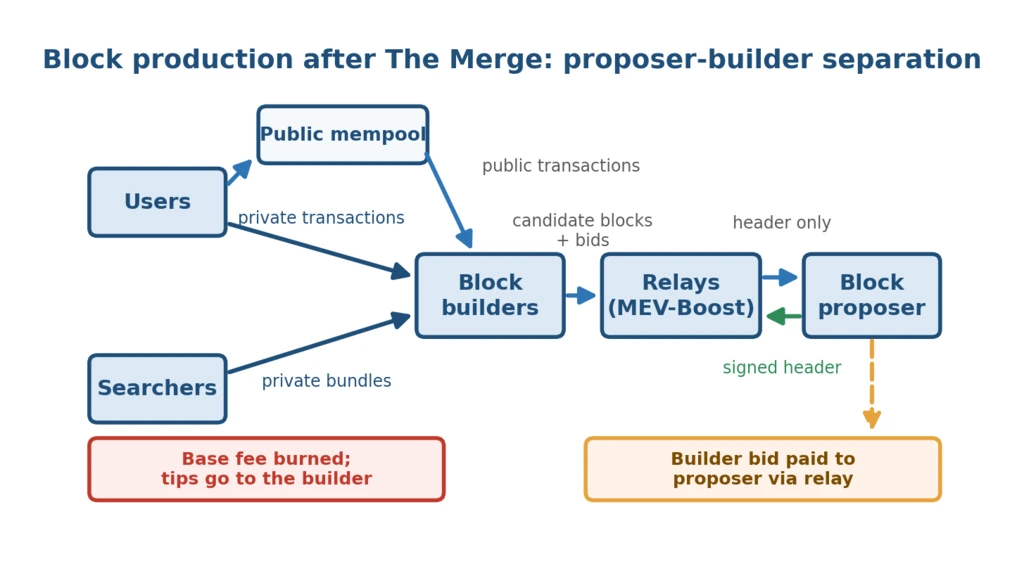
Payment flows split across four roles after the Merge. Users and searchers pay base fees, which the protocol burns, plus tips, which go to builders. Builders bid part of their revenue to proposers for the right to fill the slot, and relays enforce delivery of the promised payment. Proposers also collect issuance, while builders and proposers can capture maximal extractable value through ordering decisions.
Auction Formats: Discriminatory, Uniform and Generalized Second-Price
A discriminatory-price (DP) auction, the format Ethereum relays use, charges winners their own bids. A uniform-price (UP) auction charges the highest losing bid, and a generalized second-price (GSP) auction charges the next-highest bid. Under Greedy allocation, only the uniform price makes truthful bidding optimal, because the unique truthful price equals the critical value a bidder must exceed to win.
Uniform pricing carries a credibility problem, because a block producer can insert fake bids to raise the clearing price or collude with users who submit inflated bids and receive refunds off-chain, as Vitalik Buterin outlined in a 2018 research post. Akbarpour and Li reached a related result: the first-price auction is the only credible sealed-bid static format.
Khezr, Mohan and Page tested the three formats with human subjects and Q-learning simulations under Greedy allocation. UP delivered the highest allocative efficiency, followed by GSP and DP, while DP delivered the highest revenue, followed by GSP and UP. GSP revenue stayed close to DP, and GSP efficiency stayed close to UP, so the primer identifies GSP as a candidate for block space even though no blockchain uses it for block building.
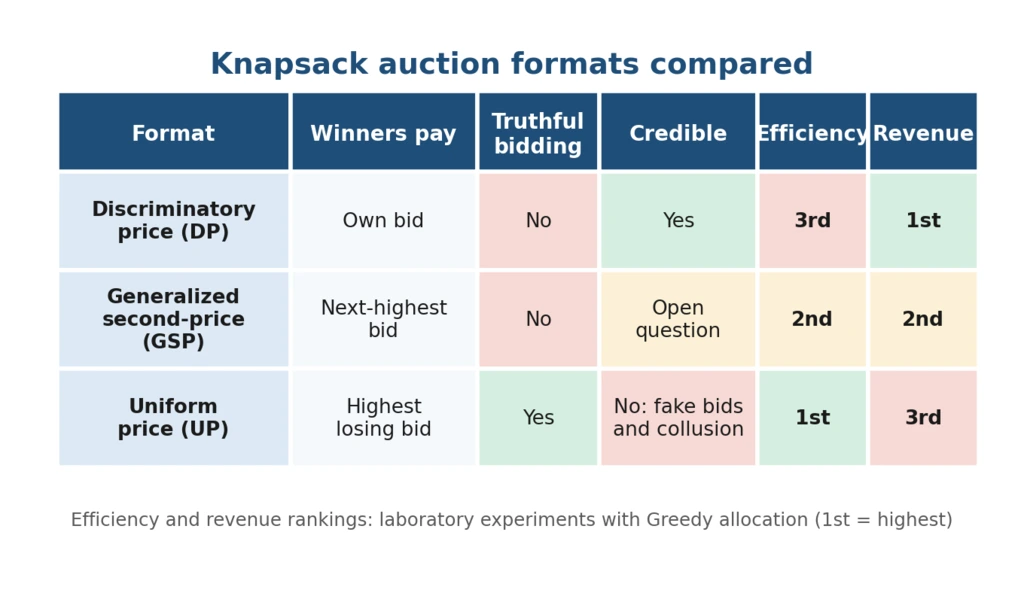
The results frame a design choice between security funding and user allocation: a protocol focused on validator revenue favors DP, while a protocol focused on efficient block space favors UP. Mohan and Khezr argue inefficient mechanisms leave room for rent extraction from maximal extractable value, so GSP offers a compromise worth testing before developers add further layers of intermediaries.
A March 2026 study of 2.2 million MEV transactions across three orderflow providers supports the case for changing formats. The authors found extracted values concentrate in a small share of transactions, and simulations show English and second-price sealed-bid auctions outperform first-price formats when searcher valuations correlate, with a revenue advantage of 14% to 28% at moderate correlation.
Ordering, Censorship and Centralization Risks
Existing knapsack models ignore position inside the block, yet maximal extractable value depends on transaction ordering. Gawiejnowicz, Halman and Kellerer analyzed a position-dependent knapsack problem, where item value scales with slot, and derived a pseudo-polynomial exact algorithm and a fully polynomial-time approximation scheme for monotone scaling functions. Mohan and Khezr point to sponsored search auctions and limited-edition auctions as models for extension, and note UP loses truthfulness in the limited-edition setting.
Measurement studies add caution to the design debate: Heimbach, Kiffer, Ferreira Torres and Wattenhofer report PBS tends to stimulate censorship, concentrates activity among a few builders and relays, and relies on relays with a record of missed commitments. Relay funding remains unsettled, since many relays operate on venture capital or foundation grants rather than market pricing. Public dashboards like relayscan track builder and relay market shares, giving researchers data to test alternative auction designs for maximal extractable value.

Isai Alexei is a journalist and financial analyst covering cryptocurrency markets and traditional securities for Blockchaindose. He has spent ten years analyzing digital assets, trading activity, and market structure.