
Decentralized Digital Identity: DIDs, Credentials and the Projects Building Them
Decentralised identity lets people prove who they are – or just one fact about themselves – without handing their data to a platform. We explain the standards and review the projects.
Explore Projects
Ultimate Guide to the Best Decentralized Identity Solutions
The best decentralized identity solutions solve a simple problem: every login you have ever created lives in someone else's database, not yours. This corner of decentralized…
Latest in this topic
What is decentralized digital identity?
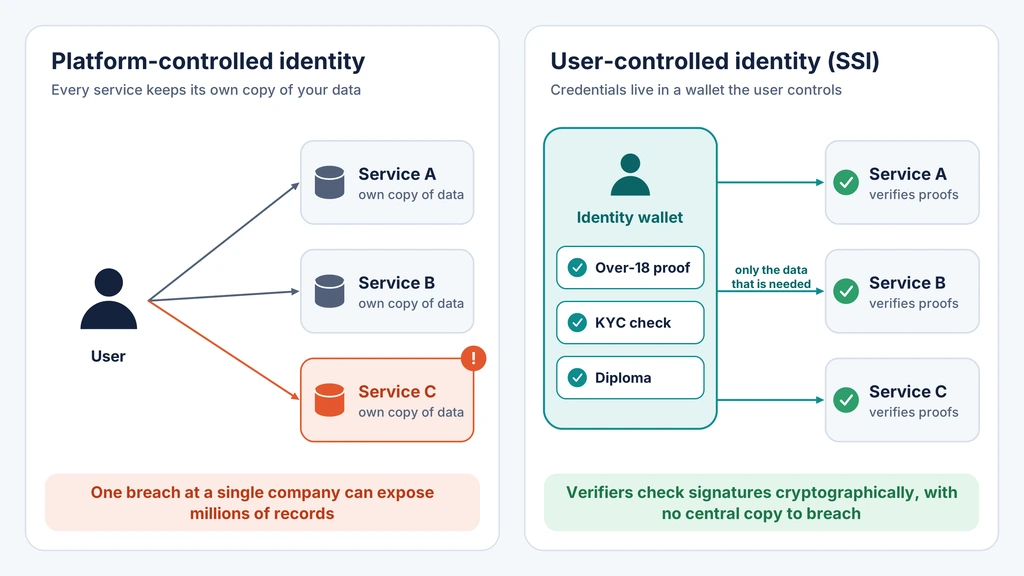
Identity on the web is issued and stored by platforms and governments, and each service keeps its own copy of user data, which concentrates risk: a breach at one company can expose millions of records. Decentralized identity, also called self-sovereign identity (SSI), changes the model by placing identifiers and credentials in a wallet controlled by the user. Any verifier can check the credentials cryptographically without contacting the issuer on each request.
The building blocks
A Decentralized Identifier (DID) is an identifier standardized by the W3C and controlled by its subject through cryptographic keys, without a central registry. Common DID methods include did:key, did:web and did:ethr, and each method resolves an identifier through a different mechanism.
A verifiable credential is a signed claim issued to a holder and checked by a verifier, and examples include an over-18 attestation, a completed KYC check and a university diploma. Zero-knowledge proofs extend the model by letting a holder prove a statement about a credential without revealing the underlying data, for example proof of age without a birth date.
A naming system maps a readable name to addresses and profile records, and the Ethereum Name Service (ENS) applies the model to names including name.eth.
How a credential flow works
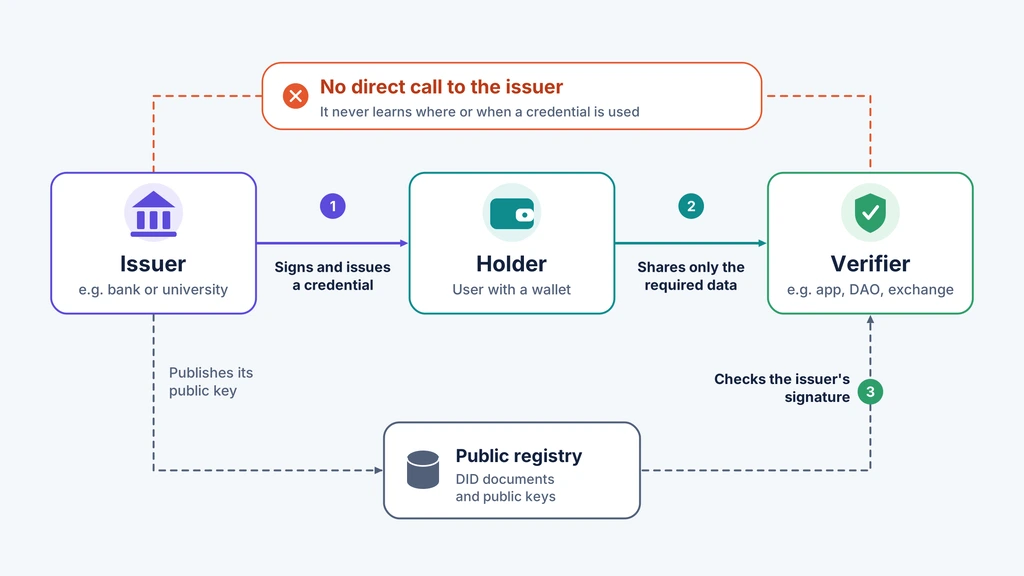
An issuer, for example a bank or a university, signs a credential about a person, and the person stores it as the holder in an identity wallet. When a verifier requests proof, the holder shares only the required data, and the verifier checks the issuer’s signature, often against a public registry, without calling the issuer.
Because verification relies on a signature, the issuer receives no record of where or when the holder presents a credential.
Where decentralized identity is used
Typical use cases include reusable KYC, Sybil resistance for airdrops and governance, access control in DAOs, proof of personhood and portable reputation. Sybil resistance limits abuse by one person operating many accounts, and proof of personhood establishes that each account belongs to a distinct human.
Governments follow a similar direction outside crypto: the EU’s eIDAS 2.0 framework introduces European digital identity wallets built on comparable principles of user-held credentials.
The hard problems
Adoption, not the underlying cryptography, limits decentralized identity: a credential holds value only when trusted issuers sign it and verifiers accept it. Users also need a way to recover lost keys without returning control to a central party.
Criteria for Evaluating Identity Projects
Reviews of identity projects examine which standards a project supports, whether credentials are portable to other wallets, how the project protects privacy, how users recover keys, which personal data, if any, reaches the blockchain and whether real issuers, including banks, universities, governments and employers, use the platform in production.
Privacy and Tracking Risks
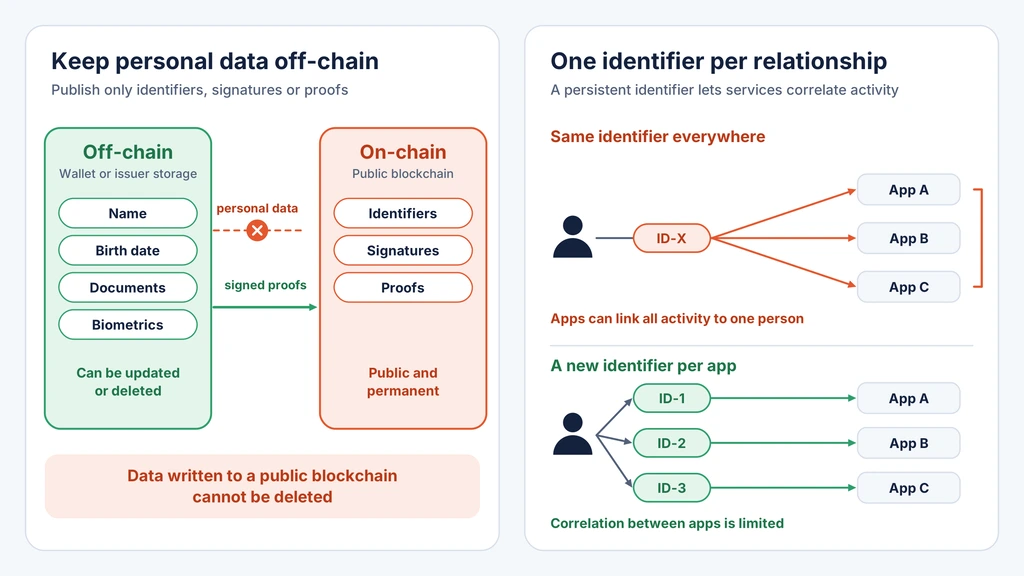
Personal data written to a public blockchain cannot be deleted, which is why well-designed systems keep it off-chain and publish only identifiers, signatures or proofs on-chain.
Linking one identity across many applications can increase tracking instead of reducing it, because a persistent identifier lets separate services correlate a user’s activity, and a different identifier for each relationship limits the correlation.
Proof-of-personhood systems collecting biometrics raise additional privacy and regulatory questions, because biometric data is permanent and falls under data-protection rules in many jurisdictions.
FAQ
What is a DID?
A DID is a globally unique identifier defined by a W3C specification, and the subject proves control through a private key. Resolving the identifier returns a DID document with the public keys and service endpoints a verifier uses.
Is ENS a decentralized identity?
ENS maps readable names to addresses and records, and Web3 applications use it as a building block of identity. Ownership of a name proves control of the name, not who the owner is, which requires a verifiable credential from an issuer.
How do zero-knowledge proofs help identity?
Zero-knowledge proofs let a holder prove a single attribute, for example an age above 18 or absence from a sanctions list, while the verifier receives no credential data beyond the result. Verifiers store a proof result instead of a full document, which reduces the personal data exposed in a breach.
How do users recover access to a decentralized identity wallet?
Wallets offer social recovery, where trusted contacts approve a replacement key, encrypted backups of the recovery phrase and multi-party computation schemes that split the key into shares, and each method trades convenience against the risk of returning control to a central party. DID methods that support key rotation let the user replace the lost key while keeping the same identifier.
How does a verifier know a credential is still valid?
A verifier checks the issuer’s digital signature, the expiry date and the revocation status, which the issuer publishes through a revocation registry or a status list. Because the list covers many credentials, the issuer cannot tell which one a verifier checks.
This page is for educational purposes only and is not financial, investment or tax advice. Crypto assets are volatile and you can lose all of the money you invest.