The best decentralized identity solutions solve a simple problem: every login you have ever created lives in someone else’s database, not yours. This corner of decentralized digital identity technology has moved from whitepaper to standard fast – though the category’s most visible product, World ID, is also currently a case study in how that promise can go wrong.
Key Takeaways
- The category splits into four directions solving different problems: wallet-based login, zero-knowledge credentials, proof-of-personhood, and enterprise verifiable-credential platforms. They don’t compete; they answer separate questions.
- World ID is the cautionary tale nobody wanted. Banned or under investigation in at least six countries over biometric privacy failures, yet simultaneously expanding into mainstream apps like Tinder and Zoom. The expansion doesn’t negate the bans—it just shows the disconnect between adoption and governance.
- Zero-knowledge proofs (Privado ID, zk-KYC) are the real 2026 upgrade. They let you prove something—”I’m over 18″—without exposing the underlying data. It’s cleaner, and it actually works at scale.
- For most people, start simple: wallet-based login first. Add verifiable credentials or proof-of-personhood only when you have a concrete reason to. These aren’t universal upgrades; they’re tools for specific problems.
This guide compares the leading solutions across consumer and enterprise use cases, unpacks the World ID controversy as a case study in what can go wrong, and closes with a practical framework for choosing one yourself.
What Are the Best Decentralized Identity Solutions Solving?
The current model is a liability by design: every service you sign up for creates a new copy of your personal data, on a server you do not control, protected by security practices you cannot audit. Decentralized identity rebuilds this around three components you hold yourself instead – an identifier, your credentials, and a wallet to manage both – and the approach is no longer experimental. The W3C published DID Core as a formal recommendation in 2022, and Ethereum’s Sign-In with Ethereum standard (ERC-4361) reached Final status in 2025 after four years of development, and dozens of providers now compete across wallet login, zero-knowledge credentials, and enterprise identity rails.
The Core Technology: DIDs, Verifiable Credentials, and Zero-Knowledge Proofs
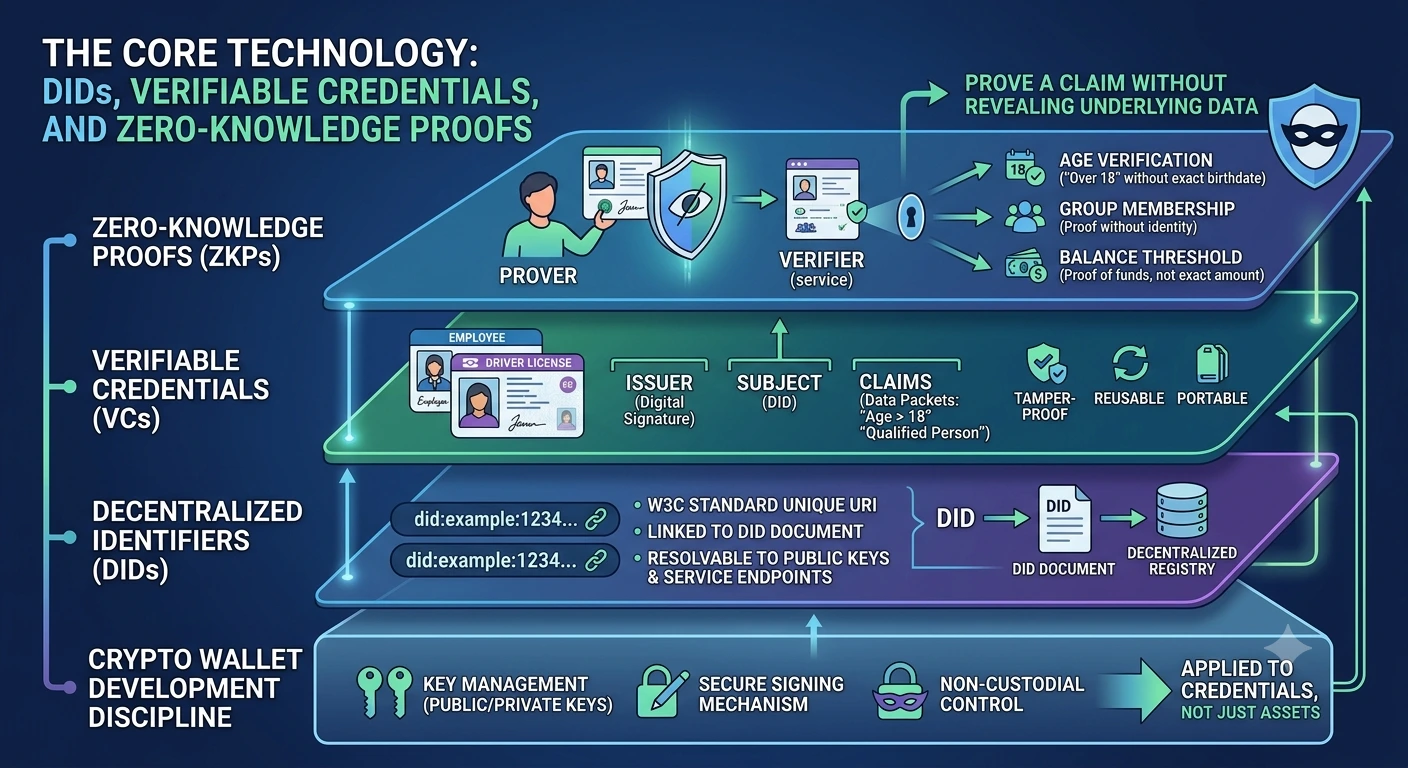
Three technical layers show up across every product in this guide, held together by a crypto wallet development discipline – the same key management and secure signing used for holding funds, applied here to credentials instead of assets. Understanding the three layers makes the comparison table below far more useful than a features list alone.
DID Methods
A DID is not one format – it is a family of methods, each specifying how identifiers are created and resolved: did:ethr anchors identity to an Ethereum address, did:key needs no blockchain at all, and did:web ties identity to a domain you control – the method Microsoft uses for its enterprise product. The diversity reflects genuine experimentation but also creates real interoperability friction between vendors, which is worth checking before committing to one.
Verifiable Credentials
A verifiable credential is a signed, tamper-evident claim – a university issuing a degree, a bank confirming KYC status – that you store once and present to any verifier without the issuer being involved in every check. This is the piece that eliminates repeated KYC: prove your status once, reuse the proof indefinitely.
Zero-Knowledge Proofs
The most consequential upgrade in the category is proving a fact without revealing the data behind it. Zero-knowledge rollup cryptography, repurposed for identity, lets a zk-KYC system confirm “this wallet passed KYC” or “this person is over 18” without exposing a name, birthdate, or document scan to the verifier – or to the blockchain. This is the difference between decentralized identity done well and decentralized identity that just moves the surveillance problem on-chain.
Comparing the Best Decentralized Identity Solutions
The honest framing, echoed across current market analysis, is that “best” depends entirely on the job: proof-of-personhood, reusable KYC, wallet login, or enterprise credential issuance are different problems with different right answers.
ENS (Ethereum Name Service) – Human-Readable Wallet Identity
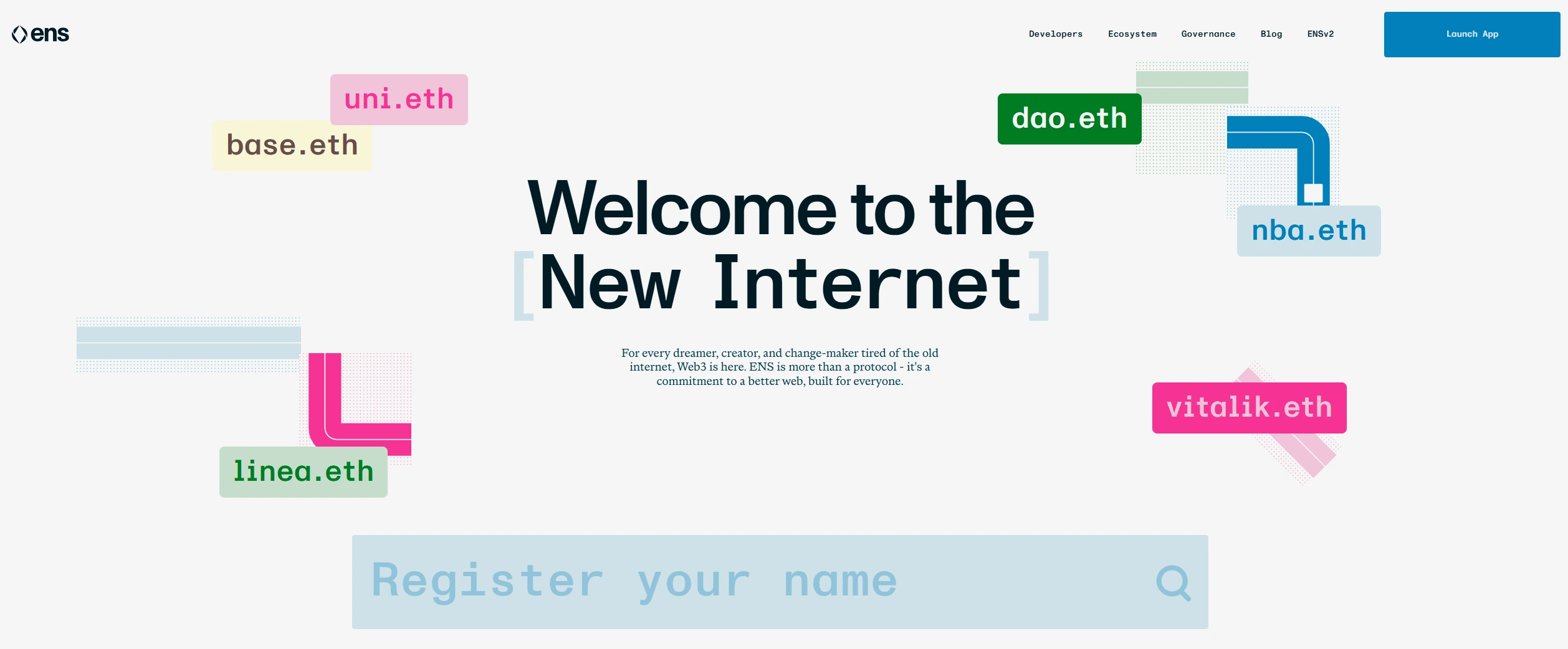
ENS turns a 42-character wallet address into a readable name like “name.eth”, backed by a registry and resolver system that maps names to addresses. It is the lightest-weight entry in this guide – not a full credentialing system, but the identity layer most Ethereum users already touch daily, and the naming foundation several heavier solutions build on top of.
Sign-In with Ethereum (SIWE / ERC-4361) – Passwordless Wallet Login
SIWE standardizes “connect wallet, sign a message, you’re logged in” – no passwords, no centralized identity provider, and the message format finalized as ERC-4361 in 2025 means it now behaves like a stable web standard rather than an experimental pattern. It solves authentication specifically, not credentialing, and is frequently combined with DIDs and verifiable credentials for richer flows – the natural login layer for any dApp development project.
Privado ID (formerly Polygon ID) – Zero-Knowledge Credentials
Privado ID uses zk-SNARK proofs to verify identity claims without revealing the underlying data, with recent releases adding dynamic, updatable credentials and on-chain revocation. Per current comparisons, it is positioned as the strongest option for zero-knowledge identity and reusable KYC proofs – prove you passed KYC once, reuse the proof across DeFi protocols without re-submitting documents each time.
SpruceID – Developer Infrastructure for Sign-In and Credentials
SpruceID positions itself as the developer toolkit rather than a consumer product: open standards, reusable building blocks, and libraries that bridge Web2-style login expectations with DID principles – reducing what would otherwise be significant integration work for teams building portable reputation or DAO membership systems.
World ID – Proof-of-Personhood at Massive Scale (and Massive Controversy)
World ID scans a user’s iris with a hardware device called the Orb to issue a cryptographic proof of unique humanness, aimed at the bot-and-Sybil problem that plagues open platforms. It is the most recognized proof-of-personhood system in the category by a wide margin – and also its most controversial product, covered in detail below.
Civic – Compliance-Focused Wallet Access Control
Civic targets a narrower, commercially pragmatic use case: dApp access control and compliance gating tied to wallet-based verification, letting platforms confirm a user meets KYC or age requirements without operating their own verification pipeline.
Microsoft Entra Verified ID – The Enterprise Standard
Built on W3C DID and VC standards using the did:web and did:ion methods, Entra Verified ID plugs directly into Azure Active Directory – the path of least resistance for large organizations issuing employee badges, education records, or healthcare access credentials without leaving Microsoft’s infrastructure. It is the choice that wins by distribution, not by being the most decentralized option on this list.
Ontology (ONT ID) – Multi-Chain Enterprise Identity
Ontology spans DID and verifiable-credential support across Cosmos IBC, Ethereum, Polygon, Solana, and BNB Chain, targeting enterprises and banks that need identity rails working consistently across several chains rather than betting on one ecosystem.
| Solution | Category | Best for | Key mechanism |
| ENS | Naming | Human-readable wallet identity | Registry + resolver |
| Sign-In with Ethereum | Authentication | Passwordless dApp login | Signed message (ERC-4361) |
| Privado ID | ZK credentials | Reusable, private KYC proofs | zk-SNARK claims |
| SpruceID | Developer toolkit | Teams building login + credentials | Open standards + libraries |
| World ID | Proof-of-personhood | Bot/Sybil resistance at scale | Iris biometric hash |
| Civic | Access control | Compliance-gated dApp access | Wallet-based verification |
| Microsoft Entra Verified ID | Enterprise | Azure-integrated organizations | did:web / did:ion |
| Ontology (ONT ID) | Enterprise, multi-chain | Banks needing cross-chain identity | Multi-chain DID + VC |
Case Study: What World ID Gets Right and Wrong
World ID deserves its own section because it is simultaneously the most recognizable product in this category and the clearest illustration of what happens when a decentralized-identity pitch collides with a centralized collection method. The proof of personhood it issues is genuinely useful – AI-generated bots and fake accounts are a real and worsening problem – but the way it gets there has drawn sustained regulatory rejection.
As of 2026 reporting, World ID has been banned or halted in at least six countries – including Brazil, Hong Kong, the Philippines, and Thailand – with investigations open in several more, including Spain and Colombia.
The pattern across jurisdictions is striking because it’s identical: regulators found insufficient consent disclosures, data collected from minors without parental consent, biometric deletion claims that nobody could independently verify, and payment-for-biometrics models that looked like coercion dressed as choice.
Spain’s data protection authority wasn’t subtle—Orb operators withheld information and made consent withdrawal difficult. The Philippines’ privacy commission said the same thing in October 2025 when it ordered an immediate halt: this isn’t consent; it’s vulnerability being monetized.
The company responded with three moves: open-sourced the Orb software, launched a self-custody feature called “Personal Custody,” and cleared a third-party security audit on its encrypted messaging. Real moves, yes. But legal experts split immediately.
Some see a genuine correction; others argue the encryption solves the wrong problem—that the core issue isn’t how the data is stored but whether it should be collected at all. A locked box still holds problematic contents.
The uncomfortable irony completes the case study: the same months these bans multiplied, World ID announced partnerships with Tinder, Zoom, and Docusign, pushing further into mainstream consumer apps precisely as governments were shutting it down. The lesson for evaluating any decentralized identity product: the “decentralized” label describes where credentials are stored, not how they were collected.
A biometric captured by a company-owned device and hashed into a company-run verification network carries real centralization risk regardless of what happens to the proof afterward – a distinction worth checking on every product in this guide, not just this one.
How to Choose a Decentralized Identity Solution
- Match the tool to the actual problem. Wallet login needs SIWE, not proof-of-personhood; reusable KYC needs zero-knowledge credentials, not a naming service. Buying more decentralization than the problem requires adds cost and friction for nothing.
- Check what is collected, not just what is stored. The World ID case study is the standing example: a centralized collection step undermines a decentralized storage claim. Ask specifically how the credential was captured, by whom, and whether that step could be independently audited.
- Prefer standards over proprietary formats. Solutions built on W3C DID Core and verifiable credentials interoperate with the wider ecosystem; proprietary formats lock you into one vendor’s roadmap.
- Verify the zero-knowledge claim is real. “Privacy-preserving” is marketing language until you confirm the system actually uses zk-proofs or comparable cryptography rather than simply promising not to look at the data.
- Start progressive. Wallet-based login first, add proof-of-personhood or verifiable credentials only when abuse or a compliance requirement actually appears – the sequence current market guidance recommends for most builders and users alike.
The bottom line: decentralized identity has moved from whitepaper concept to finalized standards and production products in the space of a few years, and the best solutions genuinely put credential ownership back where it belongs. But the category also now has its own cautionary tale running in parallel with the success stories, which makes the diligence in this guide – not just the feature comparison – the actual point of reading it.
FAQ
What is decentralized identity in simple terms?
A system where you hold your own identity credentials – in a digital wallet, secured by a private key – instead of a company storing and controlling them for you. You decide what to share, with whom, and for how long, rather than a database deciding for you.
Is decentralized identity actually private?
It depends entirely on the implementation. Systems using zero-knowledge proofs (Privado ID and similar) can prove a claim without revealing the underlying data. Systems that collect biometrics through a centralized device – the World ID model – carry real privacy exposure regardless of how the resulting proof is later stored, which is exactly what has driven its regulatory bans.
What is the difference between a DID and a crypto wallet address?
A wallet address is one specific use of a DID pattern – it identifies you for transactions. A full DID system goes further, attaching verifiable credentials (degrees, KYC status, memberships) to that identifier so it can prove more than just “this address controls these funds.”
Which decentralized identity solution should a developer start with?
For most projects: Sign-In with Ethereum for authentication first, since it is a finalized standard with broad wallet support. Add SpruceID’s tooling or Privado ID’s zero-knowledge credentials only once the product needs verifiable claims or Sybil resistance beyond simple login.
Why is World ID banned in some countries?
Regulators in Brazil, Hong Kong, the Philippines, Thailand, and others cited insufficient consent disclosure, data collected from minors, and unverifiable deletion claims around its iris-scanning Orb devices. The core objection is the centralized biometric collection step, not the decentralized credential that results from it.
Do I need a decentralized identity solution right now?
Most people do not need to actively choose one – Sign-In with Ethereum already works passively any time you connect a wallet to a dApp. Actively adopting verifiable credentials or proof-of-personhood only makes sense once a specific need appears: reusable KYC, Sybil-resistant access, or portable reputation across platforms.

Isai Alexei is a journalist and financial analyst covering cryptocurrency markets and traditional securities for Blockchaindose. He has spent ten years analyzing digital assets, trading activity, and market structure.