Key Takeaways
- Own NFT domains – you only rent traditional ones like .com.
- Best use case today: replace long wallet addresses with a readable name like john.eth.
- Two main providers: ENS (.eth) and Unstoppable Domains (.crypto, .nft, .wallet and more).
- Browser support is limited — only Brave and Opera work natively. Chrome requires an extension.
- Decentralized hosting via IPFS starts at ~$10 one-time — static content only, not indexed by Google.
- “Unstoppable” isn’t guaranteed — providers can disable resolution even if you hold the NFT.
Most people think they own their domain. They don’t. They’re renting it, year after year, from a registrar that can suspend, transfer, or simply take it away. With over 157.2 million .COM registrations active as of Q1 2025, the traditional domain market is massive. But a quiet shift is happening underneath it. NFT domains work differently. Instead of leasing a name from a centralized registrar, you mint it as a token on the blockchain and store it directly in your crypto wallet. No renewal fees. No middlemen. No company that can flip a switch and make your address disappear.
NFT domains work differently. Instead of leasing a name from a centralized registrar, you mint it as a token on the blockchain and store it directly in your crypto wallet. No renewal fees. No middlemen. No company that can flip a switch and make your address disappear.
That said, NFT domains are not a perfect solution, and the crypto community is refreshingly honest about their limitations. This guide covers both sides.
What Are NFT Domains?
At its core, a domain name is a human-readable address that points to something harder to remember – an IP address for a website, or a long alphanumeric wallet address on the blockchain. Traditional domains translate something like ‘google.com’ into a server location. NFT domains do the same, but on the blockchain.
The key difference is ownership. An NFT domain is a token you hold in your wallet, not a license you rent from a registrar. It is recorded on-chain, transferable peer-to-peer, and not dependent on any single company staying in business or keeping your account active.
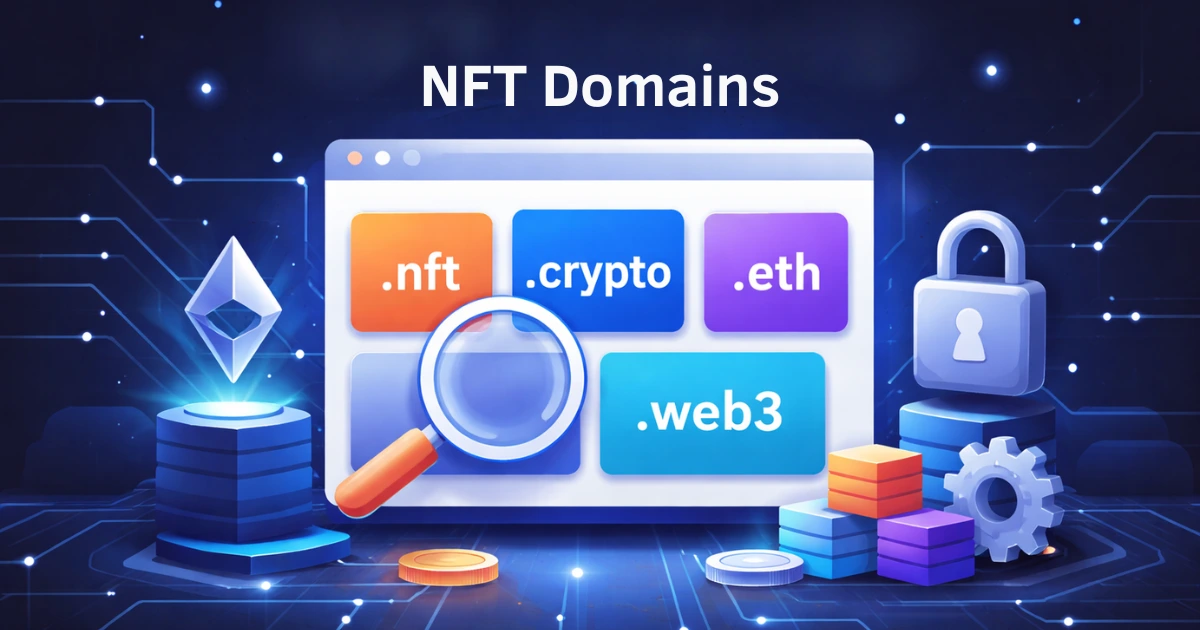
Most NFT domains fall into one of these extensions:
- .crypto – associated with crypto-related websites, runs on Ethereum and Polygon
- .eth – managed by the Ethereum Name Service, the most widely adopted standard
- .nft – popular with NFT creators and collectors
- .dao – used by Decentralized Autonomous Organizations
- .wallet, .x, .blockchain – offered by Unstoppable Domains across various blockchains
The Main NFT Domains Providers in 2026
The NFT domain space is more fragmented than most guides let on, and that fragmentation is itself one of the biggest real-world problems users face today.
Unstoppable Domains
Unstoppable Domains is the most widely used provider. It became an ICANN-accredited registrar in October 2024 – a significant legitimacy milestone – and now offers over 200 traditional DNS TLDs alongside its blockchain-native extensions. It operates on Ethereum and Polygon, charges a one-time fee with no renewals, and integrates with over 865 blockchain apps and wallets.
Ethereum Name Service (ENS)
ENS (Ethereum Name Service) is the other major player and is widely regarded in the crypto community as the more decentralized option. It issues .eth domains on Ethereum, operates on a subscription model with annual renewal required, and has become a standard identifier on platforms like OpenSea, Farcaster, and Snapshot. ENS is a community-driven non-profit, which matters to users who prioritize open governance over convenience.
In 2024, ENS and Unstoppable Domains became entangled in a significant patent dispute. ENS petitioned the USPTO to invalidate a patent UD had obtained on blockchain-based naming technology, arguing it was based on open-source work. In November 2024, the Patent Trial and Appeal Board ruled in UD’s favor. The decision set a precedent: blockchain naming systems can be protected under US patent law.
Freename
Freename is a growing alternative that became the first ICANN-accredited Web3 registrar. It lets users create their own custom TLDs and bridges Web2 and Web3 domains on-chain, meaning your traditional .com domain can also function as a wallet address.
What Can You Actually Do With NFT Domains?
- Wallet address simplification is the clearest and most immediate use case. Instead of sharing a 42-character address like 0x8bE28a3e35E4F8D…, you share john.eth or blockchaindose.crypto. Major wallets – including MetaMask, Trust Wallet, Rainbow, and Coinbase Wallet – support ENS and Unstoppable Domains resolution natively, so this works right now without any extra setup.
- Decentralized website hosting is possible through IPFS (InterPlanetary File System). If your site stays under 1 GB, hosting is free. A static website with an NFT domain can cost as little as $10 to $20 as a one-time expense, compared to $100 or more per year for traditional hosting and domain registration combined. The catch is that IPFS only supports static content – no server-side processing, no databases, no dynamic functionality.
- Digital identity across Web3 is where things get more interesting long-term. Your NFT domain can carry metadata – social links, a profile picture, verified credentials – that travels with you across compatible dApps. ENS usernames are already live on Farcaster, and Unstoppable Domains offers a Sign-In feature that works similarly to Sign in with Google, except you own the identity rather than a platform controlling it.
- Tokenization of real-world assets (RWA) sits further on the horizon but is already gaining traction. Real estate NFTs reached a $1.4 billion market size with 32% year-over-year growth in 2025. Music NFTs generated over $520 million in revenue in the same period. NFT domains serve as the identity layer that ties all of these assets together under one readable name.
The Real Limitations of NFT Domains
The main drawbacks of NFT domains are:
- Browser support remains the biggest barrier. Chrome, Safari, Firefox, and Edge – the browsers used by the vast majority of internet users – do not resolve NFT domains without an extension or plugin. Only Brave and Opera have built-in support, and even then it varies by blockchain. Until mainstream browsers adopt NFT domain resolution natively, the audience for any NFT domain-based website stays limited to a crypto-aware minority.
- Fragmentation across providers is a genuine problem that rarely gets discussed. ENS domains do not resolve through Unstoppable Domains resolvers, and vice versa. Each provider runs its own contracts, supports its own extensions, and manages its own resolver infrastructure. For a technology promising a unified decentralized identity layer, the reality today involves a lot of incompatible islands.
- “Unstoppable” proved to be stoppable. The most cited cautionary tale in the community is UD’s .coin extension. When UD discovered a naming collision with another provider, they disabled .coin resolution entirely and offered 3x the purchase price in store credit as compensation. Users were left with NFTs that existed on-chain but did nothing. Owning the token does not guarantee the service built around it keeps working.
- Search engine visibility is nonexistent. Google does not index websites hosted on NFT domains. If organic search traffic matters to your project, an NFT domain-hosted site is effectively invisible.
- Traditional .com domains cannot truly become NFT domains. You can sell an NFT that represents a promise to transfer a .com, but there is no smart contract enforcement. The next person who holds that NFT could sell it without ever transferring the underlying domain.
How to Mint NFT Domains
The simplest way to create an NFT domain is to use already existing providers like the above-mentioned .crypto, .eth, or others. Let’s take ens-domain issued .eth as our example for the article.
The minting process is simplified below as follows:
Step 1: Select Name
The initial step in creating a domain NFT is selecting your name. For instance, you can use name.eth, like blockchaindose.eth.
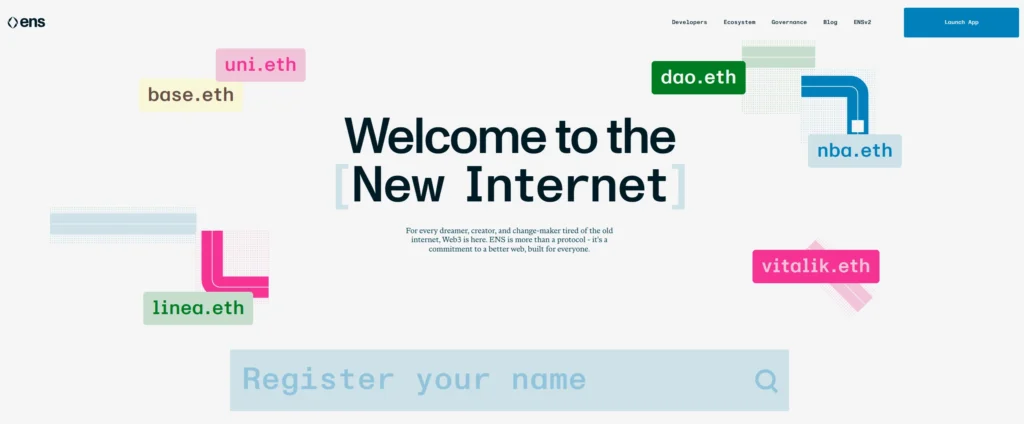
Visit ens.domains, and click Launch App in the top right corner. You will be redirected to a new page.
Step 2: Link Your Wallet
Click Connect at the top right corner to link your wallet. A new page will pop up with a list of wallets, including MetaMask, Browser Wallet, WalletConnect, Rainbow, Coinbase, Ledger, and Ardent.
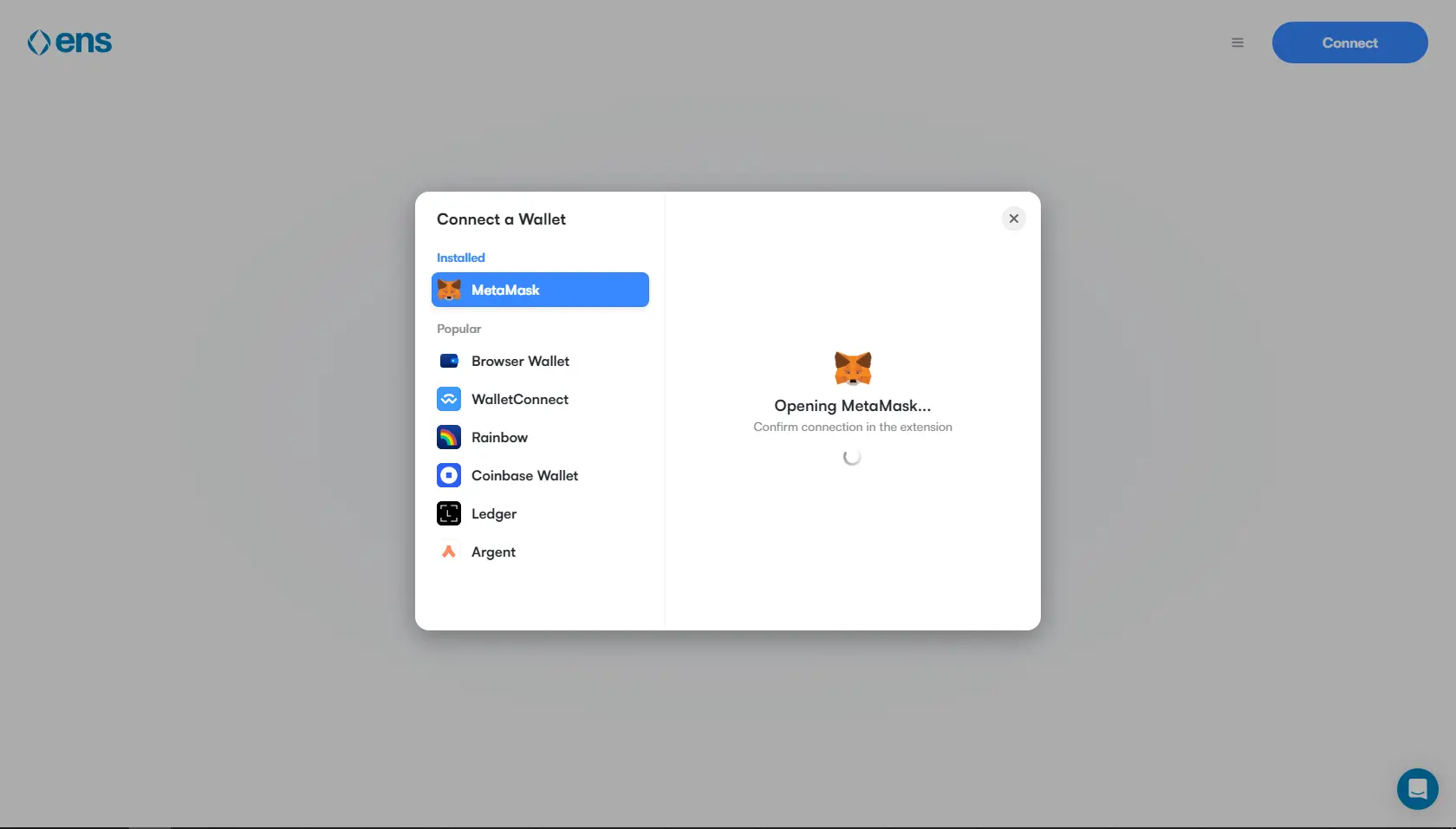
Click Metamask, and the connection process will start. Complete a series of confirmations before ENS domains connect to your wallet.
Step 3: Search for Name
Use the search button to quickly search for your name and see whether it’s available.
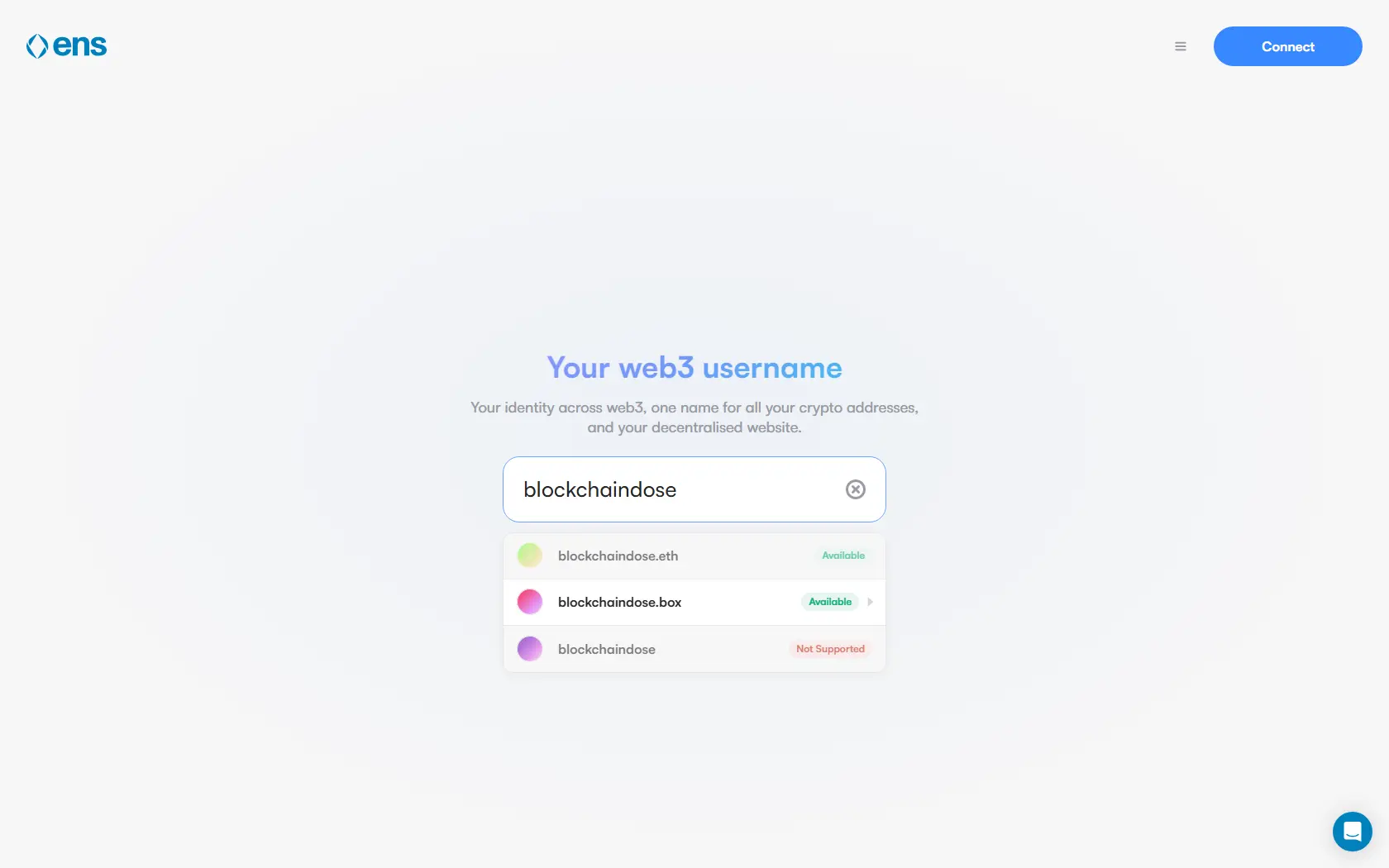
In this case, blockchaindose.eth is available. Click enter, and a new page opens.
Step 4: Register Blockchaindose.eth
At this point, you can register the domain name and set the number of years to register.
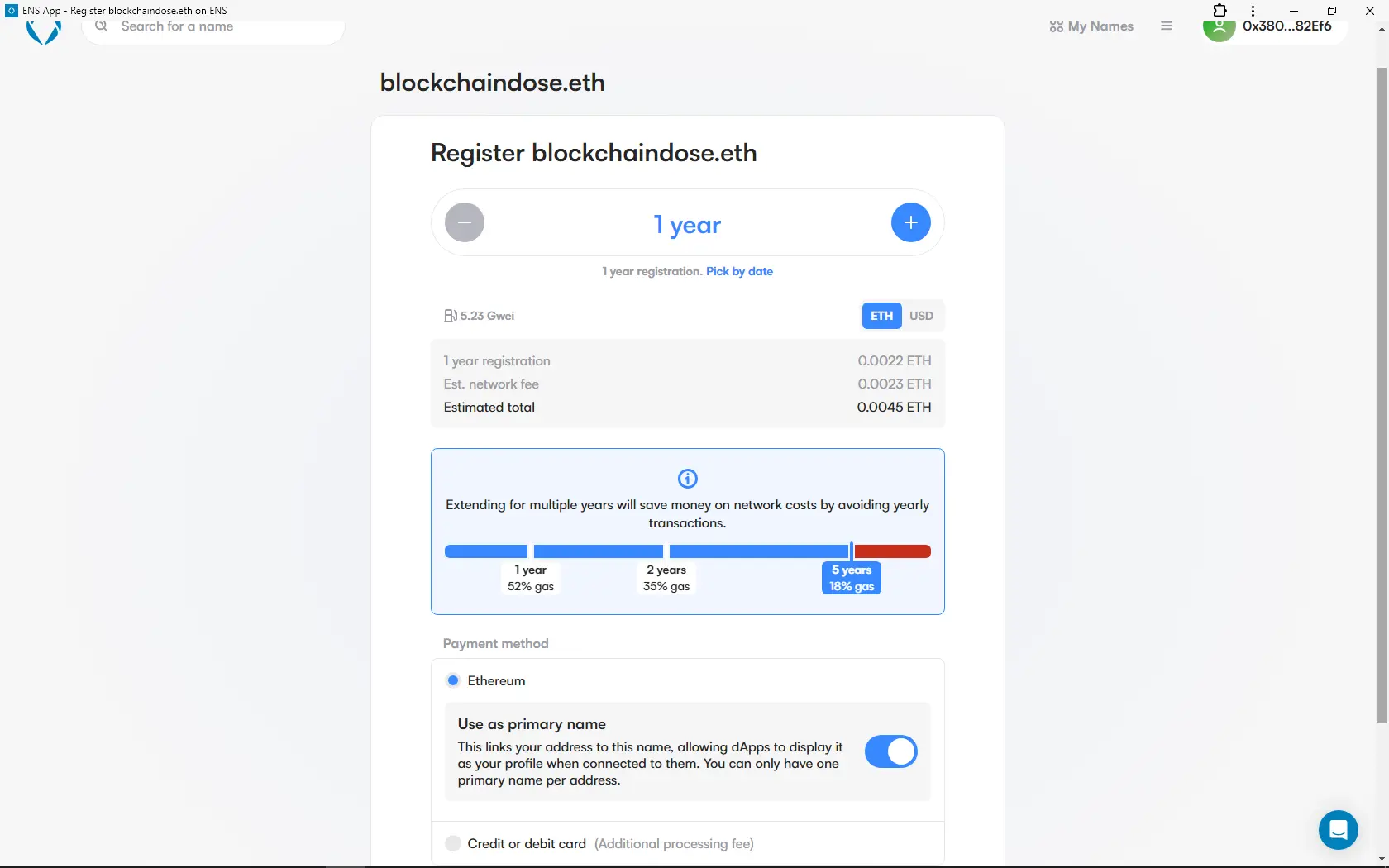
The network autonomously calculates the amount of ETH needed for gas and registration.
Step 5: Complete Payments
You can complete the payments with your Metamask wallet. If you have the needed ETH in your wallet, you can complete your domain registration.
The minting process is entirely managed by smart contracts based on preset conditions. Because of the power of smart contracts, you can be sure your Domain can not be altered. For storage on blockchain, the ENS network stores the names in the ERC-721 or ERC-1155 standards, popular with NFTs.
After the minting process, you will own the Domain you created, which can be verified on the blockchain.
How To Buy an Available NFT Domain
Alternatively, you can purchase a ready NFT domain that is available in the markets. Like minting, the process of buying is simple. However, unlike in minting, you cannot enjoy the benefits of personalized names with buying.
Unstoppable Domain is a good marketplace for buying NFT domains in 2026. Visit the web page and sign up to buy a domain.
Step 1: Signup with Metamask
Click login in the top right corner of the home page. Select the Signup option below. Again, you have several signup options, including email, Google, X, and Connecting Wallet.
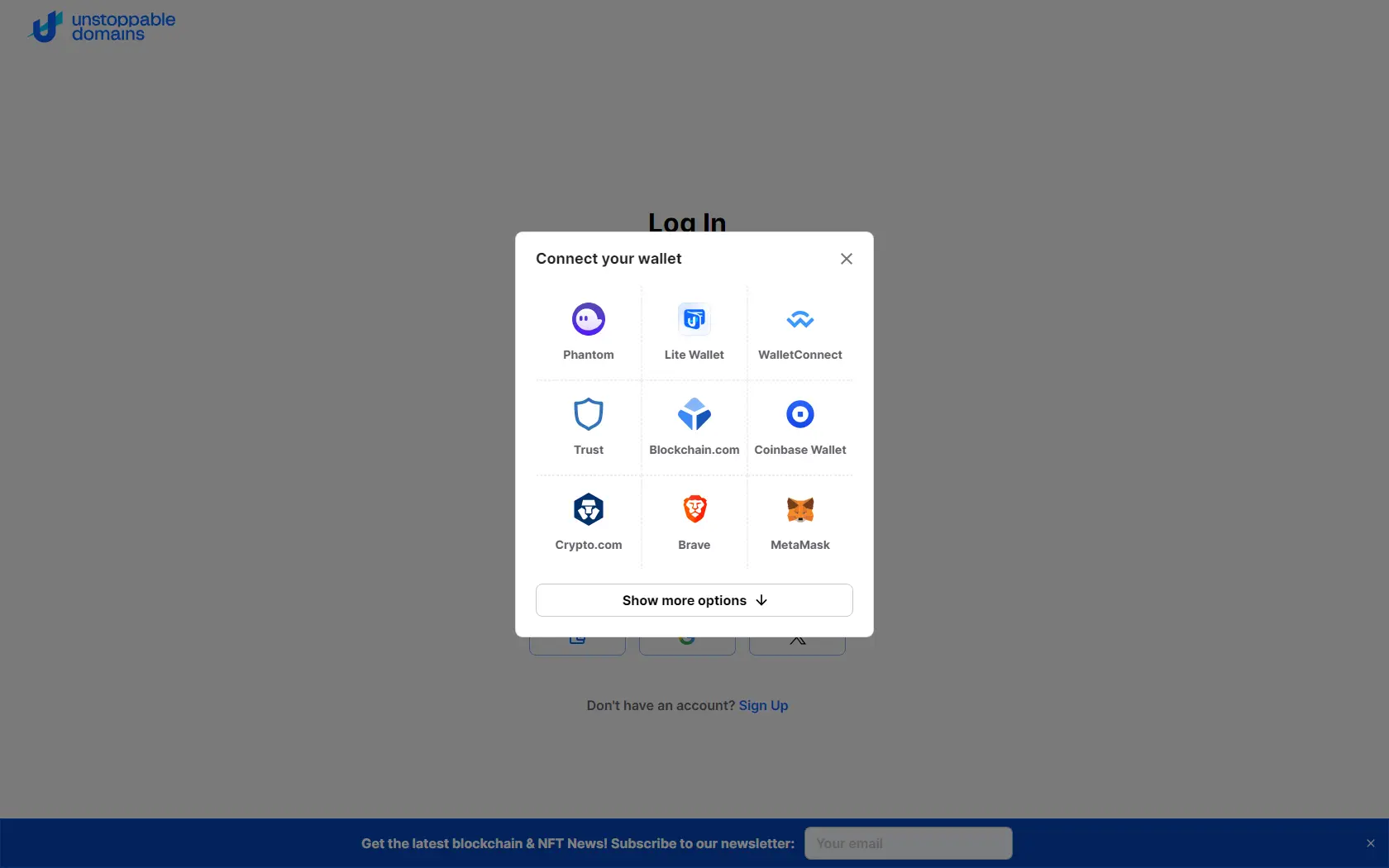
In our case, we chose to connect the wallet, specifically Metamask. You are logged in.
Step 2: Search your Domain Name and Add to Cart
On the home page, search for the domain name you want. Your search could bring you exactly what you want or something close to it.
Add the NFT domain you target to the cart. Click Continue to Cart, and you will see your new NFT therein.
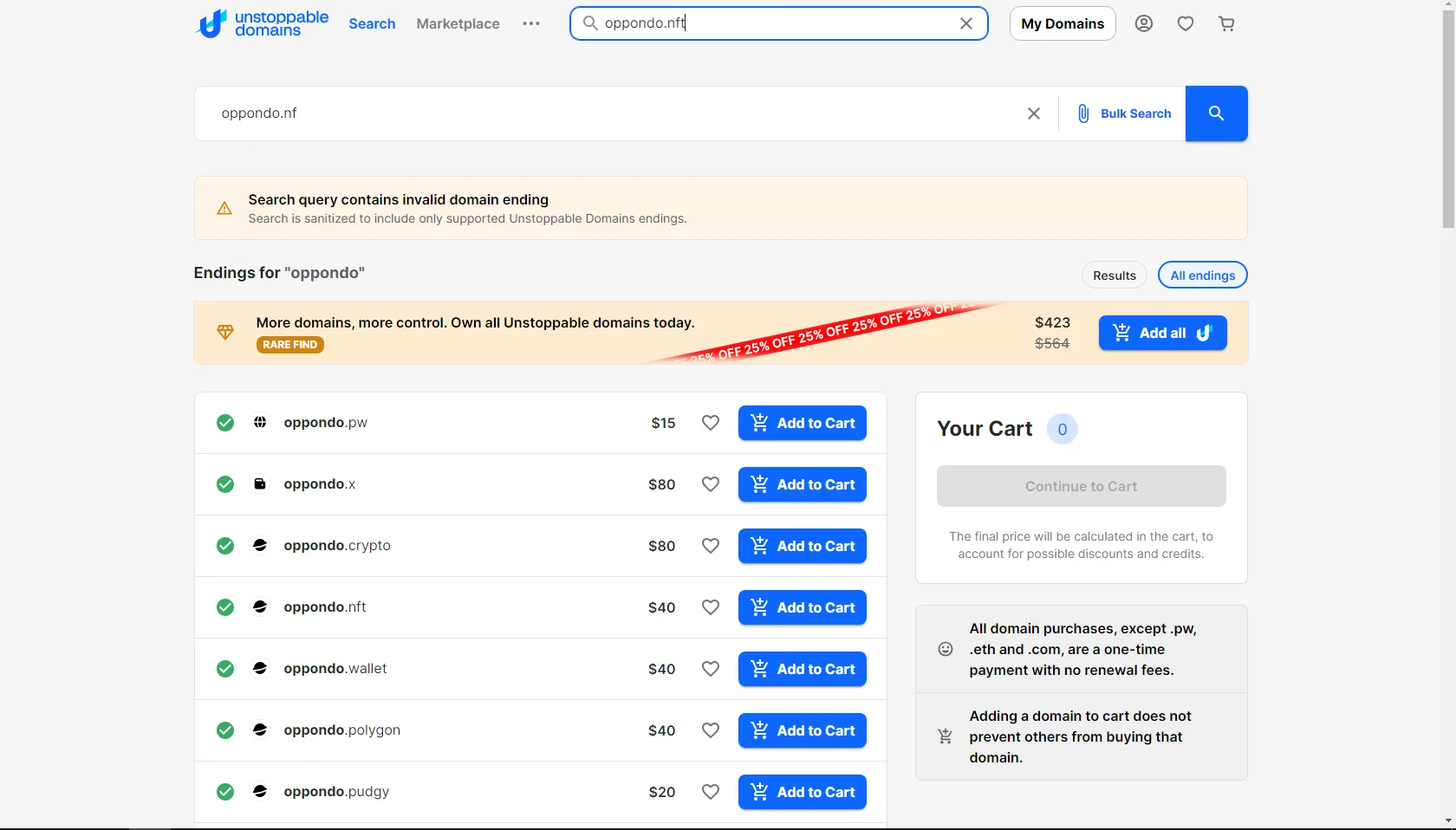
You can confirm the details in the cart by clicking ‘Go to Checkout.’
Step 4: Select and Complete Payments
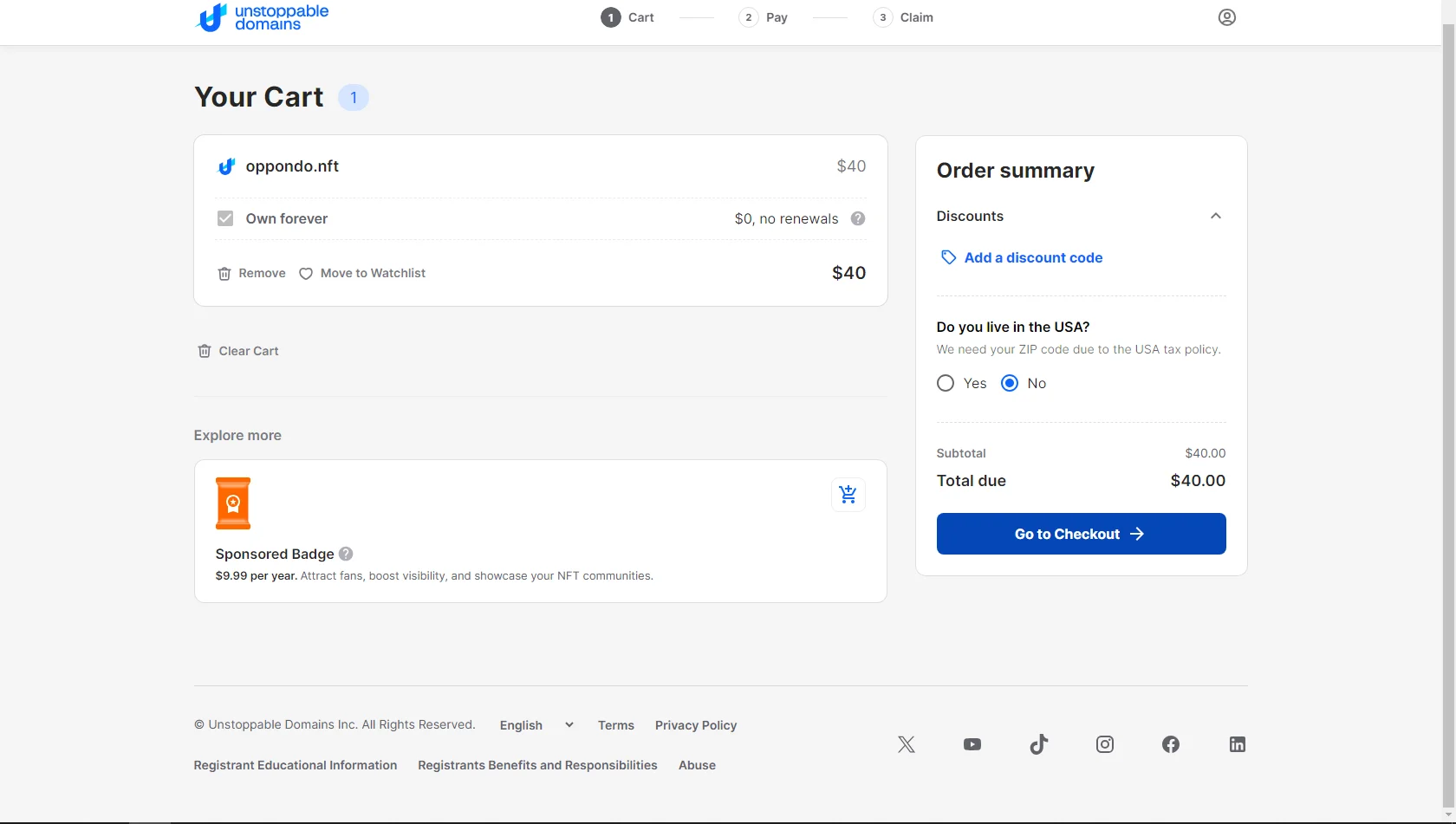
Select the payment options from the available Card, Paypal, Crypto or Crypto.com. In our case, we went with crypto and, finally, Metamask. You must complete a series of confirmations before you genuinely own the Domain.
One practical note from the community: if you are buying ENS domains as an investment, always link them to a wallet. Early adopters who bought ENS domains without linking them to wallets missed out on the ENS governance token airdrop – worth tens of thousands of dollars per connected wallet.
NFT Domains vs. Traditional Domains
| Traditional Domains | NFT Domains | |
| Ownership | Annual lease | One-time purchase (usually) |
| Browser support | Universal | Limited (Brave, Opera, extensions) |
| Search engine indexing | Full | None currently |
| Dynamic websites | Full support | Not supported on IPFS |
| Transfer time | 5–7 days | Seconds |
| Censorship resistance | Low | Moderate |
| Cost (long-term) | ~$100+/year | ~$10–100 one-time |
Who Should Consider NFT Domains?
NFT domains make the most practical sense for crypto-native users who interact primarily with Web3 wallets and dApps, creators building a portable identity across decentralized platforms, and anyone who regularly sends or receives crypto and wants a readable address instead of a long hex string.
They make less sense for anyone trying to build a mainstream website, rank in search engines, or reach an audience that isn’t already familiar with Web3. Those limitations are real and not going away in the near term.
The technology is solid and the direction is clear. The gap between what NFT domains promise and what they deliver today is narrowing – as browser support grows, more registrars get ICANN accreditation, and the boundary between traditional web infrastructure and blockchain continues to blur.
Frequently Asked Questions for NFT Domains
An NFT domain is a blockchain-based domain name that you own as a token in your crypto wallet. Unlike traditional domains that require annual renewal fees, NFT domains are a one-time purchase with no recurring costs.
ENS issues .eth domains on Ethereum and requires annual renewal. It is open-source and community-governed. Unstoppable Domains offers a wider range of extensions like .crypto, .nft, and .wallet, charges a one-time fee with no renewals, and is a private company. ENS is generally seen as more decentralized, while Unstoppable Domains is considered easier to use.
Not in most browsers. Chrome, Safari, and Firefox do not support NFT domains natively. You need Brave, Opera, or a browser extension to visit websites hosted on NFT domains. This is currently the biggest barrier to mainstream adoption.
Prices vary by provider and the name you choose. A basic NFT domain typically starts at around $10 to $20 as a one-time purchase. ENS domains also require a small gas fee on the Ethereum network, which fluctuates with network activity.
No. Google does not index websites hosted on NFT domains. If search engine visibility is important for your project, an NFT domain is not a replacement for a traditional .com at this point.
You cannot lose ownership of the token itself as long as your wallet is secure. However, as the .coin case showed, a provider can disable resolution for your domain even if you still hold the NFT. Owning the token does not guarantee the underlying service keeps working.

Dan is a seasoned crypto writer for Blockchaindose who got his start in the space back in 2019. Over the past four years, he’s built a solid grasp of how the industry moves, focusing heavily on DeFi, NFTs, GameFi, and promising new projects.
Off the clock, you’ll usually find him buried in a good book or kicking back with a movie. His blend of hands-on market experience and straightforward commentary makes him a clear, trusted voice across the platform.