Privado ID zero knowledge credentials solve a problem every DeFi user has felt: submitting the same passport scan to a fifth different service this month. Formerly Polygon ID, Privado ID is one of the more mature products in decentralized digital identity. It lets a proof travel where the underlying document never does.
Key Takeaways
- Privado ID uses zk-SNARK proofs to let a user verify a claim, like passing KYC or being over 18, without exposing the document behind it.
- Credentials are reusable: verify once, present the resulting proof to any number of services afterward. No document re-submission.
- Credentials and on-chain revocation, shipped in Release 6, let an issuer invalidate a credential without breaking the whole system.
- In 2025, the team behind Privado ID launched Billions Network, a separate proof-of-personhood product competing directly with World ID. Its $BILL token began trading on six exchanges in May 2026.
- The core use case remains compliance without custody: a DEX or lending protocol can gate access by KYC status without ever holding a user’s personal data.
What Privado ID Zero-Knowledge Credentials Actually Prove
A conventional KYC check produces a yes/no result. That result lives in whatever company’s database performed it, reused nowhere else. It becomes a liability the moment that database gets breached.
Privado ID replaces the database with a zk-SNARK proof: a cryptographic construction that lets someone demonstrate a statement is true. “This wallet holder is over 18.” “This identity passed a KYC check with a licensed provider.” The proof reveals none of the underlying data. The verifier learns only the answer to the specific question asked, nothing more.
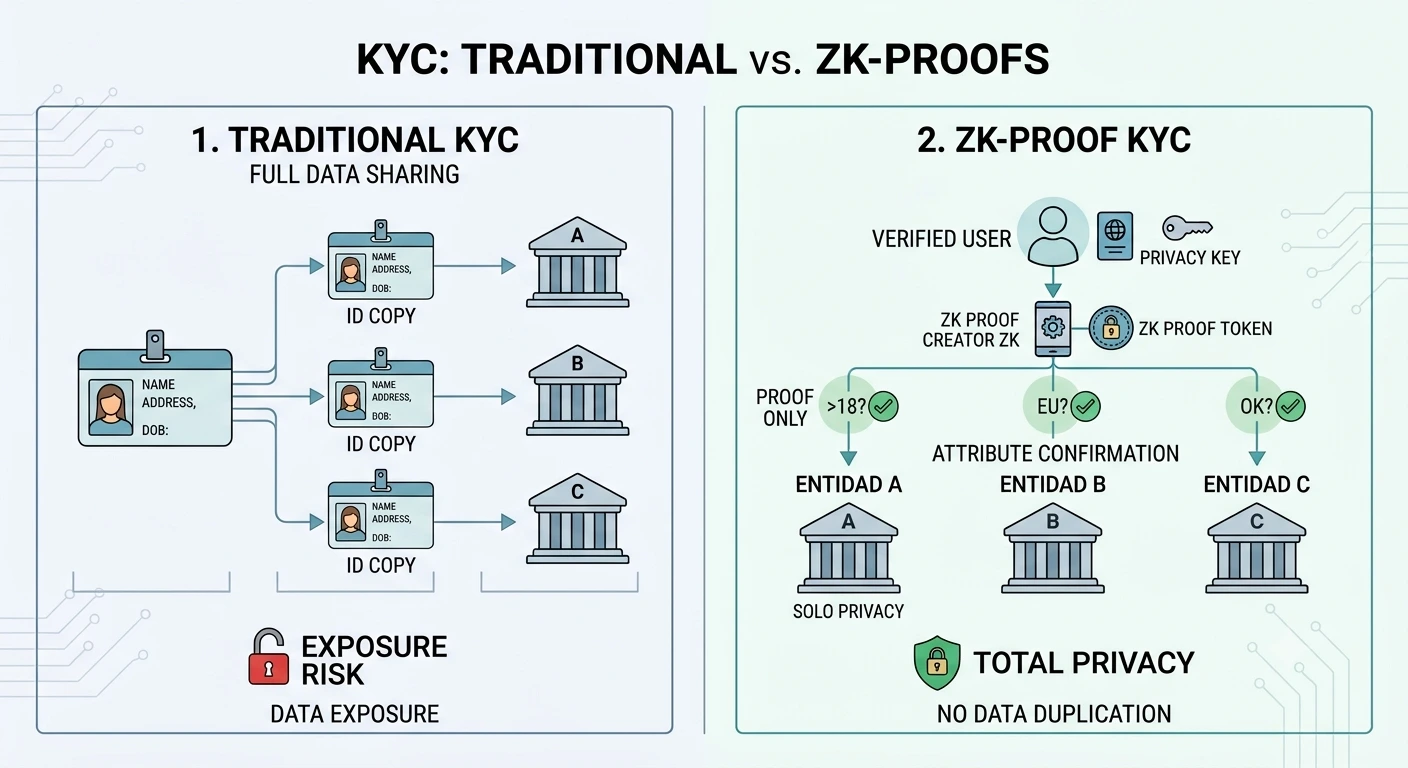
The distinction from simple encryption matters here. Encrypting a document and handing over a decryption key still moves the data twice. A zero-knowledge proof never transmits or reconstructs the underlying data, in either direction.
How the Issuance and Verification Flow Works
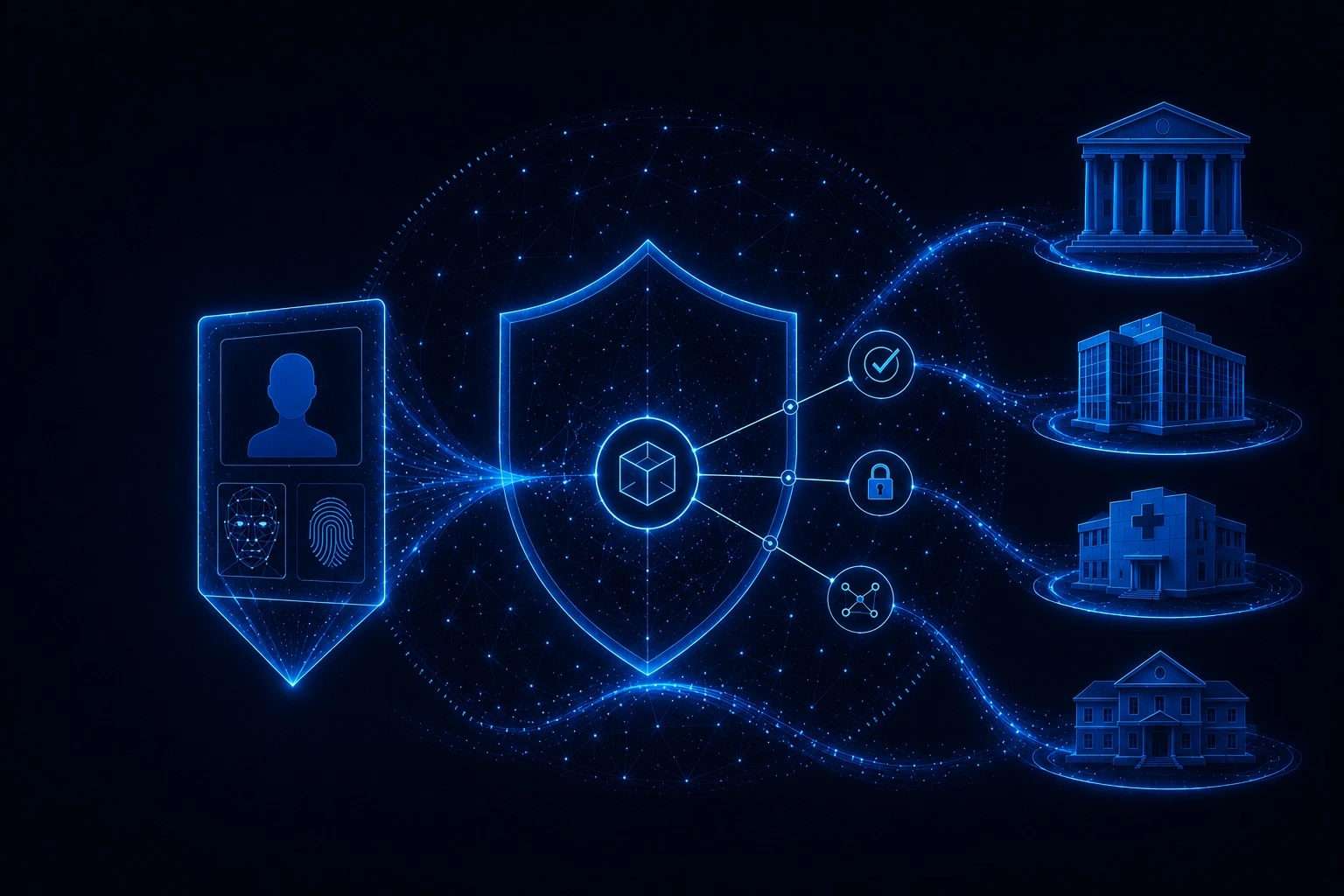
- An issuer verifies the real-world fact. A licensed KYC provider, a government body, or an institution confirms identity, age, or accreditation status through their normal process.
- The issuer signs a verifiable credential and delivers it to the user’s identity wallet – the credential itself, not a copy of the underlying documents, is what the user now holds.
- The user generates a zero-knowledge proof from that credential when a platform requires verification – proving the specific claim requested (“over 18,” “KYC-verified”) without disclosing the credential’s full contents.
- The verifying platform checks the proof cryptographically against the issuer’s public signature, confirming validity without ever contacting the issuer or seeing the original document.
- Dynamic credentials and on-chain revocation let the issuer update or invalidate the credential later – an expired document or a revoked accreditation status propagates without the user needing to re-enroll from scratch.
That last point is a real technical advance: earlier verifiable-credential designs often treated credentials as static, all-or-nothing objects. current comparisons of the decentralized identity landscape specifically flag Privado ID’s dynamic credentials and on-chain revocation service as a meaningful step past that limitation, letting expired or invalid credentials be handled gracefully instead of requiring a full re-issuance cycle.
The Compliance Problem This Actually Solves
The clearest use case sits at the intersection of DeFi and regulation. A cryptocurrency exchange or lending protocol operating in a regulated market needs to confirm users are KYC-verified and, in some jurisdictions, of legal age – but storing that personal data directly exposes the platform to breach liability and regulatory scope it may not want.
Zero-knowledge credentials let the platform enforce the gate without ever holding the underlying data: the smart contract or backend checks a proof, not a passport scan. This is meaningfully different from Civic’s attestation-based access-control model or World ID’s biometric proof-of-personhood – Privado ID’s specific strength is the zero-knowledge layer itself, proving arbitrary claims about identity data without exposing that data at any point in the flow.
This also solves the repeated-KYC problem from the user side. Someone who has completed a compliant KYC check once can generate proofs from that same credential across every subsequent platform requiring it, instead of re-uploading documents and waiting on manual review each time – a friction point that current market guidance identifies as one of the biggest reasons users abandon onboarding flows in regulated DeFi products.
From Polygon ID to Privado ID: A Rebrand With Real Substance
The name changes have drawn genuine frustration in developer communities – understandably, since tracking a product through Polygon ID, then Privado ID, then a further merger is real friction for anyone trying to evaluate it. But the substance behind the renaming is not cosmetic.
Privado ID merged with Disco, a verifiable-data and reputation-management platform, specifically to accelerate a unified, chain-agnostic digital identity infrastructure bridging Web2 and Web3 rather than remaining a Polygon-specific tool.
In practice this shows up as expanded chain support: beyond its original Polygon deployment, the smart contracts have extended to Optimism, Base, and Arbitrum, reflecting the same industry-wide push toward multi-chain identity that shows up across this category – the same logic that makes ONT ID’s multi-chain approach attractive to enterprises who do not want to bet on a single ecosystem.
Limits and What to Check Before Adopting It
- Issuer trust still matters. A zero-knowledge proof is only as trustworthy as the issuer who signed the underlying credential – the cryptography guarantees privacy, not that the issuer performed a rigorous check.
- Revocation needs active maintenance. On-chain revocation is only useful if issuers actually update credential status when circumstances change (a document expires, a license is revoked).
- It is a credentialing layer, not a full wallet. Privado ID integrates with existing identity wallets and dApps rather than replacing the crypto wallet development stack a user already relies on.
Privado ID answers a specific question: how do you comply with KYC requirements without becoming a data-breach liability? For any service weighing whether to store personal documents directly or verify a zero-knowledge proof instead, the privacy, liability, and user-experience math consistently favors the proof.
Just know that “Privado ID” today sits alongside a newer, separately branded product, Billions Network, built on the same zero-knowledge foundation.
What is Privado ID formerly known as?
Privado ID was previously called Polygon ID before rebranding to reflect its position as a chain-agnostic identity product rather than one tied specifically to the Polygon ecosystem.
How do zero-knowledge credentials protect my privacy?
They let you prove a specific claim – such as being over a certain age or having passed KYC – without revealing the document or data behind it. The verifier learns only the answer to the question asked, never the underlying passport, ID, or birthdate.
Can a Privado ID credential be revoked?
Yes – on-chain revocation lets an issuer invalidate a previously issued credential, and dynamic credential support lets details be updated without requiring the user to re-enroll from scratch.
Who issues Privado ID credentials?
Any entity a platform trusts as an issuer – licensed KYC providers, institutions, or government bodies – signs the credential after performing their normal verification process. The zero-knowledge layer protects the data afterward; it does not replace the initial verification.
Is Privado ID only useful for KYC?
KYC and age verification are the most common use cases, but the same zero-knowledge proof mechanism can verify any claim tied to a signed credential – accreditation status, membership, or eligibility checks of many kinds.

Isai Alexei is a journalist and financial analyst covering cryptocurrency markets and traditional securities for Blockchaindose. He has spent ten years analyzing digital assets, trading activity, and market structure.