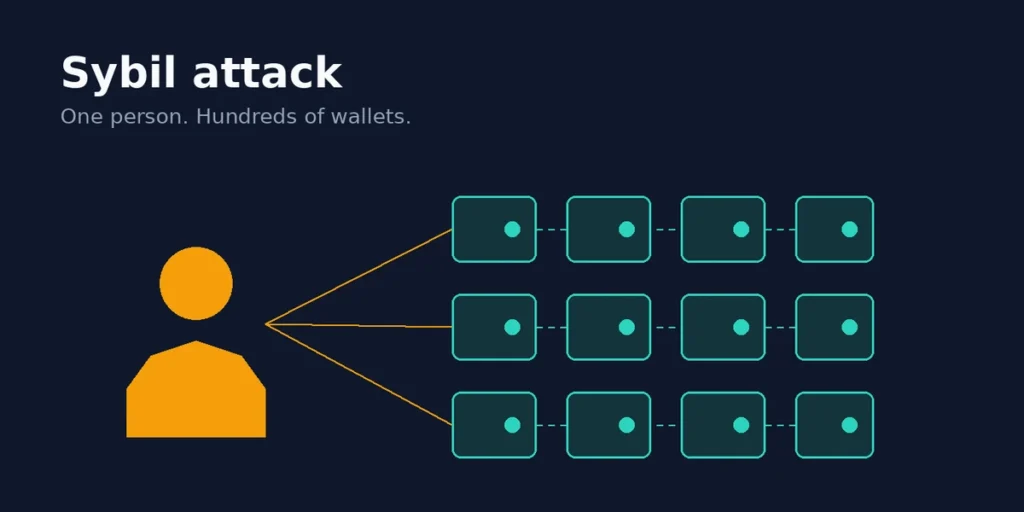

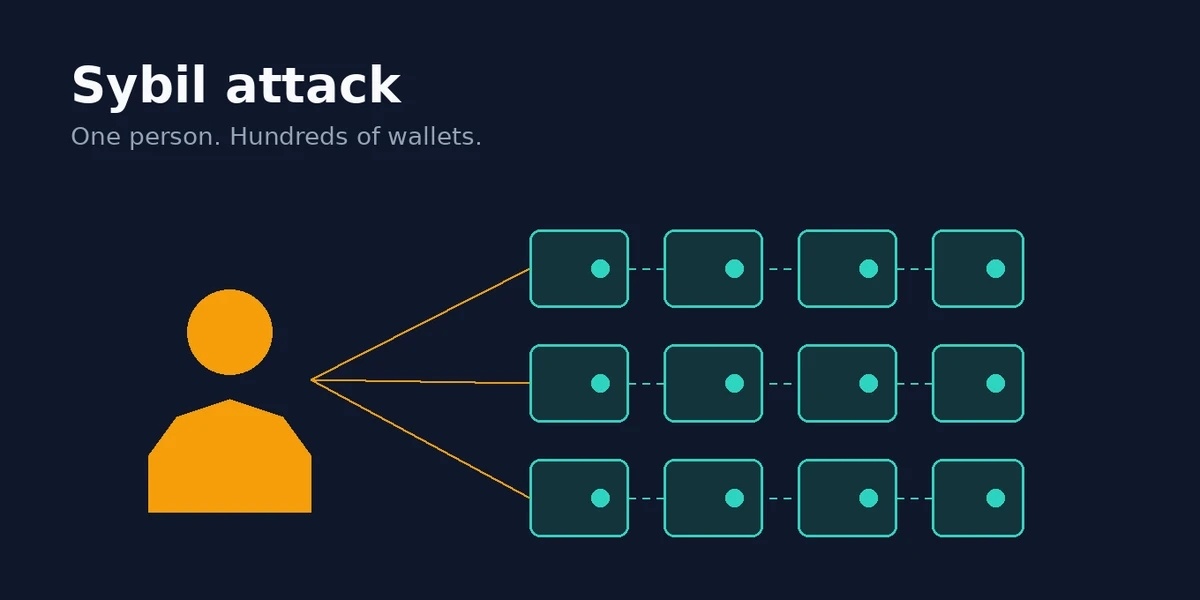
Decentralized networks let anyone participate without a central authority, but that openness makes them vulnerable to Sybil attacks. Blockchains can confirm that a wallet made a transaction, yet they cannot tell whether it belongs to a unique person, so one user can pose as an entire community. As airdrops, token rewards and governance grow more valuable, Sybil attacks are becoming a serious threat to fair distribution and sustainable Web3 ecosystems.
Key takeaways
- Sybil attacks exploit Web3 incentives by letting one person control many wallets to farm airdrops, fake activity, abuse referral programs, distort DAO voting and manipulate quadratic funding.
- A wallet is not a person, so any reward or vote assigned per address gives a Sybil attacker a disproportionate share.
- Optimism’s first airdrop later excluded 17,000 addresses and recovered 14 million OP tokens through additional Sybil filtering.
- Sybil resistance works best with layered defenses like onchain analysis, proof of personhood and economic barriers, plus transparent rules and an appeal process for wrongly excluded users.
Definition
Sybil Attack: A Sybil attack is a form of identity manipulation in which one participant creates or controls multiple accounts or wallet addresses to gain disproportionate rewards, influence or access within a network.
What Is a Sybil Attack in Blockchain?
A Sybil attack occurs when one individual or coordinated group creates and controls multiple identities to gain more influence or rewards than a single participant should receive.The concept is not exclusive to cryptocurrency. It has existed in distributed computing and online networks, where attackers create fake accounts to manipulate voting systems, reputation scores and other forms of participation.In blockchain ecosystems, the attack takes advantage of pseudonymous wallet addresses. Creating a new wallet is generally inexpensive and does not require a person to disclose their real-world identity. Consequently, a project may see 100 wallets interacting with its application without knowing whether they belong to 100 individuals or one coordinated operator.

5 Ways Sybil Attacks Exploit Web3 Incentives
Farming Multiple Wallets to Capture Airdrop Rewards
Airdrops are designed to distribute tokens to early adopters, active users and community participants. They can help projects attract attention, encourage application usage and distribute ownership across a wider group.However, when eligibility is based on wallet activity, attackers can create multiple addresses and repeat qualifying actions across them. Instead of using one wallet to complete a project’s tasks, they operate dozens or hundreds of wallets to increase their potential allocation.
Hypothetical scenario
Consider a hypothetical project that reserves 100,000 tokens for 1,000 eligible wallets. If every wallet receives an equal allocation, each receives 100 tokens. An attacker controlling 50 qualifying wallets could collect 5,000 tokens rather than the 100 tokens allocated to one address.
Manipulating Transaction Activity to Appear Like Genuine Users
Many projects use onchain activity to identify their most engaged participants. They may consider transaction frequency, application usage, trading history, liquidity provision or activity across different networks.
These indicators can help distinguish long-term users from newly created wallets. However, activity alone does not prove that an address represents an independent participant.An attacker can distribute funds across multiple wallets, perform transactions through selected applications and maintain activity over time. Some may even carry out small trades or repeated interactions to make their addresses appear more established.
Why Activity Alone Isn’t Proof
The problem is that blockchain activity measures what an address does, not necessarily who controls it. A wallet with months of transaction history may still belong to an operator managing several other addresses. This makes activity-based eligibility useful but insufficient on its own. Projects that reward transaction volume or frequency without examining relationships between wallets can create incentives for artificial participation
Exploiting Referral Programs and Community Rewards
Web3 projects frequently use referral campaigns, social quests and community reward programs to attract new participants. Users may receive points, tokens or other benefits for inviting people, completing tasks or expanding a project’s online presence.
These programs create another opportunity for Sybil activity.
An attacker can operate multiple accounts, refer those accounts to one another or coordinate groups of wallets to complete the same campaign requirements. If the project rewards each account independently, the attacker can collect benefits without bringing in an equivalent number of genuine users.
Consequences
The consequences extend beyond financial losses. Artificial engagement can make a project appear more popular than it really is, distorting community metrics and influencing decisions about future funding or token distribution.
Distorting DAO Governance and Voting Power
Decentralized autonomous organizations (DAOs) use blockchain-based voting to allow tokenholders to participate in protocol decisions. Depending on the governance design, participants may vote on treasury spending, protocol upgrades and other important proposals.
Sybil attacks can undermine this process when voting power or eligibility is linked to the number of participating identities.
for example
If a governance system gives every verified wallet one vote, a single attacker controlling 100 wallets could potentially cast 100 votes. This can distort community preferences and make a coordinated minority appear to represent a much larger group.
Token Weighted Governance
Token-weighted governance introduces a different limitation. It reduces the influence of simply creating more wallets when voting power is determined by token holdings, but it does not necessarily guarantee broad or independent participation. Large tokenholders can still concentrate influence, while coordinated actors may use multiple addresses to obscure how their holdings are distributed.
Manipulating Quadratic Funding and Other Reward Systems
Quadratic funding is designed to distribute funding according to the number of individual contributors rather than relying only on the total amount donated. It is commonly associated with public goods funding, where smaller contributions from many people can receive greater matching support.
However, this model depends on the assumption that contributions come from independent individuals.
An attacker can divide a larger contribution among multiple wallets and make it appear as though several people support the same project. If those wallets are treated as independent contributors, the project may receive more matching funds than its genuine community support justifies.This creates a direct incentive to manufacture identities rather than attract actual supporters.
Common Misconceptions About Sybil Attacks
Myth vs fact
Every person with multiple wallets is a Sybil attacker.
Multiple wallets can have legitimate security and privacy purposes. Manipulation of a system is the defining issue.
Myth vs fact
More transactions prove that a wallet belongs to a genuine user.
Activity can be automated or deliberately repeated across several addresses.
Myth vs fact
Blockchain transparency makes Sybil attacks easy to eliminate.
Transparent transactions help identify patterns, but do not automatically reveal who controls each wallet.
Myth vs fact
One identity verification method can stop every Sybil attack.
Different attack methods require different signals and layered defenses.
How Blockchain Networks Fight Back Against Sybil Attacks
There is no single method that can eliminate every form of Sybil activity. Networks generally combine several techniques, each designed to make fake identities more difficult to create, operate or profit from.
Onchain Behavioral Analysis
Projects examine transaction histories, funding sources, wallet interactions and patterns of activity to identify addresses that may be controlled by the same entity.
FOR example
Dozens of wallets funded by the same source and interacting with the same contracts in a similar sequence may warrant further investigation.
These signals are useful, but they are not conclusive. Genuine users can share exchanges, bridges or funding services, while sophisticated attackers can vary their behavior to avoid obvious patterns.
Proof of Personhood and Identity Credentials
Proof of Personhood systems attempt to establish that an account represents a unique human without necessarily requiring every application to collect traditional identity documents.
Real world Example
Human Passport, previously known as Gitcoin Passport, is one example. It offers verification methods known as Stamps, which aggregate signals from different identity providers and activities to help applications assess whether participants are likely to be unique humans.
Its documentation describes applications such as airdrop protection, quadratic funding and decentralized governance.

However, verification methods must balance uniqueness, accessibility and privacy. Stronger identity requirements may exclude users who lack certain documents or do not want to share personal information.
Economic Barriers and Cost of Forgery
Another approach is to make it more expensive or time-consuming to create convincing fake identities.
Projects can require a history of meaningful participation, impose minimum costs, use staking requirements or combine multiple forms of verification. The objective is not necessarily to make attacks impossible, but to reduce the expected profit from carrying them out.
However, financial requirements can create a disadvantage for users with limited funds. A system that relies too heavily on token holdings or transaction fees may filter out genuine participants simply because they cannot afford to meet the requirements.
Reputation and Multiple Verification Signals
Rather than relying on a single wallet metric, projects can combine transaction history, account credentials, community participation and other forms of evidence.
Human Passport, for example, allows applications to use multiple verification signals to assess unique humanity. Its documentation also explains that scoring thresholds involve a trade-off: stricter thresholds may reject more suspected Sybil accounts, but can also exclude genuine users.
The important distinction is that a reputation score or verification result should be treated as evidence, not absolute proof. Attackers can adapt, and legitimate users may share behavioral patterns with suspicious wallets.
Tip
Do not treat one suspicious signal as proof of fraud. Shared funding sources, similar transaction patterns or new wallet activity should trigger additional checks rather than automatic exclusion. Combining independent signals and allowing users to appeal decisions can reduce false positives.
A Practical Process for Designing Sybil-Resistant Programs
For a project distributing tokens or rewards, the objective should be to make manipulation less profitable without making participation unnecessarily difficult.
Step by step
- Define eligibility clearly: Decide what meaningful participation actually means before launching a reward program.
- Analyze wallet relationships: Review shared funding sources, transaction timing and repeated interaction patterns.
- Combine verification signals: Use onchain history, identity credentials and reputation data rather than relying on one metric.
- Set proportionate thresholds: Make manipulation costly without creating unreasonable barriers for genuine users.
- Review and allow appeals: Give participants a transparent way to challenge incorrect exclusions and update decisions when new evidence emerges.
The Trade-Off Between Sybil Resistance and Open Participation
Preventing Sybil attacks is necessary for fair reward distribution, but stronger verification can introduce new problems.
A system that requires government identification may improve identity uniqueness while reducing privacy and excluding users who cannot complete verification. A system based on transaction history may be more accessible but can be manipulated by coordinated wallet operators.
The difference between common approaches can be summarized as follows.
Comparing Sybil Resistance Methods
| Method | Main advantage | Main limitation |
| Onchain analysis | Detects suspicious wallet relationships and activity patterns | Sophisticated attackers can imitate genuine behavior. |
| Proof of Personhood | Helps establish unique human participation | Can create privacy and accessibility concerns. |
| Economic requirements | Raises the cost of operating multiple identities | May disadvantage users with limited capital. |
| Reputation systems | Combines evidence from different activities | Scores can be manipulated or incorrectly assigned. |
Risk notice
The Risk of False Sybil Detection
Sybil detection systems can incorrectly classify legitimate users as attackers. Shared funding sources, common exchanges, family members using the same network or similar application behavior may create suspicious patterns without proving coordinated control. Projects should avoid treating automated scores as definitive evidence and provide a review process before permanently excluding participants.
Conclusion
Sybil attacks expose a fundamental weakness in Web3 incentive systems: a wallet is not the same as a person. As airdrops, governance and community funding programs distribute more value through digital participation, attackers have stronger reasons to create multiple identities and manipulate eligibility. Behavioral analysis, proof of personhood and economic barriers can make these attacks harder, but none provides a perfect solution. The real challenge is building systems that reward genuine participation without turning decentralized access into a process controlled by identity checks or financial privilege.
Why is it called a Sybil attack?
The term comes from a 2002 Microsoft Research paper by John Douceur, who described how one entity can pose as many identities in a peer-to-peer network. He named it after “Sybil,” a well-known book about a woman with multiple personalities.
Is a Sybil attack the same as a 51% attack?
No. A 51% attack happens when one party controls most of a blockchain’s mining power or stake and can rewrite recent transactions. A Sybil attack is about faking many separate identities to gain influence or rewards. The two can be related, but they exploit different weaknesses.
Are Sybil attacks illegal?
There is no single answer, because it depends on the country and the circumstances. Most airdrop and reward programs ban multiple accounts in their terms, so Sybil farming usually breaks program rules, and in some cases it could raise fraud concerns. I’m not a lawyer, so anyone worried about a specific case should get legal advice.
What happens to wallets flagged as Sybil addresses?
They are usually removed from the reward or vote, and the project may redistribute their share to the remaining eligible users. Optimism, for example, said recovered OP would be redistributed proportionally to the remaining addresses in its first airdrop. Some projects also offer an appeal process for wrongly flagged users

Muhammad Mubashir is a crypto enthusiast who has been in the Web3 space since 2019 and writing content for major industry platforms since 2024. They specialize in blockchain architecture, Layer 1/2 solutions, NFTs, DeFi, and Web3 technologies, and enjoy gaming in their free time.