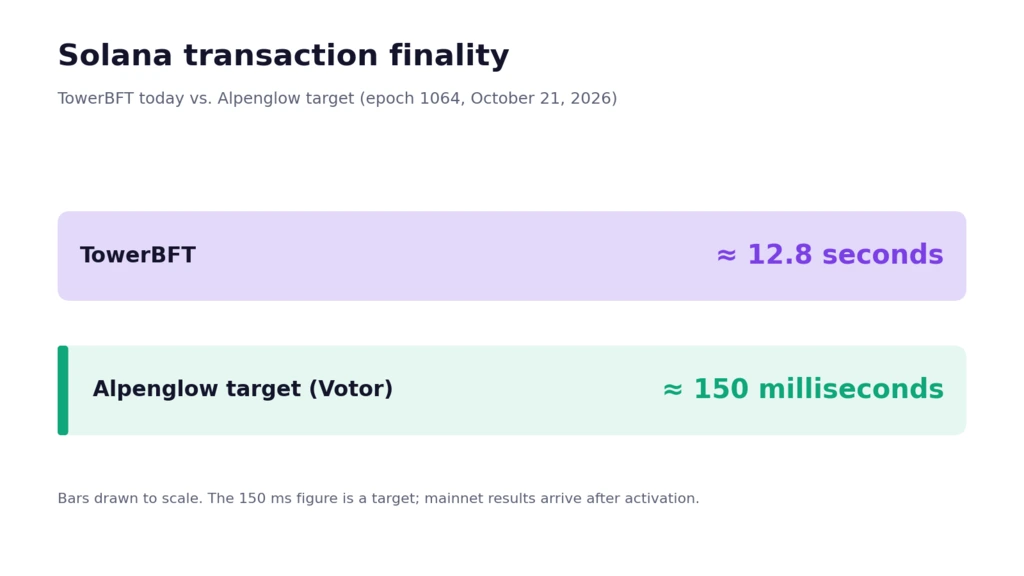
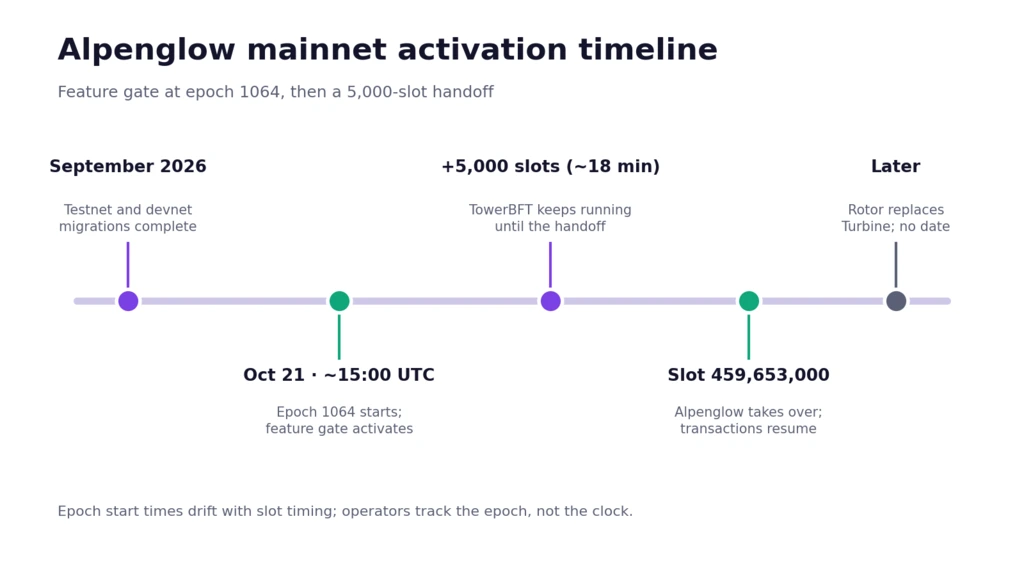
Solana Alpenglow reaches Solana mainnet on Wednesday, October 21, 2026. The mainnet activation starts at epoch 1064, at approximately 15:00 UTC, according to the Solana Foundation. Anza, the Agave client developer, lists 14:50 UTC. Testnet and devnet completed their migrations in September 2026, after stakers approved proposal SIMD-0326 in a 2025 vote. Epoch start times drift with slot timing, so operators track the epoch rather than the clock. The upgrade replaces TowerBFT and targets 150 milliseconds of finality, down from 12.8 seconds.
How Solana Alpenglow Votor Finalizes Blocks
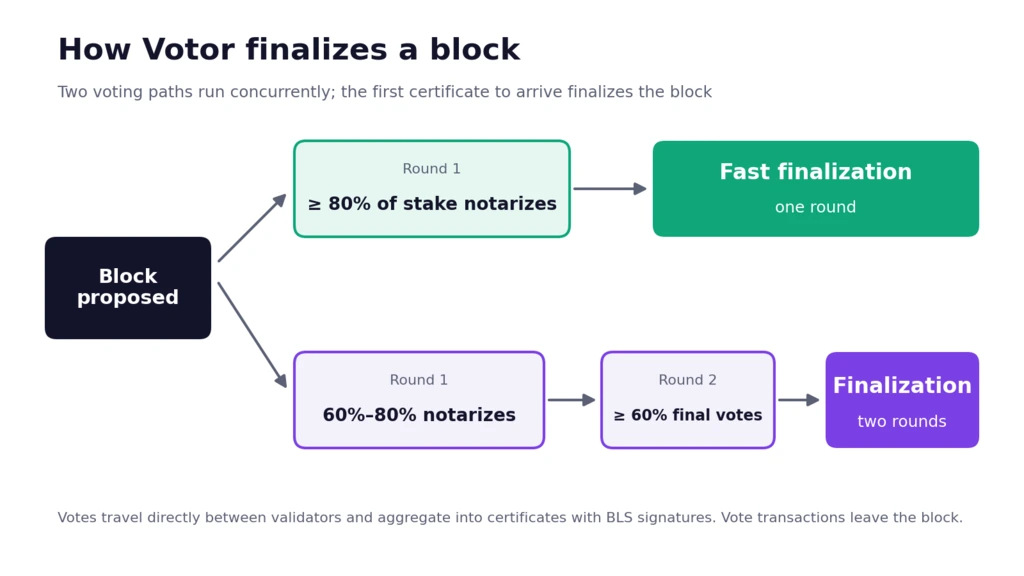
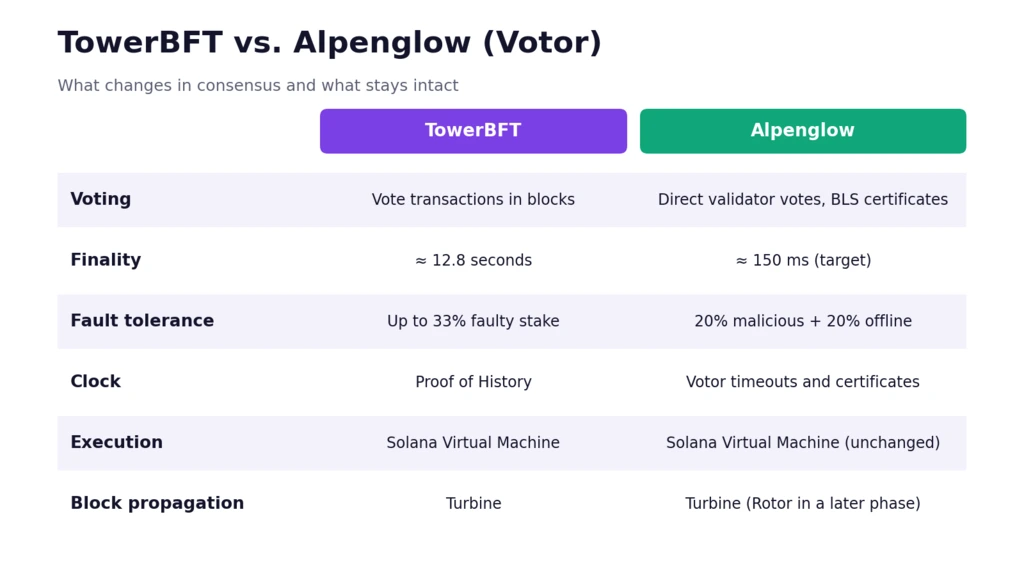
Votor, the first phase of Solana Alpenglow, changes how validators vote. Under TowerBFT, validators submit votes as transactions, and a block becomes final after votes accumulate across 32 slots. Votor removes vote transactions. Validators send votes directly to each other and aggregate them into certificates with BLS signatures. A block finalizes in one round when validators holding at least 80% of stake notarize it. If the first round gathers between 60% and 80%, a second round runs, and a 60% threshold finalizes the block.
Both paths run concurrently, and the earlier result applies. Any validator holding enough votes assembles and broadcasts a certificate, and anyone with the validators’ BLS public keys verifies it.
20+20 Fault Tolerance and Byzantine Fault Tolerance
The protocol keeps finalizing when up to 20% of stake acts maliciously and an additional 20% stays offline. Classical Byzantine fault tolerance designs accept up to 33% faulty stake of a single type. Two conflicting blocks cannot both cross the 60% notarization threshold, because 120% of stake would have to exist. Anza and ETH Zurich researcher Roger Wattenhofer designed the protocol.
Proof of History Leaves Block Production
Proof of History no longer paces block production. Votor timeouts and certificates assume the role, and leaders stop emitting tick entries. Execution stays intact: the Solana Virtual Machine, transaction formats, programs and fees do not change. Wallet users take no action. Indexers must re-baseline transaction counts, because vote transactions leave blocks and reported throughput drops without a decline in activity.
Validator Requirements Before Epoch 1064
Validator operators face two requirements before epoch 1064. Operators must run a client built on Agave 4.3.0: Agave, Jito-Solana or Harmonic Salsa. The Solana Foundation lists Firedancer and Frankendancer as unsupported during the migration. Operators must also hold at least 0.8 SOL above the rent-exempt minimum in the vote account to pay the Validator Admission Ticket (VAT). The fee of 0.8 SOL per epoch is burned and replaces vote transaction fees. A validator missing the payment stops voting and producing blocks in the next epoch.
Alpenglow Mainnet Migration Stages
A feature gate activates at the start of epoch 1064, and TowerBFT continues for 5,000 slots, about 18 minutes. Validators holding 82% of stake sign an Alpenglow genesis certificate, the network rolls back later blocks, and user transactions resume under the new consensus at slot 459,653,000. Developers verify the switch with the getAgGenesisCert RPC method, which returns null while the cluster runs TowerBFT.
Finality Changes for Developers
The processed, confirmed and finalized commitment levels remain, but confirmed and finalized describe one state after activation. The Solana Foundation advises developers to keep current settings on activation day and to move new code to finalized only once Solana Alpenglow runs, because finalized still means a 12.8-second wait under TowerBFT.
Rotor and Post-Activation Metrics
The 150-millisecond figure is a target. Mainnet performance stays unmeasured until activation, and finality varies with stake distribution and fast-path usage. Rotor, the second phase, replaces Turbine block propagation and has no release date. Block time fell from 400 to 200 milliseconds through separate reduced-slot-time changes completed in October 2026.
FAQ
When does Solana Alpenglow activate on mainnet?
Solana Alpenglow activates at the start of epoch 1064, on Wednesday, October 21, 2026, at approximately 15:00 UTC. Anza lists 14:50 UTC. TowerBFT keeps running for the first 5,000 slots before Alpenglow consensus takes over.
What changes for Solana users after Alpenglow?
Wallets and applications keep working without action. Finality targets about 150 milliseconds instead of 12.8 seconds. Fees, programs and the Solana Virtual Machine stay unchanged.
What is Votor in Alpenglow?
Votor is the voting and finalization protocol. Validators send votes to each other, aggregate them into certificates with BLS signatures, and finalize a block in one round with 80% of stake or in two rounds with 60% thresholds.
Which requirements apply to validators before epoch 1064?
Operators run a client built on Agave 4.3.0: Agave, Jito-Solana or Harmonic Salsa. Each vote account holds at least 0.8 SOL above the rent-exempt minimum to pay the Validator Admission Ticket.
Does the October 21 activation include Rotor?
No. Rotor replaces Turbine block propagation in a later phase, and the Solana Foundation has announced no release date.

Isai Alexei is a journalist and financial analyst covering cryptocurrency markets and traditional securities for Blockchaindose. He has spent ten years analyzing digital assets, trading activity, and market structure.