
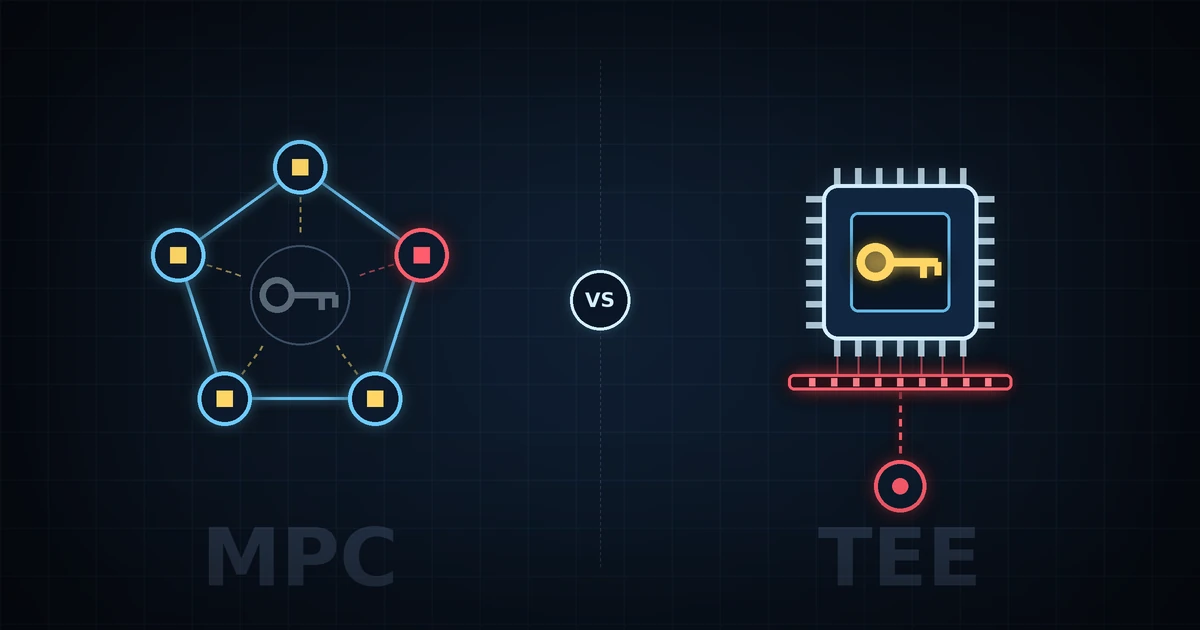
The MPC vs TEE decision for institutional custody gained operational relevance on September 14, 2026, when researchers disclosed DDRop, a DDR5 memory-interposer attack against Intel TDX, Intel Scalable SGX and AMD SEV-SNP. The interposer costs about $159, and on Intel TDX the researchers forged attestation reports carrying an attacker-chosen workload measurement.
The attack requires privileged host software plus one-time physical access, and no software patch closes the architectural gap, so custodians storing private keys in hardware enclaves carry a residual risk beyond the reach of firmware updates.
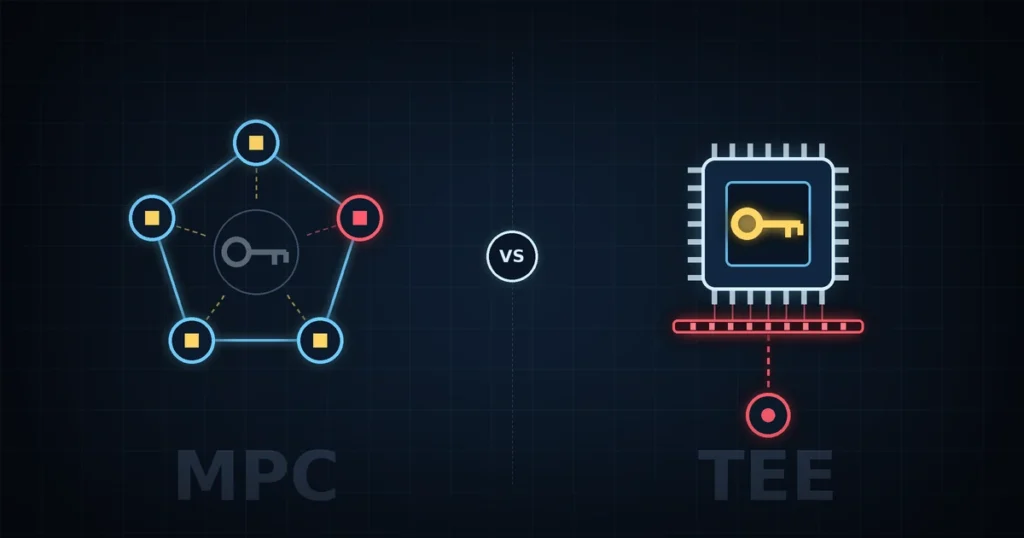
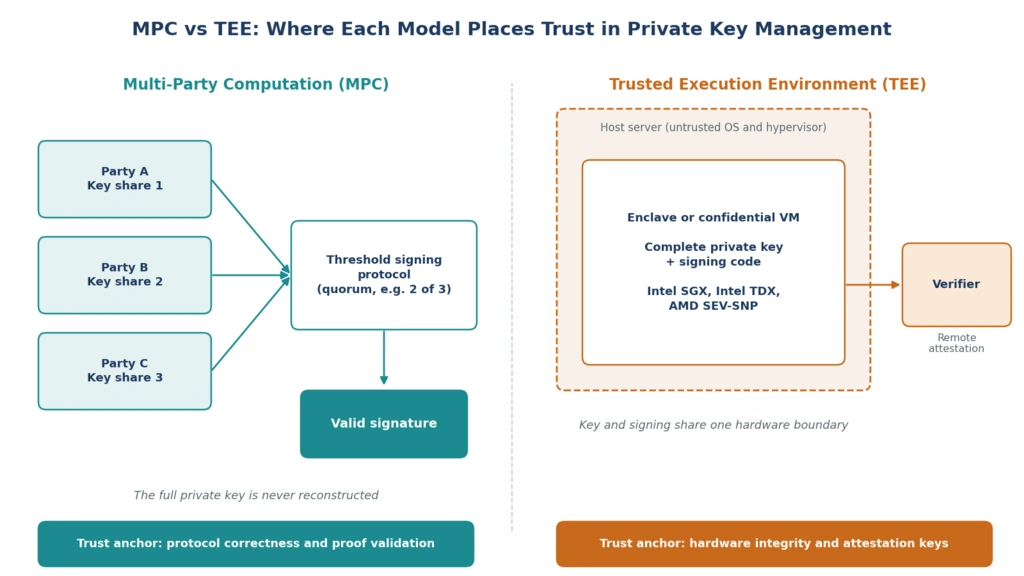
Multi-party computation (MPC) splits a private key into shares held by independent parties and never reconstructs the key, while a trusted execution environment (TEE) isolates key operations inside processor-protected memory. Each design places trust in a different layer: protocol correctness for MPC and hardware integrity for TEE. NIST addressed the first layer on January 20, 2026, when it published IR 8214C, its first call for multi-party threshold schemes, and the MPC vs TEE trade-off depends on evidence from both layers.
MPC vs TEE: Different Trust Models for Private Keys
An MPC wallet distributes control across independent parties through a threshold signature scheme (TSS), which produces a valid ECDSA or EdDSA signature when a quorum of shares participates, so the compromise of one server, one employee or one cloud account does not expose the key. Security rests on mathematical assumptions, on zero-knowledge proofs validating each party’s inputs, and on faithful protocol implementation.
A TEE keeps key handling inside a protected region of the processor, with Intel SGX isolating application enclaves while Intel TDX and AMD SEV-SNP protect entire confidential virtual machines. Memory encryption keeps the hypervisor and administrators away from plaintext, and remote attestation lets a verifier confirm code identity and hardware state before releasing secrets. Security rests on the hardware root of trust, microcode and the vendor’s attestation keys.
In the MPC vs TEE comparison, the two models fail in different ways: a flaw in an MPC protocol leaks key shares through network messages without physical access, while a flaw in a TEE usually requires privileged software or physical access but exposes every secret inside the boundary at once.
Disclosed Attacks Against Intel SGX, Intel TDX and AMD SEV-SNP
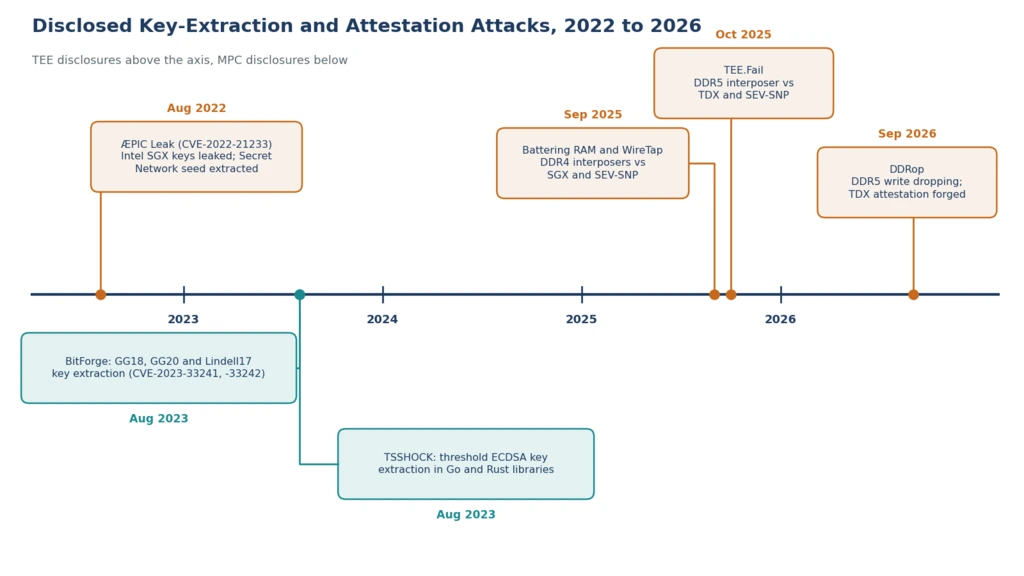
In the MPC vs TEE record, researchers have documented a consistent pattern against TEE-based key management, starting with ÆPIC Leak (CVE-2022-21233), which leaked AES keys, RSA keys and the SGX sealing key from enclaves on most 10th, 11th and 12th generation Intel CPUs, and which the SGX.Fail team extended to a Rocket Lake server to extract the consensus seed of Secret Network, an SGX-based blockchain.
In September 2025, Battering RAM from KU Leuven and the University of Birmingham used an interposer costing under $50 to bypass SGX and SEV-SNP memory protections, and WireTap from Georgia Tech and Purdue extracted an SGX attestation key from DDR4 systems with about $1,000 in equipment.
TEE.Fail followed on October 28, 2025, and extended the approach to DDR5, extracting keys from Intel TDX and AMD SEV-SNP with Ciphertext Hiding and forging attestation on fully updated machines. DDRop added an active technique in September 2026: the interposer drops DDR5 write commands, so the CPU reads stale encrypted data without detecting the rollback.
Intel and AMD answered the 2025 interposer disclosures by placing physical attacks outside their threat models, and Intel pointed to Total Memory Encryption Multi-Key (TME-MK) as additional protection on some Xeon processors. In the MPC vs TEE analysis, attestation forgery carries the highest consequence for custodians, because a forged quote lets an attacker obtain secrets from a verifier convinced the enclave is genuine.
Implementation Flaws in Threshold ECDSA Protocols
The MPC record includes BitForge, disclosed by Fireblocks researchers in August 2023, a set of vulnerabilities (CVE-2023-33241 and CVE-2023-33242) in GG18, GG20 and Lindell17 implementations used by more than 15 wallet providers, blockchains and open-source projects. Missing zero-knowledge proofs let an attacker controlling one party extract key shares, and the related paper describes attacks requiring between one signature and one million signatures, depending on the protocol and implementation.
Verichains presented TSSHOCK at Black Hat USA 2023 and reported key-extraction attacks against nearly all threshold ECDSA implementations it examined, including audited open-source libraries in Go and Rust, with full key extraction by a single malicious party in one or two signing ceremonies. Fordefi and Mysten Labs researchers found bugs in oblivious-transfer-based implementations of DKLs19 and DKLs23, which allowed key extraction by active and passive adversaries.
The failures sit in specification gaps and implementation deviations, in particular missing or incorrect proof validation, which makes audit depth and cryptographic expertise the controlling variables in the MPC vs TEE evaluation. Exposure rises when a counterparty, a client SDK or a compromised server joins the signing quorum, because every attack above requires participation in the protocol.
MPC vs TEE Risk Matrix for Institutional Custodians
The MPC vs TEE comparison for custodians separates into five risk dimensions, and attacker access comes first: MPC attacks run through protocol messages over a network, while TEE attacks disclosed in 2025 and 2026 need privileged host software and physical access to the server.
On blast radius, an MPC attacker needed between one and one million signatures to recover shares, so rate limits and abort monitoring constrain exposure, while a TEE compromise exposes every secret in the enclave, and ÆPIC Leak recovered an AES key in 1.35 seconds on average.
On remediation, MPC vs TEE outcomes diverge: cryptographic bugs receive patches and key share refresh, which rotates shares without changing the blockchain address, while deterministic memory encryption without integrity or freshness protection requires new processor designs.
On collusion and insider risk, MPC spreads control across administrators, organizations and jurisdictions, whereas a TEE concentrates the key in one physical host. On auditability, MPC protocols have published specifications open to cryptographic review, while TEE microcode and firmware remain under vendor control.
| Risk dimension | MPC | TEE |
|---|---|---|
| Attacker access | Protocol messages over a network. | Privileged host software plus physical access to the server. |
| Blast radius | Attacks needed between 1 and 1,000,000 signatures to recover shares, so rate limits and abort monitoring constrain exposure. | Compromise exposes every secret in the enclave at once. |
| Remediation | Cryptographic bugs receive patches and key share refresh. | Deterministic memory encryption without integrity or freshness protection requires new processor designs. |
| Collusion and insider risk | Control spread across administrators, organizations and jurisdictions. | Key concentrated in one physical host. |
| Auditability | Published specifications open to cryptographic review. | Microcode and firmware remain under vendor control. |
Hybrid Designs and Control Recommendations
Production custody platforms already combine both layers: Fireblocks stores MPC-CMP key shares inside Intel SGX enclaves across tier-1 cloud environments, and reported MPC-CMP avoided the BitForge vulnerabilities because it validates key material with zero-knowledge proofs. In the MPC vs TEE decision, the combination converts an enclave compromise into a partial event, because an attacker who extracts one enclave obtains one share while the signing threshold still protects the key.
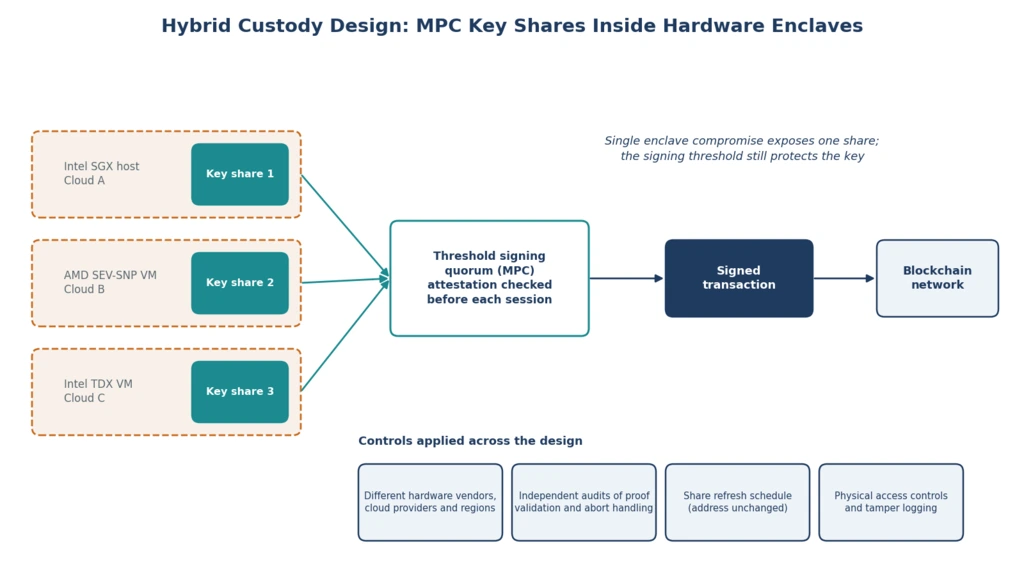
Custodians evaluating MPC vs TEE architectures can distribute shares across hardware vendors, cloud providers and regions so one processor flaw cannot expose a quorum, and can commission independent audits covering zero-knowledge proof validation, abort handling and parameter checks.
Controls for the TEE layer include verifying attestation against current vendor recovery status, adding physical access controls and tamper logging for hosts running enclaves, and enabling TME-MK or memory integrity features where processors support them.
Operations teams can schedule share refresh and track the NIST threshold program, which defines previews, packages and analysis phases for threshold signatures.
FAQ
What is the main difference between MPC and TEE for protecting private keys?
They place trust in different layers. MPC splits the key into shares held by independent parties and never reconstructs it, so its security rests on protocol correctness, mathematical assumptions and zero-knowledge proofs. A TEE keeps key operations inside processor-protected memory, so its security rests on the hardware root of trust, microcode and the vendor’s attestation keys.
Why does the DDRop attack matter for custodians using TEEs?
Disclosed on September 14, 2026, DDRop is a DDR5 memory-interposer attack against Intel TDX, Intel Scalable SGX and AMD SEV-SNP. The interposer costs about $159, and on Intel TDX the researchers forged attestation reports with an attacker-chosen workload measurement. The attack needs privileged host software plus one-time physical access. No software patch closes the architectural gap, so firmware updates cannot remove this residual risk.
Are MPC wallets also vulnerable to attacks?
Yes, but through implementation flaws rather than hardware. BitForge (August 2023) affected GG18, GG20 and Lindell17 implementations used by more than 15 providers and projects. TSSHOCK reported key-extraction attacks against nearly all the threshold ECDSA implementations it examined, and researchers also found bugs in DKLs19 and DKLs23 implementations. The common cause is missing or incorrect proof validation. Every one of these attacks requires participating in the signing protocol.
Can MPC and TEE be combined?
Yes, and some production platforms already do. Fireblocks stores MPC-CMP key shares inside Intel SGX enclaves across tier-1 cloud environments. An attacker who extracts one enclave obtains only one share, and the signing threshold still protects the key. That turns an enclave compromise into a partial event instead of a total one.

Isai Alexei is a journalist and financial analyst covering cryptocurrency markets and traditional securities for Blockchaindose. He has spent ten years analyzing digital assets, trading activity, and market structure.