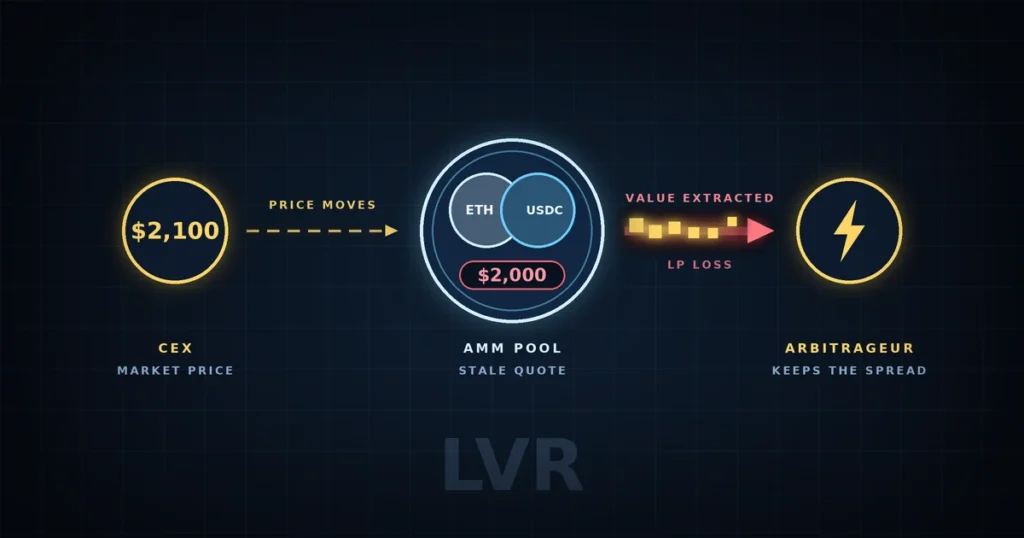

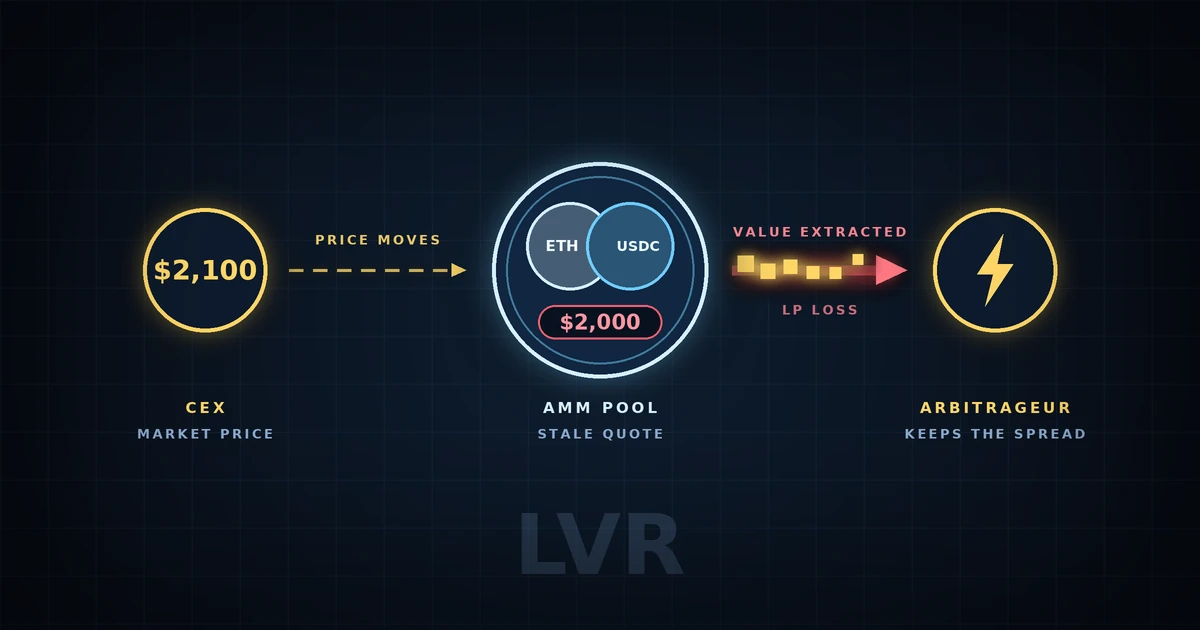
Loss-versus-rebalancing (LVR) measures the value arbitrageurs extract from liquidity providers in automated market makers (AMMs). Researchers at Columbia University, the University of Chicago and a16z crypto introduced loss-versus-rebalancing in 2022 as a running cost of passive liquidity provision.
Constant function AMMs like Uniswap quote prices from a formula, not from a live order book, and every external price move leaves the pool with a stale quote until a trader corrects it. Informed arbitrageurs correct the quote and keep the spread. Liquidity providers (LPs) absorb the loss, and trading fees must cover it before profit appears.
How Loss-Versus-Rebalancing Works
The LVR framework compares an LP position with a rebalancing strategy, a portfolio holding an equal amount of the risky asset as the pool but trading at centralized exchange prices. Whenever the pool sells an asset below the market price or buys it above, the rebalancing portfolio makes an identical trade at the better price.
The gap between both results is loss-versus-rebalancing. The standard decomposition sets LP profit equal to rebalancing profit, minus LVR, plus trading fee income.
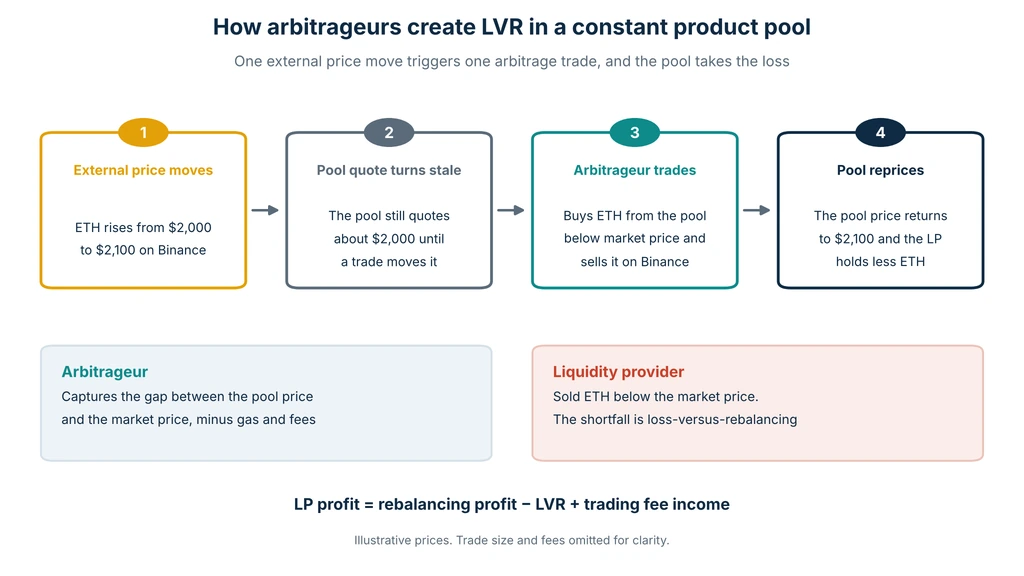
Loss-versus-rebalancing is non-negative and non-decreasing, and it depends on the price path, not only on the start and end prices. It stays at zero for flat prices and grows with each move. Predictability lets an LP hedge market exposure and treat LVR as the remaining running cost fees must cover.
The LVR Formula: Volatility Drives the Cost
For a constant product pool, instantaneous loss-versus-rebalancing equals σ²/8 of pool value per year, with σ as the annualized volatility of the risky asset. The result assumes continuous arbitrage and zero fees, and it works as an upper reference for pools with fees.
The general formula scales with squared volatility, squared price and marginal liquidity at the current price, which means concentrated liquidity ranges carry higher LVR per dollar of capital within the active price range.
An asset with 60% annualized volatility costs LPs 4.5% of pool value per year (0.36 divided by 8 equals 0.045). At 100% volatility the cost rises to 12.5%. Doubling volatility quadruples loss-versus-rebalancing, because the formula squares the input.
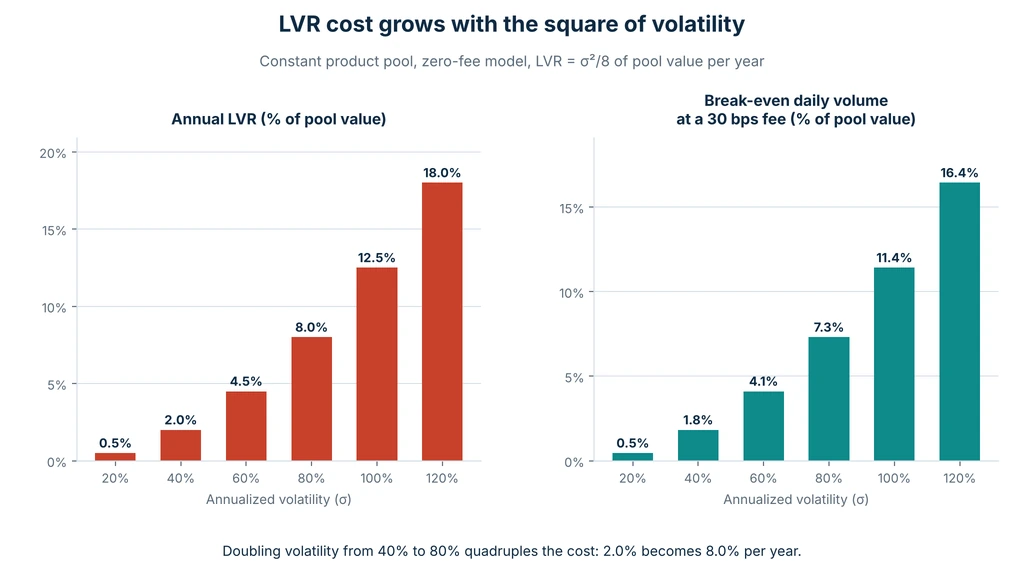
4.5%
Annual LVR at 60% volatility (0.36 ÷ 8)
12.5%
Annual LVR at 100% volatility (1.00 ÷ 8)
4.1%
Daily volume, as a share of pool value, needed to break even at 60% volatility.
Fee income offsets part of the cost, and a 30 basis point fee sets the break-even point: an LP breaks even when daily volume reaches about 4.1% of pool value at 60% volatility and about 11.4% at 100% volatility. Pools with lower daily turnover lose money for hedged LPs.
LVR vs Impermanent Loss: Different Benchmarks
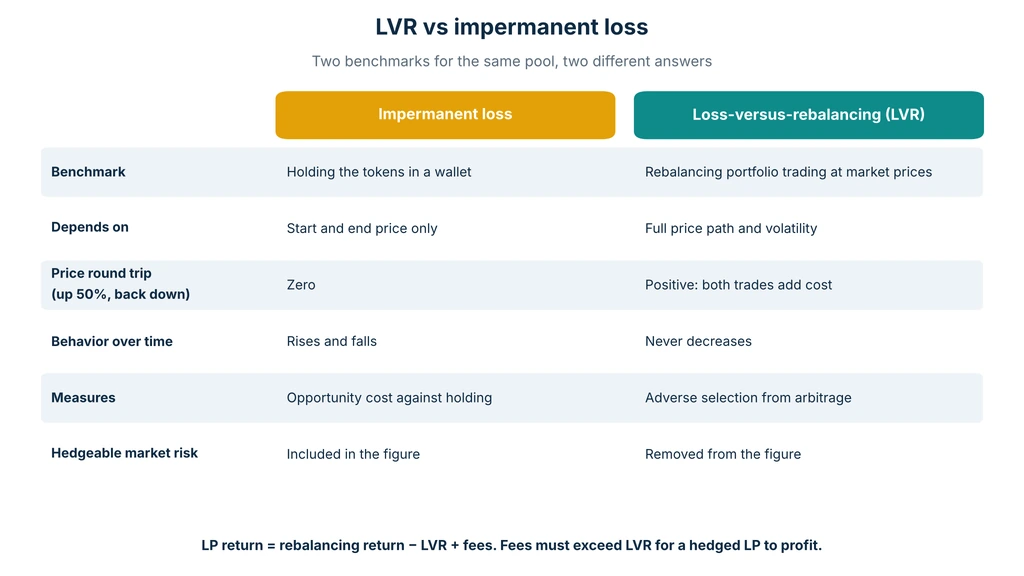
Impermanent loss compares an LP position with holding the tokens in a wallet, and it depends only on the starting and ending prices. If an asset rises 50% and falls back to its starting price, impermanent loss returns to zero, even though arbitrageurs traded against the pool on the way up and on the way down.
LVR records both trades as costs: the pool sold the asset below the market price during the rise and bought it above the market price during the decline, and each trade adds to cumulative LVR. The metric tracks adverse selection on every price move, and impermanent loss measures the gap to a buy-and-hold portfolio.
Reports built on loss-versus-rebalancing show whether trading fees cover adverse selection, and reports built on impermanent loss show only the opportunity cost against holding, which includes market exposure the LP could have hedged.
How Informed Arbitrageurs Extract Value From Order Flow
Price discovery for major assets happens on centralized exchanges like Binance, and a DEX pool learns a new price only when a trade moves it. Informed arbitrageurs watch the gap between both venues, buy the asset where it costs less, sell it where it pays more and settle in the pool’s block. The trade has two sides, and the arbitrageur’s profit equals the LP’s loss before gas costs.
Pools receive two types of order flow with opposite effects on LP returns. Uninformed traders swap for their own reasons and pay fees without knowing where the price is heading, and informed arbitrageurs trade only when the pool price is wrong and take value from the pool. LVR measures the cost of informed flow, and fees from uninformed flow offset it.
On Ethereum, competition for the arbitrage profit happens in the block-building pipeline. Ethereum documentation notes searchers pursuing competitive DEX arbitrage may pay 90% or more of revenue to validators as gas fees. Gas competition changes who captures loss-versus-rebalancing, not how much LPs lose.
An empirical study of the largest Uniswap pools found fees did not compensate arbitrage losses across many of the pools. Uniswap v2 pools outperformed their v3 counterparts for passive LPs, and shorter block times reduced arbitrage losses at a different rate for each trading pair.
Auction-Based AMMs Mitigate LVR
Auction-based AMMs sell the right to trade against stale prices and send the proceeds to LPs, which cuts loss-versus-rebalancing. Competition among bidders pushes bids toward the arbitrage profit, and LPs recover part of the value gas auctions send to block producers.
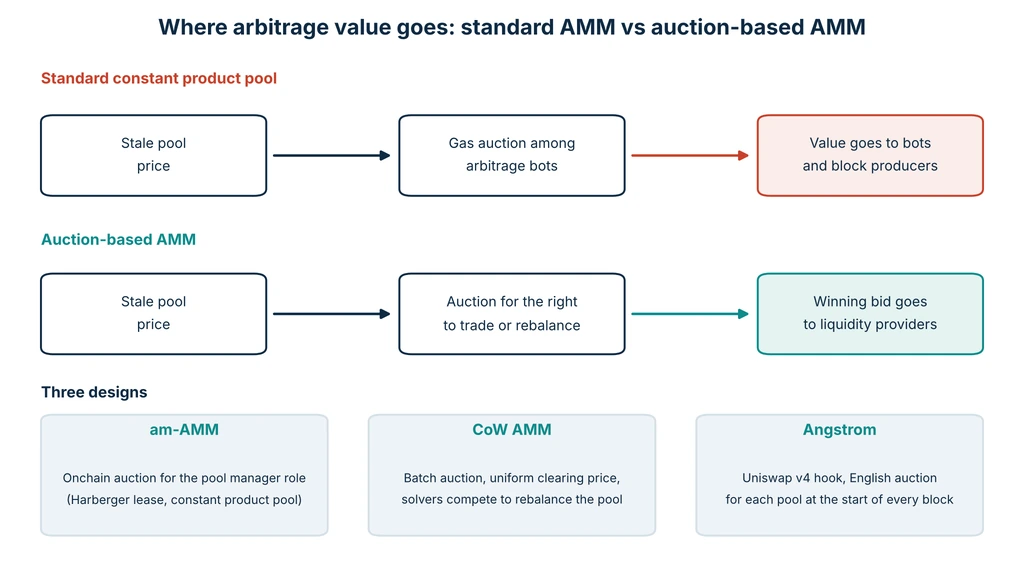
Uniswap Labs, Columbia University and Paradigm researchers published the auction-managed AMM (am-AMM) in 2024. The design runs an onchain auction for the pool manager role of a constant product pool. The winning bidder sets the swap fee, collects fee revenue and captures part of the arbitrage, and the benefits reach LPs as rent. Under the model’s assumptions, the pool attracts more liquidity than any fixed-fee pool in equilibrium.
Batch auctions take another route through the function-maximizing AMM (FM-AMM), which groups trades into a batch and settles every order at one uniform clearing price. Competition between arbitrageurs moves the pool to the equilibrium price, and the model eliminates loss-versus-rebalancing. CoW AMM implements the design on Balancer: solvers compete for the right to rebalance the pool, and the highest curve improvement wins.
Sorella Labs designed the Angstrom hook for Uniswap v4 to run an English auction for each pool at the start of every block, with staked validators enforcing the sequencing rules and winning bids returning to LPs. The hook system went live on January 30, 2025 and allows custom pool logic without changes to the Uniswap core contracts.
Each auction design adds operational dependencies: CoW AMM relies on a solver network, Angstrom on a validator set and am-AMM on bidders who value the manager role. CoW documentation states CoW AMM pools work best on volatile token pairs, where arbitrage outweighs LP fees.
What LPs Should Check Before Providing Liquidity
Estimate expected LVR from volatility before comparing yields: divide σ²/8 by 365 for the daily rate and compare the result with fee income at the pool’s volume ratio. Volatile pairs on constant product pools need high turnover to break even, and pools with auction-based rebalancing return part of the arbitrage profit to Lps. Track loss-versus-rebalancing next to fee yield and treat impermanent loss as a secondary figure.
How to estimate LVR before providing liquidity
- Get the volatility. Find the annualized volatility (σ) of the risky asset in the pair.
- Calculate annual LVR. Apply σ²/8 to pool value. At 60% volatility, 0.36 ÷ 8 equals 4.5% per year.
- Convert to a daily rate. Divide the result by 365.
- Compare with fee income. Multiply the pool’s daily volume ratio by the fee rate and check whether fees cover the daily LVR.
- Check turnover. Volatile pairs on constant product pools need high turnover to break even.
- Look for auction-based rebalancing. Pools with auction-based rebalancing return part of the arbitrage profit to LPs.
- Track the right metric. Follow LVR next to fee yield and treat impermanent loss as a secondary figure.
FAQ
What is the loss-versus-rebalancing formula for a constant product AMM?
Instantaneous LVR equals σ²/8 multiplied by pool value, with σ as annualized volatility. A pool holding $1 million in an asset with 80% volatility loses about $80,000 per year to arbitrageurs in the zero-fee model, since 0.64 divided by 8 equals 0.08.
Does loss-versus-rebalancing apply to concentrated liquidity pools?
Yes. The general formula scales with the pool’s marginal liquidity at the current price. A concentrated position in Uniswap v3 holds more liquidity per dollar inside its range, so LVR per dollar of capital rises while the price stays in range.
How can an LP measure realized LVR?
Take the pool’s on-chain trades and price each one at the centralized exchange price when it settled, usually from Binance. The sum of the differences between pool execution prices and market prices, weighted by trade size, gives realized LVR, which LPs compare with fee income.
Can hedging remove loss-versus-rebalancing?
Hedging removes market exposure, and LVR remains as the running cost of the hedged position. A hedged LP earns fee income minus LVR, so the position turns profitable only when fees exceed the adverse selection cost.
Is LVR a form of MEV?
Yes. DEX arbitrage counts as maximal extractable value, and LVR measures the arbitrage profit which comes out of LP positions. Auction-based AMMs like CoW AMM and Angstrom redirect part of the arbitrage MEV to LPs.

Isai Alexei is a journalist and financial analyst covering cryptocurrency markets and traditional securities for Blockchaindose. He has spent ten years analyzing digital assets, trading activity, and market structure.