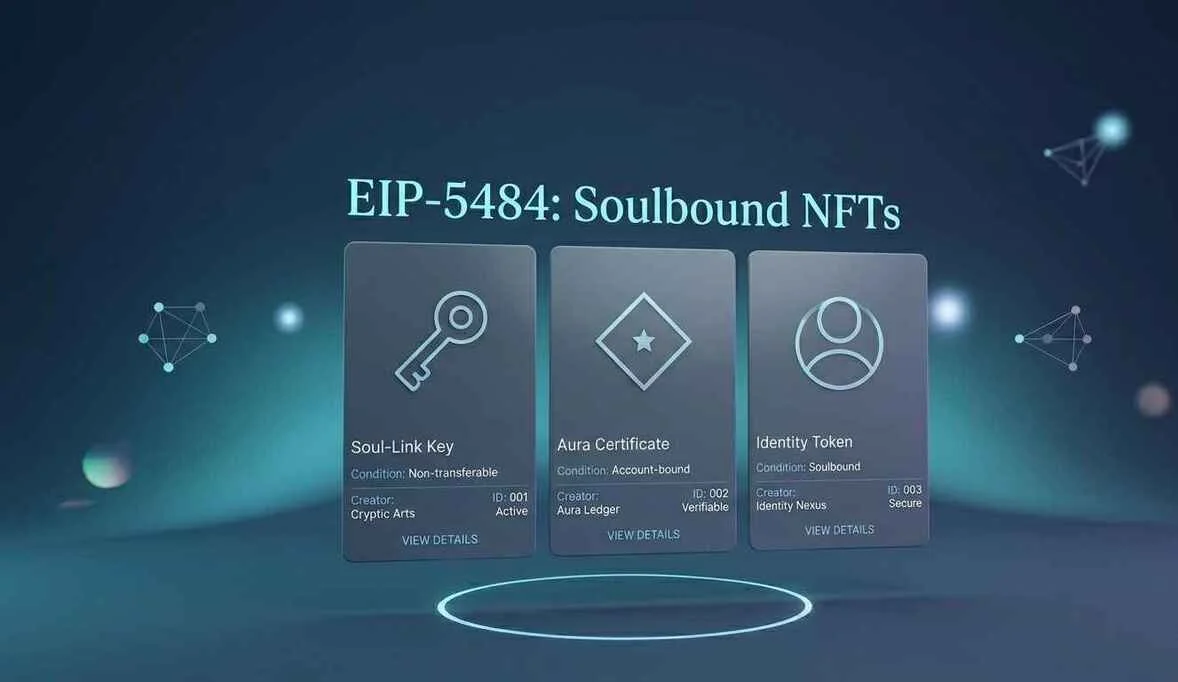
Traditional “soulbound” NFTs (non-transferable) were implemented by blocking the transferFrom function or reverting any movement. But this approach has a fundamental flaw: the token stays trapped forever in the same wallet, even if the user violates the terms of a service or the credential expires.
EIP-5484 introduces a much more flexible standard: conditional burning. Instead of merely preventing transfers, the contract can automatically destroy the token when a predefined condition is violated.
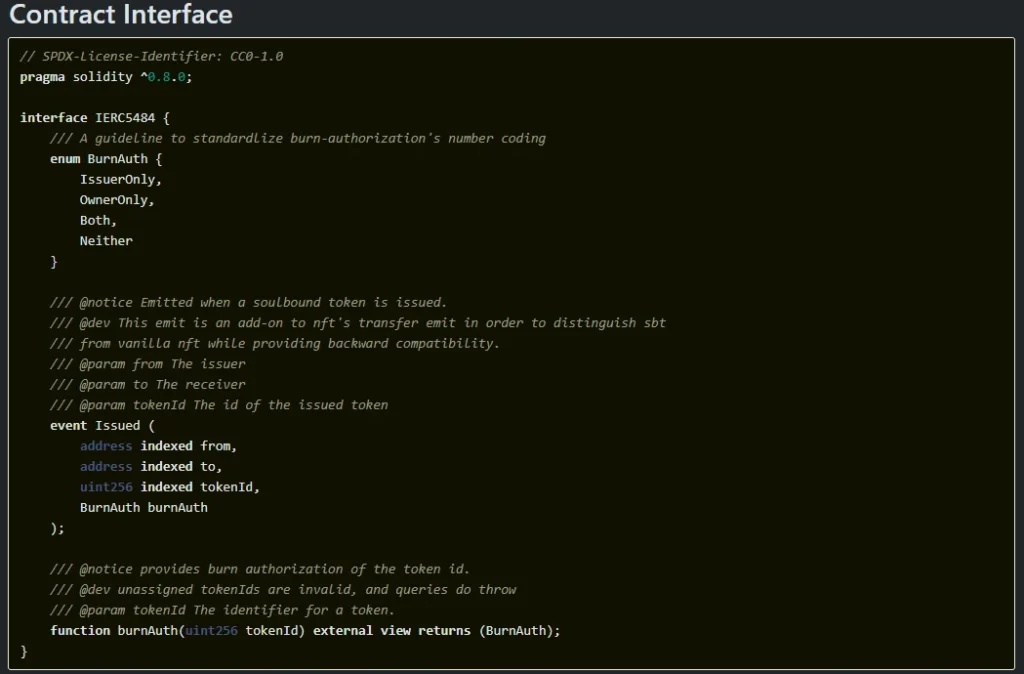
How does IConsumer work?
The core of the EIP is the IConsumer interface, which adds a new role: the consumer. Unlike the traditional owner, the consumer is an entity (another contract or an authorized EOA) that has the power to trigger burning if a condition is met.
The key function is:
function burnWithCondition(uint256 tokenId, bytes calldata data) external;
The consumer calls this function and passes data proving the violation (e.g., an expiration timestamp or a cryptographic proof of breach). The contract verifies the condition and, if valid, burns the token.
Additionally, EIP-5484 defines four burn modes using an enum:
- Not Burnable – can never be burned.
- Burnable by Owner – only the owner can burn.
- Burnable by Consumer – only the authorized consumer can burn.
- Burnable by Both – both can burn.
Differences from the Traditional Approach
| Aspect | Blocking transfers (classic soulbound) | Conditional burning (EIP-5484) |
| Token after violation | Still exists, useless, taking up storage | Disappears, frees storage |
| Value recovery | Impossible | Contract can re-mint a new token (e.g., re-enrollment) |
| Use cases | Permanent, fully trusted credentials | Expiring passes, dynamic membership rules, revocable reputation NFTs |
The distinction is important because traditional soulbound NFTs only prevent movement, while conditional burning allows the asset to reflect changes in status automatically. Instead of leaving obsolete credentials inside wallets forever, the contract can remove them when they no longer represent a valid state.
Practical Example
Imagine an NFT that grants access to a Discord server as long as you pay a monthly subscription. With the classic approach, if you stop paying, you can only block access off-chain, but the NFT remains in your wallet.
With EIP-5484, a consumer contract (the payment system) detects the missed payment and automatically burns the NFT. The user can no longer even show the token as proof of anything.
This creates a much stronger connection between the real-world service agreement and the on-chain credential, ensuring that the NFT accurately reflects the user’s current status.
Why Does It Matter for Developers?
Burning frees storage slots, potentially generating a partial gas refund while preventing unnecessary accumulation of expired tokens. The code executes the penalty automatically, without intermediaries, reducing reliance on off-chain enforcement mechanisms and manual intervention. The proposal extends the ERC-721 standard without breaking compatibility with existing wallets, marketplaces, and developer tools.
Expanded use cases
The standard is particularly useful for:
- Reputation systems
- Temporary memberships
- Subscription-based access
- Revocable credentials
- Dynamic loyalty programs
- Service-linked NFTs
These applications require more flexibility than traditional non-transferable NFTs can provide.
If you’re building reputation systems, temporary memberships, or any NFT tied to a service contract, EIP-5484 is far more powerful than simply blocking transfers. It doesn’t just immobilize the token — it makes it disappear when it should.
By introducing conditional burning, the proposal transforms soulbound NFTs from static credentials into programmable, self-enforcing digital assets capable of adapting to changing conditions.
Note: This is still a draft standard (not finalized), but reference implementations already exist in OpenZeppelin forks and projects like RevocableNFT, making EIP-5484 one of the most interesting developments in the evolution of on-chain identity, memberships, and revocable digital credentials.

Isai Alexei is a journalist and financial analyst covering cryptocurrency markets and traditional securities for Blockchaindose. He has spent ten years analyzing digital assets, trading activity, and market structure.