Wallet merging in crypto represents a counterintuitive strategy—one that Adam Weitsman demonstrated on June 20, 2026, when he consolidated four separate cryptocurrency wallets into a single address. His decision occurred mere hours before the NormiesART community snapshot, a moment that would determine allocation for the Zombie NFT collection.
In the NFT world, collectors usually do the opposite. They split their holdings across many wallets. They do this to get more rare mints and airdrops. Weitsman chose to reduce his share instead. His decision highlights a growing debate about fairness and decentralization in Web3.
Wallet Merging and the Sybil Attack Problem
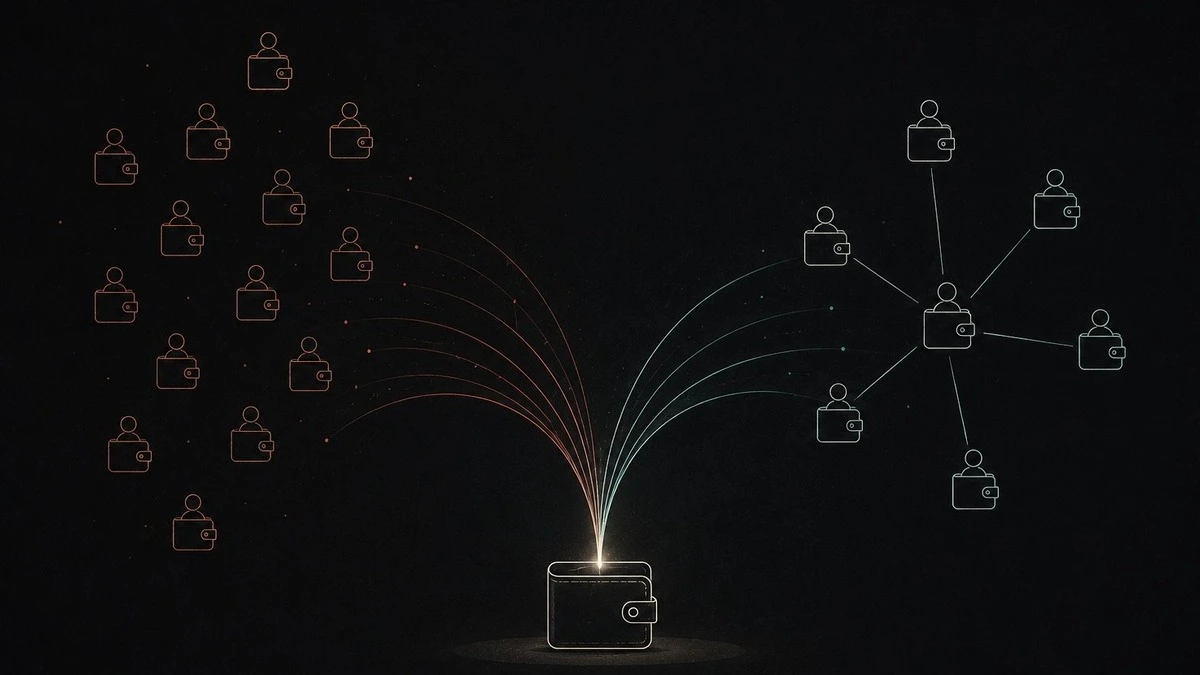
His wallet merging directly confronts a major issue in crypto. Many users employ “sybil attacks.” They create dozens or hundreds of wallets. Their goal is to trick smart contracts into giving them more tokens. This practice harms regular collectors. It concentrates power in the hands of a few.
Weitsman did the exact opposite. By merging, he reduced his share from 4 to 1. This frees up three additional slots for other holders. Consequently, the final distribution of the 21 Zombies becomes fairer. More people can participate in the project’s history.
Wider distribution prevents price manipulation. It reduces the risk of a single whale dumping their holdings. Stable, diversified communities usually retain higher values over time. Therefore, his move benefits everyone in the ecosystem.
The Announcement That Caught Everyone’s Attention
Weitsman shared his plan on X (formerly Twitter). He wrote:
“I’m very excited for the Zombie claim from @normiesART tomorrow. I previously had my canvases spread across 4 different wallets and would technically qualify for 4 Zombies. I don’t think it’s fair to deprive others of a chance to get one so I am merging the 4 into my…”
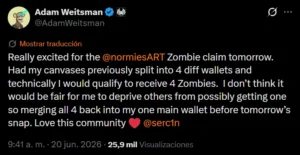
His statement quickly went viral. Many praised his honesty. However, some questioned his motives. They wondered if this was just a public relations move. But his track record suggests otherwise. He has consistently supported the NormiesART project since its early days.
Why the Zombie Collection Matters So Much
NormiesART launched in early 2026. The artist Serc, who is of Turkish-German origin, created it. The base collection includes 10,000 on-chain profile pictures. These images are monochromatic but highly customizable.
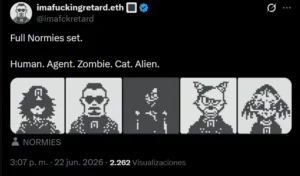
However, the real excitement surrounds the Zombie NFTs. Only 21 will ever exist. This extreme scarcity makes them incredibly valuable. For context, only 9 CryptoPunks Aliens exist globally. Those pieces sell for millions of dollars each. Consequently, the Zombie drop creates massive demand within the community.
But NormiesART offers more than just scarcity. Users can burn their base NFTs to earn additional art pieces. They then add these pieces to their digital canvases. Furthermore, the project has an open API. This allows artists to create hundreds of custom works. As a result, the ecosystem feels dynamic and community-driven.
Who Exactly Is Adam Weitsman?
Weitsman is not an average collector. He brings real-world experience and credibility to the table. For example, he purchased 229 Meebits in a single private transaction in 2025. That deal marked the largest known Meebits purchase ever. Additionally, he bought 5,000 Otherside metaverse NFTs a few months earlier. These deals prove he understands the market deeply.
His involvement with NormiesART goes far beyond holding tokens. In March 2026, he acquired 300 Normies in an over-the-counter deal. The founder Serc facilitated that transaction directly. After that, Weitsman burned 50 of his Normies. He collaborated with artist A.C.K. to create a custom masterpiece.
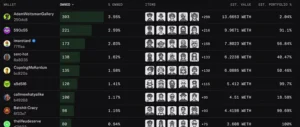
Earlier this June, he announced even bolder plans. He intends to burn his entire Normies collection, worth nearly $300,000. He will use those burns to create four pixelated artworks with global artists.
Because of these actions, Weitsman demonstrates genuine commitment. He is not just flipping assets for profit. Instead, he actively participates in the creative process. This level of involvement boosts his trustworthiness and expertise.
Wallet Merging Effect on the NFT Market
Initial reactions on social media remain largely positive. Many see this as a much-needed example of “fair play.” The NFT space often feels cutthroat and greedy. Weitsman’s gesture offers a refreshing alternative.
However, we must view this in context. He still holds one Zombie. That single piece places him among an elite group of 21 holders. So he retains significant influence. Still, his voluntary restraint sets a powerful precedent. Other whales might now think twice before hoarding allocations.
For NormiesART, this moment provides excellent publicity. The project gains credibility. New collectors may feel safer joining. They see that the community prioritizes equity. This positive sentiment could attract more artists and developers to the platform.
Adam Weitsman merged his wallets for one clear reason
He wanted to be fair. He gave up three ultra-rare Zombie NFTs to protect the community’s integrity. In a space driven by hype and speculation, this gesture stands out. It proves that decentralization involves ethics, not just technology.
The snapshot for the 21 Zombies has already occurred. Thanks to Weitsman, three extra community members will now join the club.
But morally, it sends a powerful message. As Web3 evolves, we need more leaders who prioritize people over profits. Weitsman just showed us how that looks in practice.
Isai Alexei is a journalist and financial analyst covering cryptocurrency markets and traditional securities for Blockchaindose. He has spent ten years analyzing digital assets, trading activity, and market structure.