Oasis Network blockchain was one of the earliest privacy blockchains to bet on hardware-based confidentiality rather than pure cryptography, and it’s still home to the only production-ready confidential EVM in the industry. Founded by a UC Berkeley security professor in 2018, Oasis has spent years building toward a simple pitch: privacy that developers can add to ordinary Solidity contracts, not a separate, hard-to-use privacy language.
Key Takeaways
- Oasis Labs was founded in 2018 by Dr. Dawn Song, and Oasis Network’s mainnet launched in 2020, backed by a $45 million round that included a16z crypto’s first-ever investment.
- Sapphire, launched in 2023, remains the only production-ready confidential EVM ParaTime in the industry as of 2026, running Solidity contracts inside Intel SGX secure enclaves.
- ROFL (Runtime Offchain Logic), launched in 2024, extends Oasis’s confidential computing to off-chain AI agents and verifiable machine learning workloads.
- ROSE traded around $0.0053 with a roughly $42 million market cap in July 2026 – down more than 99% from its 2021 all-time high of $0.593.
- Oasis relies on Intel SGX trusted execution environments, the same broad category of hardware-based privacy technology used by Secret Network, and shares the structural security tradeoffs that come with trusting chip hardware over pure cryptography.
This guide explains how Oasis Network’s ParaTime architecture and confidential EVM actually work, compares its TEE-based approach to zero-knowledge alternatives, looks honestly at real community concerns about its partnerships and token price, and closes with where the project stands in 2026.
What Is Oasis Network Blockchain?
Oasis Network blockchain is a Layer 1 built to separate consensus from execution, so that privacy-preserving computation can run without slowing down the base chain. It was developed by Oasis Labs, founded in 2018 by Dr. Dawn Song, a UC Berkeley computer security professor and MacArthur Fellow, after the company raised $45 million in a round that included a16z crypto’s first-ever investment alongside Pantera and Polychain Capital. Oasis Network’s mainnet went live in 2020, the same year the project announced an early partnership with BMW to test differential privacy techniques on internal data.
In 2022, Oasis Labs separately partnered with Meta on a tool to assess fairness in Meta’s products while keeping individual survey responses confidential from both Meta and the third party running the assessment. The full breakdown of how Oasis actually delivers this kind of privacy – through its ParaTime architecture and Sapphire’s confidential EVM – follows in the next section.
How Oasis Network’s ParaTime Architecture Works
Oasis splits its blockchain into two layers: a Consensus Layer that handles agreement on transaction ordering and validity, and multiple parallel execution environments called ParaTimes that each specialize in a different workload. This separation means a slow or congested ParaTime doesn’t drag down the whole network, since each one scales independently.
The flagship ParaTime is Sapphire, a fully EVM-compatible environment that runs ordinary smart contracts written in Solidity inside Intel SGX secure enclaves, encrypting calldata and contract state so that even node operators can’t read them. A companion ParaTime, Emerald, offers standard (non-confidential) EVM compatibility for developers who don’t need privacy but still want Oasis’s low fees.
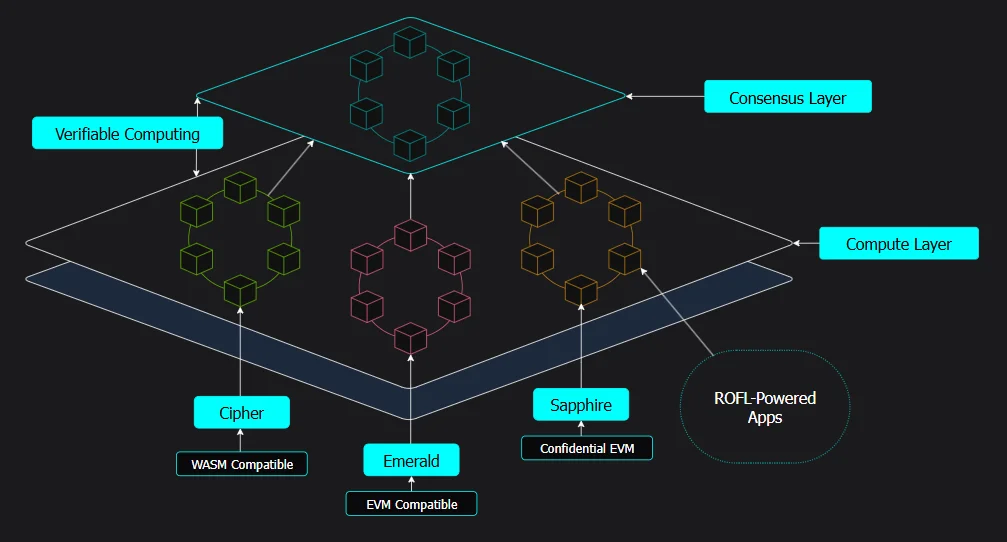
In 2024, Oasis extended this model off-chain with ROFL (Runtime Offchain Logic), a framework for AI agents and off-chain compute that still produces verifiable, TEE-backed proofs of correct execution – aimed at use cases like autonomous trading agents and private AI model training.
Developers who don’t want to migrate their entire application to Oasis can instead use the Oasis Privacy Layer (OPL), which lets an existing dApp on another EVM chain selectively route specific confidential operations through Sapphire while keeping the rest of the application where it already lives.
Oasis vs Other Privacy Blockchains
Oasis is part of a small group of privacy-focused crypto projects that take fundamentally different technical approaches to the same problem. Secret Network also uses TEEs (Intel SGX specifically) but runs on the Cosmos SDK with its own “secret contract” model rather than full EVM compatibility. Zero-knowledge chains like Zcash, Aztec, and Namada rely on cryptographic proofs instead of trusted hardware, avoiding the need to trust a chipmaker but generally at higher computational cost. Monero shields only its own native asset using ring signatures, with no smart-contract layer at all.
The TEE Security Debate
The community’s technical debate on Oasis has long centered on the same dilemma faced, in general, by TEE-based blockchains: Intel’s SGX enclaves have had multiple disclosed vulnerabilities over the years, and critics argue that hardware trust is a weaker foundation than pure cryptography, however inconvenient cryptography is by comparison.
This isn’t a hypothetical concern specific to Oasis – it’s the same category of risk that materialized when researchers demonstrated the TEE.fail attack against SGX-based systems in 2025, extracting secrets from other TEE-reliant blockchain infrastructure. Proponents counter that TEEs are available and performant today, while equivalent general-purpose zero-knowledge computation is still comparatively slow and expensive to run at scale.
Known Challenges: Partnerships, Price, and Community Confidence
What Happened to the BMW, Meta, and Google Cloud Partnerships?
A recurring community question is what became of Oasis’s early corporate partnerships. The BMW collaboration and Meta fairness-assessment project were real, but both were scoped as time-limited research pilots rather than ongoing commercial products, and neither company has publicized updates in recent years. A separate integration with Google Cloud’s confidential computing product was also announced for Oasis’s Parcel data-management tool.
Community members have reasonably pointed out that these partnerships get cited in marketing materials without corresponding evidence of continued, active collaboration – a fair criticism, though it’s also common for corporate R&D pilots projects in the field of emerging technologies to be quietly shut down without any official announcement.
Token Price and Circulating Supply
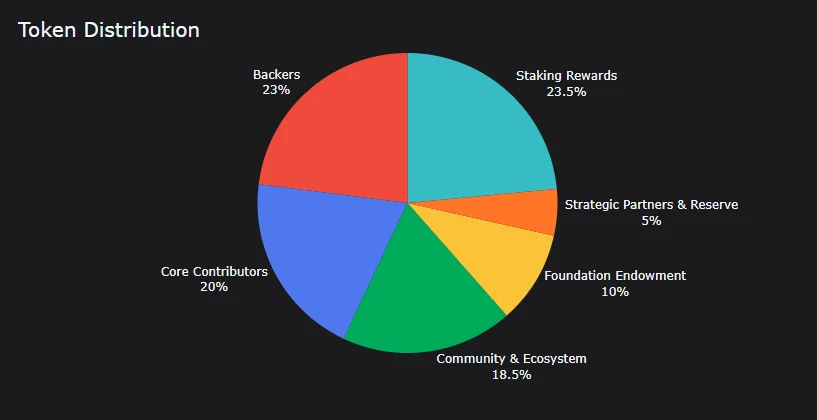
ROSE reached an all-time high of $0.593 in 2021 before falling more than 99% to trade around $0.0053, with a market cap of roughly $42 million as of late July 2026. The community’s initial concerns that a large portion of the ROSE supply would remain locked have subsided somewhat over time: circulating supply now sits at roughly 78% of the 10 billion token maximum, though the remaining unlock schedule is still worth checking directly before making any decisions based on scarcity.
Is Development Still Active?
Direct community skepticism, including a widely discussed “is Oasis dead?” thread pointing to quiet Discord dev channels and unclear partnership follow-through, has been met with pushback from the Oasis team itself, which points to its own hackathon programs (including multiple editions of the Privacy4Web3 hackathon), an active developer grants program, and regular GitHub commits across dozens of repositories as evidence of continued work.
Both things can be true at once: public-facing hype has clearly cooled since 2021-2022, while underlying development activity, judged by grants distributed and code shipped, has continued at a steadier pace than casual observers scrolling Discord might assume.
Is Oasis Network Worth Watching in 2026?
Oasis Network’s main selling point remains valid, even if its price has not: Sapphire is still the only privacy-preserving EVM in production that Ethereum-style developers can access, and ROFL puts the project in a fairly favorable position given the current interest in privacy-preserving, verifiable AI agents. Its team has stayed active on infrastructure even through a prolonged token price decline, which says something about commitment independent of speculation.
At the same time, the gap between Oasis’s headline corporate partnerships and their current real-world activity is worth taking seriously, and its reliance on TEE hardware carries the same structural risk profile as any other SGX-based system. Whether ROFL’s bet on AI-native confidential compute reverses years of price decline, or Oasis remains a technically credible but commercially under-recognized project, will likely depend on whether real applications – not just grants and hackathons – start running meaningful volume through Sapphire and ROFL.
FAQ
Is Oasis Network the same as Secret Network?
No. Both use Intel SGX trusted execution environments for privacy, but Secret Network runs on the Cosmos SDK with its own secret-contract model, while Oasis offers full EVM compatibility through Sapphire, letting developers deploy ordinary Solidity contracts with confidentiality built in.
What happened to Oasis’s BMW and Meta partnerships?
They were real but scoped as time-limited research collaborations: a 2020 differential-privacy pilot with BMW and a 2022 fairness-assessment tool with Meta. Neither company has publicized significant recent updates, which is a fair point of community skepticism, though not unusual for corporate R&D pilots in emerging technology.
Is Oasis Network’s TEE technology secure?
It carries the same tradeoffs as any Intel SGX-based system: enclaves have had multiple disclosed hardware vulnerabilities over the years, meaning security ultimately depends partly on trusting Intel’s chip design rather than on cryptography alone. This is a known, structural limitation of TEE-based privacy generally, not an issue unique to Oasis.
Why has ROSE’s price fallen so much since 2021?
ROSE is down more than 99% from its 2021 all-time high of $0.593, trading around $0.0053 as of July 2026. This reflects the broader multi-year decline across most small and mid-cap altcoins since the 2021 cycle peak, rather than any single Oasis-specific event.
What is ROFL?
ROFL (Runtime Offchain Logic) is Oasis’s framework for confidential, verifiable off-chain computation, launched in 2024. It’s designed for AI agents and machine learning workloads that need to prove they ran correctly without exposing the underlying data or model.
Is Oasis Network still being developed?
Yes. Despite community concerns about quiet public channels, the Oasis Foundation continues to run developer grants and hackathons and maintains active GitHub repositories for Sapphire, ROFL, and its core SDK, even though public hype has cooled significantly since 2021-2022.

Isai Alexei is a journalist and financial analyst covering cryptocurrency markets and traditional securities for Blockchaindose. He has spent ten years analyzing digital assets, trading activity, and market structure.