

Zama is trying to solve blockchain privacy differently than any single chain can: instead of building a new network, it places the core problem behind privacy-focused crypto projects – data confidentiality – into a layer that plugs into chains people already use. Its tool is Fully Homomorphic Encryption (FHE), letting smart contracts compute directly on encrypted numbers without ever decrypting them, even for the nodes running the network.
Key Takeaways
- Zama’s Confidential Blockchain Protocol went live on Ethereum mainnet December 30, 2025, completing the first confidential stablecoin (cUSDT) transfer using FHE.
- The company behind it has raised over $150 million at a $1.2 billion valuation from investors including Multicoin Capital, Pantera, and protocol founders like Gavin Wood and Anatoly Yakovenko.
- Its January 2026 token auction raised roughly $118-121 million, was oversubscribed more than 200%, and cleared at $0.05 per ZAMA token, ahead of a February 2, 2026 token generation event.
- Total ZAMA supply is 11 billion tokens, with only 20% circulating at launch and the rest locked for one to four years across team, VC, and treasury allocations.
- The protocol currently processes around 20 encrypted transactions per second on standard CPUs, with a roadmap targeting 500-1,000 TPS via GPUs by the end of 2026.
The guide explains how Zama´s Fully Homomorphic Encryption protocol works, what makes it different from zero-knowledge or hardware-based privacy approaches, walks through community skepticism about performance and corporate incentives, and closes with an assessment of where the project stands after its token launch.
What Is Zama Blockchain?
Zama blockchain is not itself a Layer-1 or Layer-2 – it’s a cross-chain confidentiality protocol that sits on top of existing blockchains like Ethereum, letting developers deploy confidential smart contracts without asking users to bridge to a separate network. Its mainnet went live on Ethereum on December 30, 2025, marked by the first confidential transfer of a stablecoin (cUSDT) using the protocol’s Fully Homomorphic Encryption technology.
The company behind the protocol, also called Zama, was founded in 2020 by cryptographers Dr. Rand Hindi and Dr. Pascal Paillier, and has raised over $150 million at a $1.2 billion valuation from investors including Multicoin Capital, Pantera, and individual backers such as Ethereum co-founder Gavin Wood and Solana co-founder Anatoly Yakovenko.
Following mainnet launch, Zama ran a public token auction in January 2026 that raised roughly $118-121 million, before the ZAMA token itself began trading on February 2, 2026. The full detail on how the underlying encryption technology works follows in the next section.
How Zama’s Fully Homomorphic Encryption Protocol Works
Fully Homomorphic Encryption (FHE) lets a computer perform calculations directly on encrypted data and get an encrypted result, without ever decrypting the underlying numbers at any point. It’s long been considered cryptography’s “holy grail” precisely because, unlike most privacy techniques, it doesn’t require trusting specialized hardware or limiting what kind of computation is possible.
Since Ethereum and other chains can’t run FHE computations natively, Zama’s protocol uses a design it calls symbolic execution: a contract calling an FHE operation on the host chain doesn’t actually run the encrypted math there – it emits a pointer and an event, and a network of Coprocessors does the real computation off-chain, publishing results that anyone can independently re-verify.
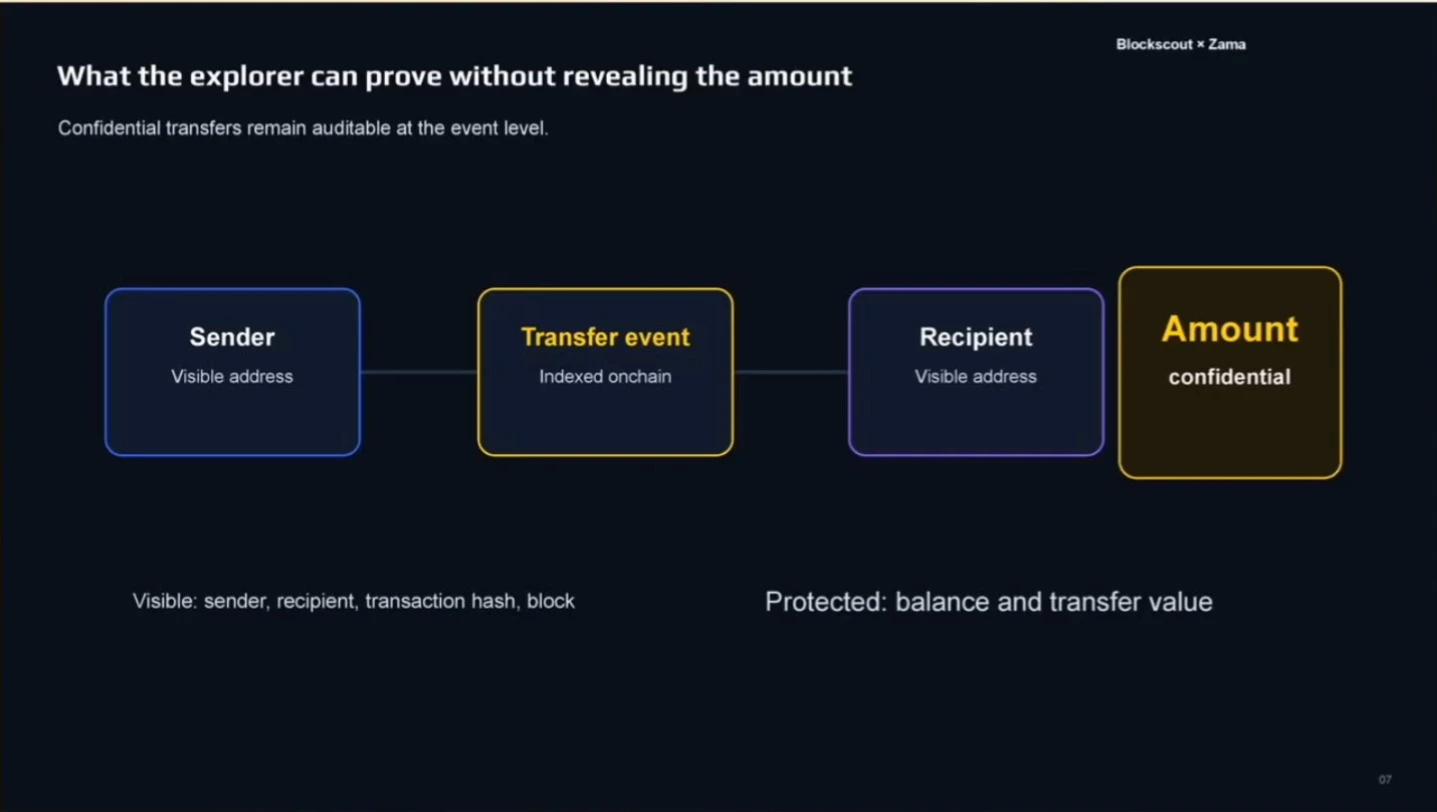
Decryption works separately, through threshold decryption: the private key needed to decrypt any value is split across a Key Management Service made up of multiple independent operators, so no single party ever holds the whole key, and every decryption request has to be explicitly authorized by the smart contract that produced the encrypted value in the first place.
Developers write confidential contracts using ordinary smart contracts in Solidity via Zama’s FHEVM library, rather than learning a specialized privacy-specific language – a deliberate design choice meant to lower the barrier for existing Ethereum developers.
Zama vs Other Privacy Approaches (TEE, ZK, MPC)
Zama’s own comparison of confidentiality approaches, published in its litepaper, positions FHE as the only technique that is simultaneously secure, decentralized, publicly verifiable, and composable with other contracts, without needing specialized trusted hardware the way TEE-based chains like Secret Network do. Speed has been FHE’s historical tradeoff. FHE computation costs more compute than a hardware enclave or a zero-knowledge proof. Zama’s performance roadmap references GPUs and, later, dedicated ASIC chips.
Zama does not claim CPU-based FHE alone will reach payment-network throughput. Comparison comes from Zama’s own publications. Independent benchmarks against live TEE and ZK systems in production are still a matter wider industry has yet to establish.
|
Approach |
Example Project |
Needs Trusted Hardware |
General Computation |
|
FHE |
Zama Protocol |
No |
Yes |
|
TEE |
Secret Network |
Yes (Intel SGX) |
Yes, within secret contracts |
|
ZK-SNARKs |
Zcash, Aztec, Namada |
No |
Varies by project |
|
Ring signatures |
Monero |
No |
No |
Because the protocol is chain-agnostic rather than tied to one network, Zama also frames itself as interoperability infrastructure: the same encrypted asset can, in principle, transfer between Ethereum, other EVM-compatible chains, and eventually Solana, while staying encrypted the entire time, rather than being re-shielded separately on each destination chain.
Known Challenges and Community Skepticism
Is FHE Fast Enough Yet?
Performance skepticism has followed FHE for years, and for good reason: fully homomorphic encryption was, until recently, notoriously slow compared to other cryptographic privacy techniques. Community members who worked with FHE research a few years ago describe it as slow then, though most agree underlying algorithms keep improving.
Zama’s own numbers illustrate both the progress and the remaining gap: the protocol currently handles roughly 20 transactions per second on standard CPU hardware, with a roadmap targeting 500 to 1,000 TPS once GPU-based coprocessors roll out later in 2026, and a further jump to over 100,000 TPS per chain planned for dedicated hardware accelerators arriving in 2027-2028. Until those hardware upgrades actually ship in production, the performance case for FHE at global payment scale remains a roadmap claim rather than a proven result.

Do Data-Hungry Companies Have an Incentive to Adopt This?
A separate strand of doubt has less to do with the cryptography and more to do with incentives: some privacy-focused commenters have pointed out that companies whose business models depend on analyzing user data have little commercial reason to adopt encryption that would prevent them from ever seeing that data, even where the technology to do so exists and works well.
Others have raised the opposite concern – that end-to-end encrypted computation, if adopted by large platforms, could make it harder to audit what a black-box service is actually doing with user data internally, since even the operator running the code couldn’t inspect the underlying values.
Skepticism Toward Funding-Driven Privacy Projects
Some early reaction to Zama’s public announcements was simple pattern‑matching doubt: seeing a well‑funded startup with a “.ai” domain announce plans to encrypt “the internet” end‑to‑end struck some commenters as marketing language rather than a credible technical roadmap, regardless of underlying cryptography’s merit. Such doubt is not a rebuttal of FHE as a technique, but a reasonable reminder that a strong research pedigree and heavy VC backing don’t by themselves guarantee real‑world adoption.
Zama’s Governance and Token Model
The Zama Protocol runs on Delegated Proof-of-Stake, secured at genesis by 18 named operators – 5 running FHE Coprocessor nodes and 13 running Key Management Service nodes – selected initially based on reputation and existing infrastructure experience rather than an open permissionless process. Over time, the protocol plans to let any operator qualify by proving reliable testnet performance and staking at least 0.5% of circulating ZAMA supply.
ZAMA token economics follow a burn-and-mint model: every protocol fee, for verifying encrypted inputs, decrypting values, or bridging ciphertexts between chains, is paid in ZAMA and burned, while new tokens are minted on a roughly 5% annual inflation schedule to reward operators who accept staking delegations that secure the network.
|
Allocation Group |
Share of Supply |
Lockup |
|
Public Sale |
12% |
No lockup |
|
Treasury |
20% |
2 years |
|
Team |
20% |
4 years, 1-year cliff |
|
VCs |
20% |
2 years, 1-year cliff |
|
Angels |
10% |
2 years, 1-year cliff |
|
Growth |
10% |
4 years |
|
TGE Campaigns + Liquidity |
8% |
No lockup |
Is Zama Worth Watching in 2026?
Zama blockchain technology arrives with a distinctive pitch: rather than asking users to trust specialized hardware or move to a new chain entirely, it offers a mathematically grounded way to compute on encrypted data across whatever chain a developer already builds on. Its team’s cryptography pedigree, scale of its funding, and a mainnet launch backed by a real confidential stablecoin transfer are especially strong signals for a project at such an early stage.
At the same time, FHE’s core limitation, computational cost, hasn’t disappeared; it’s been pushed down a roadmap that depends on GPU and eventual ASIC hardware that doesn’t exist in production yet. Whether Zama becomes a default confidentiality layer for Ethereum and other platforms, or one of several competing FHE and privacy approaches, including rivals like Fhenix, will likely come down to how quickly hardware roadmap actually ships, not just how well‑designed cryptography is on paper.
FAQ
Is Zama a blockchain?
Not exactly. Zama is a cross-chain confidentiality protocol that sits on top of existing blockchains like Ethereum, rather than a standalone Layer-1 or Layer-2 network with its own independent consensus.
What is Fully Homomorphic Encryption (FHE)?
FHE is a cryptographic technique that lets a computer perform calculations directly on encrypted data and produce an encrypted result, without ever needing to decrypt the underlying values during the computation itself.
When did the ZAMA token launch?
The ZAMA token generation event and the start of exchange trading both took place on February 2, 2026, following a public token auction held in late January 2026.
Is Zama’s FHE technology fast enough for real use?
It’s improving quickly but still maturing. The protocol currently handles around 20 encrypted transactions per second on CPUs, with GPU-based upgrades targeting 500-1,000 TPS by the end of 2026 and dedicated hardware accelerators planned for 2027-2028.
How is Zama different from Secret Network or Aztec?
Secret Network relies on Intel SGX trusted hardware enclaves, and Aztec uses zero-knowledge proofs on an Ethereum Layer-2. Zama uses Fully Homomorphic Encryption instead, which needs no specialized trusted hardware and can, in principle, work across multiple host chains rather than being tied to one network.
Who founded Zama?
Zama was founded in 2020 by Dr. Rand Hindi, who serves as CEO, and Dr. Pascal Paillier, the CTO and a pioneer in homomorphic encryption research.

Isai Alexei is a journalist and financial analyst covering cryptocurrency markets and traditional securities for Blockchaindose. He has spent ten years analyzing digital assets, trading activity, and market structure.