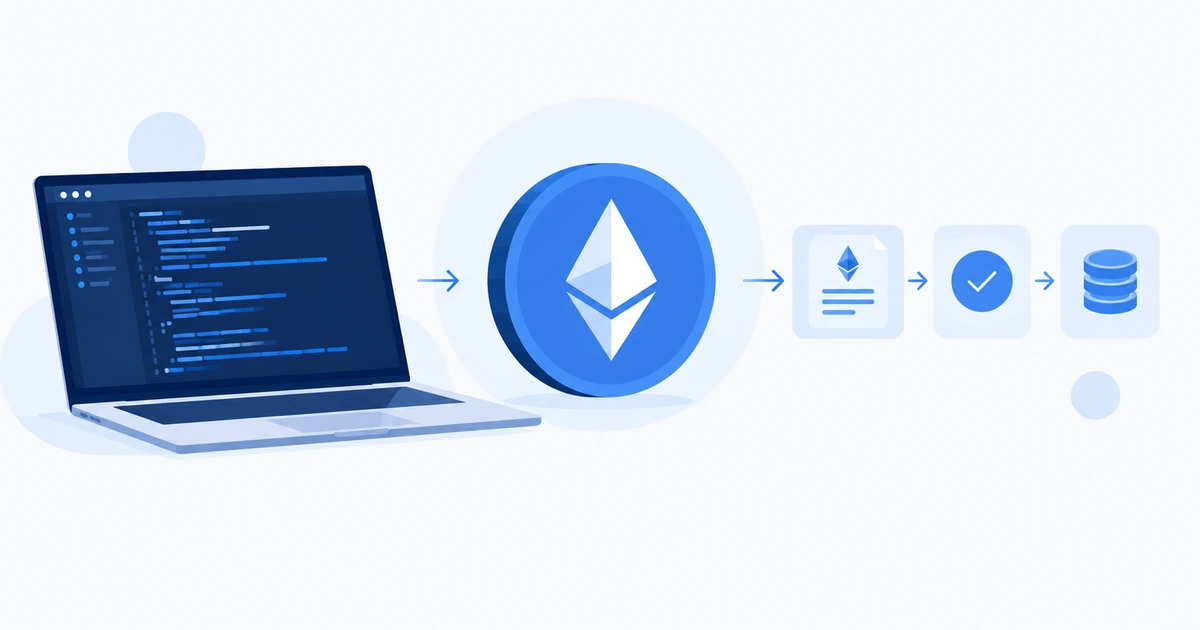
Making a token on an existing blockchain is today something that takes minutes and costs cents. Open-source libraries and already-resolved standards eliminated the technical barrier. The result is a market flooded with new tokens: CoinGecko analyzed 18.67 million tokens launched on Pump.fun and found that 68.67% stopped trading on the same day of their creation. Only 4.55% remained active after 90 days. The code is not the problem. The design, distribution, and legal structure decide if a token survives.
A token runs on its own blockchain and works as a native token to pay fees and secure the network. Bitcoin and Ethereum are coins. A token runs on a blockchain that already exists through a smart contract, inheriting the security and settlement of that network. Almost always, when speaking about token development, it refers to this second case.
Tokens divide into functional categories
Utility tokens give access to services of a platform or pay operations inside it. LINK from Chainlink pays oracle operators. Governance tokens grant voting rights over protocol parameters. UNI from Uniswap and AAVE from Aave are examples. Stablecoins maintain parity with fiat currency and dominate real transaction volume. Security and RWA tokens represent regulated assets, including tokenized shares and real estate.
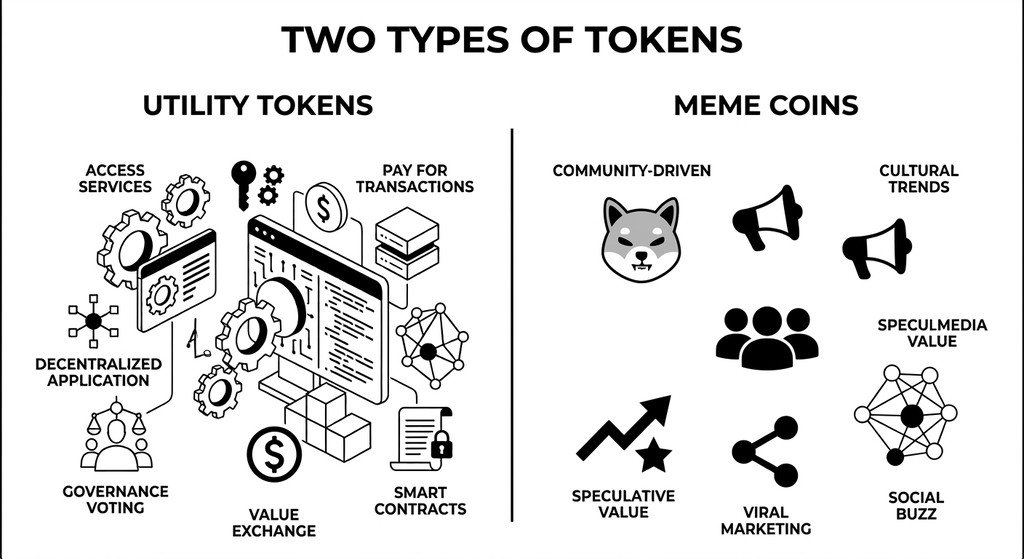
Meme coins work as community attention instruments without cash-flow logic. Non-fungible tokens (NFTs) encode unique metadata for digital collectibles. Soulbound tokens are non-transferable credentials for identity verification. Each category carries different technical requirements and legal exposure. Choosing the category is the first concrete decision in any token project.
Token standards and compatibility between blockchains
Standards define the interface between a token contract and external applications. ERC-20 on Ethereum and EVM-compatible chains specifies six required functions and two events for fungible tokens. The same contract pattern deploys on BNB Chain as BEP-20, on Polygon, Avalanche, and Ethereum Layer 2 networks with minimal changes. ERC-721 defines non-fungible tokens with unique identifiers. ERC-1155 supports fungible and non-fungible assets in a single contract.
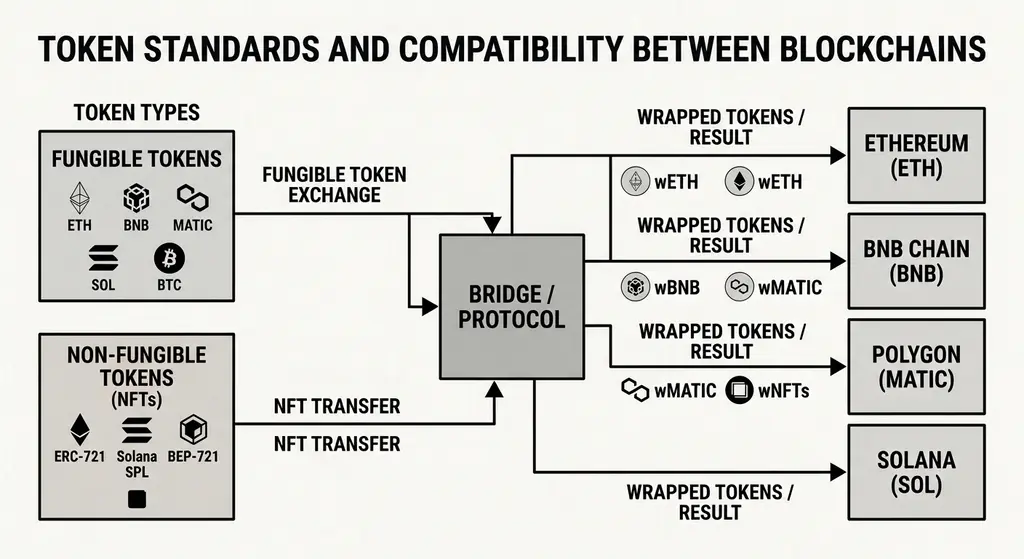
Solana uses a different architectural model. The SPL Token Program is a shared on-chain program, not a per-token contract. Creating a token means initializing a mint account with supply, decimals, and authorities configured. The newer program Token-2022 adds extensions like transfer fees and confidential transfers. Creating SPL tokens is extremely fast and cheap, which explains the concentration of meme coin launches on Solana.
Ethereum mainnet offers maximum liquidity and credibility but high fees. Layer 2 networks like Arbitrum and Optimism reduce costs by inheriting Ethereum security. BNB Chain and Polygon give lower fees with EVM tools. Solana aims at high-frequency, low-value transactions. The decision depends on the use case and the target users of the token.
Tokenomics: supply, allocation, vesting, and value accumulation
Tokenomics is the economic model that determines long-term viability. Four linked decisions structure any token economy.
Supply policy fixes the total number of tokens and the emission schedule. Tokens with fixed supply have a hard cap, creating scarcity by design.
Inflationary emission mints new tokens per block or epoch to fund staking rewards or protocol operations.
Deflationary mechanisms burn tokens on each transfer or through buyback programs. Each model creates different incentives and price for holders.
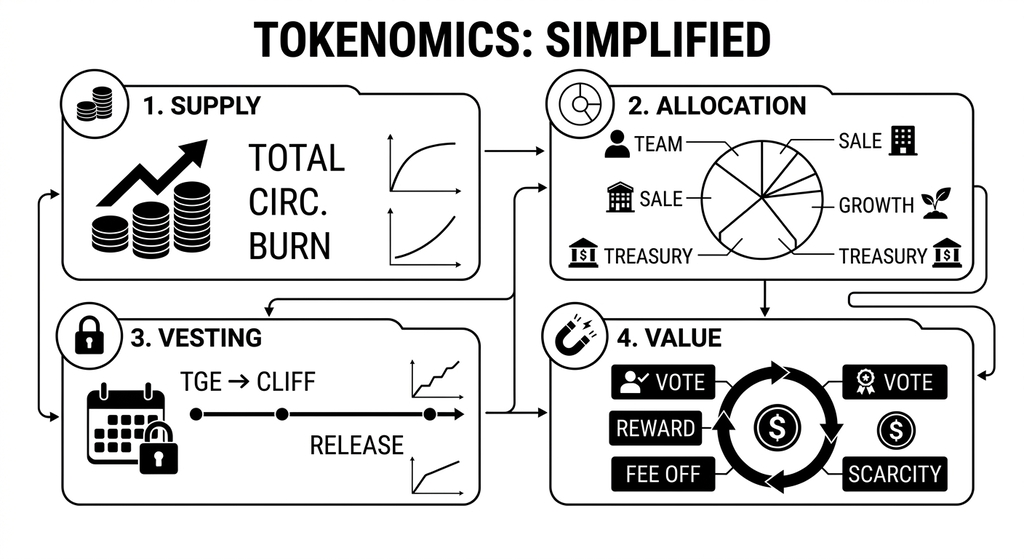
Allocation divides the total supply among community, team, investors, treasury, and liquidity providers. The allocation table is the most scrutinized element by users and centralized exchanges. A concentrated distribution where few wallets control most of the supply makes the price vulnerable to coordinated selling regardless of technological merit.
Vesting schedules lock team and investor tokens for a defined period, normally 12 to 48 months, with linear or cliff releases. Unlock events are visible points of selling pressure.
Mechanisms include fee sharing from protocol revenue, staking yields paid with inflation or treasury, governance power over treasury and parameters, access rights to premium functions, or collateral function in lending markets. If the only reason to hold is speculative price appreciation, the tokenomics design is incomplete and will probably fail.
Development process
The technical sequence is direct but demands discipline at each stage.
Define purpose and legal category
Write a specification document that indicates what the token does, who holds it, and which jurisdictions apply. Identify if the token risks classification as a security under the Howey Test or the EU MiCA regulation. Hire legal counsel before writing code.
Design tokenomics
Produce a written document with supply, allocation, vesting schedules, and value accumulation mechanisms. This document becomes the base of the whitepaper and the audit scope.
Choose chain and standard
Select the blockchain and token standard based on expectations of transaction volume, tolerance to gas cost, and target user base.
Write the smart contract
On EVM chains, use audited libraries from OpenZeppelin as the base. Add custom logic only for necessary functions: minting restrictions, burn mechanisms, fee routing, pause capability, and access control. Keep the contract minimal and explicit about administrative powers. For Solana, configure the mint account through the SPL Token Program.
Test and audit
Run full unit and integration tests on a local network, then deploy to a testnet. Order an independent audit from a recognized firm like CertiK, Trail of Bits, or OpenZeppelin. Audit costs go from $5,000 to $150,000 according to complexity. The reputational cost of an exploit far exceeds the audit fee.
Deploy and verify
Deploy the audited contract to mainnet. Verify the source code on the block explorer. Consider renouncing mint authority or placing it behind a timelock contract to eliminate rug pull risk. A non-renounced mint authority is the first red flag detected by automatic scanners.
Provide liquidity and list
Seed a liquidity pool on a decentralized exchange like Uniswap or Raydium. Lock the liquidity tokens and publish proof of the lock. Submit the token to data aggregators like CoinGecko and CoinMarketCap. Publish the tokenomics documentation and the audit report publicly.
Launch strategies and legal compliance in 2026
Launch models go from fair launches without presale and without team allocation to IDOs on launchpads with vetted audiences and platform fees. Airdrops distribute tokens to existing users to bootstrap network effects. Regardless of the model, the mechanics of launch day matter more than marketing. Buyers check within minutes if there is locked liquidity, published vesting schedules, verified contracts, and administrative authorities renounced or with timelock. Missing any of these signals leads to immediate selling pressure.
Legal reality now shapes token launches
The EU’s MiCA regulation requires a compliant whitepaper for most public token offerings. Stablecoin issuers face full authorization requirements. In the United States, the Howey framework determines whether a token sale is a regulated securities offering. Enforcement actions continue against projects that promise profits derived from team efforts. Cross-border launches require legal review before deploying code.
The Pump.fun dataset shows the consequence of near-zero technical barriers: more than 21,000 new tokens per day at the peak, with more than 80% dead within two days. A new token in 2026 does not compete on technology, because the standard guarantees basic functionality. It competes for attention, trust, and a defensible reason to exist. Projects that survive more than 90 days launch tokens as a component of a working product, not as the product itself. Success in token development comes from disciplined economic design, verifiable trust signals, and legal foresight, not from smart contract complexity.
FAQ
What is the difference between a coin and a token?
A coin runs on its own blockchain and works as a native asset for transaction fees and security. A token operates on an existing blockchain through a smart contract and can represent any programmable asset.
Which token standard should I choose?
For EVM-compatible chains, ERC-20 is the default for fungible tokens and ERC-721 or ERC-1155 for NFTs. For Solana, use the SPL Token Program. The choice depends on the target blockchain and the function of the token.
How much does auditing a smart contract cost?
Audit costs go from $5,000 to $150,000 according to code complexity, audit scope, and the reputation of the firm. The fee is a small fraction of the potential loss from an exploited contract.
What is the most common reason new tokens fail?
The most common reason is lack of a value accumulation mechanism. Tokens without utility, without fee sharing, without governance function, and without staking yield depend only on speculation, which does not sustain a market. Data from Pump.fun shows that 68.67% of tokens stop trading on the first day.
Do I need to renounce mint authority?
Renouncing mint authority eliminates the ability to create new tokens, which increases user trust. If future minting is required for protocol operations, place the mint function behind a timelock contract or a multi-signature wallet with publicly documented policy. Leaving mint authority in a single external account is a critical vulnerability.

Isai Alexei is a journalist and financial analyst covering cryptocurrency markets and traditional securities for Blockchaindose. He has spent ten years analyzing digital assets, trading activity, and market structure.