The future of NFT metaverse projects does not match the 2021 pitch. Billions in corporate spending failed to produce a virtual world people wanted to live in, and most of the land NFTs sold on the promise are worth a fraction of what buyers paid. For the wider picture, see our overview of NFT metaverse projects, and what a working version might require is a narrower question than the original hype indicated.
Key takeaways: the numbers behind the hype cycle, and what they say about what comes next.
- Meta’s Reality Labs division lost $4.62 billion in Q2 2026 alone, pushing cumulative losses since 2020 toward $88 billion, with no VR product line to show for it.
- Individual metaverse land plots have lost as much as 99.8% of their peak value, with a widely cited $24 million Decentraland-style plot now valued near $9,000.
- NFT trading volume reached $1.58 billion in Q3 2025, but the growth is concentrated in profile-picture collections (up 187%) and sports NFTs (up 337%), not virtual land or gaming.
- VRChat and Second Life, not any company’s official metaverse, are the platforms actually holding an active population: VRChat set a record of over 158,000 concurrent users in 2026, and Second Life reports 620,000 monthly active users.
- A future NFT metaverse that works would need three things none of the failed attempts had: an open standard instead of one company’s app, lightweight glasses instead of bulky headsets, and an popular killer app pulling people in on its own.
What follows looks at what failed and why, what is working instead, and what would have to be true for the next attempt to produce a different outcome.
The future of NFT metaverse projects starts with admitting what failed
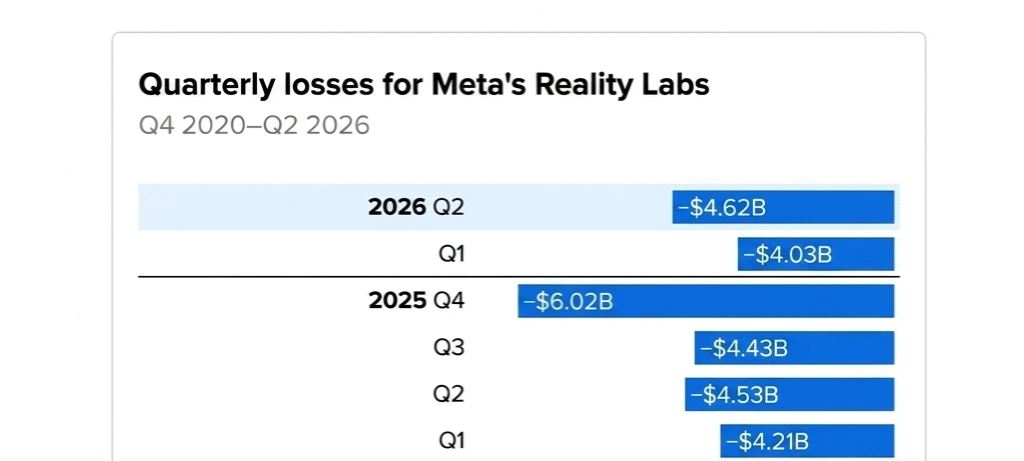
Meta’s Reality Labs division, the unit behind Horizon Worlds and the Quest headset line, lost $4.62 billion in the second quarter of 2026 alone, pushing its cumulative operating losses since late 2020 to roughly $88 billion. That is not a one-off write-down; it is the continuation of a five-year pattern with no profitable VR product to show for it.
In March 2026, Meta announced it would shut Horizon Worlds down in VR entirely and shift to mobile only, then reversed the decision within 48 hours after user backlash. The app survives, but Meta has stopped building new VR content for it and is prioritizing the mobile version instead: a maintenance-mode existence, not a growth plan.
Commenters online have their own name for current era: they call it ‘Zuckaverse’ and not metaverse, treating it as one executive’s personal project, not a neutral industry effort. That framing understates what actually happened. The metaverse, as originally pitched, was meant to be joint, multi-company, interoperable 3D infrastructure that would take years to mature. Horizon Worlds was one company’s first-party social app, and a poorly received one. Judging a five-year infrastructure bet by reception of a single low-poly app conflates two different things, although app’s failure is real and money spent on it is real.
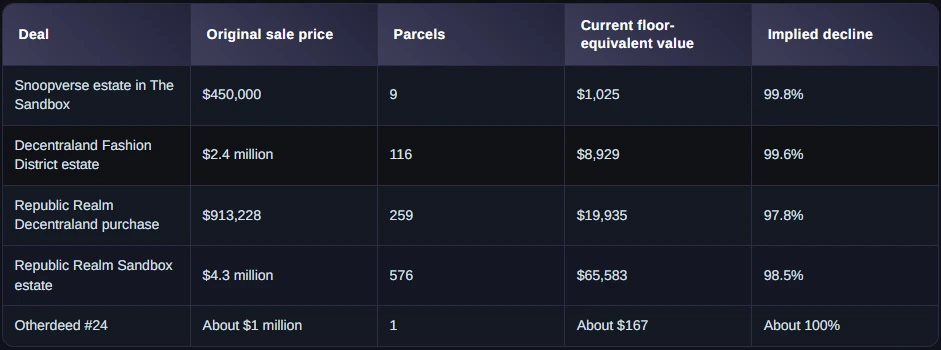
Virtual land NFTs took the sharpest hit. By June 2024, average metaverse land prices were already down 72% from their cycle highs, a baseline that kept eroding. By early 2026, some individual plots had lost as much as 99.8% of peak value, including one $24 million plot now trading near $9,000. Land was sold on the premise of scarcity in a space that, unlike physical real estate, has no actual limit on how much can exist.
Why VR headsets remain the bottleneck
Ask people who tried a corporate metaverse what stopped them from staying, and answer is not software for most. It’s the headset. The recurring complaints are consistent: bulk, weight, cost, short battery life, heat, sweat, and the friction of having to take the thing off for a bathroom break or a snack. Better passthrough video has reduced the discomfort without removing it. For a meaningful share of users, there’s a second, biological barrier layered on top: motion sickness and inner-ear disorientation triggered by movement the body isn’t actually making, a problem no price cut fixes on its own.
Meta’s own roadmap is a tacit admission of this. Its newer push is toward glasses, not headsets. The Meta Ray-Ban Display, a $799 pair of glasses with a built-in lens display and a wrist-worn neural band for control, launched in the US in September 2025. Demand outstripped supply badly enough that Meta paused the planned international rollout to the UK, France, Italy, and Canada in January 2026, citing inventory limits.
Behind that product sits a longer-running program once known internally as Project Nazare, Meta’s effort to build true augmented-reality glasses; the company has since shown that work publicly under the name Orion. None of this is a headset. It’s a bet that a face-worn device only works if it looks and behaves like something people would wear outside a living room.
Nobody in the conversation around this topic has answered a more basic question convincingly: what does being physically present in a 3D space let you do that a phone, a monitor, or a video call doesn’t already do as well? The closest attempts are virtual concerts with live avatar performances and multi-monitor style virtual workspaces, and even people who tried both usually concluded the 2D equivalent, a livestream or a real desk, was faster or more comfortable. Until that question has a real answer for a specific task, hardware improvements alone won’t be what moves adoption.
The corporate pitch nobody asked for
A pattern shows up across every corporate metaverse analysis: pitching the concept around virtual meetings, virtual offices, or virtual shopping malls made things worse, not better. Replicating the flat, effortful feeling of a video call inside a headset adds friction without adding anything people wanted. It’s a specific framing choice, not the technology itself, that made the corporate metaverse feel tone-deaf, and it’s worth naming because a future attempt could easily repeat it. Gaming and social use, not workplace productivity, are where any demand has shown up.
What already works: VRChat, Second Life, and the platforms that quietly won
| Platform | 2026 activity | Model |
|---|---|---|
| VRChat | Record of over 158,000 concurrent users; regular weekend peaks of 120,000-125,000 | User-built worlds, headset and desktop, no official land NFTs |
| Second Life | 620,000 monthly active users; roughly 45,000 peak concurrent | Desktop-first virtual economy running since 2003 |
| Horizon Worlds | Maintenance mode in VR, mobile-first going forward | Corporate first-party app, no new VR content pipeline |
While Meta’s numbers were falling, two platforms nobody built as a “metaverse initiative” kept growing. VRChat set a concurrent-user record of nearly 149,000 on New Year’s Eve 2025-26, then broke that record again in May 2026 with over 158,000. Second Life reported 620,000 monthly active users in December 2025, up from 600,000 two months earlier, on a platform that has been running since 2003 without ever needing an NFT or a token to sustain its economy.
Whether either one “counts” as a real metaverse is genuinely disputed. One side argues VRChat already meets the definition: persistent 3D worlds, custom avatars, an in-world economy, years of active use. The other side holds that a true metaverse has to be an open, federated standard, the way the web itself is open, and that a single privately owned and moderated app can never qualify no matter how popular it gets, no matter who runs it.
Both positions are defensible, and the disagreement is really about definitions, not about whether these platforms are succeeding on their own terms. On the metric that matters for a business case, sustained active use, they are the closest thing the category has to a working answer.
Where NFTs still fit in a metaverse that mostly failed
Our earlier look at how NFTs establish digital ownership found that the token layer works exactly as designed; what failed was the scarcity story built on top of it. Virtual land was marketed as scarce the way physical land is scarce, but a platform operator can always create more parcels, so the scarcity was never real in the way buyers assumed. DappRadar’s Q3 2025 data shows where NFT activity actually moved once that premise stopped working: profile-picture collections like CryptoPunks and BAYC saw trading volume rise 187% to $544 million, and sports NFTs jumped 337% to $71 million, while gaming NFT volume fell 17% over the same quarter.
The growth is in collectibles with an identifiable, verifiable real-world referent, not virtual real estate. Tokenized real-world assets are following the same logic: ownership you can verify on-chain, attached to something that has value independent of a company’s roadmap.
Three conditions the next attempt would need
Across the discussion of what went wrong, three specific conditions come up again and again as what a working metaverse would actually require, and none of them existed in Meta’s version.
First, an open, federated standard, so that building or visiting a virtual world is as open as building or visiting a website, rather than one company gatekeeping the entire experience.
Second, lightweight glasses-form hardware instead of a bulky headset, which is the direction Meta’s own Ray-Ban Display and Orion programs are now pointed.
Third, a genuinely popular “killer app,” usually described as a game, that draws people in on its own merits before any metaverse layer gets added on top, rather than infrastructure built in search of a use case. Gaming-focused metaverse chains are the closest current attempt at supplying that third piece, though none has produced a breakout hit yet.
There is a disagreement about whether the $80-plus billion Reality Labs has spent counts as waste. Some draw a comparison to the Segway: the original product failed commercially, but the underlying technology investment arguably seeded a later, unrelated success in electric scooters.
On that reading, subsidized Quest headsets now selling cheaply secondhand and the ongoing Orion glasses program are a delayed return on the spending. Others reject the comparison outright and see no product to point to that justifies the bill.
Both views can be true at once: the specific bet on Horizon Worlds as a social app failed, while some of the underlying hardware research may still pay off in a different form factor, on a different timeline, for a different pitch.
It’s also worth naming the pattern this fits into. The same commentary that mocks the metaverse spend increasingly applies the identical framework to current AI investment: identify a narrative that excites investors, over-hire and over-promise around it, then downsize after hype declines while attention shifts to the next buzzword.
FAQ
Is the metaverse dead in 2026?
The corporate version Meta pitched in 2021 is effectively dead as a growth initiative: Horizon Worlds is in maintenance mode, and Reality Labs has lost close to $88 billion with no profitable product to show. But platforms nobody labeled a “metaverse initiative,” VRChat and Second Life, are more active than they’ve ever been. The concept survived; the specific corporate bet on it did not.
What happened to Meta’s Horizon Worlds?
Meta announced a full VR shutdown in March 2026, then reversed the decision within 48 hours after user backlash. The app still runs in VR, but Meta has stopped producing new VR content for it and is focusing new development on the mobile version instead.
Are NFT metaverse land plots worth buying now?
Based on the data available, no evidence supports land NFTs as a scarce or appreciating asset. Average prices were down 72% by mid-2024, and specific plots have since lost up to 99.8% of peak value. Platform operators can create additional parcels at will, which undermines the scarcity claim the original pricing was based on.
Is VRChat considered a real metaverse?
It depends which definition you use. VRChat has persistent 3D worlds, custom avatars, and years of active use, which satisfies one common definition. Others argue a true metaverse must be an open, interoperable standard rather than one company’s app, a bar VRChat doesn’t clear either. By raw activity, it’s outperforming every corporate alternative.
What is Meta’s Project Nazare?
Project Nazare was the internal codename for Meta’s true augmented-reality glasses program, separate from the Horizon Worlds VR app. Meta has since shown this work publicly under the name Orion, positioning it as the long-term hardware bet that replaces bulky headsets with glasses-form devices.

Isai Alexei is a journalist and financial analyst covering cryptocurrency markets and traditional securities for Blockchaindose. He has spent ten years analyzing digital assets, trading activity, and market structure.