How much are At tokens worth? Well, this sounds like one of the easiest questions ever.
Yet, it turns out to be amongst the hardest to answer. Why? Because, AI token market cap is not a fixed figure sitting somewhere in a vault. It is a total someone calculates after deciding which coins count. Change the guest list and the total changes with it.
Two sites, one sector, a $9 billion gap
Here’s a breakdown of how different sites track the AI sector’s market value, and why the numbers don’t always add up.
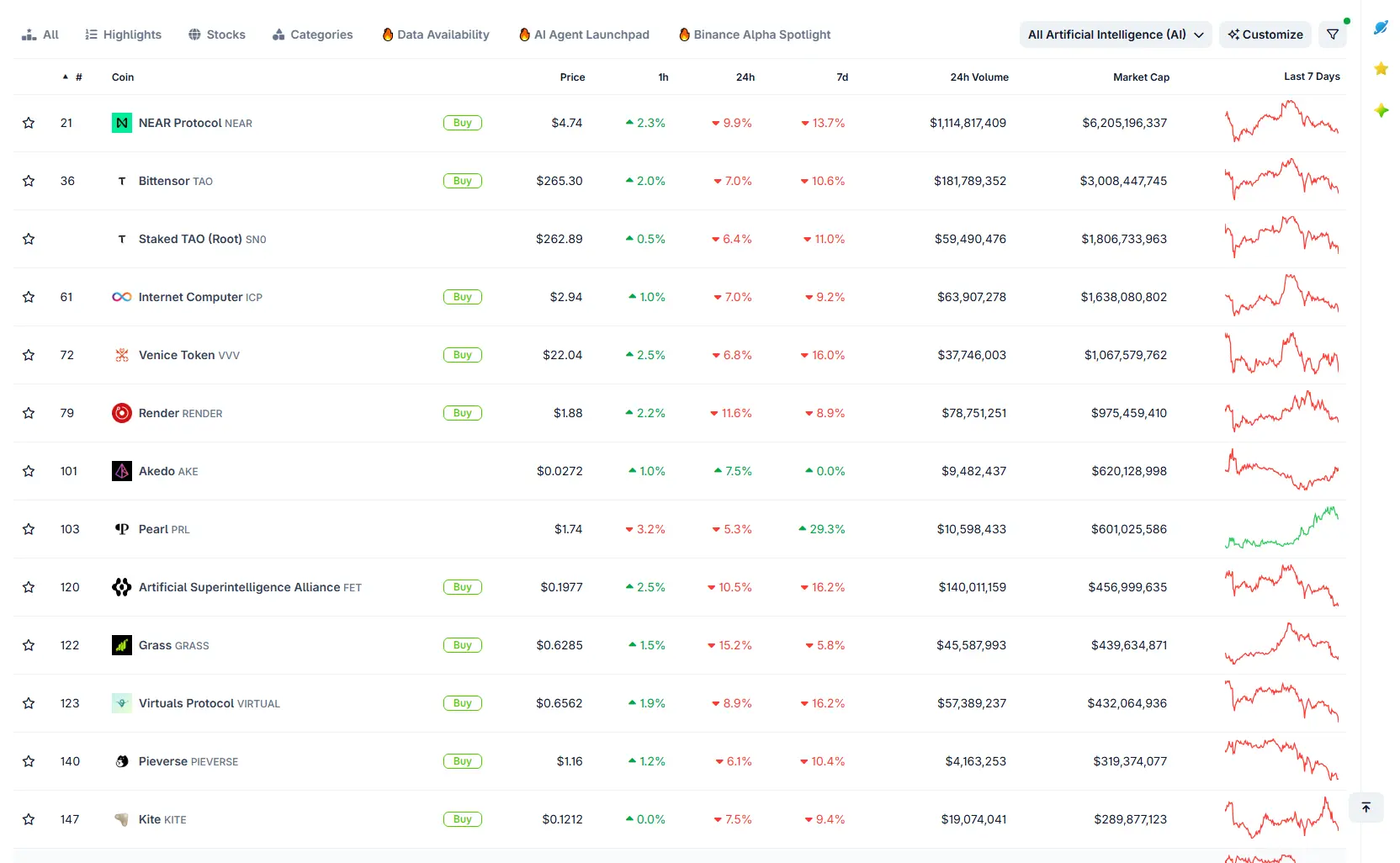
Looking at two major trackers, CoinGecko’s “Artificial Intelligence” category reported a market cap of about $26.9 billion from 1,532 projects. CryptoSlate’s “AI” category, however, showed $36.01 billion across only 272 assets. This means CryptoSlate’s figure is about 34% larger, but uses roughly one-fifth the number of tokens. When you see headlines about the total market cap, it’s worth being skeptical of any single number.
CoinMarketCap makes things even less clear. Their AI & Big Data tag has over 944 listings, but they don’t provide a total market cap for the sector. It’s just a list, not a complete index.
The “AI agents” slice is even wider
The situation gets more confusing when you look at a specific hot area like AI agents. CoinGecko’s AI Agents category is valued at about $3.89 billion.
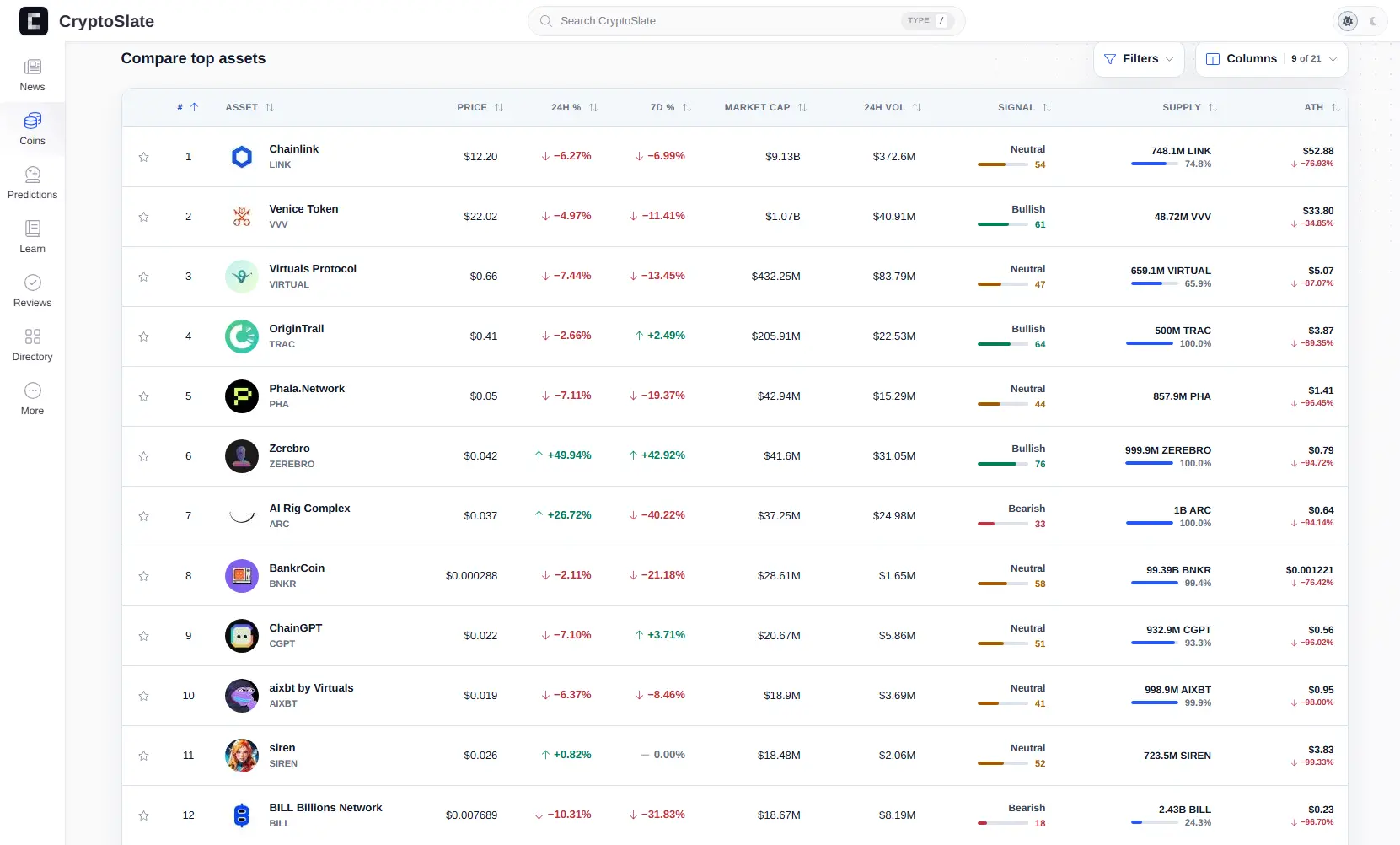
CryptoSlate’s AI Agents category, on the other hand, is around $12.38 billion with 43 assets.
Another tracker focused on agents, Cookie.fun, reported about $4.5 billion on April 7, 2025, looking at over 1,600 agents across all blockchains.
Comparing these, CryptoSlate’s number is about 3.2 times larger than CoinGecko’s. While the Cookie.fun number is from a different date, making a direct comparison difficult, it highlights how three different trackers can present vastly different pictures of the same sector.
Why the totals don’t match
The main reason these totals don’t match is that each tracking site sets its own rules for inclusion. CoinGecko, for example, states their AI tag is for projects that build or use AI, need a working product, and generally exclude general-purpose blockchains unless they are heavily AI-focused.
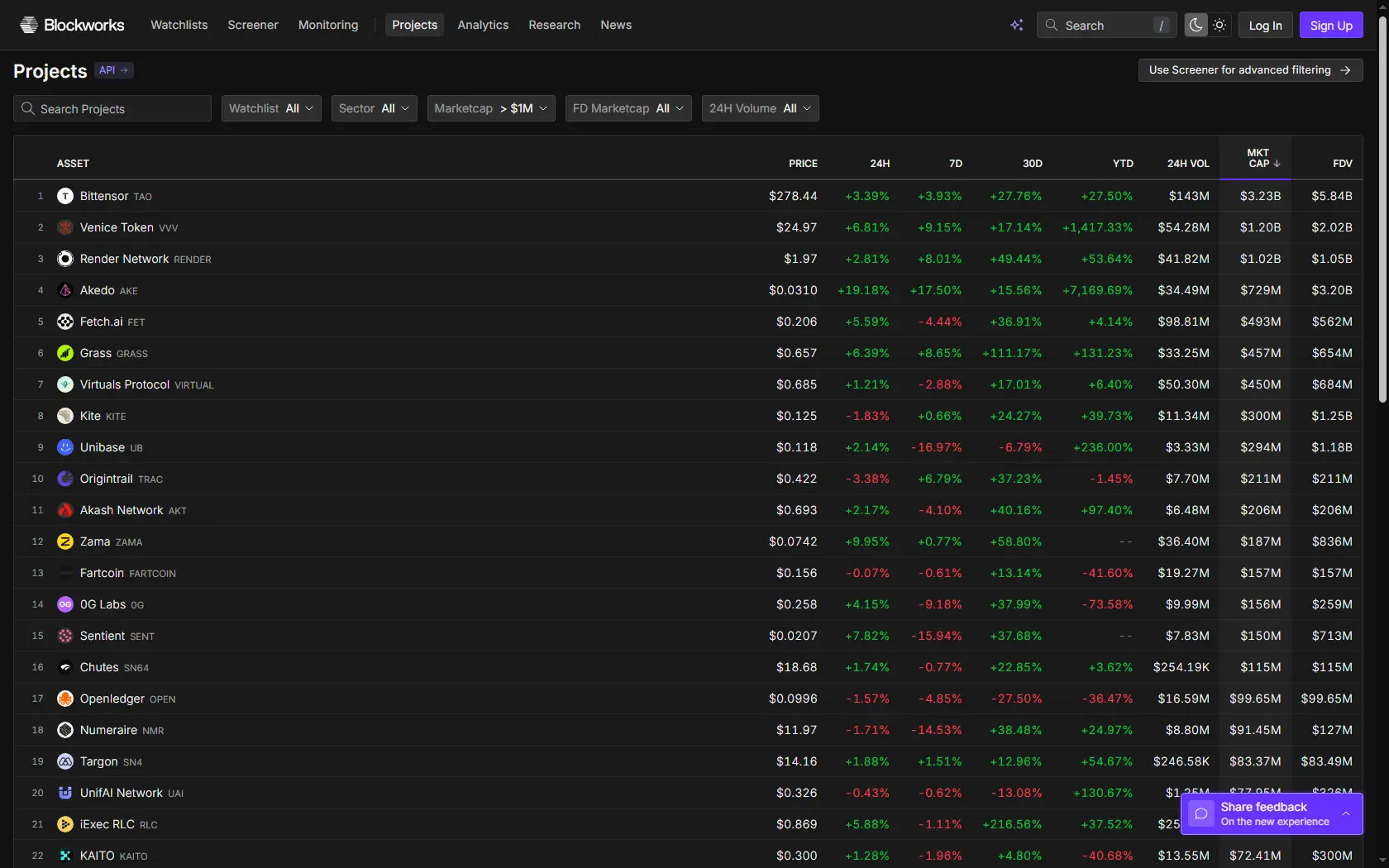
Messari has a different system: a project can belong to multiple sectors, and they break down AI into areas like compute, agents, infrastructure, tooling, and DeFAI.
This means the same token could be listed as “AI” on one site, “infrastructure” on another, or in both categories on a third. If you add up the categories from multiple sites, you might end up counting the same coin multiple times.
Even general charting platforms like TradingView have an “AI market cap” symbol (AI.C). However, one user in their community discussion pointed out a valid question: which specific instruments actually make up that total? They couldn’t find a clear list.
Even one site’s number moves around
Furthermore, even a single site’s numbers can fluctuate significantly over time. Reports and saved versions of CoinGecko’s AI category show how quickly the total market cap can change.
One report from Decrypt showed the figure just under $26 billion, after a 14% weekly increase. Another explainer from 2026 mentions the AI sector crossed $25 billion in June 2026, peaking above $26 billion in late May, but then dropped to around $22 billion by mid-July.
We also found undated cached copies of the same CoinGecko category page showing totals of $15.9 billion, $20.8 billion, and $21.2 billion.
Since these cached pages aren’t dated, they should be seen as examples rather than a strict timeline. The main point is that the same page on the same website has shown very different market cap totals.
A few big tokens carry the whole thing
A few large tokens really drive the overall numbers. The headline often doesn’t tell you which coins are actually included. On CoinGecko’s list, the five biggest names
- NEAR, Bittensor (TAO)
- ICP
- Venice Token
- Render
All these accounted for about 56% of the total market cap, which was around $26.9 billion.
Even though there are over 1,500 tokens on the list, most of them have very little impact. In the CoinGecko pages we looked at, tokens further down had market caps around $1.8 million, and at the very bottom, tokens were worth about $32,000.
So, when you see a headline like “AI tokens are up 7%,” it usually just means that five or six big coins went up.
Even the data firms change the basket
The data companies themselves also change what they consider “AI tokens.”
Kaiko, a company that tracks market data, has been following AI tokens for a while, and their lists show how much this category changes. In mid-2023, Kaiko’s list of top AI tokens included The Graph, Render, Injective, Oasis, SingularityNET, and Fetch.ai. Today, their AI index tracks seven assets: NEAR, ICP, FET, RENDER, GRT, AIOZ, and AKT, with each token capped at 30% of the index’s weight.
It’s the same company and the same theme, but different tokens. Neither approach is wrong; they just answer different questions.
Kaiko’s trading volumes for these tokens also fluctuate significantly.
Weekly trading volume for AI tokens dropped to a low of $570 million in late July 2023, then rose to $870 million by the end of August.
By November 2023, it had surged from under $1 billion in early October to over $3 billion per week, a jump of more than 200%.
In an analysis from May 2024, Kaiko reported that AI tokens averaged about $8 billion in weekly volume from February onwards, compared to a low of $300 million in mid-2023.
Binance’s share of this trading volume decreased from over 70% to 39%. Open interest in five major AI tokens fell from $170 million to $60 million between February and August 2023.
These different snapshots use varying dates and token lists, so it’s not helpful to view them as a single, continuous trend. However, they do show that the answer to “how big is the AI crypto market?” changes depending on the week, the platform, and the specific list of tokens being considered.
Size isn’t the same as success
Just because the total market cap is large doesn’t mean every token is successful. Large overall numbers can hide significant losses. One report, citing CoinGecko, stated that 83% of AI tokens launched since 2023 are currently trading below their initial listing price. It’s worth noting that this is a secondary source, so it should be viewed with caution.
The price changes of individual coins tell a similar story. VIRTUAL reached about $5 billion in value during a surge in early 2025, but by mid-July 2026, it was worth close to $414 million. Fetch.ai’s FET token was around $360 million in mid-July 2026.
Kaiko also found that AI tokens’ 60-day correlation with Nvidia stock was only about 0.2 to 0.3. This suggests that these crypto tokens don’t simply move in line with Nvidia’s stock performance.
Why it matters
If you read a headline that says “AI tokens are worth $X billion,” ask one question: according to whom, and counting what? A number from CoinGecko, CryptoSlate and Kaiko measures three different baskets, on different days.
That matters for anyone sizing an investment, writing a report or judging whether a sector is booming. Quote the source and the date, and compare like with like.

Dan is a seasoned crypto writer for Blockchaindose who got his start in the space back in 2019. Over the past four years, he’s built a solid grasp of how the industry moves, focusing heavily on DeFi, NFTs, GameFi, and promising new projects.
Off the clock, you’ll usually find him buried in a good book or kicking back with a movie. His blend of hands-on market experience and straightforward commentary makes him a clear, trusted voice across the platform.