

Ask a crypto skeptic about Solana and you will probably hear the same line: it’s a casino for memecoins. For a stretch of 2024 and 2025, that wasn’t unfair. Memecoin launchpads like Pump.fun drove enormous trading volume, and a lot of the network’s fees came from traders racing each other.
But look at the data from the past year and a different picture shows up. It isn’t hidden, exactly. It just doesn’t make headlines the way a price move does.
The stat almost nobody quotes
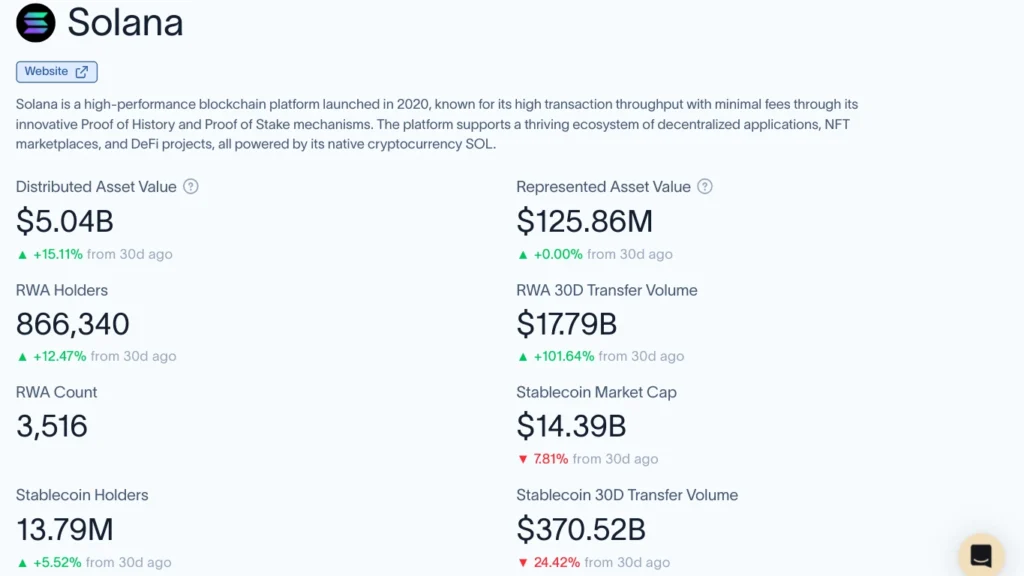
In September 2026, Solana’s daily stablecoin active addresses hit about 888,000. A year earlier, the same measure was 333,000. That is a 269% jump, according to RWA.xyz data cited by Solana Compass.
The definition matters. This is not a count of wallets that simply hold stablecoins. It counts wallets that sent or received at least one stablecoin transaction in a 24-hour period. Someone had to actually do something: pay, transfer, trade, or settle.
That makes it a better test of the “just speculation” claim than a general user count. Memecoin traders mostly swap tokens. Stablecoin movers are, in large part, moving dollars.
The supply behind it is growing too. Solana Compass reported a record $17.3 billion in stablecoin supply on September 25, 2026, and RWA.xyz’s Solana page lists more than 11 million stablecoin holders, with about $513 billion in stablecoin transfer volume over 30 days.
First, a warning about “daily active addresses”
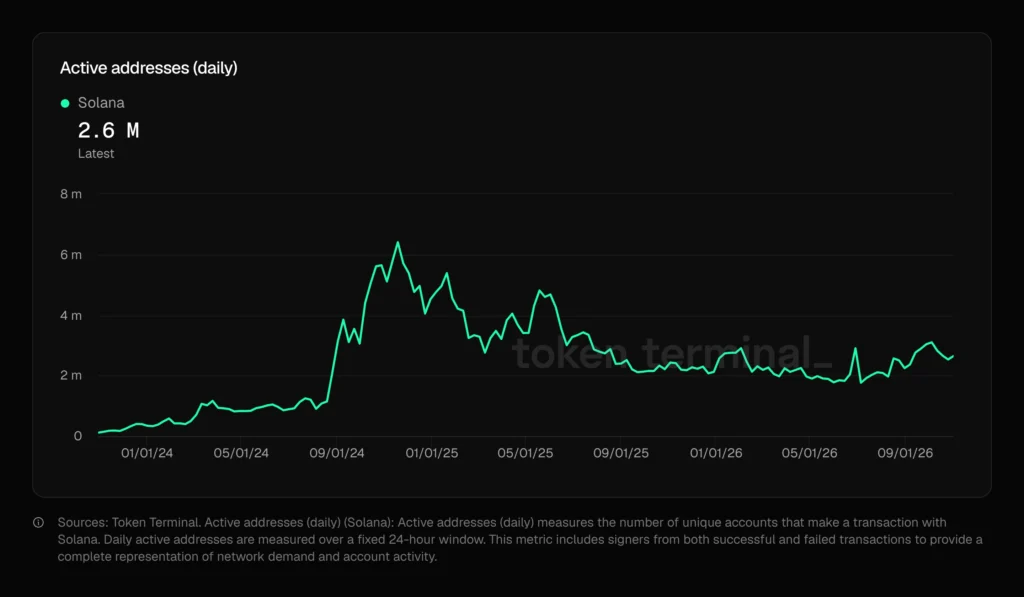
The more commonly quoted number is total daily active addresses, and it is messy. Paybis cited an average of about 3.6 million for Solana. Other trackers disagree:
- Santiment reported roughly 4.27 million in early October 2026.
- SolanaFloor and Blockworks reported 1.88 million unique active addresses on October 9, a 13-month high.
- DefiLlama showed about 3 million in one 24-hour reading.
- Messari put the Q1 2026 average at around 2.4 million.
These are not contradictions so much as different rulebooks. Trackers filter accounts differently, treat vote transactions differently, and count over different windows. Crypto Briefing explicitly warned that the 1.88 million and 4.27 million readings come from different trackers and shouldn’t be read as the same measurement. So don’t average them, and don’t treat any single figure as gospel.
There is also the obvious catch: one person can control many wallets. An address count is not a headcount.
The safe takeaway from the total-address numbers is modest. On every tracker, activity is large and trending up. The stablecoin figure is the one that speaks to what kind of activity it is.
What happened to the memecoin share?
Here is the claim in its simplest form: Solana is mostly memecoins. Test it with trading data.
According to 21Shares, memecoins made up 40% of Solana’s spot DEX trading volume in the first half of 2025. By the first half of 2026, that had fallen to 16%. Over the same period, the share of stablecoin swaps rose from 6% to 19%.
Solana still did plenty of trading: the same report put it at more than 36% of global spot DEX volume in H1 2026, and Birdeye’s H1 report put it at 54%. (The two firms measure differently, which is why the numbers don’t match. Either way, Solana is a top venue.)
The money side tells a similar story. 21Shares found Solana’s network revenue fell 87% to $141 million in H1 2026, because memecoin-driven fees collapsed. In H1 2025, priority fees and Jito tips made up 95% of gross revenue. Fewer speculative bidding wars meant far less fee income, even while the network stayed busy.
Where the thesis gets tested: the memecoins came back
This is the part a one-sided article would skip. The memecoin story is not over.
21Shares notes that by August 2026, memecoins had rebounded to about 34% of Solana’s DEX volume. Another report showed Pump.fun contributing $492 million of a $1.178 billion day, or about 42%, though that total was well below the $2 billion daily highs earlier in 2026.
So the honest reading is not “Solana grew out of speculation.” It is closer to this: speculation is a cycle that swells and shrinks, and underneath it a steadier base of payments and asset activity has been growing. When memes cool, that base is easier to see.
The swings are huge. Dune data cited by BeInCrypto showed weekly Solana DEX volume falling from about $104.3 billion to $18.8 billion in two weeks in May, as meme launches slowed. That is what speculation looks like on a chart. Stablecoin and tokenized-asset usage has been climbing far more steadily.
Beyond payments: tokenized assets
Stablecoins are not the only non-meme use case.
- RWA holders: In June 2026, Solana reached 285,971 holders of tokenized real-world assets, passing Ethereum’s 199,191, per RWA.xyz.
- Tokenized stocks: The Solana Foundation said Solana captured 97% of cumulative on-chain tokenized equity spot volume in May 2026.
- Real money, real brands: Western Union’s USDPT stablecoin went live on Solana in May, issued by Anchorage Digital Bank.
- Lending, not just holding: Messari’s Q1 report, via CCN, found about 43.7% of Solana’s active RWA value sits in DeFi lending, versus 6.1% on Ethereum.
- Payments volume: Grayscale reported $650 billion in stablecoin transactions on Solana in February 2026, the highest monthly total any blockchain had logged.
The scale caveat is important, though. Ethereum still holds roughly $16.3 billion in RWA value, more than five times Solana’s $3 billion, per the same RWA.xyz data. Solana leads in how many people hold these assets, not in how much value they hold.
What the data does not prove
A fair reading needs limits:
- Wallets are not people. The stablecoin stat counts addresses, not individuals.
- Stablecoin movement includes trading. Some of the 888,000 are traders moving dollars into and out of speculative positions. The metric is evidence of dollar usage, not proof that all of it is payments.
- Memecoins are cyclical. Their share fell and then recovered. Expect it to swing again.
- Value still trails Ethereum in tokenized assets, and price has not followed activity: SOL traded around $97 in late September even as usage climbed.
Why this matters
If Solana were only a memecoin venue, its activity would vanish when speculation cooled. The data suggests something different: a base of dollar-denominated, repeat usage that kept growing through the slowdowns. That is the difference between a trend and a fad, and it is why this metric deserves more attention than price alone.

Dan is a seasoned crypto writer for Blockchaindose who got his start in the space back in 2019. Over the past four years, he’s built a solid grasp of how the industry moves, focusing heavily on DeFi, NFTs, GameFi, and promising new projects.
Off the clock, you’ll usually find him buried in a good book or kicking back with a movie. His blend of hands-on market experience and straightforward commentary makes him a clear, trusted voice across the platform.