RWA tokenization gained a comparison framework in June 2026, when researchers Giorgio Vella, Luca Pennella and Mark C. Ballandies posted an study with a classification of real-world asset tokenization protocols across five components and 23 attributes. The authors applied the taxonomy to the 20 largest protocols on the DeFiLlama RWA dashboard, using the market-capitalization ranking of February 2026.
Fragmented Research Motivated the Framework
DeFiLlama tracked about $26 billion in RWA market capitalization and more than 100 issuers as of May 2026, and academic work on tokenized assets remained divided among technical, legal and economic studies. Technical papers examine token standards, oracles and settlement, legal papers examine enforceability and custody, and macro-financial papers examine concentration and systemic risk.
Legal research separates complete tokenization, in which the token carries enforceable rights, from incomplete tokenization, in which the token gives holders little legal standing on its own. Researchers lacked a common vocabulary to compare how a Treasury fund and a gold token differ in claims, custody and redemption.
Five Components and 23 Attributes
The authors followed the taxonomy-development method of Nickerson and colleagues, starting from observed protocols and refining dimensions over repeated rounds. The process ended when new protocols required no substantially new dimensions. They allowed multi-label values for dimensions like chain deployment and fees, and they recorded N/A whenever public documentation did not confirm a characteristic.
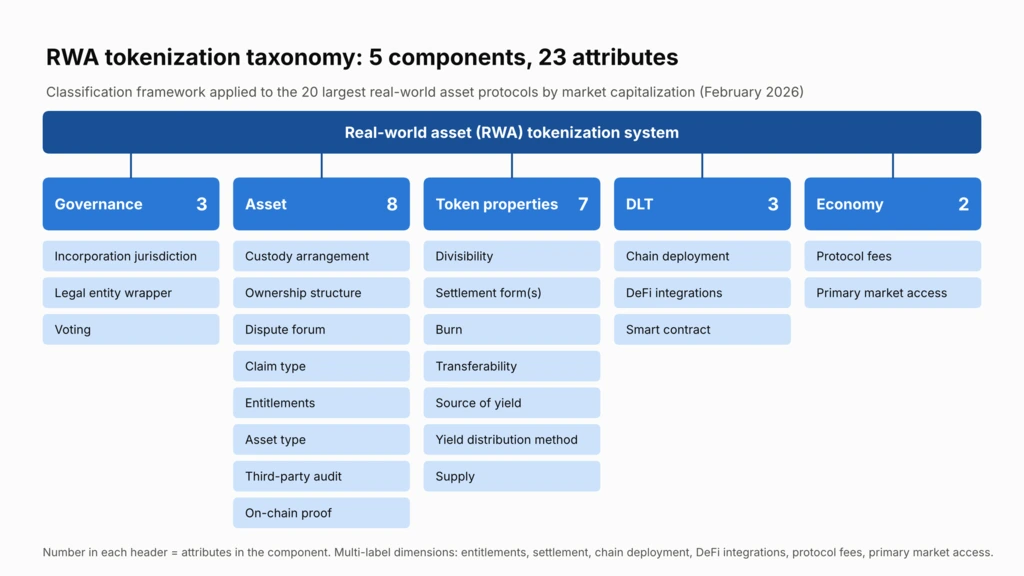
The framework organizes attributes under governance, asset, token properties, distributed ledger technology (DLT) and economy. Governance covers incorporation jurisdiction, legal entity wrapper and voting. The asset component covers custody, ownership structure, dispute forum, claim type, entitlements, asset type, audit and onchain proof.
Token properties cover divisibility, settlement, burn, transferability, yield source, yield distribution and supply. The DLT component covers chain deployment, DeFi integrations and smart contract functions, and the economy component covers protocol fees and primary market access.
Governance: Direct Issuers, Trusts and SPVs
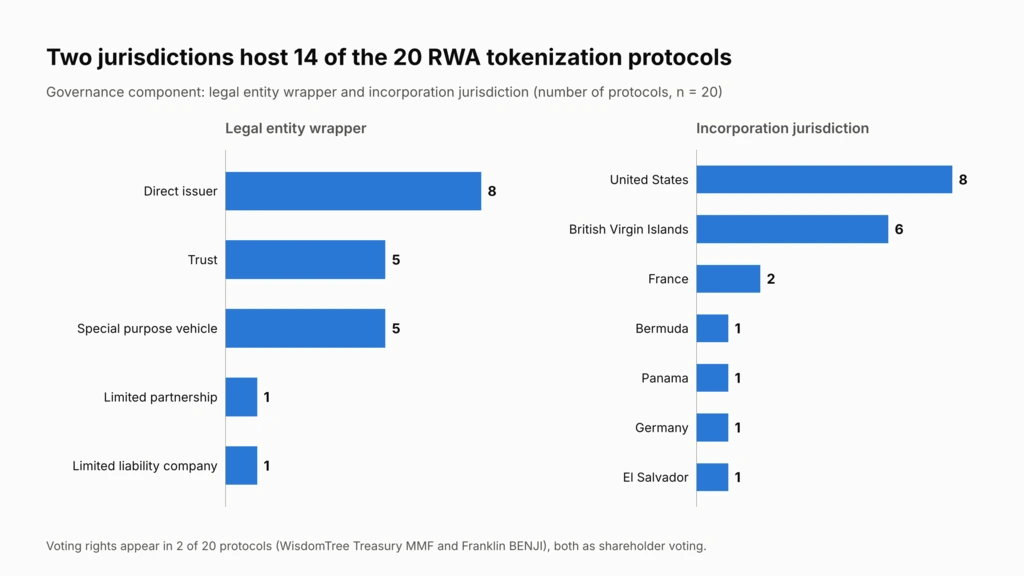
The sample relies on conventional legal entity wrappers, with eight direct issuers, five trusts, five special purpose vehicles (SPVs), one limited partnership and one limited liability company. The United States hosts eight protocols and the British Virgin Islands six, a combined 14 of the 20. France hosts two, and Bermuda, Panama, Germany and El Salvador host one each.
The governance table records voting in only two protocols, WisdomTree Treasury MMF and Franklin BENJI, and both attach shareholder voting to fund governance instead of onchain governance.
Asset Structure: Fixed Income and Offchain Claims
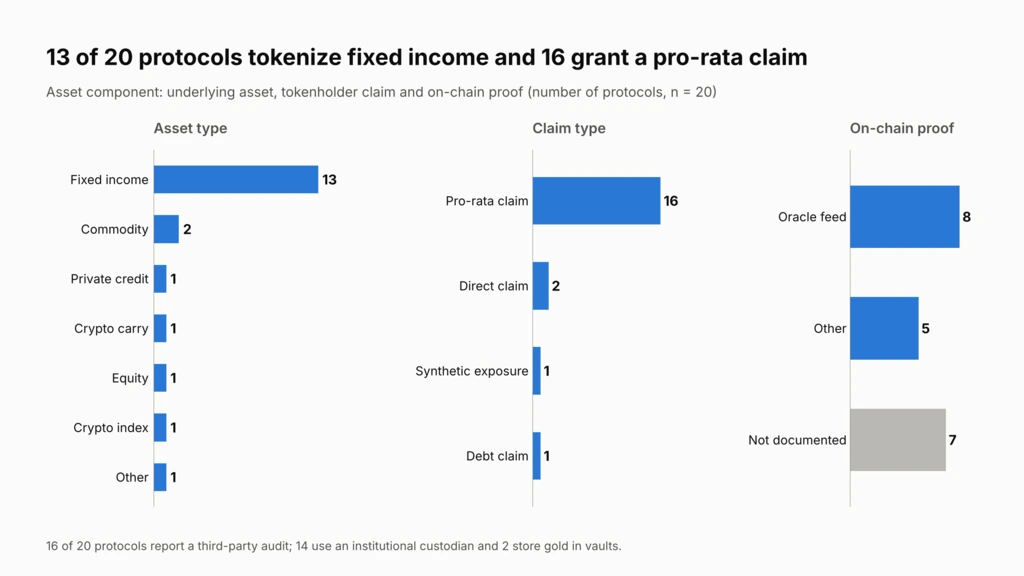
Thirteen of the 20 protocols tokenize fixed-income products, including BlackRock’s BUIDL, Treasury funds, money-market funds and credit vehicles, and two tokenize gold. Fourteen protocols rely on an institutional custodian, and two store metal in vaults. Sixteen grant a pro-rata claim on pooled assets, and most pair the claim with redemption rights and interest or income entitlements.
Tether Gold and PAX Gold show the commodity pattern: both use vault storage, beneficial ownership and issuer freeze powers, yet Tether Gold lists El Salvador as jurisdiction and BVI arbitration as dispute forum, and PAX Gold lists the United States and New York arbitration.
The token does not replace the legal ownership structure and works as an onchain interface to an offchain claim, a design in which 12 of the 20 protocols document no dispute forum and eight name a venue in New York, Delaware, Texas, the British Virgin Islands, Panama or France.
Reserve verification varies across the sample, with 16 protocols reporting a third-party audit and onchain proof dividing into eight oracle feeds, five other mechanisms and seven undocumented cases. Oracle services like Chainlink Proof of Reserve automate backing checks and can pause minting when reserves fall short.
Token Design: Whitelists, Accrual and Gaps
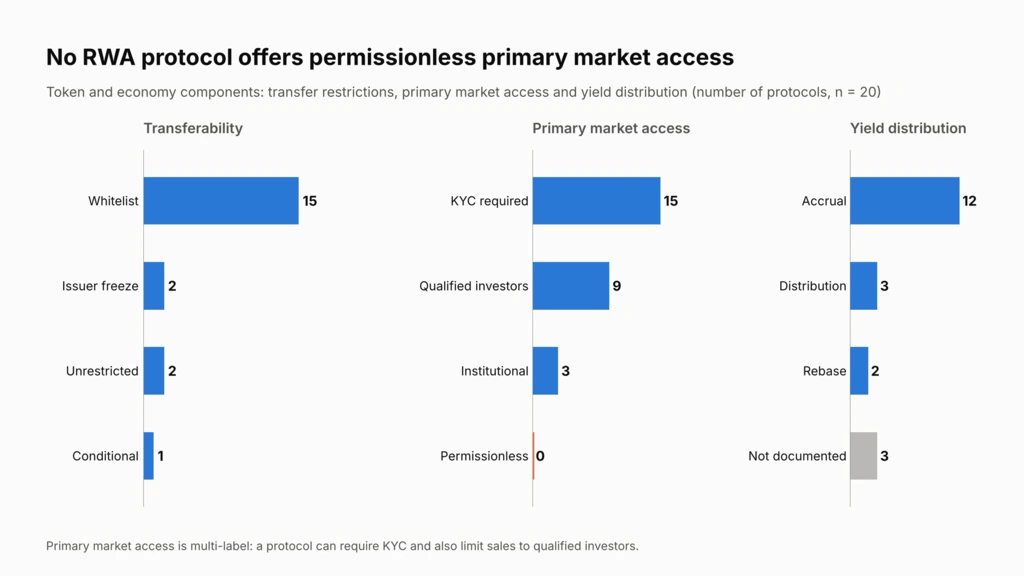
Whitelist-based transferability governs 15 of the 20 tokens, two issuers keep freeze powers, one applies conditional rules and two circulate without restrictions. Permissioned standards like ERC-3643 encode investor identity and compliance checks in transfer logic, which parallels the KYC and whitelist controls the study records.
Yield reaches holders mostly through accrual at 12 protocols, with distribution at three and rebasing at two, BUIDL and BENJI. Documentation gaps limit token-level comparison, since nine protocols publish no burn mechanism and eight publish no supply policy.
Chains and DeFi Integrations
Ethereum hosts 17 of the 20 tokens, and multichain issuance is common, with Franklin BENJI deployed on nine networks and BUIDL on eight, including Solana, Avalanche, Aptos, Arbitrum and BNB Chain. Ondo extended OUSG to the XRP Ledger in January 2025 and enabled round-the-clock minting and redemption against Ripple USD.
DeFi integrations appear in 17 of the 20 protocols and concentrate in lending markets, where Aave supports four of the tokens, including Anemoy funds through Aave Horizon, a compliance-focused market in which institutions borrow stablecoins against allowlisted tokenized assets. Morpho supports four tokens, including Spiko funds and mF-ONE, and its published playbook describes supplying a tokenized position as collateral and borrowing stablecoins from curated vaults.
Access Stays Permissioned
None of the 20 RWA tokenization protocols lists permissionless primary market access, nine restrict purchases to qualified investors, three target institutional investors and 15 apply KYC requirements. Primary issuance and redemption follow legal and commercial constraints even when tokens circulate on public blockchains.
Fee structures range from a single management fee at Anemoy, Ondo OUSG and Franklin BENJI to four-part schedules at Spiko and Superstate USCC, which add custody, administration, audit, DLT transaction or operating charges.
Regulatory Context and Study Limits
The Financial Stability Board judged tokenization immaterial to financial stability at current adoption levels in its October 2024 report, and it listed liquidity and maturity mismatch, leverage, asset quality, interconnectedness and operational weaknesses as vulnerabilities if adoption grows.
An SEC staff letter dated August 12, 2026 allows Franklin Templeton’s registered funds to hold BENJI shares for cash management without meeting certain physical custody requirements, according to The Block.

Isai Alexei is a journalist and financial analyst covering cryptocurrency markets and traditional securities for Blockchaindose. He has spent ten years analyzing digital assets, trading activity, and market structure.