
The value of real-world assets recorded on blockchain reached $38.54 billion on September 26, 2026, according to rwa.xyz. The figure represents an increase of about 84% from the $21 billion recorded in January. Asset managers use the market’s growth to support projections of $2 trillion by 2028 and $16 trillion by 2030.
Another indicator shows a different development. Open interest in RWA perpetual contracts increased from 6% to 24% of the total perpetual futures market during the same period. The growth of derivatives has accompanied the expansion of tokenized assets and represents a significant share of financial activity linked to the sector.
The Numbers Everyone Quotes
Three indicators account for much of the analysis surrounding real-world asset tokenization in 2026. According to rwa.xyz, on-chain RWA value increased from $21 billion to $38.54 billion over nine months, a rise of about 84%. BlackRock, Franklin Templeton and Securitize have used the market’s growth as a reference for their own projections.
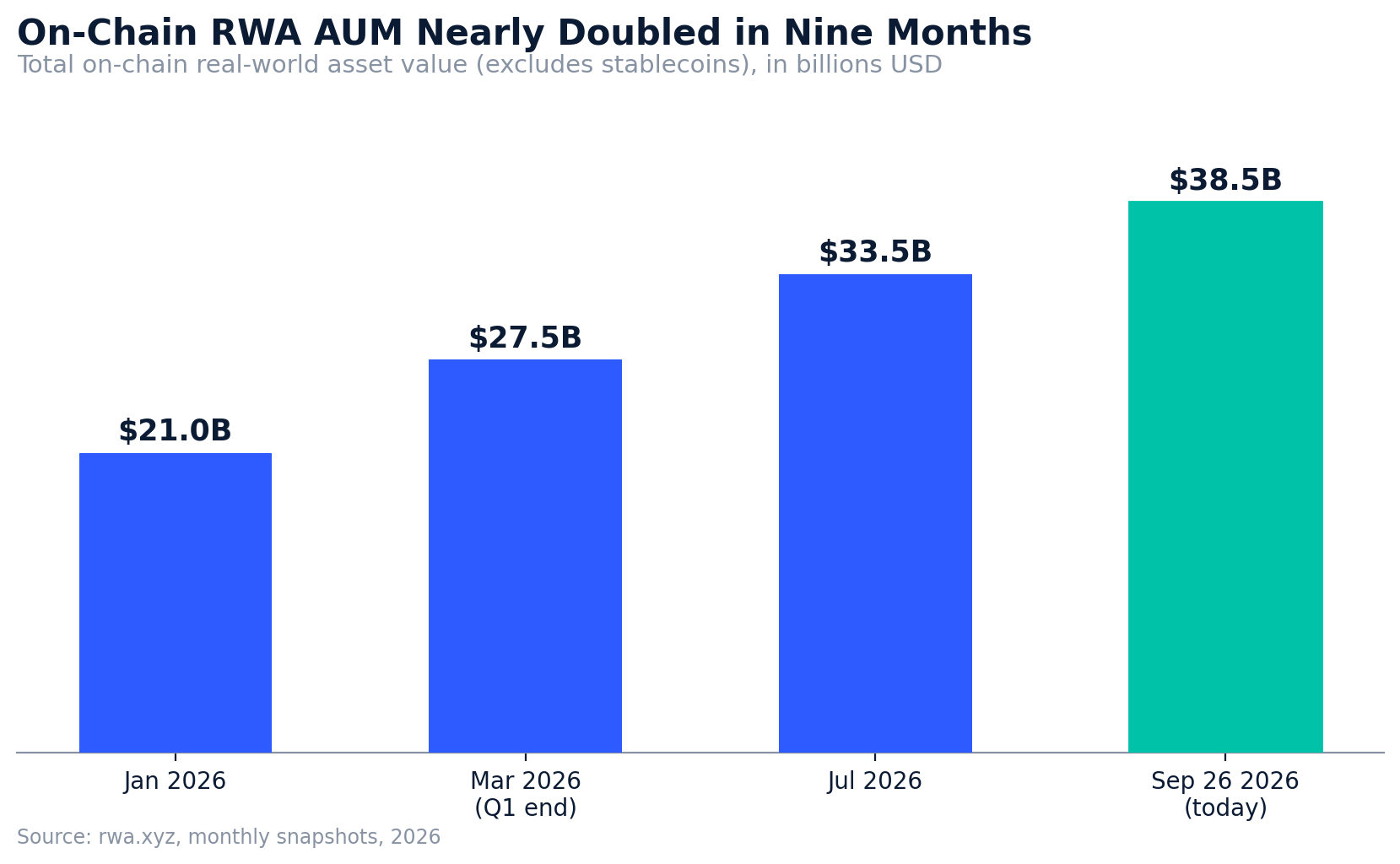
The market added about $5 billion between July and September. The period recorded the largest increase of the year after the market reached $27.5 billion in March and $33.5 billion in July.
A comparison with stablecoins requires separating the two markets. Stablecoins, which are not included in a standard methodology for calculating RWA value, maintained a market capitalization between $290 billion and $321 billion during the period under review.
RWA has recorded a higher percentage growth rate, but its absolute value remains substantially lower than the stablecoin market. The two indicators describe markets with different scales and do not contradict each other’s growth rates.
Eighty Cents of Every Tokenized Dollar Sit in Government Debt
Market composition provides more information than the headline total. According to an analysis by Steakhouse Financial cited by Yellow.com Research, US Treasury products and cash equivalents accounted for between $26 billion and $28 billion of the $33.5 billion reported in July, representing about 80% of the market.
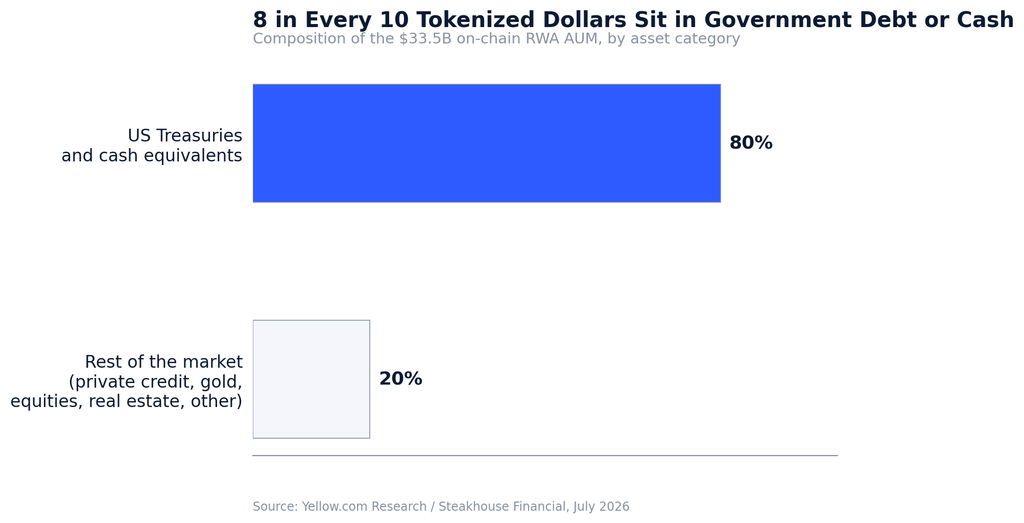
The rest of the market is distributed across private credit, tokenized gold, equities and real estate. Each category has recorded relative growth, but none approaches the share held by Treasury products.
Tokenized gold, for example, recorded $90.7 billion in spot trading volume during the first quarter, exceeding its combined volume for all of 2025. The figure measures trading activity, not the value of assets outstanding.
One Chain Dominates, and No Tracker Agrees by How Much
Blockchain concentration adds another variable to the analysis. rwa.xyz placed Ethereum at 47.9% of RWA value in July, followed by BNB Chain at 12.1%, Solana at 9.8% and Stellar at 9.0%.
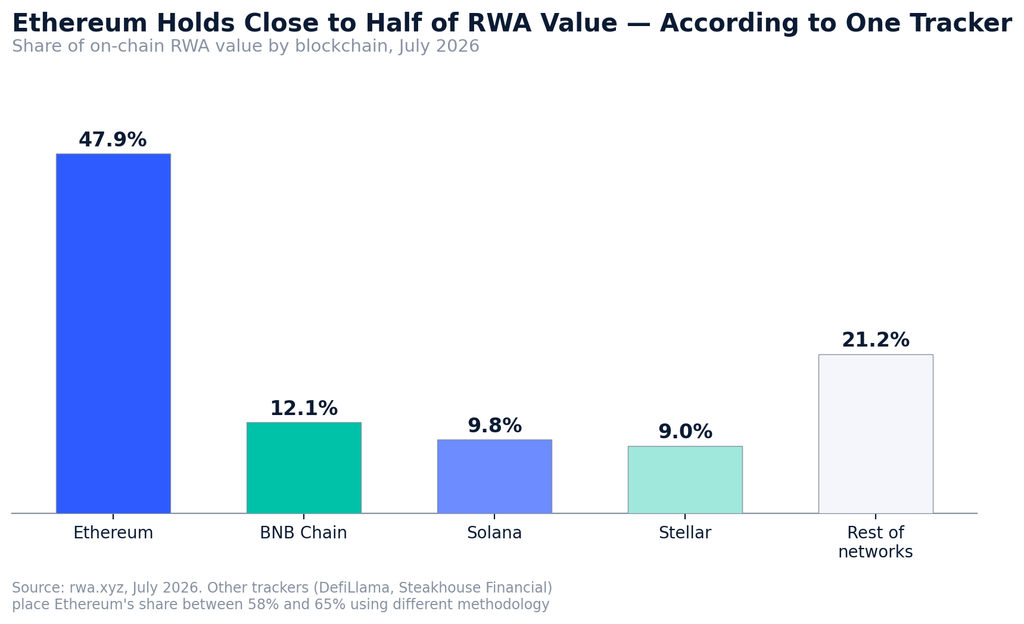
Other data providers report different figures for the same period. DefiLlama and Steakhouse Financial place Ethereum’s share between 58% and 65%, while The Block reported a 65% share in July based on its own data.
The differences result from the methodologies used to define and count RWA assets. Data providers can classify asset categories, issuance structures and blockchain networks differently. The figures therefore cannot be compared directly without examining the criteria behind each measurement.
The Capital That Does Not Work
Close to 90% of RWA assets under management (AUM) sits outside DeFi protocols. CryptoRank Research data from September 22 shows that only 11.3% of the $34 billion under management sits deployed in lending, liquidity pools or collateral. Private credit accounts for 58% of deployed capital, while the four largest categories account for nearly 95%. Even combined, deployed capital represents a small fraction of the $34 billion total.
The figure challenges the idea that RWAs function as a bridge to traditional finance. Treasury tokens, instead, move on-chain and remain in custody wallets: they generate the coupon but do not create additional economic activity.
Aave added Ondo’s OUSG token as collateral. Morpho, in turn, launched lending pools backed by tokenized Treasuries. Both cases remain exceptions within a $34 billion market.
Who Collects the Coupon While the Capital Waits
The three largest tokenized Treasury funds hold much of the idle capital: BlackRock’s BUIDL manages between $1.9 billion and $2.5 billion, Ondo Finance adds close to $1.4 billion across OUSG and USDY, and Franklin Templeton’s BENJI contributes another $680 million. All three pay between 4.3% and 4.8% a year: the T-bill yield minus a management fee.
The model works like a money-market fund represented through a token: it pays the coupon, but it does not relend the capital or use it as collateral. It also generates no additional on-chain fee revenue.
For the issuer, every dollar under management generates a fixed fee, regardless of whether the token changes hands or remains in an institutional wallet. The incentive points toward growing total AUM, not toward putting capital to work inside DeFi.
Competition among the three issuers depends largely on distribution rather than yield. BlackRock uses Securitize for issuance and a growing list of blockchain venues. Ondo developed its own lending and custody infrastructure around OUSG.
Franklin Templeton manages BENJI through its existing fund infrastructure. The three yields remain within half a percentage point of each other. Reach across chains and custodians, rather than price, determines where new capital goes.
The Other RWA: The Derivatives Market
While capital remains in custody, a parallel market grew at its own pace. According to CryptoRank Research, RWA’s share of total perpetual open interest increased from 6% at the start of 2026 to 24% on September 22. Total perpetual open interest stands near $25 billion, while on-chain perpetual exchanges reached a record $19 billion.
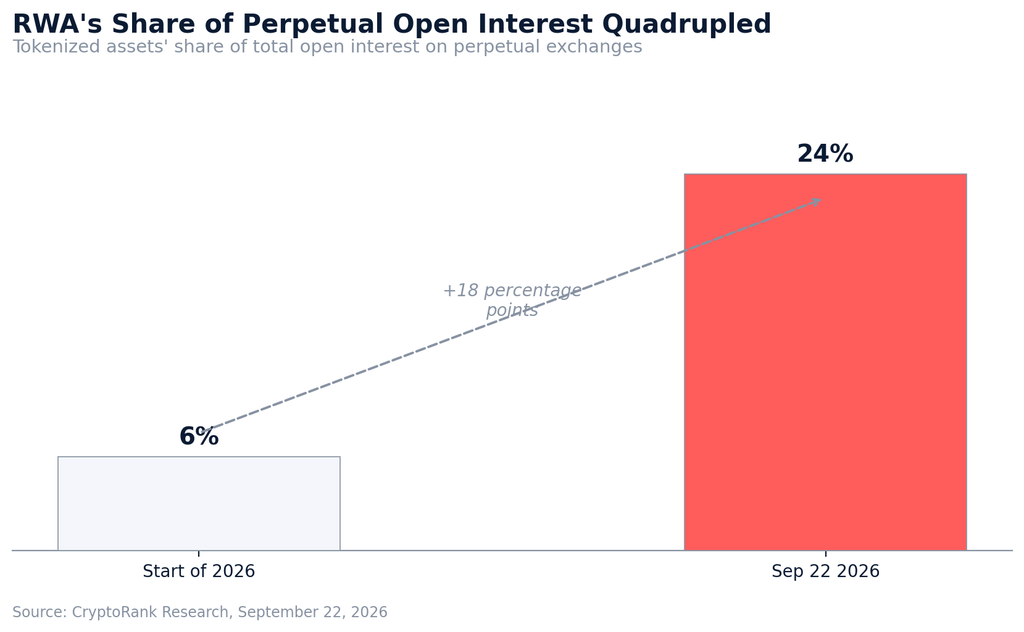
The report itself documents the correlation: RWA’s share of volume rises when Bitcoin weakens and declines when crypto-wide momentum returns. Traders use tokenized stock and commodity markets as a hedge within the same crypto system, not as an entry point from traditional finance.
More than 1,000 RWA markets now trade on perpetual exchanges. Tokenized equities account for 75% of the listings, while commodities and foreign-exchange pairs account for most of the remaining 25%. The tokenized-equity segment has a combined market capitalization of $3.5 billion, led by BNB Chain with close to $1 billion, followed by Ethereum and Solana.
Sixteen Cents of Bet for Every Real Dollar
No published report combines the two series into a single figure. At 24% of a total open interest pool near $25 billion, RWA perpetual open interest amounts to roughly $6 billion, compared with spot AUM of $38.54 billion, a ratio of about 15.6%.
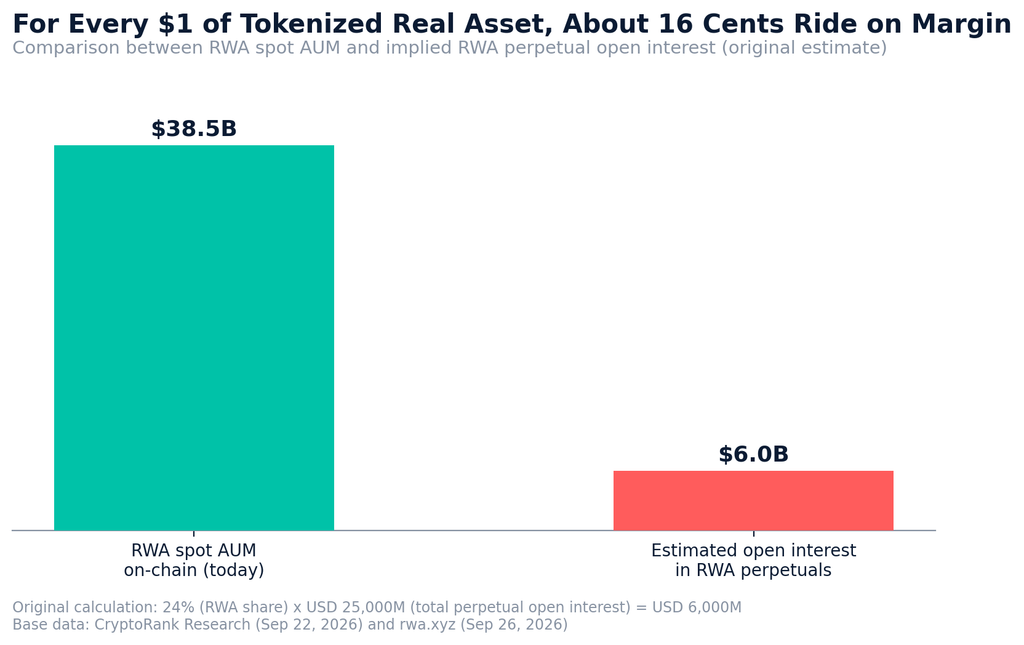
The calculation is original and uses CryptoRank Research and rwa.xyz data from September 22 and September 26, respectively. For every dollar of tokenized real-world assets, close to 16 cents of margin-based positions operate in parallel without affecting the underlying asset or its custodian.
The ratio measures open interest only, not trading volume. A Stobox report recorded $524.8 billion in RWA perpetual trading volume during the first quarter, compared with only $33 billion in spot value during the same period. Derivatives trading volume therefore reached sixteen times the size of the market it represents within a single quarter.
What Changes for 2026 and 2027
Regulators in the United States and the European Union are drafting rules that will determine whether the sector expands into equities and private credit or remains concentrated in fixed-income assets. No regulatory decision so far addresses the derivatives market, which grew four times faster than the spot market over nine months.
Forecasts that place the tokenized real-world asset (RWA) market at $2 trillion by 2028 assume that more tokenized capital will move into productive DeFi applications. Capital remains concentrated in tokenized assets while derivatives exposure continues to grow around the market.
Bitcoin reached about $126,198 in October 2025, fell below $60,000 by mid-2026 and recovered to about $80,000 by September. Changes in Bitcoin volatility coincided with changes in RWA’s share of the perpetuals market. The total crypto market capitalization stood at about $2.97 trillion in September, with Bitcoin accounting for 56.69%. RWA’s $38.54 billion represented about 1.3% of the total crypto market capitalization after nine months of growth.
Three indicators will help determine whether market structure changes during the next two quarters. The first is the share of RWA capital deployed in DeFi, which would need to move above 11.3%. The second is the difference between tracking platforms, which would need to narrow as market data standards converge. The third is RWA perpetual open interest, which would need to decouple from bitcoin price declines. September data did not show a clear change in any of the three indicators.
The difference between AUM and derivatives open interest will provide a more useful measure of market development than AUM alone. A smaller gap would indicate greater use of tokenized assets beyond passive holding. A wider gap would indicate that derivatives activity is growing faster than the underlying RWA market.

Isai Alexei is a journalist and financial analyst covering cryptocurrency markets and traditional securities for Blockchaindose. He has spent ten years analyzing digital assets, trading activity, and market structure.