

A paper published in November 2025 by Hamoon Soleimani concludes Bitcoin as money faces structural barriers beyond price swings. The analysis applies Post-Keynesian and Austrian monetary theory, tests both with econometric data, and classifies Bitcoin as a speculative asset instead of a monetary standard.
Monetary Theory Excludes Bitcoin
Post-Keynesian economists define money as a debt instrument issued by a state, which accepts it for tax payments. Money also needs near-zero elasticity of production and substitution; profitable mining and demand-driven value fail both tests. Bitcoin has no issuer and no liability on a balance sheet, and the framework excludes it. Austrian economists apply Ludwig von Mises’s Regression Theorem, which traces money to a prior non-monetary use. Bitcoin launched without one. Davidson and Block argue the theorem applies only to the first money to emerge from barter.
Volatility, Fixed Supply and Debt
Annualized volatility exceeded 100% in some periods and ran about 3.6 times the level of gold in calmer ones. A GARCH(1,1) model puts the half-life of a volatility shock near 53 days. The fixed supply of 21 million coins adds pressure: demand shifts move price because quantity cannot adjust. A growing economy under a fixed money stock produces deflation, and an IMF study of 21 advanced economies links recessionary deflation to a 3.2-point annual rise in public debt-to-GDP ratios.
A wavelet study found inflation-hedging behavior only during the acute phase of COVID-19 in 2020. Drawdowns above 70% recurred, and Bitcoin’s 60-day correlation with the S&P 500 reached 0.65 in 2020 and 2022.
Throughput, Lightning and Security Costs
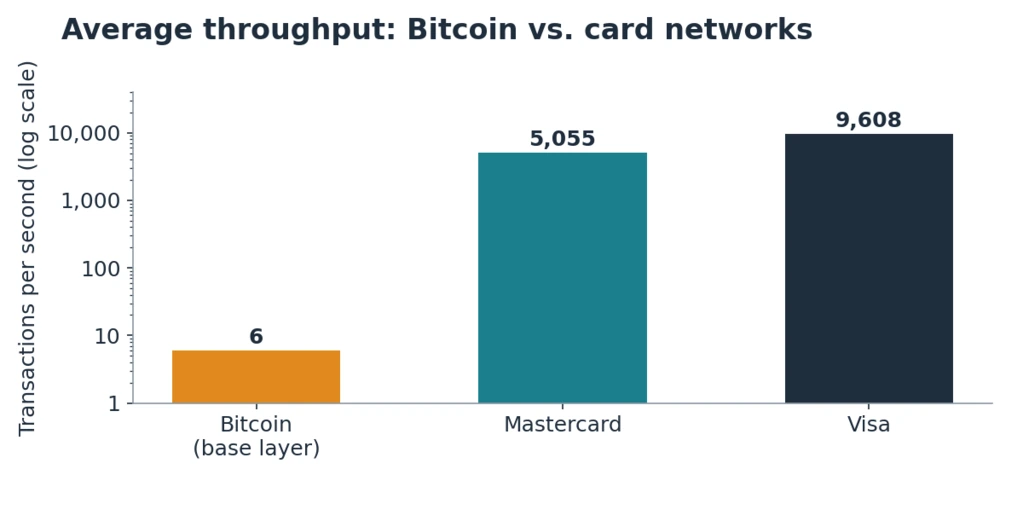
The base layer settles about six transactions per second, and Visa’s network processes more than 1,600 times Bitcoin’s base-layer volume. The Lightning Network raises capacity, but probing studies report 44% payment success at $10 in one test and failure above 80% in another, even after 25 retries. Game-theoretic models predict liquidity hubs will dominate routing and recreate intermediaries.
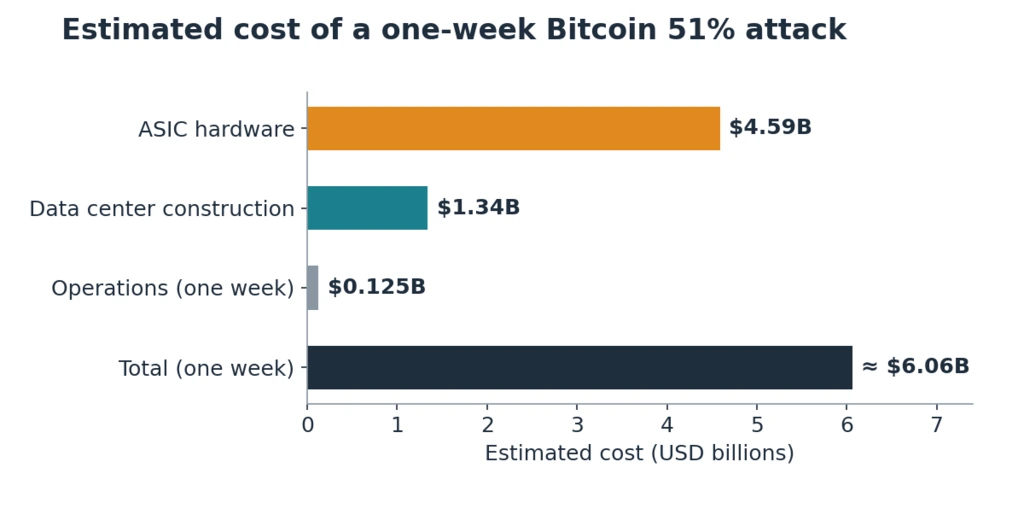
Eric Budish’s model requires continuous payments to miners larger than the one-time gain from an attack. Each halving cuts the block subsidy, and transaction fees must replace it. Higher fees reduce usability; lower fees reduce hashrate and the cost of a 51% attack, which Harvey estimates near $6 billion for one week. Foundry USA and AntPool controlled about 43% of hashrate in November 2025. Jones, Goodkind and Berrens estimated climate damages from mining at 35% of Bitcoin’s market value from 2016 to 2021, against 4% for gold.
Market Structure, Tether and Regulation
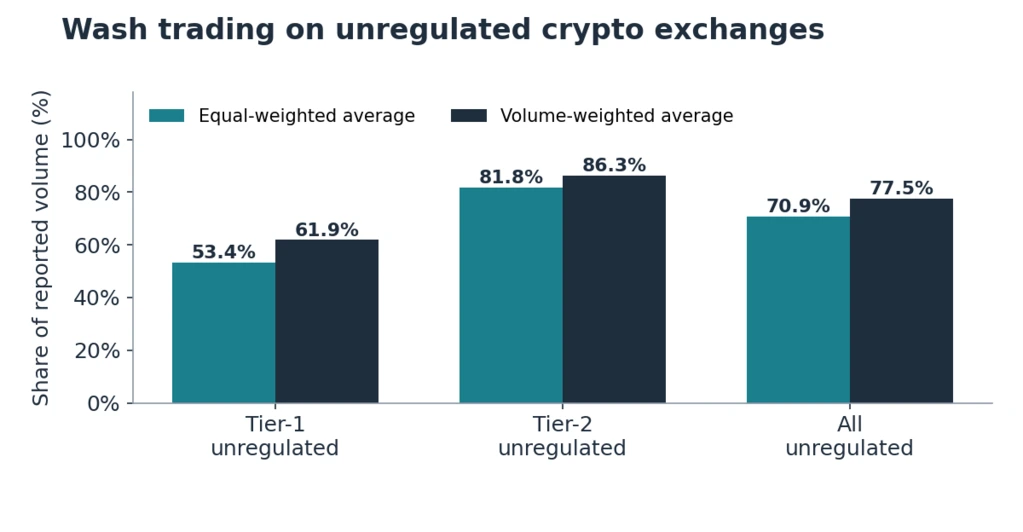
Cong, Li, Tang and Yang found wash trading averaged more than 70% of reported volume on unregulated exchanges. Griffin and Shams tied Tether issuance to Bitcoin price gains in 2017, and Tether held about 58% of stablecoin market capitalization in November 2025. Minsky’s framework classifies most market activity as speculative finance, and the failures of Celsius and Three Arrows Capital followed Ponzi-finance patterns. The Basel Committee assigns a 1250% risk weight to Group 2 crypto-assets, including Bitcoin, and has accelerated a targeted review of the standard.
In El Salvador, the first country to grant Bitcoin legal tender status, survey and blockchain data show low, concentrated and declining use. Legal status did not translate into daily payments.
Assessment: Technology Versus Monetary Function
Blockchain technology solves double spending without a trusted intermediary, but fixed supply, throughput limits and security economics conflict with monetary functions. Hazlett and Luther argue money requires only a commonly accepted medium of exchange, and market capitalization data supports the narrower definition. Bitcoin’s monetary velocity fell below the US M2 money stock, which indicates holding outweighs spending.
FAQ
Can Bitcoin function as money?
Bitcoin as money meets part of the standard definition. Bitcoin operates as a medium of exchange in a narrow domain, while price volatility, low throughput and falling velocity weaken its roles as unit of account and store of value.
Why does a fixed supply create a monetary problem?
A fixed supply of 21 million coins cannot respond to demand; demand shifts move price instead of quantity. Economic growth under a fixed money stock also produces deflation, which raises the real burden of debt.
How reliable are Lightning Network payments?
Reliability falls as payment size rises. Waugh and Holz recorded about 72% success at $0.01, 44% at $10 and 31% at $50 in a probe of Lightning Network nodes.
Did legal tender status make Bitcoin a currency in El Salvador?
No. Survey and blockchain data from NBER researchers show low, concentrated and declining use of Bitcoin and the Chivo wallet after the 2021 law.
How does the Basel framework treat Bitcoin on bank balance sheets?
Group 2 crypto-assets, including Bitcoin, carry a 1250% risk weight, which requires capital at least equal to the exposure. The Basel Committee has accelerated a targeted review of the standard.

Isai Alexei is a journalist and financial analyst covering cryptocurrency markets and traditional securities for Blockchaindose. He has spent ten years analyzing digital assets, trading activity, and market structure.