
When people discuss blockchain, the conversation often focuses on finance: Bitcoin, Ethereum, exchanges and DeFi. The association has a historical basis because Bitcoin was the first application to use blockchain architecture. However, the technology has a broader scope. A blockchain functions as a distributed, immutable ledger that every participant can verify. The architecture allows parties that do not fully trust one another to coordinate without relying on a central intermediary.
Healthcare provides several conditions for examining blockchain under that framework. Hospitals, insurers, laboratories, pharmaceutical companies, researchers and patients manage sensitive data through systems that rarely communicate with one another. Fragmentation produces medical records distributed across different systems, slow claims processing, limited supply-chain transparency and reproducibility problems in biomedical research.
Some advocates compare blockchain’s potential with TCP/IP: an open, shared protocol that belongs to no single entity and can support the development of other services. TCP/IP took more than three decades to progress through four adoption phases: single use, localized use, substitution and transformation.
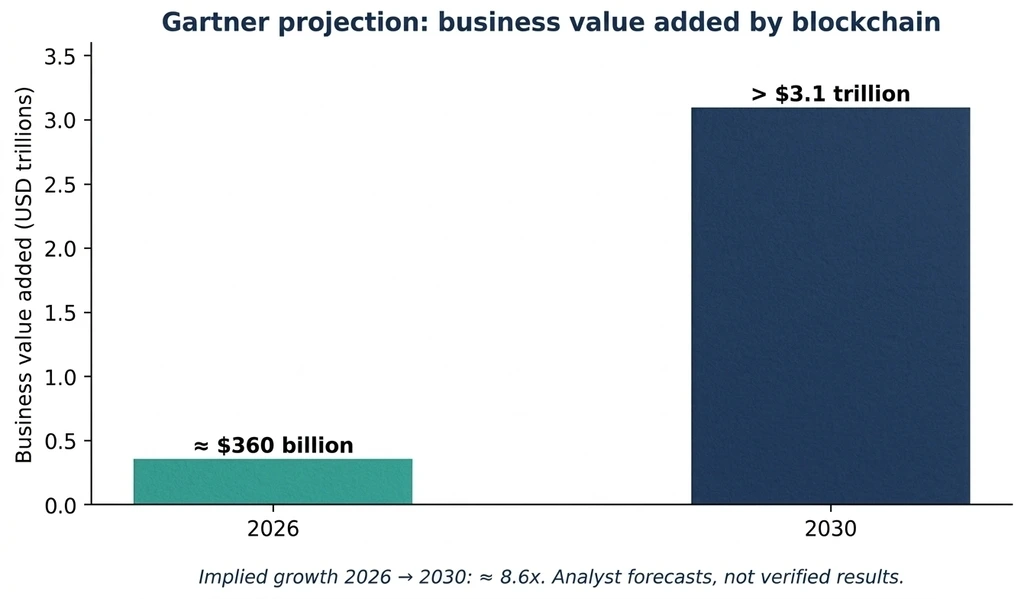
Gartner projected that the business value generated by blockchain would exceed $360 billion in 2026 and $3.1 trillion in 2030. McKinsey estimated that more than $300 billion per year could be recovered through effective and creative use of healthcare data.
Analyzing blockchain in healthcare and biomedicine requires examining several elements: what the technology is, how it fits into healthcare, which concrete projects exist, the economic implications involved and the risks it presents.
Fundamental Concepts and Technical Architecture
What a Blockchain Is, Technically
A blockchain is a record shared among participants, with each participant maintaining a copy through replication. Transactions are grouped into blocks, which form the basic unit of verification. Each block contains the hash of the previous block’s header, creating a chain.
The relationship between blocks establishes a deterministic order. Each block also serves as a time reference for the transactions it contains. The mechanism solves the double-spending problem without relying on a central authority.
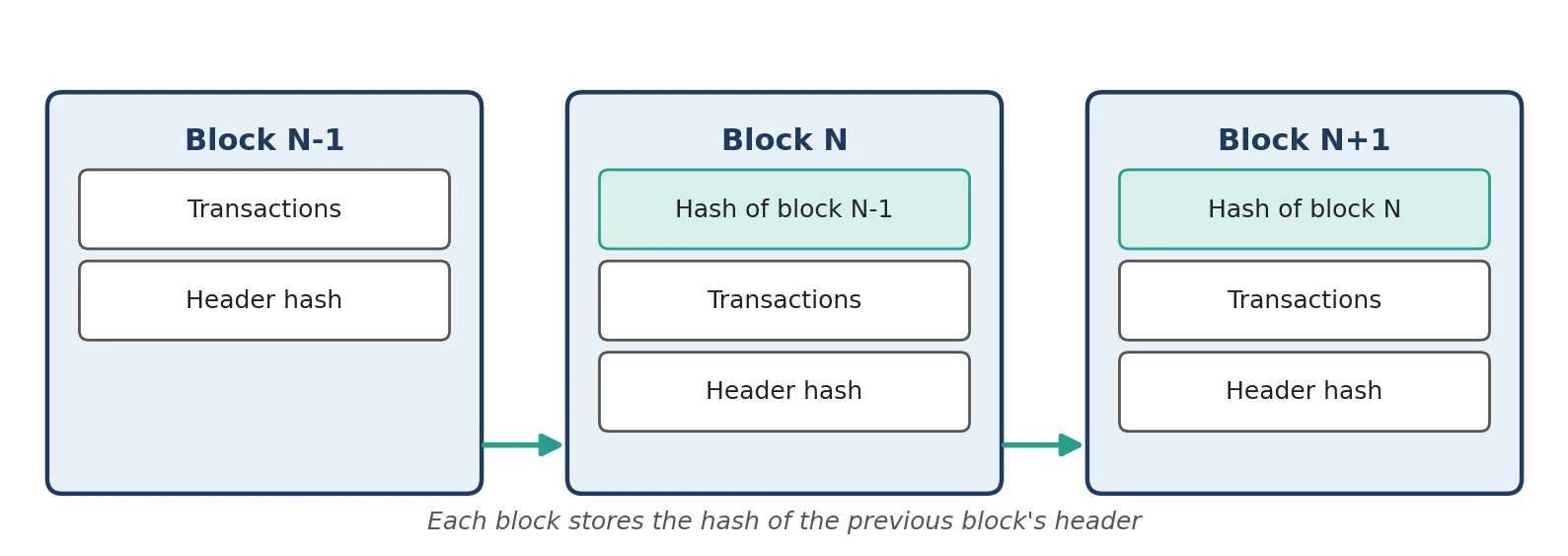
If someone modifies a transaction contained in block N-1, the block’s hash changes. As a result, the pointer stored in block N no longer matches the expected value. Any node that maintains a copy can detect the alteration. For this reason, blockchain records are described as irreversible.
Permissioned versus Permissionless
In a permissionless network, participants are anonymous or use pseudonyms, and any participant can append blocks. Bitcoin is the classic example and uses a proof-of-work (PoW) consensus mechanism.
In a permissioned network, each participant’s identity is controlled, as is their authorization to validate blocks. Permissioned networks are sometimes associated with proof-of-stake (PoS), but enterprise networks generally use mechanisms such as “selective endorsement,” which determines who can verify transactions.
Hyperledger Fabric, backed by IBM and the Linux Foundation, follows this approach. The Enterprise Ethereum Alliance and Microsoft’s Coco framework also follow this logic.
The differences between a blockchain designed for cryptocurrencies and one designed for business can be examined through three axes: assets instead of currency alone, identity instead of anonymity, and selective endorsement instead of mining.
The first axis expands the types of elements that can be recorded, from bonds to physical goods. The second replaces anonymity with participant identification, which is relevant in healthcare because organizations need to determine who accesses a record. The third replaces mining with a mechanism that selects who verifies transactions.
Smart Contracts and the Five Principles
Smart contracts are programs that facilitate, execute and enforce an agreement automatically. Ethereum is the best-known platform for these contracts, and Microsoft adopted it as the foundation of its Blockchain-as-a-Service offering on Azure. Once deployed, a contract is immutable and maintains the same behavior indefinitely. This characteristic provides predictability, but it also creates a risk: errors remain part of the contract.
The five principles that describe how blockchain works in practice are: distributed database, peer-to-peer transmission, transparency with pseudonymity, irreversibility of records and programmable computational logic.
Detailed Analysis: How It Works and Healthcare Use Cases
The Key Architectural Pattern: Data Off-Chain, Pointers On-Chain
A common mistake is to assume that medical records are stored inside the blockchain. In practice, that design is not workable because of the volume of clinical data, its exponential growth and the high frequency of transactions.
The usual solution is to keep the data off-chain, outside the blockchain, and use the chain to manage permissions and guarantee data integrity.
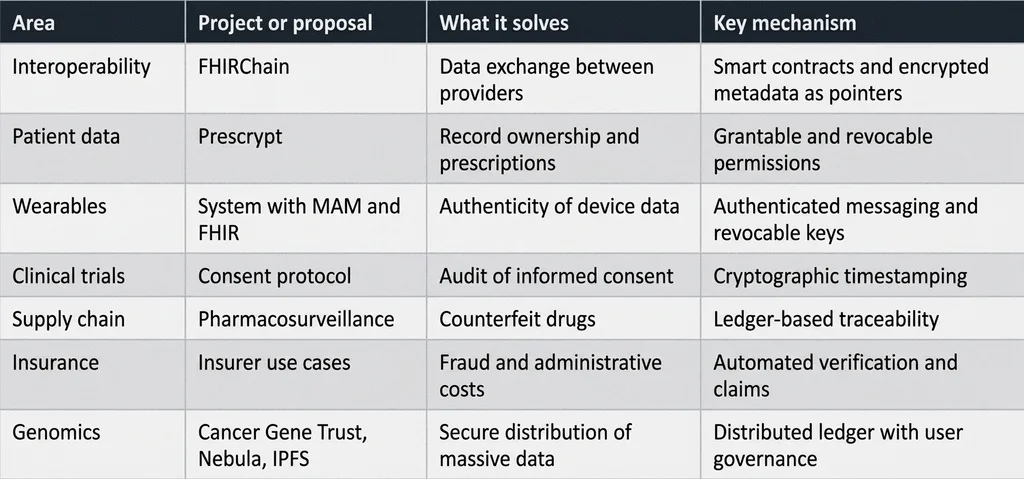
FHIRChain provides the clearest example. It is a smart-contract-based system for exchanging data according to the FHIR standard. Clinical data remains off-chain, while the blockchain stores encrypted metadata that functions as pointers to the primary source.
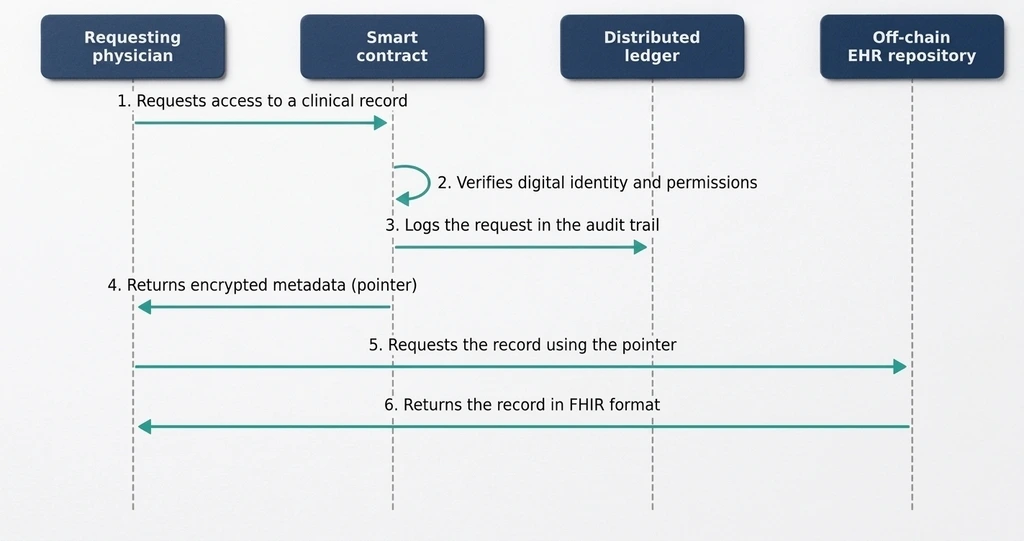
The design separates the functions of each layer. The ledger provides auditability and access control, while the conventional repository provides storage capacity.
Concrete Use Cases
Information exchange and interoperability. In the United States, the ONC’s interoperability roadmap requires secure network infrastructure, authentication of all participants and authorization to access information.
Patient control over data. Prescrypt, a proof of concept developed by Deloitte Netherlands with SNS Bank and Radboud3, gives patients ownership of their records, allows them to grant and revoke access, and enables providers to issue prescriptions directly on the chain. Another proposal, the Healthcare Data Gateway app, aims to let patients own, control and share their data without compromising their privacy.
A team of researchers also demonstrated that data from wearable devices can be transmitted with authentication and encryption and structured using FHIR. Patients can revoke access to their future data by changing authentication keys.
Clinical data and consent. A study on remote cancer care designed a decentralized application with digital health identities to authenticate participants and share specific information.
Pharmaceutical supply chain. Counterfeit drugs represent a public health problem that, according to the source article, costs the industry around $200 billion per year. Systems such as Pharmacosurveillance seek to address the problem through verifiable traceability.
Insurance. Blockchain can remove intermediaries and clearing houses, provide a basis for prior authorizations and automated claims processing, and reduce costs through automated verification of policyholder identity and contract validity.
Research and genomics. A notarization service based on smart contracts can seal each query submitted to a biomedical database together with its result and support evidence versioning. In genomics, high-throughput sequencing generates large datasets that require user-level governance. Examples include Cancer Gene Trust (GA4GH), CrypDist, Gene-chain, Zenome and Nebula Genomics, as well as the IPFS file system.
Economic Impact and Financial Implications
The advantages include less time spent finding information, resolving disputes and verifying transactions; lower intermediation costs; and reduced risks of collusion, tampering and fraud. Research also introduces an incentive mechanism. The chain can reward the sharing of computing and storage resources. Some proposals seek to assign value to personal health data based on its combination, time and relationship value, allowing patients themselves to participate in that value.
Market projections show the scale of the expectations. The figures should be interpreted as what they are: analyst forecasts, not verified results.
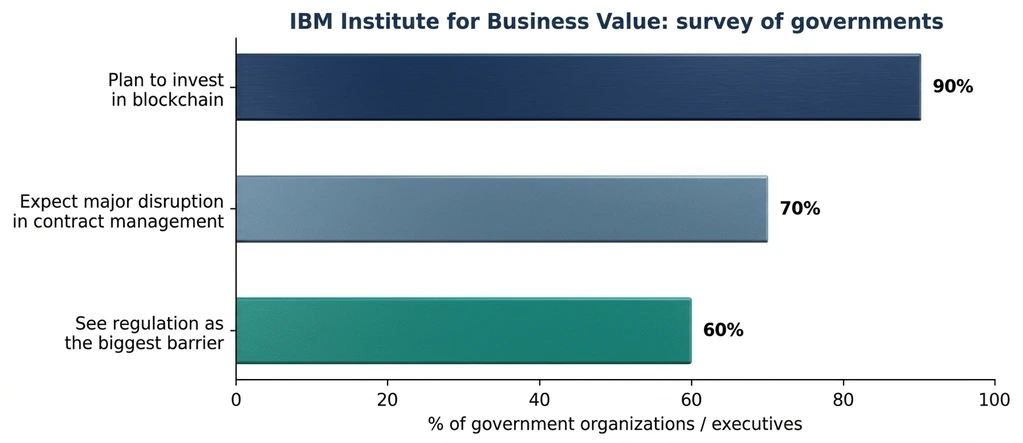
Institutional sentiment, according to a survey of governments by the IBM Institute for Business Value, shows the same contrast between interest and caution:
At the system level, the potential savings reach substantial figures: McKinsey estimated $300 billion per year, while the industry loses $200 billion to counterfeiting. A central economic obstacle remains: incentives.
Large healthcare systems have already invested—often with government incentives—in commercial medical record systems developed by vendors. Migrating to a technology considered experimental and lacking associated funding offers the best guarantees. Building patient-facing connections without a financial incentive is also difficult.
Challenges, Risks and Future Outlook
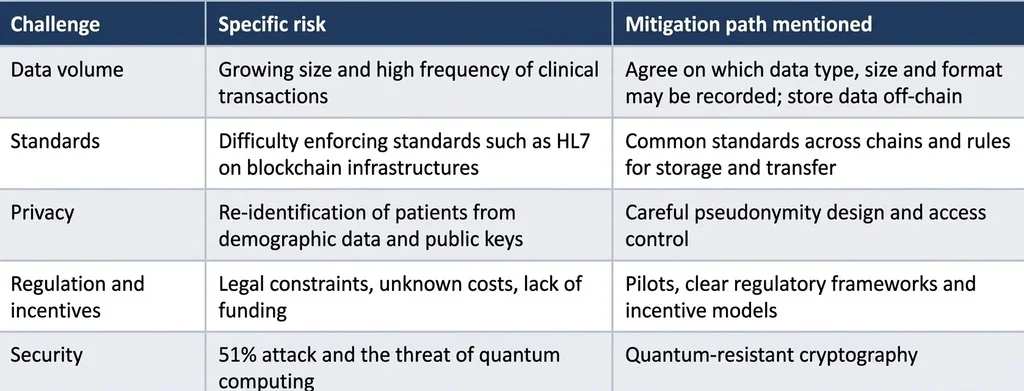
Although many implementations use pseudonyms, attributable information such as demographic data can make it possible to deduce the identity behind a public key. Once that relationship is established, the record is exposed. In healthcare, privacy and security are essential requirements.
Instead of relying on an organization’s internal administration, the blockchain enforces the rules through the network itself. As a result, part of the risk shifts to protocol and smart contract design.
In network security, the 51% attack is considered the most serious threat. If malicious participants outnumber honest participants, they can take control of the chain.
Quantum computing introduces a longer-term risk because one-way functions and cryptographic algorithms provide the system’s only defense.

Isai Alexei is a journalist and financial analyst covering cryptocurrency markets and traditional securities for Blockchaindose. He has spent ten years analyzing digital assets, trading activity, and market structure.