

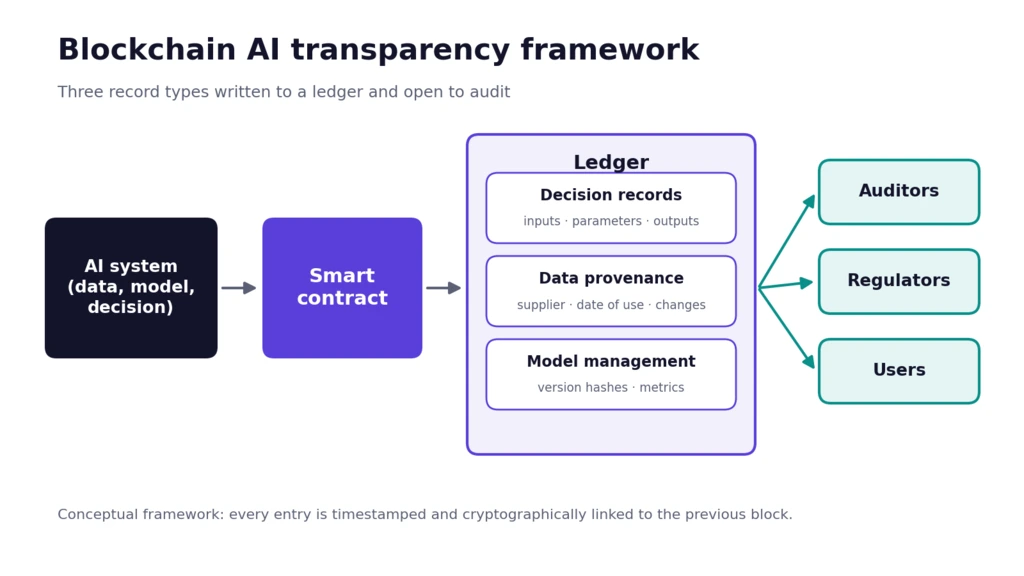
Blockchain AI transparency received a formal proposal from six researchers at Emporia State University in Kansas, who posted a framework in March 2025. The paper argues a distributed ledger can store each AI decision, the data behind it and every model update in a tamper-evident log. Auditors, regulators and users would verify the history without trusting the system operator.
The study targets healthcare, finance, autonomous driving, legal, employment and retail, where unexplained automated decisions carry legal and safety consequences.
Three Records the Framework Stores On-Chain
Decision records capture inputs, parameters and outputs, and a smart contract writes each entry when preset conditions hold. Each block carries a timestamp and a cryptographic link to the previous block. Data provenance records store dataset metadata: the supplier, the date of use and any alteration.
Model management records keep hash values of each model version with performance metrics, so reviewers identify the exact model behind a decision and restore an earlier version when needed.
Blockchain Records Actions, Not Reasoning
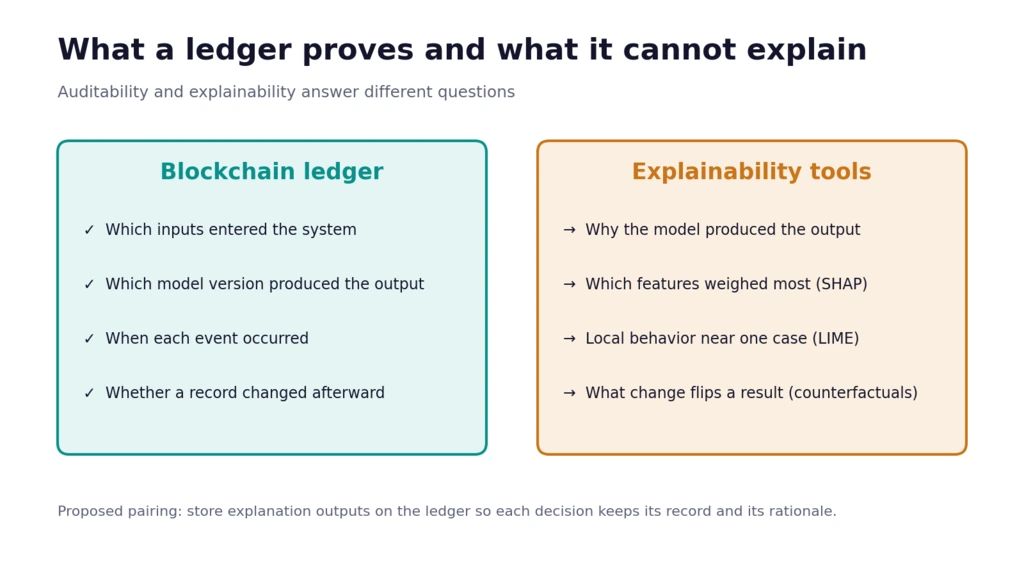
A ledger proves what a system did; the ledger does not explain why. The authors acknowledge the limit and note model interpretability varies. Decision trees expose their rules, while deep neural networks stay opaque. The paper recommends pairing the ledger with SHAP, LIME or counterfactual reasoning, and lists on-chain storage of the resulting explanations as future research.
Scalability and Platform Choice
Blockchains built on proof-of-work process few transactions per second, and real-time AI workloads in autonomous driving or trading need faster recording. The paper points to proof-of-stake, delegated proof-of-stake, directed acyclic graphs, rollups, sharding and state channels as mitigations.
It names three candidate platforms: Ethereum for programmable smart contracts, Hyperledger Fabric for permissioned enterprise ledgers and Corda for privacy-focused financial applications.
Privacy Rules Constrain On-Chain Storage
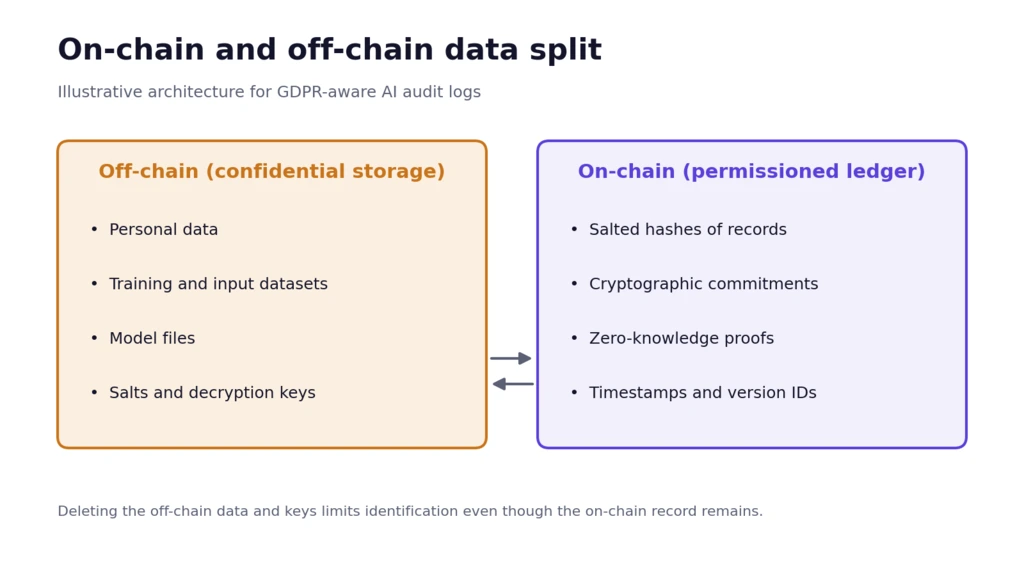
The paper flags the GDPR right to erasure and suggests zero-knowledge proofs, homomorphic encryption and privacy-preserving contracts. Regulators have since set firmer limits. The European Data Protection Board adopted version 2.0 of its blockchain guidelines on July 7, 2026.
The guidelines advise against storing personal data on-chain, favor permissioned blockchains and recommend keeping data off-chain, with only salted hashes, proofs or commitments on the ledger. The board warns unsalted hashes fail to protect confidentiality on public chains.
Regulatory Timeline for AI Accountability
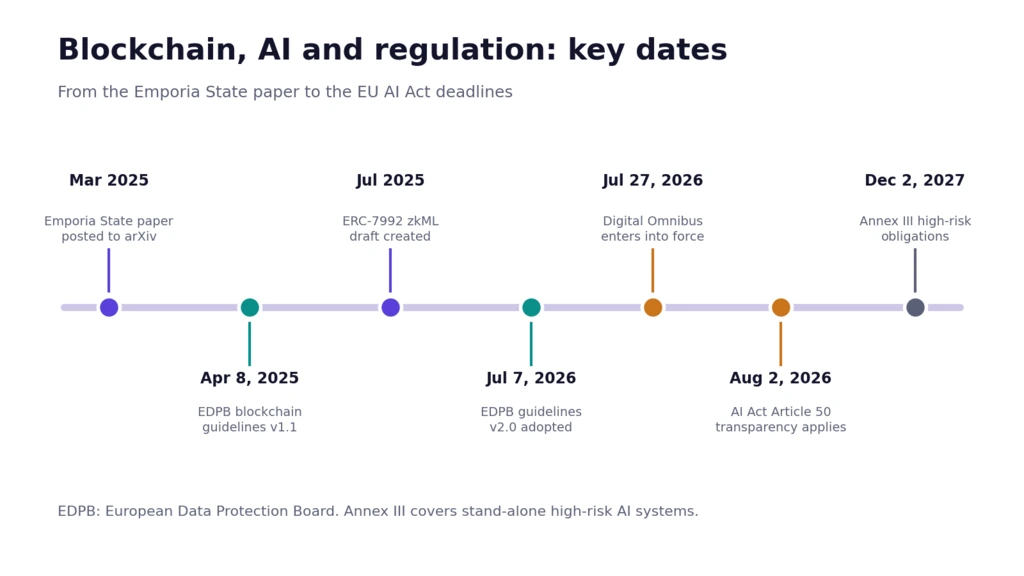
The Digital Omnibus, in force since July 27, 2026, postponed obligations for stand-alone high-risk systems, including credit scoring and recruitment tools, to December 2, 2027. Article 50 transparency obligations, which cover notices to users interacting with AI and labels on AI-generated content, have applied since August 2, 2026.
Verifiable Inference Moves Toward Standards
Zero-knowledge machine learning (zkML) extends logging to proof. A prover runs a model off-chain and publishes a cryptographic proof confirming a specific model produced a specific output. A verifier checks the proof without access to inputs or model weights.
ERC-7992, a draft Ethereum standard created in July 2025, defines interfaces to register model commitments and verify inference proofs in smart contracts. Seoul National University researchers reported a blockchain platform, BRAIN, with inference throughput 454 times higher than a naive single-phase baseline.
FAQ
What is blockchain AI transparency?
Blockchain AI transparency is the practice of recording AI decisions, training data and model versions on a distributed ledger, so auditors and regulators verify the history of a system without relying on its operator.
What does the Emporia State framework record on-chain?
The framework stores decision records (inputs, parameters, outputs), data provenance records (supplier, date of use, alterations) and model management records (version hashes and performance metrics).
Does a blockchain explain how an AI model decides?
No. A ledger proves which inputs, model version and timestamps belong to a decision. Explanation requires tools such as SHAP, LIME or counterfactual reasoning, which the paper proposes pairing with the ledger.
Does on-chain AI logging conflict with the GDPR?
Immutability conflicts with the right to erasure. EDPB guidelines version 2.0, adopted July 7, 2026, advise against storing personal data on-chain, favor permissioned blockchains and recommend off-chain storage with salted hashes, proofs or commitments on the ledger.
Which obstacles limit adoption today?
Scalability, integration complexity, computational overhead and missing deployment data limit adoption. The authors request empirical validation, and platform comparisons across Ethereum, Hyperledger Fabric and Corda remain open.

Isai Alexei is a journalist and financial analyst covering cryptocurrency markets and traditional securities for Blockchaindose. He has spent ten years analyzing digital assets, trading activity, and market structure.