
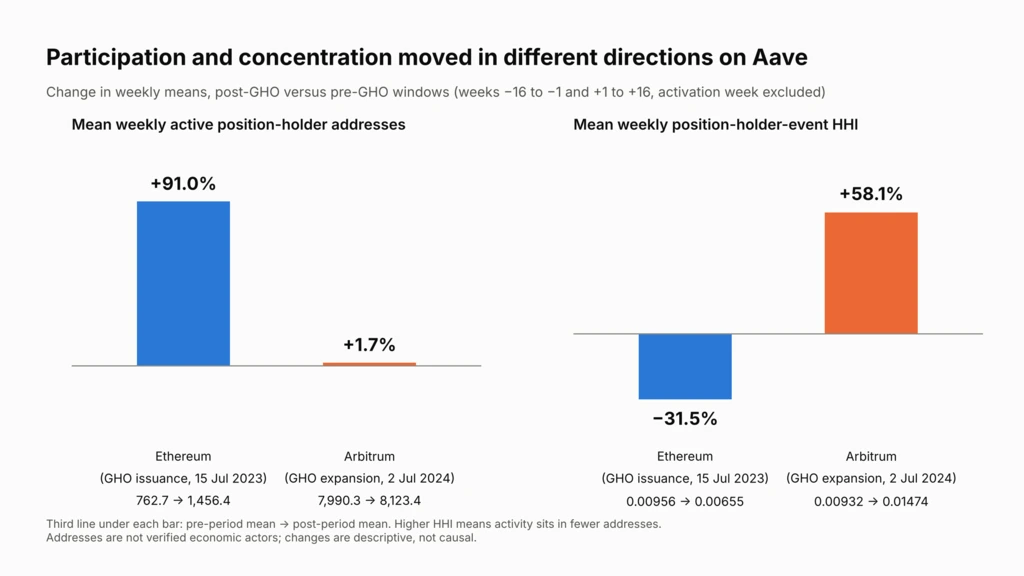
DeFi decentralization moves along four dimensions at different speeds, and Aave protocol records show the split: mean weekly active position-holder addresses rose 91.0% around GHO stablecoin issuance on Ethereum, but only 1.7% around the token’s expansion to Arbitrum, where activity concentration climbed 58.1% while Ethereum concentration fell 31.5%. The comparison covers 1,956,216 Pool events and describes weekly means without a causal claim.
Aave Event Records Cover 1.96 Million Pool Actions
Aave operates as an open-source, non-custodial lending protocol in which suppliers deposit assets and borrowers draw overcollateralized loans through smart contracts. Aave V3 launched on six networks in March 2022, including Arbitrum, and came to Ethereum in January 2023. GHO—an overcollateralized stablecoin minted by approved facilitators within capacity limits—went live on Ethereum on 15 July 2023. That date ties DeFi decentralization questions to a specific event.
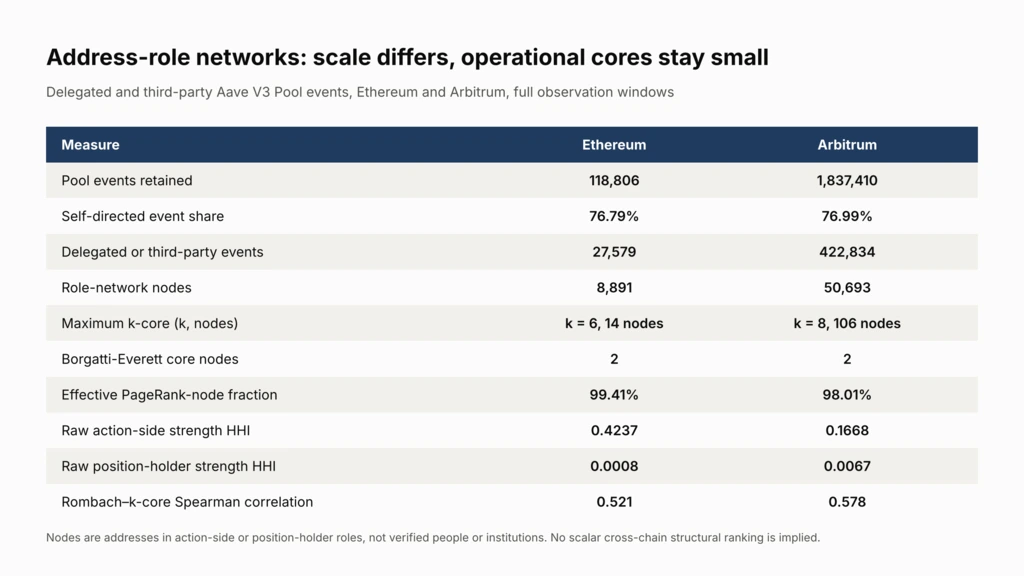
The dataset extracts five event types from Aave V3 Pool contracts across all reserve assets: Supply, Withdraw, Borrow, Repay and LiquidationCall. Ethereum has 118,806 events and Arbitrum has 1,837,410. Each set is observed from week −16 to week +16 around its GHO activation, excluding the activation week. Self-directed events account for 76.79% of Ethereum events and 76.99% of Arbitrum events. Each address is an observed address, not a verified person or institution.
DeFi Decentralization on Ethereum: Peripheral Expansion After GHO Issuance
On Ethereum, two address-level measures point to more DeFi decentralization: mean weekly active position-holder addresses rose from 762.7 to 1,456.4, and the position-holder-event Herfindahl-Hirschman Index (HHI) fell from 0.00956 to 0.00655. Pooling all events within each period gives an HHI decline of 37.0%, from 0.005647 to 0.003555. Broader participation with lower concentration matches peripheral expansion, a label for joint signs, not a behavioral mechanism.
Arbitrum, where Aave had operated for more than two years before GHO arrived, recorded mean weekly active addresses of 7,990.3 before and 8,123.4 after the expansion, while HHI rose from 0.00932 to 0.01474. Nearly flat breadth with rising concentration looks closer to incumbent amplification than to broad peripheral expansion. A 1.7% gain does not support a claim of broader DeFi decentralization on Arbitrum.
Gnosis Comparison Narrows Causal Reading
A comparison on a common calendar puts Arbitrum next to Aave’s Gnosis market, which got no GHO expansion in July 2024, across 24 weekly gaps: clean pre-weeks −16 to −9 and post-weeks +1 to +16. Log participation changed by +0.0314 on Arbitrum and −1.9519 on Gnosis, a contrast of +1.9833, so most of the gap comes from a participation decline on Gnosis rather than growth on Arbitrum.
Position-holder-event HHI rose by 0.00501 on Arbitrum and by 0.02343 on Gnosis, a contrast of −0.01842, and concentration rose on both chains but less on Arbitrum, which keeps the negative coefficient consistent with the 58.1% chain-relative increase because the two estimates use different clocks and baselines. The controlled interrupted-time-series level shift for HHI equals −0.02849, with a slope change of −0.003515 per week.
Anticipation-window choices move both estimates: keeping every pre-event week in the sample cuts the participation contrast to +1.3414 and shifts the HHI contrast to +0.00595, while Gnosis follows a different pre-period path and activated its own GHO market in 2025. With one comparison chain, the design supports a widening participation gap and a smaller relative HHI increase on Arbitrum, not an identified GHO effect on DeFi decentralization.
Agent-Based Simulations Separate Growth From Concentration
Rule-based simulations with 40 actors on a directed network test the mechanism behind the divergence, and a benefit shock spreads through connected actors. The model converges in 18, 79 and 438 iterations as feedback strength rises from 0.25 to 0.75 and 0.95, while a feedback value of 1.05 fails to converge. At directed distance one from the shocked actor, mean response is 0.0467 under weak feedback and 1.822 under 0.95 feedback.
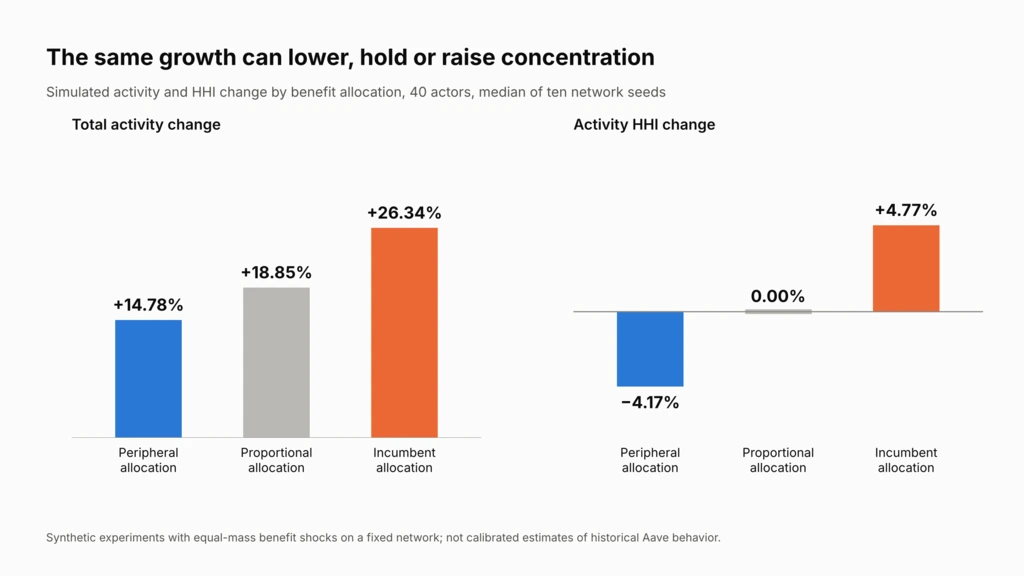
The allocation of an equal-mass benefit across actors, not the size of the benefit, determines the concentration outcome in ten simulated network seeds. Peripheral allocation raised activity by 14.78% and lowered HHI by 4.17%; proportional allocation raised activity by 18.85% and left HHI unchanged; incumbent allocation raised activity by 26.34% and HHI by 4.77%. Growth alone cannot classify DeFi decentralization, because activity rose in all three cases even as concentration moved in opposite directions.
Chain Count Does Not Measure Infrastructure Resilience
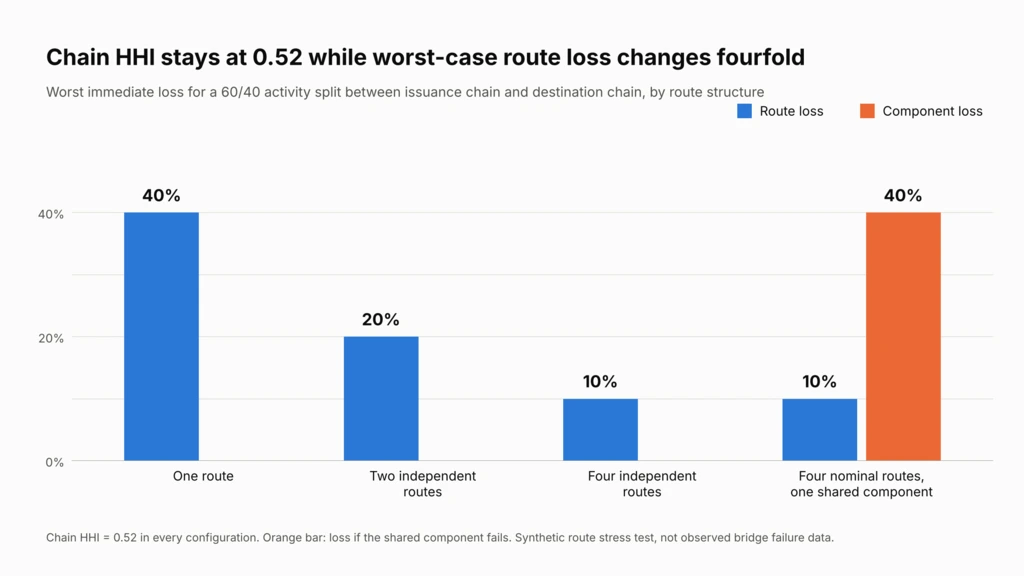
A synthetic 60/40 activity split between an issuance chain and a destination chain gives a chain HHI of 0.52 in every configuration, yet worst immediate route loss falls from 40% with one route to 20% with two independent routes and 10% with four, while dispersion across blockchains and resilience of connecting routes stay separate measurements. Chain HHI falls by 2s(1−s) when share s moves to a destination chain, which gives a drop of 0.48 at s = 0.4 and shows that chain count and route resilience move on different scales.
Four nominal routes that share one component keep a 40% component-loss exposure even though chain HHI stays at 0.52, and cross-chain GHO depends on approved facilitators and Chainlink’s Cross-Chain Interoperability Protocol (CCIP) for canonical representations on destination chains, so route independence and shared components are the data a DeFi decentralization resilience test needs. Contract-role labels act only as proxies, and no verified route-event panel exists, which limits what those labels can show about route-level exposure.
Address-Role Networks Show Small Operational Cores
Delegated and third-party events form the address-role network, with 8,891 nodes on Ethereum and 50,693 nodes on Arbitrum. The maximum k-core holds 14 nodes at k = 6 on Ethereum and 106 nodes at k = 8 on Arbitrum, and a fitted Borgatti-Everett core contains only two nodes on each chain. Rombach coreness and k-core number correlate at 0.521 on Ethereum and 0.578 on Arbitrum, so the core measures agree only in part across the two chains.
Global centrality stays dispersed, with effective PageRank-node fractions of 99.41% on Ethereum and 98.01% on Arbitrum, while raw action-side strength HHI reaches 0.4237 on Ethereum against 0.0008 for position holders. Public labels tie available core addresses to protocol-adjacent helper, gateway or migration functions, a narrow reading without ownership or route resilience evidence for DeFi decentralization assessments.
Liquidation, with only 362 Ethereum events, still produces the largest maximum-k-core share on Ethereum, at 11.2%, which shows that a small event count can dominate the core even when global centrality stays dispersed.
Reporting Rules for Protocol Dashboards
Four outcomes require separate reporting in any DeFi decentralization dashboard: participation, activity distribution, structural position and infrastructure dependence, each with an explicit unit of observation and evidence status. More users need not mean more decentralization, and a lower user-side HHI need not imply resilience to the loss of a common service, including a bridge, sequencer or facilitator, because user counts and service dependence answer different questions.
GHO reached Base, Lens and Avalanche by July 2025, and a Gnosis market followed in August 2025, which gives more destinations for repeated expansion tests of DeFi decentralization. Route-event records, verified actor labels and delegation traces for autonomous agents would extend the evidence from addresses to economic actors, agent-controlled wallets and execution paths, and those records would let a dashboard test route dependence beside address-level participation.

Isai Alexei is a journalist and financial analyst covering cryptocurrency markets and traditional securities for Blockchaindose. He has spent ten years analyzing digital assets, trading activity, and market structure.