When you submit a transaction to Ethereum, the mempool broadcasts it to the network, allowing bots, builders, and validators to see it.
When a transaction moves a significant amount of value, such as a large DEX swap, a liquidation, or an NFT bid, participants can extract profit from that visibility before the transaction executes. The phenomenon is known as MEV, or maximal extractable value, and it represents a cost for users.
LUCID proposes a different model.
Specified in EIP-8184, LUCID proposes an encrypted mempool design that keeps the transaction within the public pipeline while hiding its contents until the ordering decision is locked. The transaction arrives encrypted, and builders commit to including it before the content is revealed. The order cannot be changed based on what the transaction does.
LUCID operates as a public, protocol-aware mechanism that removes the visibility on which toxic MEV depends.
The Cost of Mempool Transparency
The Ethereum mempool is a feature whose main limitation is visibility. Users can submit transactions freely, without intermediaries controlling access, but they pay a cost for that visibility.
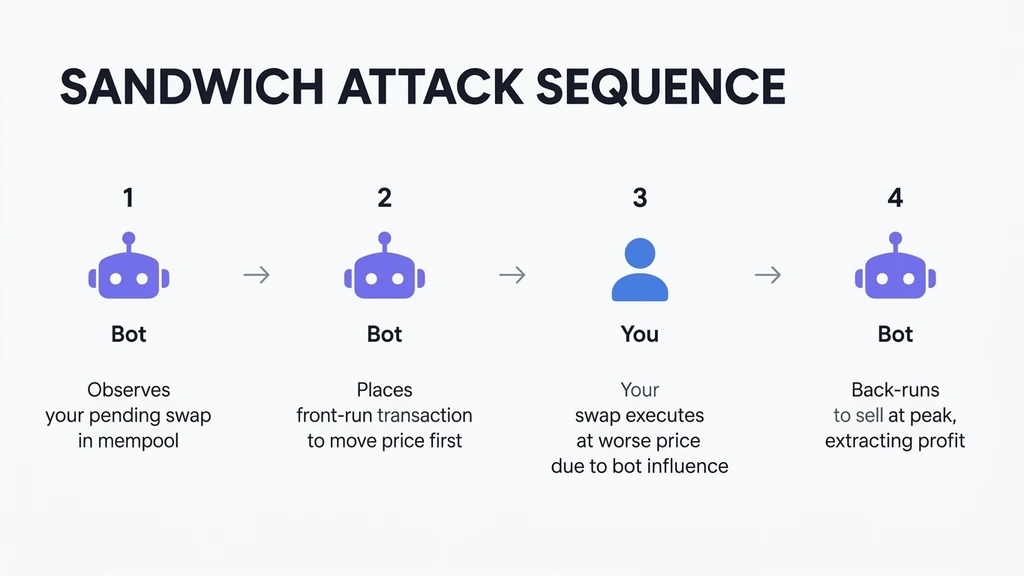
When you broadcast a pending transaction, you communicate your intent to the entire network. If you swap 100 ETH for stablecoins, bots immediately calculate the price impact, the MEV opportunity, and the profit available through a sandwich attack. The front-runner places a transaction immediately before yours and moves the market against you. The swap executes at an unfavorable price. The back-runner sells at the peak and secures the profit.
Sandwich attacks extracted $60 million in 2025 alone across roughly 95,000 documented attacks. Total MEV on Ethereum has exceeded $1.3 billion in cumulative extraction through 2026. A single bot, jaredfromsubway.eth, made $295 million by sandwiching traders since 2023.
Sandwich attacks are part of the normal operation of Ethereum’s transparent mempool. Every day, $10 million to $20 million in MEV is extracted. During periods of higher volatility, the figure reaches $40 million to $50 million.
Current defenses, including private mempools such as MEV Blocker and Flashbots Protect, shift the problem rather than solve it. They move transactions to a trusted relay where builders commit not to attack them. Trust, however, depends on a relationship outside the protocol. Builders remain profitable value extractors. Users can only trust that a builder was not responsible for selective ordering.
LUCID: Encrypt First, Order Second
LUCID, specified in EIP-8184 and proposed by Anders Elowsson, Justin Florentine, and Julian Ma in March 2026, reverses the order of operations.
Instead of broadcasting a plaintext transaction and relying on a relay to protect it, users submit an encrypted transaction to the public mempool. No one can read it: not builders, not searchers, and not block proposers. Only the payload remains visible: a cryptographic commitment hash and a reservation fee.
Builders bid on the transaction without knowing its contents. The commitment is backed by slashable stake: if the builder later attempts to censor or reorder the encrypted transaction, they lose money. Only after the builder’s commitment is locked into the beacon chain does the sender—or an off-protocol key publisher—release the decryption key.
At that point, the transaction contents are revealed. The ordering decision is already final. The builder cannot change it based on the transaction’s contents. Front-running becomes impossible. Sandwich attacks become impossible.
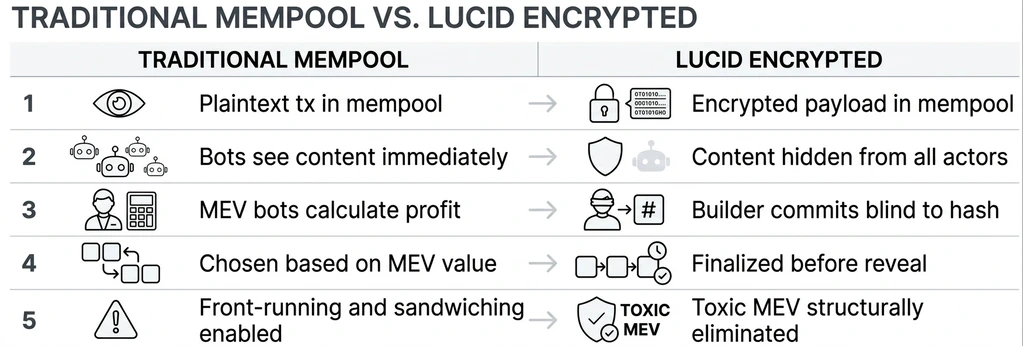
LUCID uses ChaCha20-Poly1305 AEAD encryption to seal transaction contents. The ciphertext is propagated as a new EIP-2718 transaction type. Builders commit to including it through auditable builder bids and provide slashable collateral.
Once the commitment is irreversibly included in the beacon block, the sender releases the decryption key. Execution follows. The builder cannot censor or reorder the transaction after the commitment without forfeiting their stake.
LUCID initially caps its encrypted top-of-block segment at one-eighth of the block gas limit, allowing the network to test the mechanism without full adoption.
Where LUCID Meets Reality
The core challenge is that Ethereum has not yet solved fully enshrined encryption at its current scale. No known cryptographic construction satisfies all constraints simultaneously. Key management, decryption latency, and the complexity of distributing encryption responsibility across validators remain open problems.
LUCID addresses the problem through an encryption-agnostic design, the protocol does not mandate a specific scheme. It allows different key publishers to manage decryption according to their own cryptographic choices. This flexibility moves the problem from the protocol level to the application level.
Flexibility introduces a trust requirement. Key publishers must remain available and act honestly. If a key publisher is offline when the reveal window closes, transactions remain encrypted and must be reverted.
Shutter Network competes with LUCID and represents the only threshold-encrypted mempool solution currently deployed on Gnosis Chain. Shutter uses distributed key generation across a permissioned set of Keypers, with transactions encrypted under per-block keys. However, Shutter faces latency constraints: transactions take an average of three minutes to reach inclusion, creating a tradeoff between security and speed.
Encrypted Mempools
Shutter Network also has a proposal: EIP-8105. It is a design independent of any specific encryption scheme that proposes universally integrated encrypted mempools within the protocol without specifying a single encryption scheme.
The proposals share a premise: Ethereum’s current mempool architecture leaks information that has become costly for users.
If Ethereum adopts LUCID, the changes will extend to other parts of the ecosystem. Private mempools such as MEV Blocker would no longer be necessary. Validators would gain protection against censorship accusations. Users would stop revealing transaction intent before execution. The MEV extraction model, including front-running, sandwich attacks, and liquidation hunting, would lose the advantage provided by visibility.
Backrunning and arbitrage would remain possible after execution. Benign MEV would remain. Toxic MEV, which arises solely from the user’s inability to hide their intentions, would instead be eliminated by the system’s design.
Builders, searchers, and MEV bots profit directly from mempool transparency. The adoption of encrypted mempools would directly reduce their revenue.
From Draft to Deployment
EIP-8184 remains a draft as of October 2026, core developer commentary indicates that it was rejected from the upcoming Amsterdam fork: “This hard fork came too early.” Developers cited the need for further research into encryption schemes and key management.
Shutter Network is live on Gnosis but not on Ethereum mainnet. MEV Blocker protects $2.1 million in cumulative DEX volume and has stopped roughly 80% of sandwich attacks for users who opt in. Incremental protection exists, while full encryption remains an unresolved goal.

Isai Alexei is a journalist and financial analyst covering cryptocurrency markets and traditional securities for Blockchaindose. He has spent ten years analyzing digital assets, trading activity, and market structure.