
If you follow Bitcoin mining news this fall, you have probably heard about the 320-day hashrate drought. The claim is that Bitcoin has spent almost a year below its all-time high, the longest stretch in a decade, even as its price sits near record levels.
The first half of that is roughly right. The second half is not.
What the 320-day hashrate drought actually means
The seven-day average hashrate was near 914 EH/s at the end of August 2026, about one-fifth below the October 2025 peak of 1,151.6 EH/s.
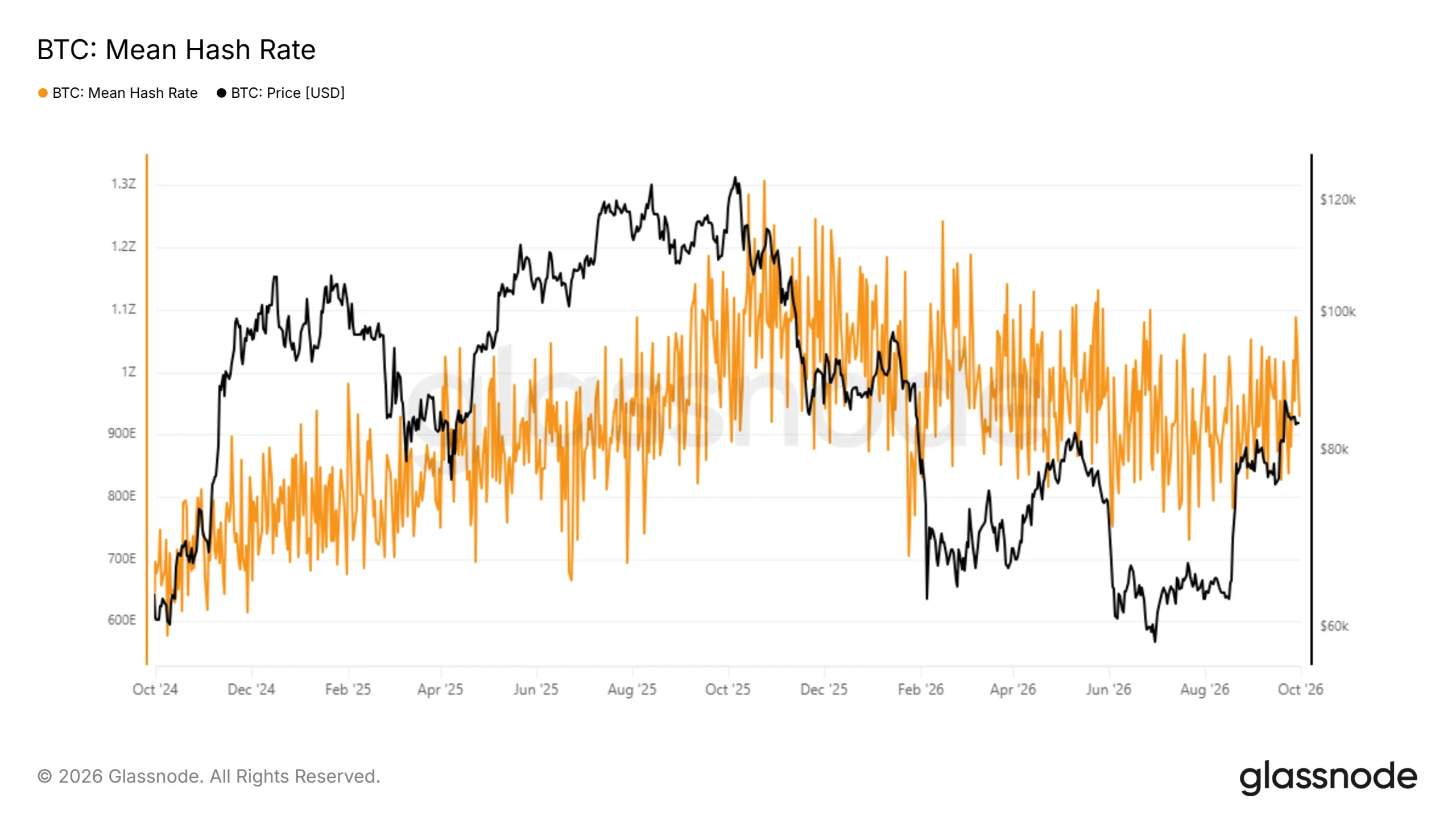
Trackers then started counting the days since. One count based on Blockchain.com’s rolling average put the streak at 316 consecutive days below the high, the longest in roughly a decade. Other trackers rounded that to 320 a few days later.
Two things are worth knowing about that number:
- It is a snapshot. The 316-day count dates to the end of August, so the streak has kept growing. By my own arithmetic from that start date, it is now around 344 days. The “320” headline is already out of date.
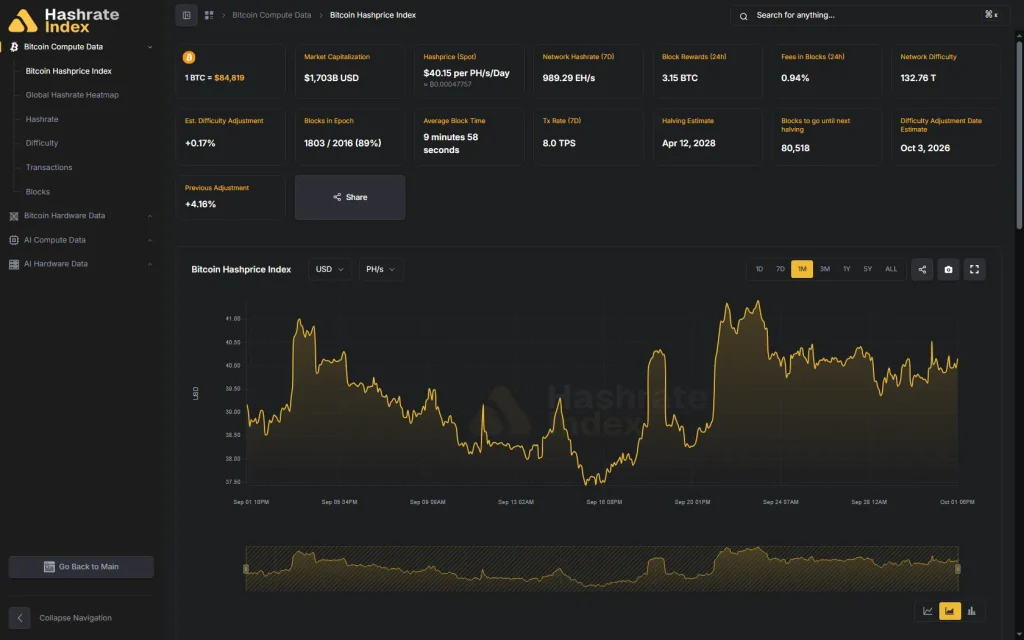
- Hashrate is estimated, not directly measured. Daily readings jump around a lot. In September, CoinWarz’s daily figures swung between roughly 821 EH/s and 1.13 ZH/s. The drought only holds on the smoothed seven-day average that most trackers use. Some sources with more sensitive methods show a different peak entirely.
So the drought is real, but it is a claim about a specific smoothed line, not about every daily reading.
The number the headlines miss
Popular sentiment is that the hashrate is falling even though the price is near record highs. That would be strange, because high prices normally pull more machines online.
But the price is not near a record. On September 28, Bitcoin traded around $83,244, about 34% below its October 6, 2025 all-time high of roughly $126,080.
Put the two gaps side by side:
- Price: about 33–34% below its peak
- Hashrate: about 20% below its peak
Hashrate has held up better than price, not worse. The mystery of “why won’t miners come back when prices are high?” mostly disappears, because prices aren’t high. Miners are running most of their machines at a price well off the top.
Why hashrate fell in the first place
If price were the only cause, this would be an ordinary bear-market story. The data shows a squeeze on miners, plus AI as the second factor.
The squeeze. Mining pays by the unit of computing power, a measure called hashprice. Hashprice closed the first quarter of 2026 around $23.9 per petahash per day, the lowest since 2018.
Costs were the other side of it. Listed miners were losing an estimated $19,000 on every bitcoin they produced as of late March, with a weighted average cash cost near $80,000 per coin. Analysts put break-even for most large public miners at around $90,000 per Bitcoin. Bitcoin is trading below that line today.
The weak spot. The 2026 slide started early. Hashrate fell from about 1,160 EH/s in October 2025 to roughly 850 EH/s by early February 2026, a drop of about 27%. That means today’s ~915 EH/s is actually a partial recovery from the trough, not a fresh low..
The AI factor. Mining sites come with cheap power and grid connections, and AI data centers want exactly that. Listed miners have announced more than $70 billion in AI and high-performance computing contracts. CoinShares has said AI work could supply as much as 70% of listed miners’ revenue by the end of 2026, up from roughly 30%.
The shift shows up in the numbers. Realized hashrate at a group of public miners fell 13.4% between Q4 2025 and Q2 2026, from 368.3 EH/s to 319 EH/s. Over the same period the whole network’s average hashrate dropped only 10.6%. Public miners are shrinking faster than the network, so private miners and a few expanders are filling part of the gap. Bitdeer, for one, grew its realized hashrate 44% to 63 EH/s.
There are also single-site examples. Hyperscale Data switched off every mining machine at its Michigan site on September 1 to free 20 MW for an AI cloud client.
Signs the pressure is real, and signs it is easing
Several indicators support the “miners are stressed” side:
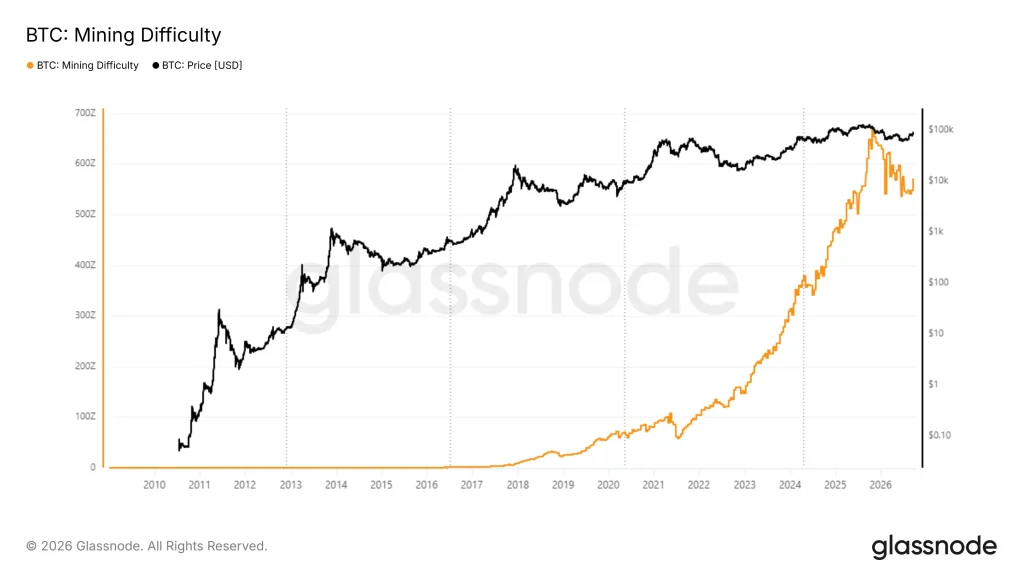
- Difficulty is down. Difficulty is the setting that keeps mining competitive. It fell from about 155.97 trillion at its peak to 125.81 trillion by August 23, roughly 19%.
- Old rigs are struggling. CoinShares estimated that 15-20% of older mining hardware was running at a loss.
- Miners are selling. Public miners sold a record 32,000 BTC in the first quarter of 2026, more than in all of 2025. In the week to September 26, miner reserves fell by 1,530 BTC to about 1.1928 million BTC.
- Fees don’t help. Transaction fees fell from about 7% of miner revenue in 2024 to around 1%. Miners live almost entirely on the block reward, so they live and die by the Bitcoin price.
But there is a counterpoint, and it matters for balance. In early September, hashprice rose from $32.42 to $39.63, a gain of about 22%, while total hashrate barely moved. Profit per machine improved, yet miners did not rush to add capacity. That fits the AI story: some capital and power are going elsewhere, not just waiting for a better price.
And the near-term picture is soft. The seven-day average slipped to about 915.8 EH/s on September 26, its lowest in three weeks. The same report cautions that one week’s reading doesn’t prove miners are broadly cutting capacity.
A forecast that aged badly
One more stat is worth flagging because it tests the “temporary slump” view. CoinShares has projected hashrate could climb back toward 1.8 zettahash per second by the end of 2026, but only if Bitcoin’s price recovers toward $100,000. Today’s hashrate is about half that figure, and the price is nowhere near $100,000. That forecast now looks very unlikely to hit its year-end target.
Verdict on the claims
- “Hashrate has been below its peak for about 320 days.” Supported, though the count is already higher and depends on the metric.
- “It’s about 20–25% below the high.” Supported: roughly 20% on the seven-day average.
- “Price is near record levels.” Not supported. Price is about a third below its peak.
- “AI is pulling capacity away from mining.” Supported by public-miner data, but it is one cause among several, alongside low hashprice and high costs.
- “This is a permanent new regime.” Plausible, but not proven. It depends on whether hashrate stays low if price recovers.
Hashrate is a rough measure of how much money and machinery is defending Bitcoin. A stalled hashrate tells you miners are cautious, and that they now have a competing use for their power. But the fair reading is more modest than the headlines. The network is about 20% off its peak while the price is about 33% off its peak. Bitcoin is under stress, not in crisis. The number to watch next is whether hashrate climbs if price does. If it doesn’t, the AI shift is more than a phase.

Dan is a seasoned crypto writer for Blockchaindose who got his start in the space back in 2019. Over the past four years, he’s built a solid grasp of how the industry moves, focusing heavily on DeFi, NFTs, GameFi, and promising new projects.
Off the clock, you’ll usually find him buried in a good book or kicking back with a movie. His blend of hands-on market experience and straightforward commentary makes him a clear, trusted voice across the platform.