

Say you put $10,000 into Ethereum liquid staking last year. Based on the latest numbers, that money earns about $270 a year. Now say you put the same $10,000 into restaking, the strategy that was supposed to pay extra. The extra restaking fees come to about $5 a year.
Those figures are my estimate, based on one week of data (more on that below). But the pattern behind them is real. It sits in a statistic few people have looked at closely.
The number behind the headline
According to a snapshot from DefiLlama, restaking earned about $99,977 in fees over a week, versus $27.35 million for liquid staking. On Sept. 8, the restaking category held $10.02 billion. Liquid staking held $51.87 billion.
Here is what that means in plain terms:
- Liquid staking holds about 5 times more money than restaking.
- It earned about 273 times more in fees.
- Dollar for dollar, ordinary staking earns roughly 53 times more.
A popular version of this story says restaking fees “collapsed 99.9%.” The data doesn’t quite say that, for two reasons.
First, the math. $99,977 is about 99.6% smaller than $27.35 million, not 99.9%.
Second, and more important, that figure is a gap between two sectors in the same week. It is not a drop over time. A gap tells you restaking pays less than staking. It doesn’t tell you restaking fell off a cliff. For that, you need a before-and-after.
The real collapse is in EigenLayer’s numbers
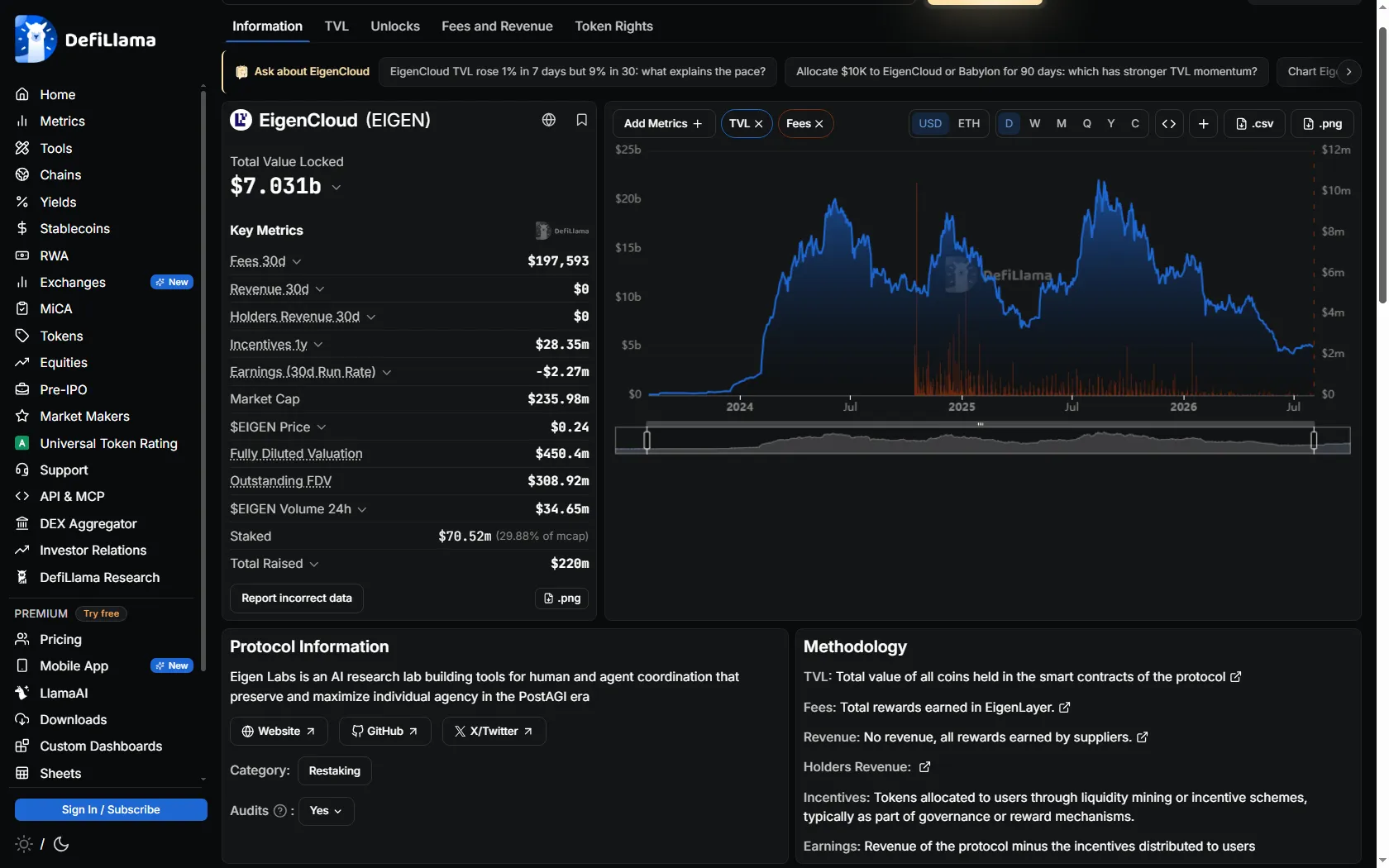
EigenLayer is the biggest restaking platform, and its history is where the drop shows up. DefiLlama’s quarterly record of rewards paid through EigenLayer reads like this:
| Quarter | Rewards paid |
| Q4 2024 | $63.28M |
| Q1 2025 | $31.94M |
| Q1 2026 | $8.75M |
| Q2 2026 | $2.5M |
(Source: DefiLlama’s EigenCloud income statement.)
The headline claim of a 73% year-over-year fall, from Q1 2025 to Q1 2026, checks out. Measured from the Q4 2024 peak to Q2 2026, the drop is about 96%. That is the real collapse. It isn’t 99.9%, but it is steep.
Money left slowly. Fees left fast.
The capital didn’t vanish the way the fees did. EigenLayer held $19.7 billion at its peak. DefiLlama now shows EigenCloud, EigenLayer’s new name, with about $6.49 billion locked, and the whole restaking category at $9.93 billion across 13 protocols. So deposits are down roughly two-thirds from the peak, while rewards are down about 96%.
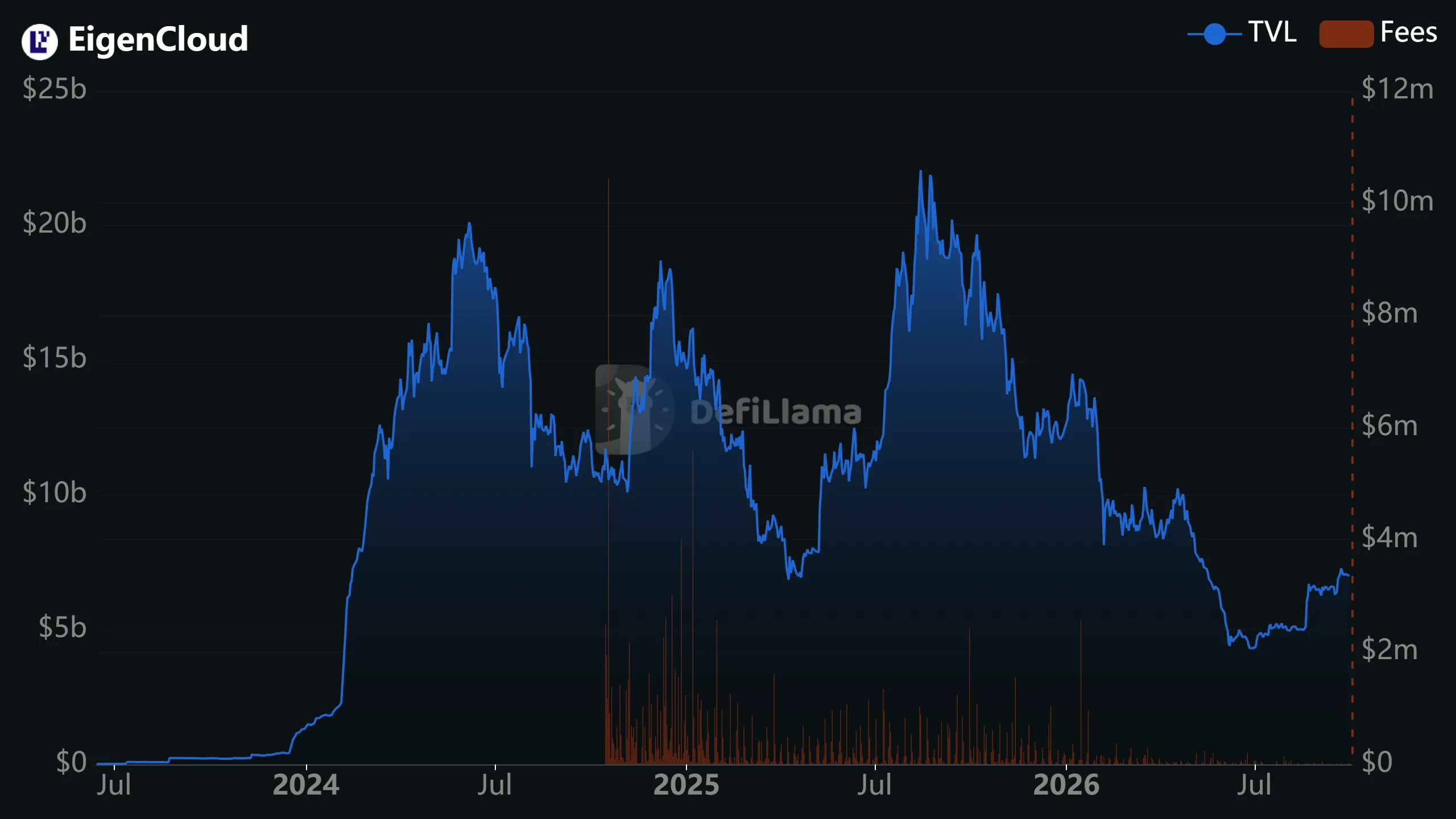
Money is leaving, but rewards are shrinking much faster than deposits. The people still restaking are earning far less for the same risk. But, what happened?
Three things happened.
- The bonuses ended. Points programs that subsidized deposits wound down through 2025.
- The risk became real. EigenLayer turned on slashing in April 2025, meaning a share of your stake can be taken if an operator misbehaves. That added a penalty without adding yield to pay for it.
- Not enough customers paid. The fees paid by services buying security have consistently failed to cover basic staking yields and risk premiums. The “second layer” of income never materialized.
Then came April 18, 2026. An attacker drained 116,500 rsETH, about $292 million and roughly 18% of the token’s supply, from Kelp DAO’s bridge. Kelp is a liquid restaking protocol. The whole attack took 46 minutes. The funds were lost on the tradable receipt token, not on EigenLayer itself. For holders, the lesson was that restaking adds another layer of risk without adding much reward.
The caveat that keeps this honest
The “273 times more” figure isn’t a fair fight, and anyone quoting it should say so.
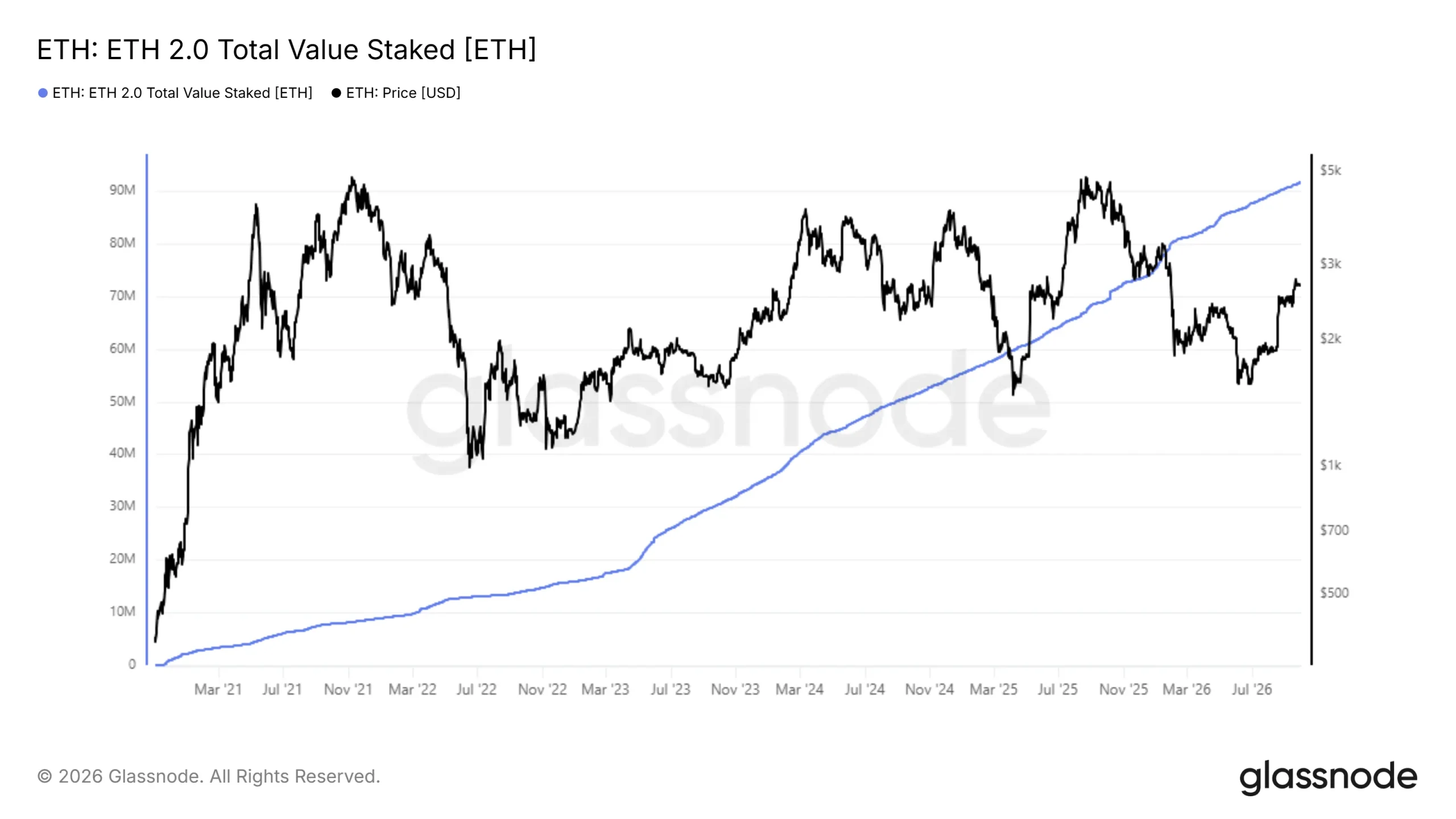
Most of what DefiLlama counts as liquid staking “fees” is simply Ethereum’s own staking reward. Network-wide staking yield was about 2.5% a year on Sept. 23, with about 43.46 million ETH staked, roughly 35% of all ETH. Liquid staking’s weekly fees work out to about 2.7% a year, which matches that baseline almost exactly. So liquid staking isn’t “beating” restaking. It is the base layer that restaking was supposed to improve on.
Restaking’s weekly total works out to roughly 0.05% a year on top of that base. The promised bonus came to about five basis points.
Other numbers are messy too. DefiLlama’s separate liquid restaking page shows $1.26 million in seven-day fees on $6.96 billion locked. That is a different category definition, and the page doesn’t show its snapshot date. Trackers also disagree on EigenLayer’s current deposits. The direction of the data is consistent, but the exact figures are not.
The companies feel it
Ether.fi, the largest liquid restaking protocol, is the clearest example. Its gross profit fell 47%, from $18.71 million in Q3 2025 to $9.99 million in Q2 2026. That is a three-quarter decline, not the quarter-over-quarter drop it is sometimes called. The company says under 1% of its assets will remain restaked.
Its card business is now the main story: card fees produced $3.14 million in gross profit in Q2, against $2.87 million from EigenLayer restaking.
Its smaller rivals look worse. Renzo, Kelp, Swell, Puffer Finance and Bedrock made $953,350 combined in Q2 2026, down from $2.18 million three quarters earlier. Puffer, which raised $23 million, booked $21,590 for the quarter. That combined figure is down 56%.
Why this matters
When the same dollar is asked to secure two things, the second job needs real customers paying real fees. This data shows those customers mostly haven’t shown up. It also shows how a yield can look strong on a dashboard (billions in deposits) while the cash paid out is tiny. Whenever you see a big “total value locked” figure, look at the fees next to it.

Dan is a seasoned crypto writer for Blockchaindose who got his start in the space back in 2019. Over the past four years, he’s built a solid grasp of how the industry moves, focusing heavily on DeFi, NFTs, GameFi, and promising new projects.
Off the clock, you’ll usually find him buried in a good book or kicking back with a movie. His blend of hands-on market experience and straightforward commentary makes him a clear, trusted voice across the platform.