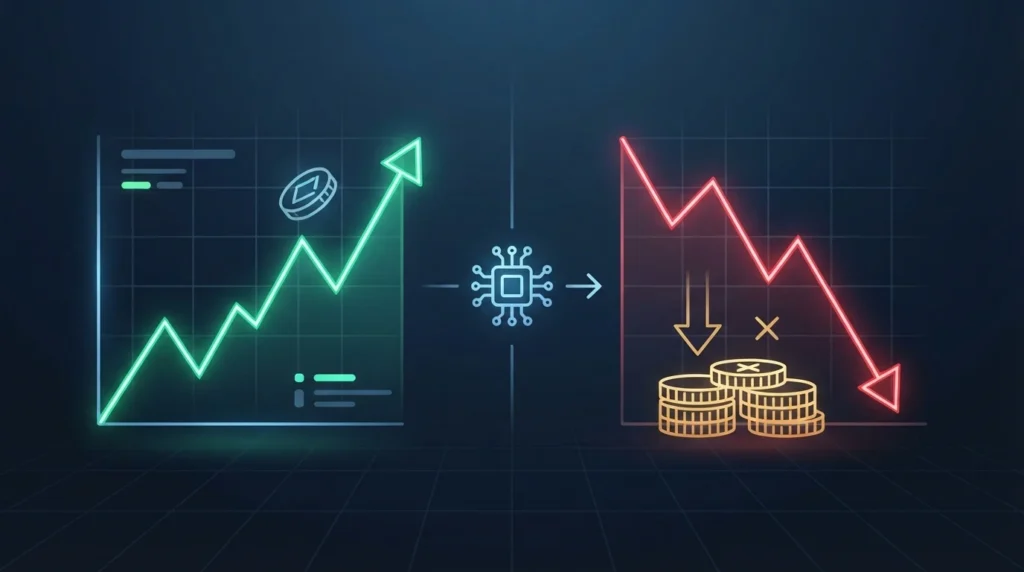
Machine learning crypto trading models ranked cryptocurrency price extrema accurately, yet lost money as Binance Spot trading policies. Researcher Ayoub Jadouli of Abdelmalek Essaâdi University audited candle-based timing models and recorded negative net results after assumed transaction costs in every executable test. All evaluated policies remain NO_TRADE. Ranking power and policy returns diverge Jadouli trained ...
Blockchain AI transparency received a formal proposal from six researchers at Emporia State University in Kansas, who posted a framework in March 2025. The paper argues a distributed ledger can store each AI decision, the data behind it and every model update in a tamper-evident log. Auditors, regulators and users would verify the history without ...
A paper published in November 2025 by Hamoon Soleimani concludes Bitcoin as money faces structural barriers beyond price swings. The analysis applies Post-Keynesian and Austrian monetary theory, tests both with econometric data, and classifies Bitcoin as a speculative asset instead of a monetary standard. Monetary Theory Excludes Bitcoin Post-Keynesian economists define money as a debt ...
Solana Alpenglow reaches Solana mainnet on Wednesday, October 21, 2026. The mainnet activation starts at epoch 1064, at approximately 15:00 UTC, according to the Solana Foundation. Anza, the Agave client developer, lists 14:50 UTC. Testnet and devnet completed their migrations in September 2026, after stakers approved proposal SIMD-0326 in a 2025 vote. Epoch start times ...
How much are At tokens worth? Well, this sounds like one of the easiest questions ever. Yet, it turns out to be amongst the hardest to answer. Why? Because, AI token market cap is not a fixed figure sitting somewhere in a vault. It is a total someone calculates after deciding which coins count. Change ...
A comparative study of blockchain consensus mechanisms—including Bitcoin, Ethereum, Ripple, and Tendermint—evaluates peer-to-peer networks, native cryptocurrencies, transaction validation, block creation, consensus protocol design, and application development. Bitcoin relies on proof of work. Miners hash block headers until the result falls below a difficulty target, and full nodes select the chain with the most cumulative work. ...
Researchers at Matter Labs, the University of Toronto, Télécom Paris and Imperial College London mapped in 2023 how decentralized sequencers reshape transaction ordering on Ethereum rollups. Their framework links shared sequencing to maximal extractable value (MEV) and transaction privacy, the two factors that decide who controls order and who profits from it. It defines seven ...
Chain abstraction protocols route cross-chain actions through solver networks instead of manual bridging. A user signs one intent describing the desired outcome, and a solver selects the route, pays gas on the destination chain and collects a fee. The Ethereum Foundation, Hyperlane and Bootnode co-led the Open Intents Framework, and Coinbase Payments joined as a ...
Blockchain networks determine the sequence of pending operations through transaction ordering, the process of selecting which transactions enter the next block and in which position. Block producers hold authority over sequence, and position affects execution price, liquidation outcomes and arbitrage profit. Validators on proof-of-stake networks and miners on proof-of-work networks select transactions from the mempool, ...
What Is Tokenized Water Tokenized water refers to the representation of water rights, allocations, or conservation credits on a blockchain. In traditional systems, water rights are often tied to land ownership or governed through paper-based legal frameworks, which can make trading slow and difficult. Tokenization converts rights into tokens managed through smart contracts, allowing network ...
To enhance your experience, we use cookies. Consent helps us process data like browsing behavior. Denying may affect site features.
Functional
Always active
The technical storage or access is strictly necessary for the legitimate purpose of enabling the use of a specific service explicitly requested by the subscriber or user, or for the sole purpose of carrying out the transmission of a communication over an electronic communications network.
Preferences
The technical storage or access is necessary for the legitimate purpose of storing preferences that are not requested by the subscriber or user.
Statistics
The technical storage or access that is used exclusively for statistical purposes.The technical storage or access that is used exclusively for anonymous statistical purposes. Without a subpoena, voluntary compliance on the part of your Internet Service Provider, or additional records from a third party, information stored or retrieved for this purpose alone cannot usually be used to identify you.
Marketing
The technical storage or access is required to create user profiles to send advertising, or to track the user on a website or across several websites for similar marketing purposes.