
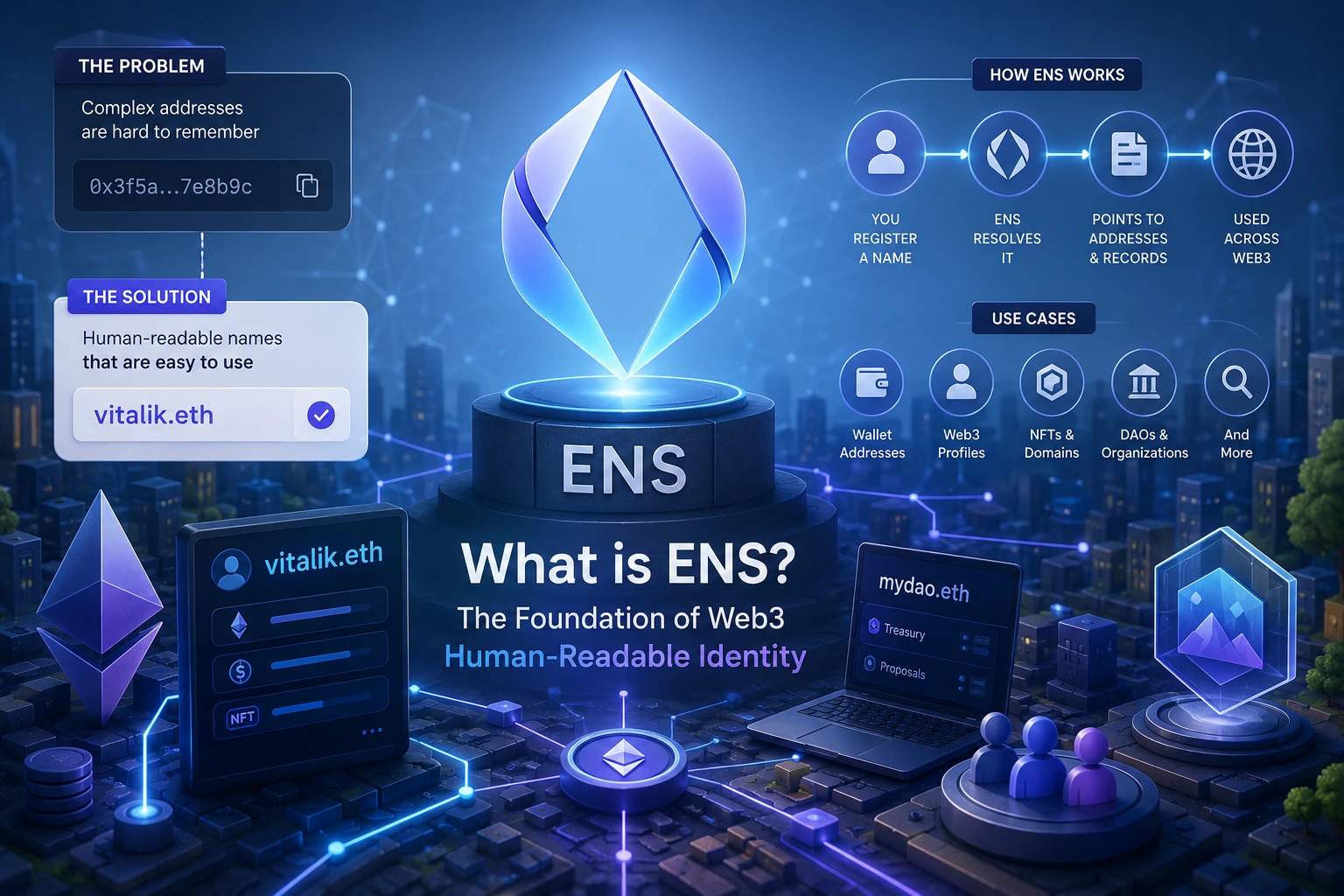
What is ENS? The Foundation of Web3 Human-Readable Identity
Understanding how Ethereum Name Service works starts with a familiar frustration: nobody wants to copy-paste a 42-character wallet address to get paid. ENS solves this the same way DNS solved it for the early internet – and it has quietly become the easiest on-ramp into decentralized digital identity, long before most people ever touch a verifiable credential or a zero-knowledge proof.
Key Takeaways
- ENS turns a long Ethereum address into a readable name like “yourname.eth” – registrations passed roughly 910,000 active domains by late 2025 and have kept climbing toward all-time highs into 2026.
- It works like DNS but is fully on-chain: a registry tracks ownership, resolvers map names to addresses, and every .eth name is also an NFT you can hold, transfer, or sell.
- Integration depth is ENS’s real moat – MetaMask, Coinbase Wallet, OpenSea, Etherscan, Uniswap, and hundreds of other wallets and dApps resolve .eth names natively, something rival naming services have not matched.
- A single name can carry an entire identity layer: subnames (pay.batman.eth), text records for social profiles, and IPFS links for a fully decentralized website all attach to one .eth domain.
- Pricing is simple, but going public is a trade-off: roughly $5/year for names of five or more characters, and a linked .eth name makes a wallet’s transaction history easy to look up – which is why many holders keep it optional.
This guide explains how Ethereum Name Service actually works under the hood, why it functions as the identity abstraction layer of Web3, what a .eth name can do beyond payments, and how to register one yourself.
How Ethereum Name Service Works: Registry, Resolvers, and Records
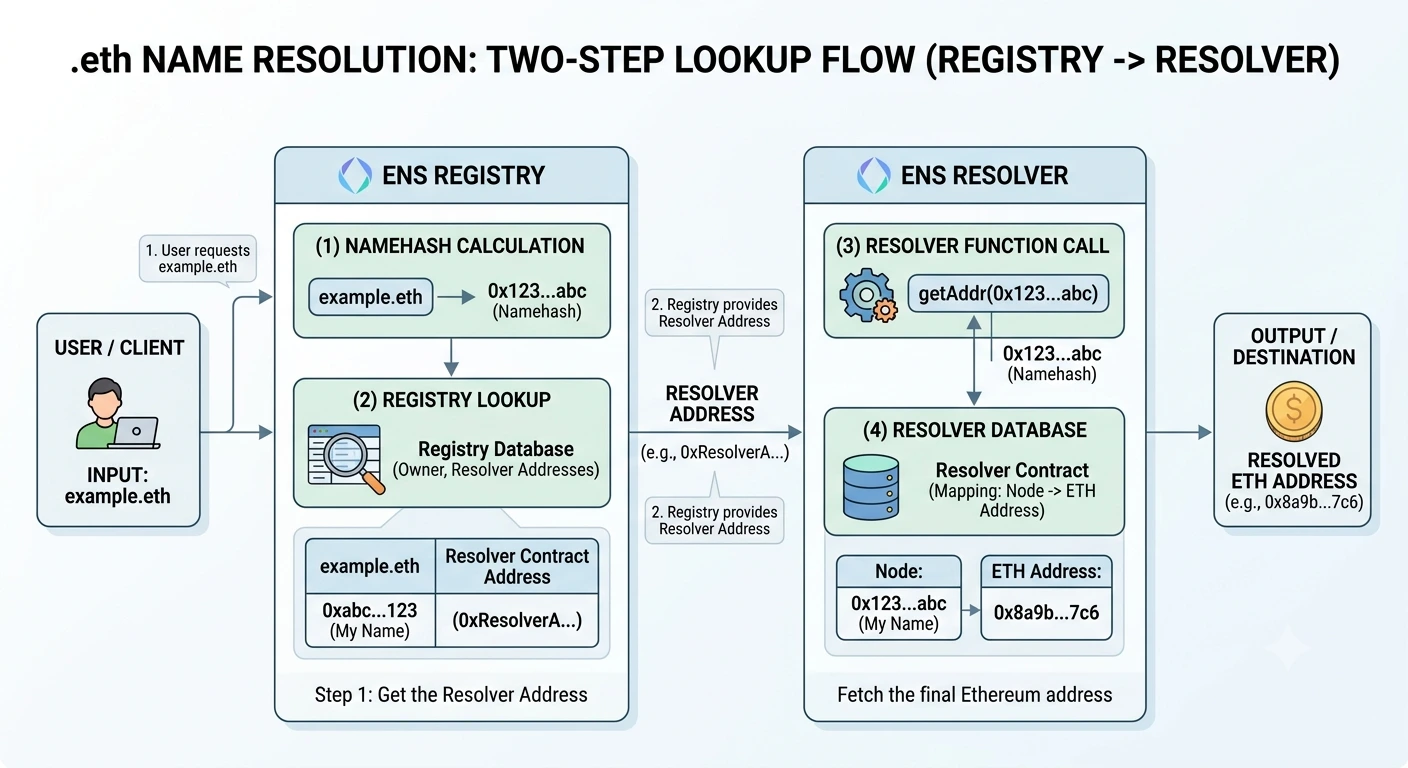
Two smart contracts run the whole system, and the lookup between them explains almost everything else. The registry holds the master record. It tracks who owns each name and which ENS resolver contract answers for it, so it works like a directory that says “ask the resolver about the name.” The resolver then returns the actual data: for a given name, which address, content hash, or record applies. A lookup for yourname.eth first queries the registry to find the resolver, then queries the resolver for the final answer. The two-step design is why ENS scales past simple address lookups — one registry, many resolver types, each free to support different records.
The growth data backs up how far this has moved from novelty to infrastructure: ENS registrations grew 8% month-over-month as of October 2025, totaling roughly 910,000 active domains, and by spring 2026, .eth registrations and renewals were trending toward all-time highs even as the ENS token price fell – a split between speculative token price and actual network usage that is itself a signal of sticky, non-speculative demand for the naming layer.
ENS as the Identity Abstraction Layer of Web3
The framing that matters most for this guide is that ENS is not just a naming convenience – it is the simplest form of identity abstraction available in Web3 today. Where full decentralized identity systems ask users to manage DIDs, verifiable credentials, and wallets full of proofs, ENS asks for one thing: register a name, point it at an address.
Everything else – profile pictures, social links, other blockchain addresses, a decentralized website – attaches to that same name as records, so the .eth name becomes a single, ownable identifier a person controls for the long term rather than a rented account on someone else’s platform.
This is also why ENS became the base layer other identity standards build on top of. Sign-In with Ethereum (ERC-4361) explicitly uses ENS names for reverse resolution during login, so a user authenticating with their wallet can present a human-readable name instead of a raw address.
Enterprises have picked up the same pattern for practical reasons: Gemini now issues ENS-based subnames for wallet deposits (you.gemini.eth), simplifying recovery and reducing the address-copying errors that cause lost funds.
Beyond Payments: Subnames, Records, and Decentralized Websites
A registered .eth name works as a base, not a label. Owners can mint ENS subnames: batman.eth can issue pay.batman.eth pointing to a different address or resource, useful for organizations, DAOs, or families running many wallets under one identity. Text records let a name carry avatars, X handles, email addresses, and other social metadata that wallets and dApps read and display. By pointing a name’s content hash at IPFS, Swarm, or Arweave, an owner hosts a decentralized website with no central provider to take it down.
One caveat deserves precision. Most mainstream browsers do not resolve .eth addresses out of the box. Brave is the exception, and gateways like eth.limo let any browser reach ENS content through a normal URL. Gateways carry a cost, though: they reintroduce a central chokepoint. In 2026 a social engineering attack briefly hijacked the eth.limo gateway through its registrar, easyDNS. The incident is a reminder: a gateway is only as safe as the domain behind it. A gateway trades decentralization for reach, the opposite of what ENS content hashes are meant to guarantee.
A quieter, practical benefit: ENS names make clipboard-hijacking malware easier to catch. Malware of the kind silently swaps a copied address for an attacker’s before you paste it — invisible inside a 42-character hex string. A fake janethehacker.eth swapped for john.eth is far easier to notice before you hit send..
The Trade-off Nobody Mentions: ENS and Anonymity
The debate resurfaces wherever ENS comes up, and it deserves a straight answer. A readable name makes a wallet easier to track, not harder. Anyone who knows vitalik.eth can watch every transaction the address makes: holdings, purchases, donations. Some users avoid public names for the reason. The counter runs the other way just as often. Ethereum wallets are pseudonymous, not anonymous — a bare hex address was never private, only harder to search. ENS removes no privacy that existed before; it swaps obscurity-by-inconvenience for usability, and the swap stays optional. Nothing forces a public primary name, and most people keep several addresses, one public and the rest unlinked.
A second benefit of the NFT design surfaces here. Because a .eth name is a transferable token, a lost or compromised wallet need not mean losing the identity around it. The name can move to a fresh wallet, carrying history visibility and social recognition with it — a recovery path a raw address cannot offer..
Registering an ENS Name: Cost and Process
Registration requires a Web3-compatible wallet, connects to the official ENS app, and involves searching for availability, a brief commit-reveal security delay (to prevent front-running), and a final registration transaction. Pricing scales sharply with name length:
|
Name length |
Approximate annual cost |
Notes |
|
3 characters |
~$640/year in ETH |
Premium tier, high demand |
|
4 characters |
~$160/year in ETH |
Still commands a premium |
|
5+ characters |
~$5/year flat rate |
The vast majority of registrations |
After registration, the default resolver works for most users. Power users add a Bitcoin address, social records, and an avatar. Renewal runs annually, unlike rival services that charge once with no renewal. The renewal model ties active names to active users, while no-renewal services pile up registered-but-abandoned names that never return to market.
The fair counter: a name you keep paying for reads more like a long lease than outright ownership. In practice, integration decides more than fee structure. Rival services often win on price yet still lack native support in MetaMask, Coinbase Wallet, and OpenSea — the exact advantage ENS spent years building.
How does Ethereum Name Service work in simple terms?
A registry contract tracks who owns each .eth name and which resolver is responsible for it; the resolver then maps that name to an actual wallet address or other data. It works like DNS, but ownership and records live entirely on-chain instead of in a centralized database.
How much does an ENS domain cost?
Names of five or more characters cost roughly $5 per year, paid annually in ETH. Shorter, premium names cost dramatically more – around $160/year for four characters and $640/year for three characters.
What happens if I forget to renew my ENS name?
There is a grace period after expiry, but once it passes the name becomes available for anyone else to register. Because renewal is required annually, active .eth names are a reasonably reliable signal of active ownership, unlike naming services with a one-time fee and no renewal.
Can I use an ENS name on other blockchains, not just Ethereum?
A single ENS name can store multiple address records – Bitcoin, Solana, and other chains – so the same “yourname.eth” can resolve to different addresses depending on which asset someone is sending. Full cross-chain resolution at Layer 2 speed is part of the planned ENSv2 upgrade.
Does using an ENS name make me less private?
Somewhat, if you set it as public – anyone who knows your .eth name can look up every transaction that address has made. But this is optional, not forced; most active users keep several wallets and only attach an ENS name to the one they are comfortable making recognizable. It is worth remembering that a bare wallet address was never truly anonymous either – ENS just makes the lookup easier for everyone, not just forensic analysts.
What is the difference between ENS and Unstoppable Domains?
ENS uses annual renewal and has the deepest wallet/dApp integration of any naming service. Unstoppable Domains charges a one-time fee with no renewal, which produces a higher total registration count but includes many abandoned, unused names alongside active ones.

Isai Alexei is a journalist and financial analyst covering cryptocurrency markets and traditional securities for Blockchaindose. He has spent ten years analyzing digital assets, trading activity, and market structure.