
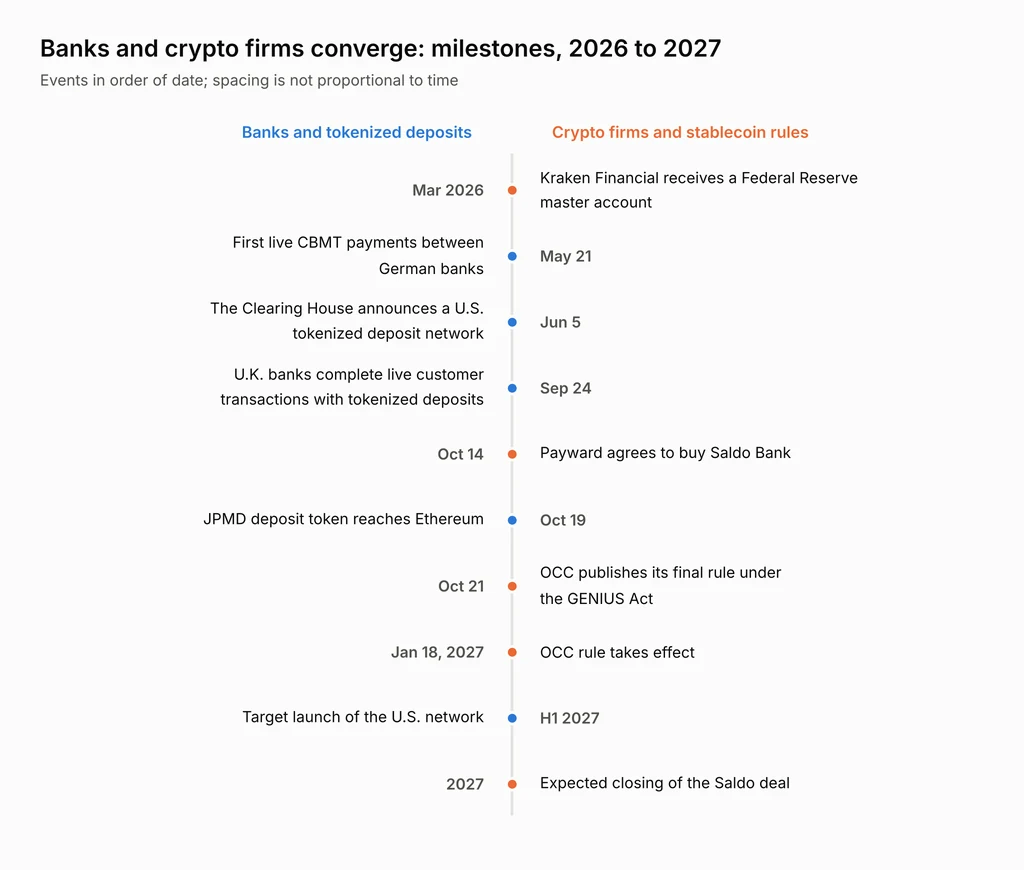
Payward, the parent company of the Kraken exchange, agreed on October 14 to buy Saldo Bank, a Lithuania-licensed digital lender with operations in four EU markets. The purchase would give the crypto firm a European banking license once regulators approve it and the deal closes in 2027.
Banks are advancing in parallel: seven U.K. lenders have completed live customer payments with tokenized deposits, and 25 U.S. banks are building a shared network for the same product.
Kraken Financial received a limited-purpose master account at the Federal Reserve Bank of Kansas City in March, which gives it direct access to the Fed’s payments system.
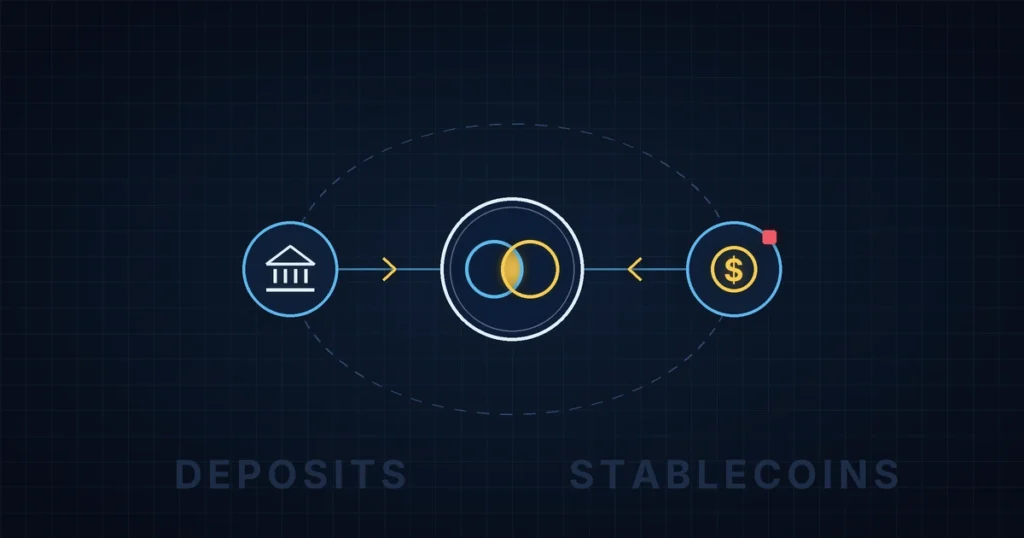
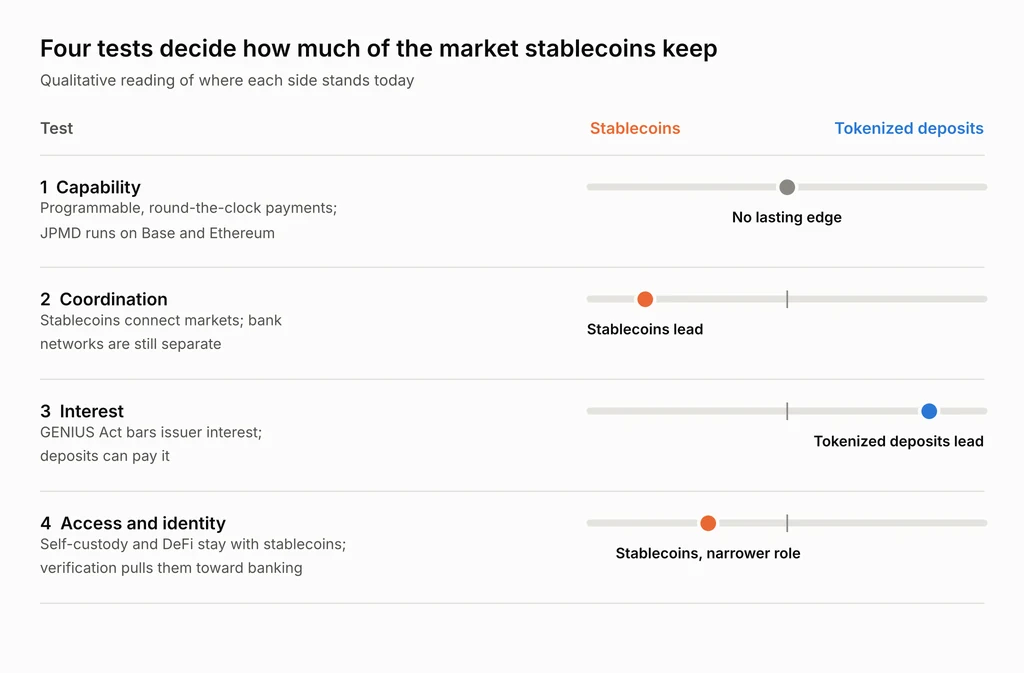
Crypto firms are gaining bank status while banks gain blockchain tools, and the contest between deposit tokens and stablecoins turns on four questions: technical capability, coordination between banks, interest, and access.
How Tokenized Deposits and Stablecoins Differ
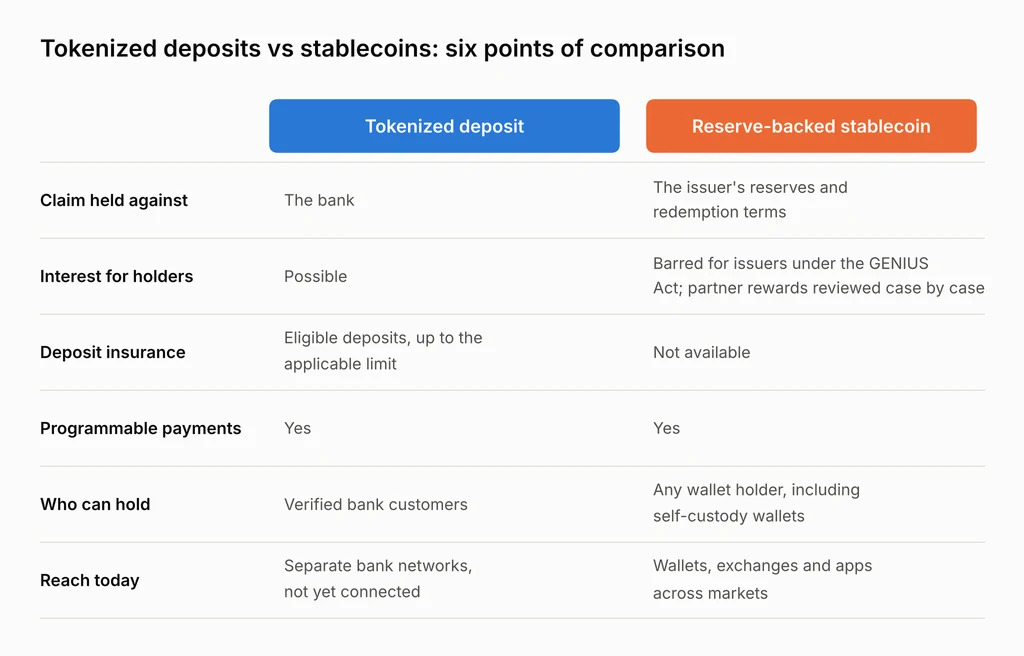
A tokenized deposit is a regular bank deposit recorded on a blockchain. The holder keeps a claim on the bank, and smart contracts release payments when agreed conditions are met, which gives the instrument the programmable payments associated with stablecoins.
A reserve-backed stablecoin gives its holder a claim on the issuer’s reserves and redemption terms. An eligible bank deposit can earn interest and carry deposit insurance up to the applicable limit.
Both instruments settle on a blockchain at any hour, so the difference lies in the legal claim behind each token, not in transfer speed.
Bank money does not need a closed ledger, as the JPMD deposit token shows: JPMorgan launched it on Base in November 2025 and extended it to Ethereum in October, where institutional clients can transfer it between wallets. JPMorgan still approves every holder, a requirement businesses with completed identity checks meet easily.
Capgemini estimates banks risk losing $230 billion in payments revenue as stablecoins and deposit tokens reach mainstream use.
In the same research, executives rank deposit tokens as their most urgent near-term priority because the deposits behind them stay on bank balance sheets and work within existing rules.
Bank Coordination Decides the Outcome
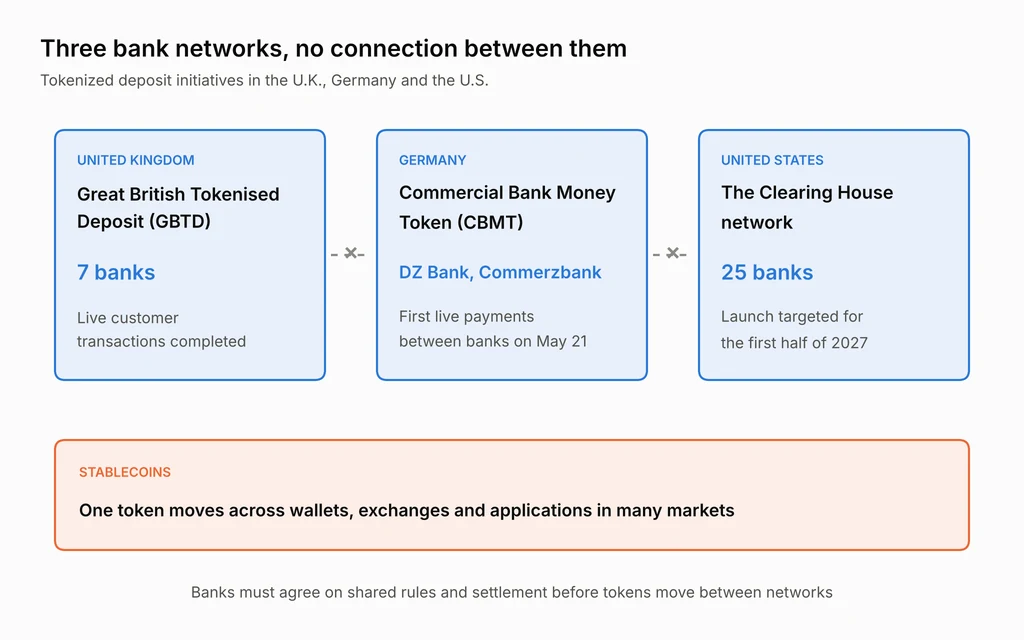
In coordination, stablecoins lead: one token moves across wallets, exchanges and applications in many markets, while a token usable at a single bank reaches few counterparties. Traditional banking solved the problem through clearing houses and central bank settlement.
Tokenized deposits need equivalent foundations: common rules, compatible systems and interbank settlement in central bank money. Issuing a token takes little effort; persuading competing banks to accept each other’s liabilities takes agreement.
Three projects test the model, starting in the United Kingdom with the Great British Tokenised Deposit initiative, which UK Finance convened. Barclays, HSBC UK, Lloyds, Monzo, Nationwide, NatWest and Santander completed live customer transactions with deposit tokens, including two remortgages and a marketplace purchase.
The group moved from a unified ledger toward clearing and interoperability between existing single-bank ledgers.
In Germany, DZ Bank and Commerzbank processed the first live Commercial Bank Money Token payments on May 21 for Siemens and Evonik. The transfer followed a manufacturing process with IoT sensor monitoring, a use case where tokenized deposits handle conditional execution between companies. BaFin, the German regulator, classified CBMT tokens as deposits in December 2025.
In the United States, The Clearing House, whose 21 owners include JPMorgan, Citi, Bank of America and Wells Fargo, chose Quant’s Overledger platform for a tokenized deposit network of 25 member banks, with a launch targeted for the first half of 2027.
Quant also built the orchestration layer for the U.K. initiative, where UK Finance expects further digital-asset settlement pilots in the coming months.
DZ Bank describes fungibility across participating banks as a core conceptual challenge, because a token from one bank must trade at par with a token from every other bank.
Interest Rules Change the Treasury Calculation
The GENIUS Act bars issuers from paying holders interest for holding payment stablecoins, and its rules take effect in January 2027. On October 21, the Office of the Comptroller of the Currency published its OCC final rule, effective January 18, 2027, dropping a proposed presumption against issuer arrangements with third parties.
They can pay interest, though blockchain recording alone does not oblige a bank to pay it. Treasury teams compare yield, settlement certainty and legal protection before moving a balance into tokenized deposits or stablecoins.
Self-Custody and Identity Keep Stablecoins Relevant
Stablecoins retain several features deposit tokens cannot copy easily: self-custody lets holders control their own keys without an intermediary, DeFi integration opens lending and trading protocols, and established liquidity pools support large trades.
Users in countries with high inflation or weak banks can hold dollars through a stablecoin when a local dollar account is out of reach.
The Financial Action Task Force reported on March 3 growing criminal use of stablecoins, mainly through peer-to-peer transfers between unhosted wallets, which bypass regulated intermediaries.
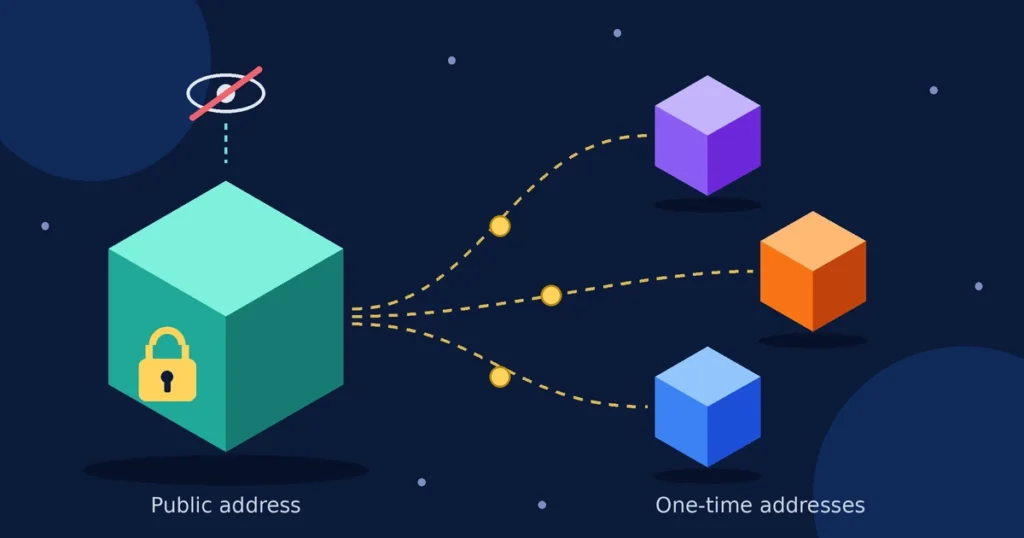
The report found only a limited number of jurisdictions have rules tailored to stablecoin risks and urged issuers to build freeze and burn capabilities. A public ledger records transactions but does not always show who controls each address, while deposit tokens stay with verified bank customers.
Regulators and Banks Set the Pace
Kraken’s bank purchase, its Federal Reserve account and three bank networks show one direction: regulated finance is absorbing digital money rather than yielding to it.
Banks joining shared networks can keep corporate deposits, and banks staying out risk losing balances to competitors’ tokens.
Kraken’s strategy reflects the shift: the exchange buys a bank instead of competing with banks.
If exchanges accept deposit tokens, traders and companies with bank accounts lose most of the reason to hold a token paying no interest.
Regulators control the timeline, and BaFin’s ruling gives CBMT a legal basis in Germany, but other EU jurisdictions lack the same clarity.
Myth vs fact
Tokenized deposits will replace stablecoins.
Convergence narrows the stablecoin market without closing it. DZ Bank’s Claus George sees the two as complementary: stablecoins already operate under clear US and EU rules, while Germany’s CBMT is six months to two years from reaching the market at scale.

Isai Alexei is a journalist and financial analyst covering cryptocurrency markets and traditional securities for Blockchaindose. He has spent ten years analyzing digital assets, trading activity, and market structure.