
Ethereum sells most of its blocks through an auction, and the two roles that feed it, builders and searchers, increasingly overlap. Public data documents exclusive order flow, vertical integration and off-chain settlements between them. It cannot document an agreement to restrain competition, because that proof sits in records no chain publishes.
MEV-Boost delivered 90.6% of Ethereum blocks between October 22 and 28, 2026, so the question reaches nearly every block.
Two Auctions Set the Price of a Block
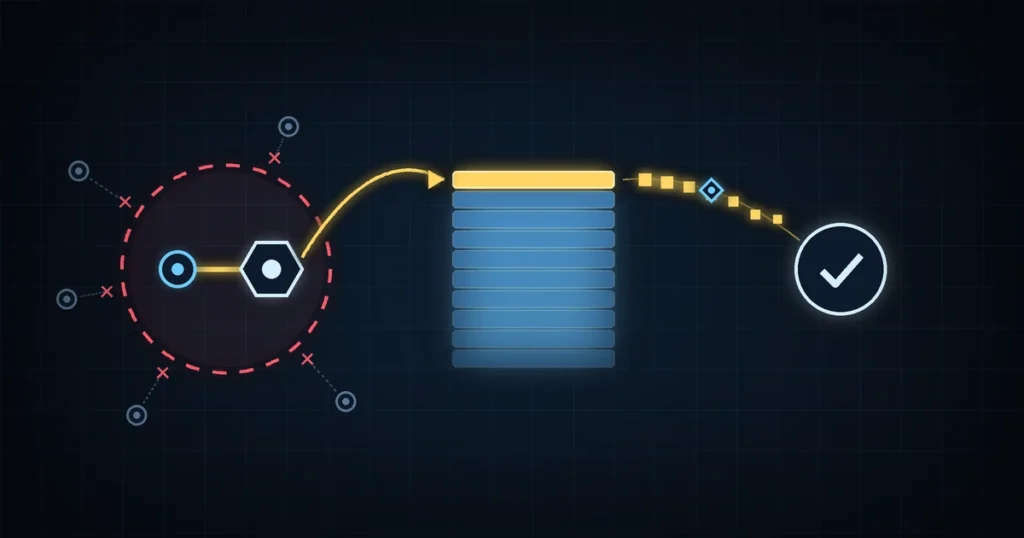
Searchers send bundles to builders through private APIs, and builders place the most profitable ones in the block. An independent searcher pays the builder a tip for inclusion; a higher tip raises the odds of inclusion and cuts the searcher’s profit.
An integrated searcher-builder pays no tip, because the profit stays inside one firm. A 2023 economic model of MEV-Boost adds that integrated builders can fix their margin late in the auction, when more information is available.
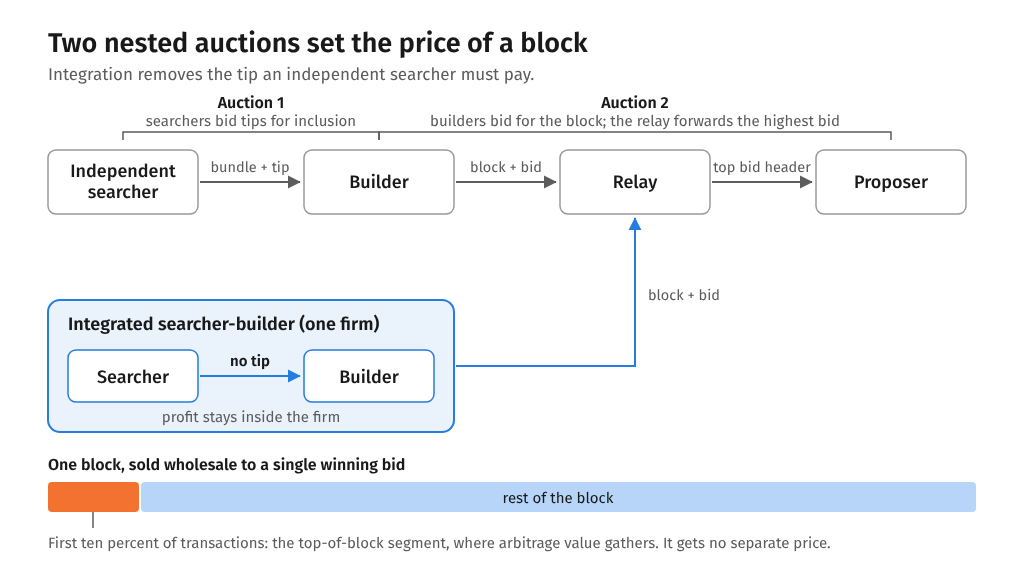
The second auction runs through relays that forward the highest bid header to the proposer, while builders send complete blocks and bids. The proposer signs the header before the relay reveals the block body, and the winning builder pays its bid.
The mechanism sells the block wholesale: it sets no separate price for the first ten percent of transactions, the top-of-block segment where arbitrage value gathers.
Why the Top of the Block Favors Integrated Builders
The top-of-block is occupied by CEX-DEX arbitrage, which is considered a non-atomic strategy, and its value follows price movements on centralized exchanges, so speed turns into revenue.
non-atomic arbitrage
A trade whose legs do not settle in one on-chain transaction. In CEX-DEX arbitrage, the searcher trades on a centralized exchange and on an on-chain exchange, so nothing guarantees both legs complete together. The searcher carries price risk between the legs and needs balances held at the exchange. That risk is why it pays for early placement and dependable inclusion.
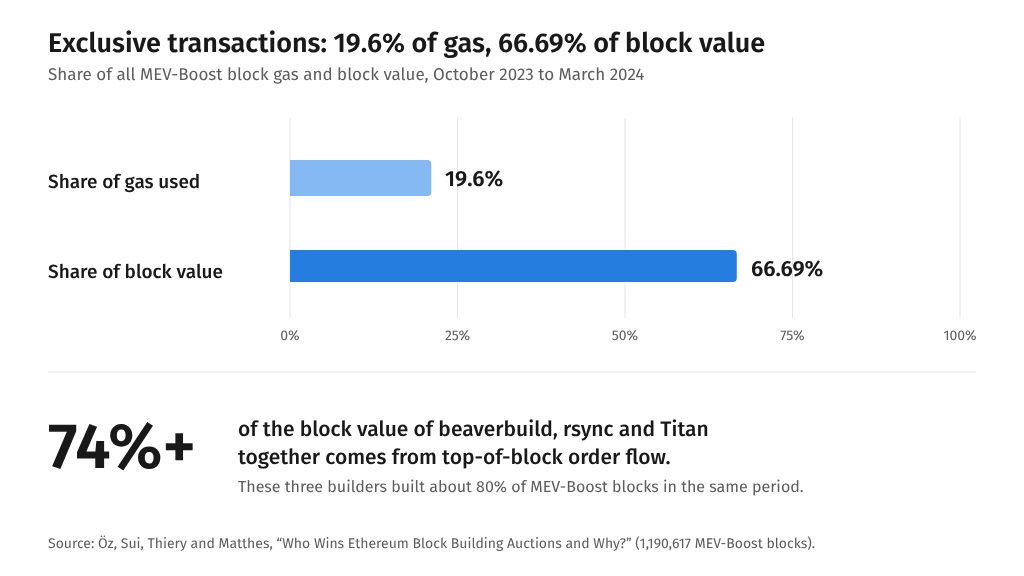
From October 2023 to March 2024, transactions sent exclusively to builders produced 66.69% of block value while using 19.6% of gas, according to Öz et al. Beaverbuild, rsync and Titan drew more than 74% of their block value from top-of-block order flow. Flashbots’ measurements show top builders starting bids later, bidding faster and raising bids in smaller steps.
Öz et al. also report that beaverbuild, rsync and Titan placed more than one cancellation per won block on the Ultra Sound relay, and they link the practice to integrated builders such as beaverbuild and rsync.
Evidence of Exclusive Pairings
Öz et al., who studied 1,190,617 MEV-Boost blocks, found SCP sending sizable order flow only to beaverbuild and Wintermute only to rsync, because each builder operates its own searcher.
Titan began receiving flow from the Banana Gun Telegram bot in February 2024, which looks like an exclusivity deal. Zhang et al. analyzed 164,249 order flows from September 2023 to August 2025 and identified 75 exclusive ones. Those 75 produced 70.53% of trading-related builder revenue.
Builders need differentiated flow to profit, but providers send it only to builders that already hold share, thus raising the cost of entry. Zhang et al. add that incumbents now keep their share without relying on exclusive flow, since searchers gravitate toward them anyway.
What the Data Cannot Show
On-chain records show payments to the proposer and transfers to the builder’s coinbase address; these settlements between searchers and builders occur off-chain.
Builder profit estimates therefore overstate profit for builders that pay for flow and understate it for integrated builders, whose upstream earnings never reach on-chain revenue. Wu et al. model builder bidding and find that unequal access to private order flow pushes the market toward a few dominant builders, while equal access restores competitive bidding.
Concentration in October 2026
A few builders produce nearly all MEV-Boost blocks, and one of them also runs a relay. The figures below show the market a year apart.
73%
built by Titan and Quasar together in October 2026.
15.0%
built by BuilderNet (29.8% a year earlier).
6.5%
built by Eureka.
Countermeasures: BuilderNet and ePBS
Flashbots, Beaverbuild and Nethermind launched BuilderNet in November 2024 to defuse exclusive order flow deals, running builders inside trusted execution environments.
Flashbots operates BuilderHub, which verifies attestations and authorizes nodes, so the operator set depends on one coordinator.
Zhang et al. found BuilderNet’s order flow distribution nearly identical to Beaverbuild’s, which suggests the entrant absorbed an incumbent’s share without restoring competition.
EIP-7732 (ePBS) moves bids, commitments and payments between proposers and builders into the protocol and registers builders as staked entities, with a stake as low as 1 ETH. Analysts at stakefish and Spark both say builder concentration stays unsolved. Glamsterdam, the upgrade that carries ePBS, activated on the Sepolia testnet on October 6, 2026, and Ethereum still lists no mainnet date.

Isai Alexei is a journalist and financial analyst covering cryptocurrency markets and traditional securities for Blockchaindose. He has spent ten years analyzing digital assets, trading activity, and market structure.