
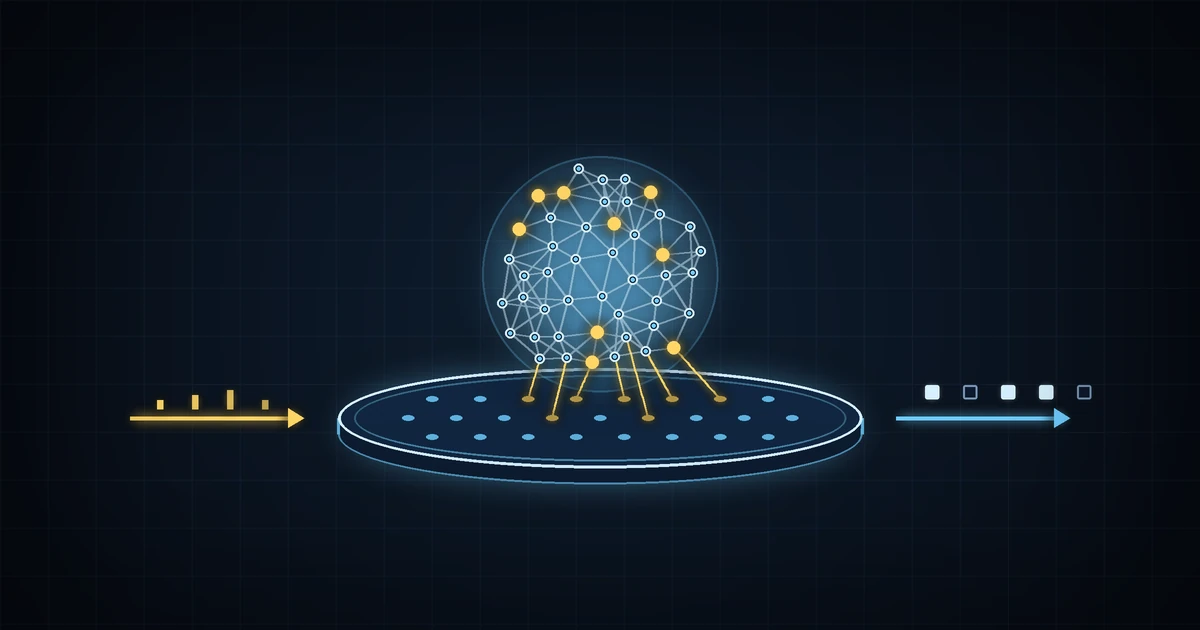
Organoid biocomputing moves neurons grown from stem cells out of neuroscience labs and into the hardware debate around artificial intelligence.
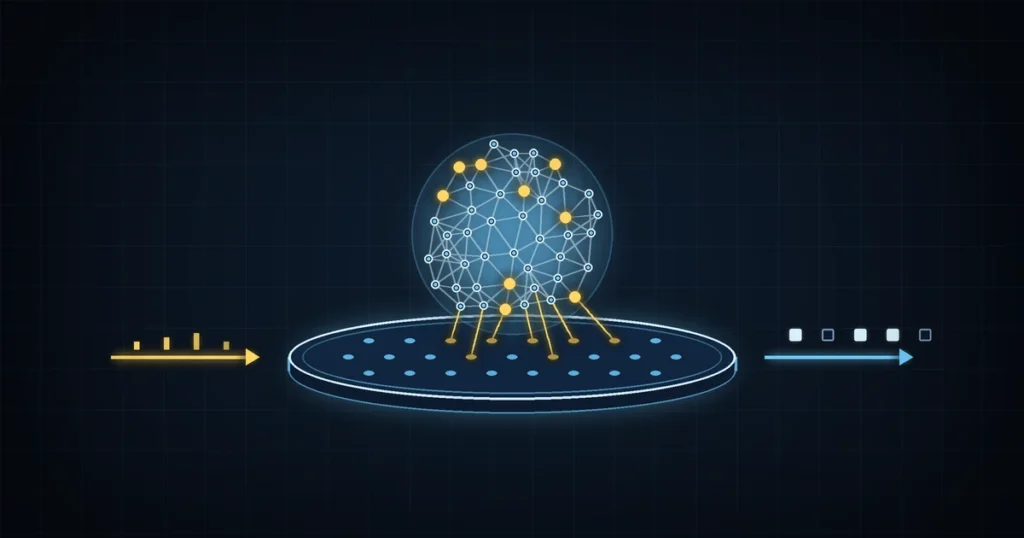
Researchers connect three-dimensional neural cultures to electrodes, send the cells electrical signals, and decode the response patterns as computational output.
Developers expect brain organoid computing to run AI workloads on a fraction of the electricity silicon accelerators draw, with no rare-earth elements and no large volumes of cooling water.
The 1st International Organoid Intelligence Conference in Maryland put the idea on a public stage, and speakers forecast future compute capacity inside culture dishes instead of server halls. Commercial products already exist: Cortical Labs sells the CL1 biocomputer, FinalSpark rents remote access to neural cultures, and 28bio trains neuron clusters inside video-game environments.
Why Data Centers Look at Neurons for Efficiency
The International Energy Agency estimated global data center consumption at 415 TWh in 2024, about 1.5% of world electricity, and projects 945 TWh by 2030, with demand from facilities built for AI set to more than quadruple.
The agency also flags the critical minerals inside data center equipment, a supply chain concentrated in a few countries.
Neurons process signals electrically, as transistors do, yet a living network completes complex calculations on far less power, and its biology needs neither rare-earth minerals nor industrial cooling loops.
Power draw explains most of the commercial interest in ultralow-power AI hardware. A silicon accelerator cluster needs grid connections, chillers, and imported minerals, whereas a culture of neurons needs a nutrient solution and a stable temperature.
Developers treat energy per computation as the metric where biology can compete with chips; accuracy and speed still favor silicon on general workloads.
From Disease Models to Computing Units
Brain organoids started as observation tools for neuroscience, and labs grow them to study how the human brain develops and why disease appears.
Regulators push research groups to reduce animal experiments, which raises interest in brain organoids as test beds for the effects of gene mutations, environmental toxins, and drug candidates on nervous tissue.
Brain organoid
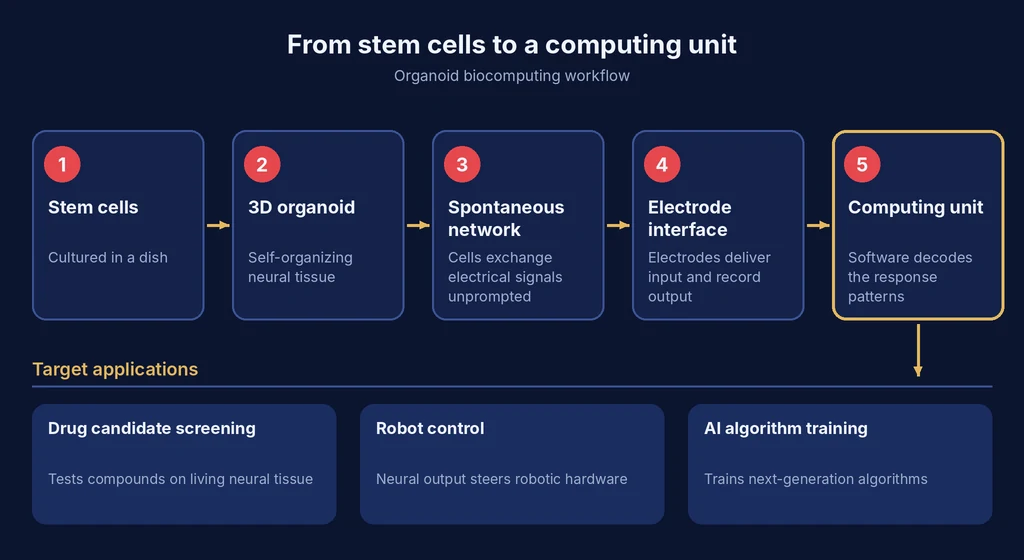
A three-dimensional culture of nerve cells obtained from stem cells. Once it reaches a certain complexity, the cells form networks and send electrical signals to one another on their own, which makes it possible to use it to study brain development, evaluate drugs, and build computing units.
Organoid biocomputing research began when stem-cell cultures grew complex enough to form networks without outside prompting and to exchange electrical signals on their own.
Biocomputing groups treated the spontaneous activity as raw material and built interfaces to turn a culture into a processing unit: electrodes deliver input, the tissue responds, and software decodes the output.
Cortical Labs demonstrated the principle in 2022, when about 800,000 human and mouse neurons on a chip learned to play Pong in a simulated environment.
Documented Results: Pac-Man, Braille and a Robot Dog
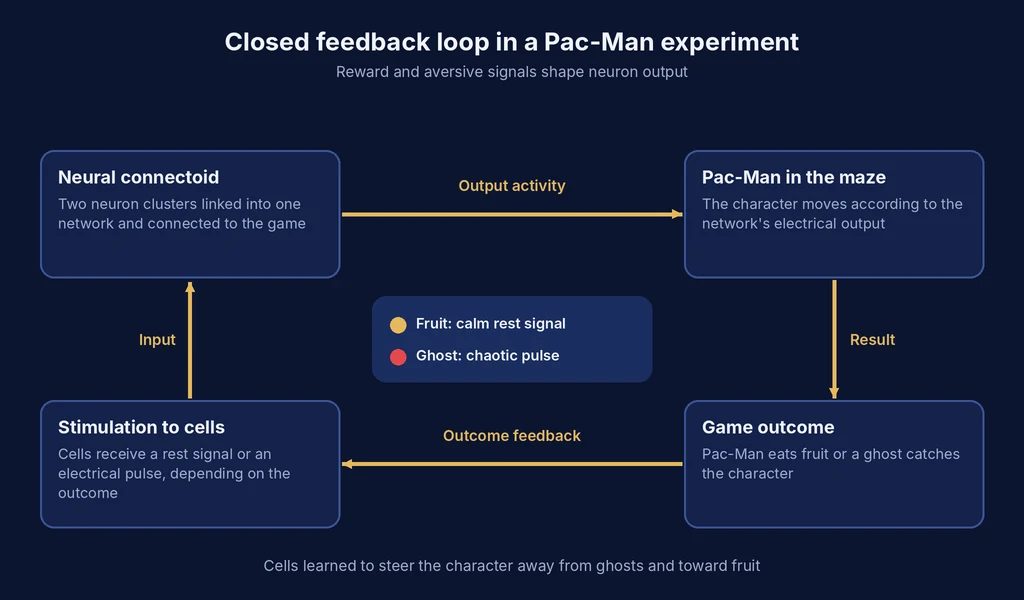
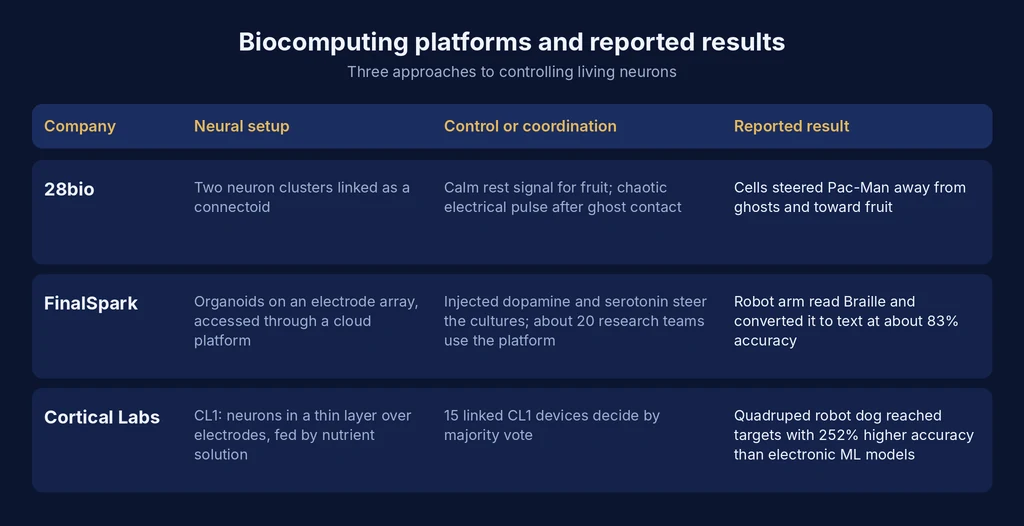
28bio linked two neuron clusters into a neural connectoid and wired it to Pac-Man. Fruit in the maze sent the cells a calm rest signal, and contact with a ghost triggered a chaotic electrical pulse.
The cells adapted their output to avoid the pulse, which steered the character away from ghosts and toward fruit.
FinalSpark places organoids on electrode arrays and steers them with injected neurotransmitters, including dopamine and serotonin. The Swiss company runs a Brain Organoid Computing as a Service platform with remote cloud access for about 20 research teams.
One team trained a robot arm with tactile sensors on the platform, and the system converted Braille characters into text with 83% accuracy.
Cortical Labs commercialized the CL1, a compact box in which neurons spread in a thin layer across electrodes and receive a nutrient solution. The company priced the first units at $35,000 each, lowered the price to $20,000 per unit for a 30-unit rack, and rents remote access to live cultures for $300 per week. Each culture lasts about six months, and buyers need institutional ethical approval and cell-culture facilities before installation.
Companies in Singapore and Australia plan biological data center projects linking several CL1 units together, aimed at drug candidate screening, robot control, and training of next-generation AI algorithms.
Cortical Labs also treats the natural variability between cells as a feature of organoid biocomputing instead of suppressing it: the company connected 15 CL1 devices into a collective system in which the cellular networks decide by majority vote.
Controlling a quadruped robot dog, the system located and approached a target with accuracy 252% higher than conventional electronic machine-learning models reached.
83 %
Accuracy with which a robotic arm with tactile sensors converted Braille into text using the FinalSpark platform.
252 %
Improvement in accuracy of a quadruped robot dog controlled by 15 CL1 devices versus electronic machine-learning models.
$35,000
Initial price of one CL1 unit; $20,000 per unit in a 30-unit rack and $300 per week for remote access.
Reservoir and Closed-Loop Computing: Two Technical Paths
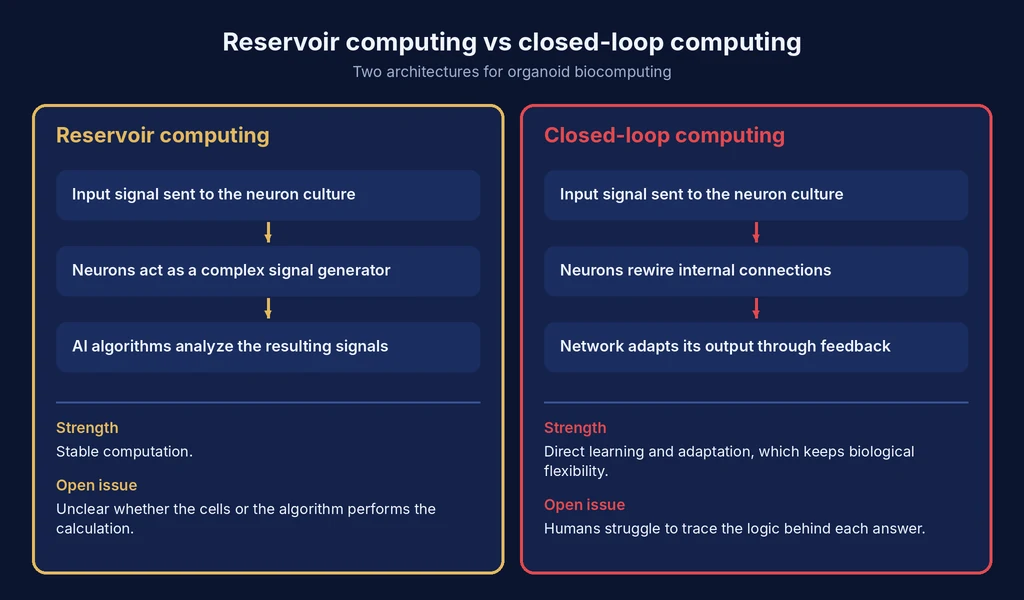
Engineers build every organoid biocomputing system around one of two architectures, and each architecture carries a different technical trade-off.
In reservoir computing, neurons act as a complex signal generator and AI algorithms analyze the output, which gives stable computation but raises an attribution problem: nobody can state with certainty whether the cells or the algorithm perform the calculation.
Closed-loop computing lets neurons rewire their own connections to learn and adapt directly, which preserves the flexibility of biological learning. The cost is limited interpretability, because researchers struggle to trace the logic behind an answer the cells produce.
Scientists expect advances in neuron biology to raise precision and efficiency, and current organoid biocomputing products target research laboratories rather than general AI workloads.
Cloud Access, Decentralized Compute and Crypto Infrastructure
Akash Network runs a decentralized compute marketplace where providers bid to host workloads through a reverse auction, and DePIN protocols use token incentives to coordinate GPUs, storage, and sensors from independent operators.
Marketplace listings cover CPU and GPU capacity, and wetware stays behind centralized platforms like the FinalSpark cloud service.
Ethereum cut its network electricity use by more than 99.9% after the 2022 move to proof of stake, and several publicly traded Bitcoin miners reduced their mining capacity in 2026 to host AI workloads on sites with existing power contracts and cooling systems.
Compute buyers price electricity and cooling as the binding constraint, and developers of organoid biocomputing argue neurons ease both limits. DeSci projects like VitaDAO and Bio Protocol raise capital through tokens for longevity and other life-science work, and Bittensor organizes AI tasks into subnet marketplaces paid in TAO.
A marketplace for organoid compute would verify results from variable biological hardware, which differs from checking the deterministic output of silicon, so verification design would shape any on-chain version of organoid biocomputing.

Isai Alexei is a journalist and financial analyst covering cryptocurrency markets and traditional securities for Blockchaindose. He has spent ten years analyzing digital assets, trading activity, and market structure.