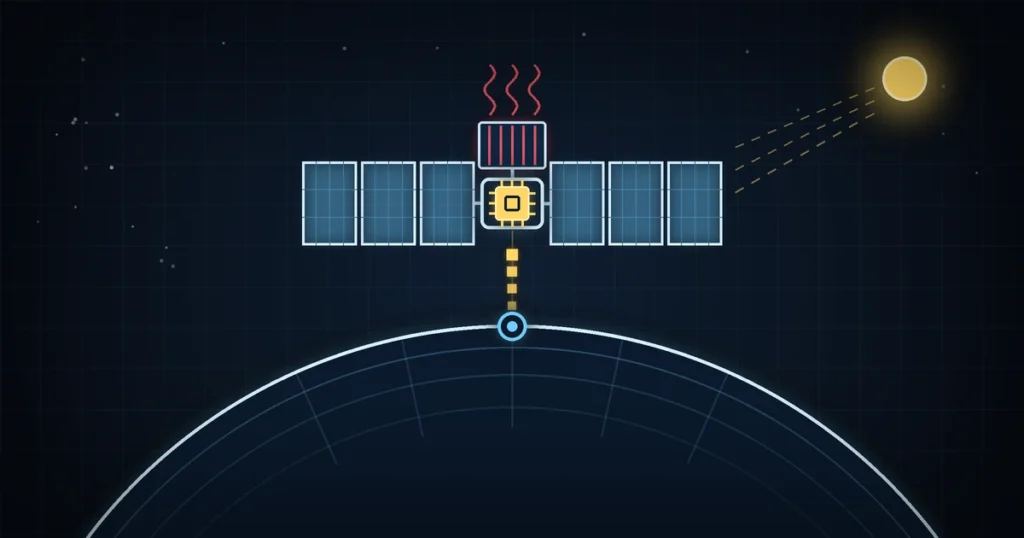

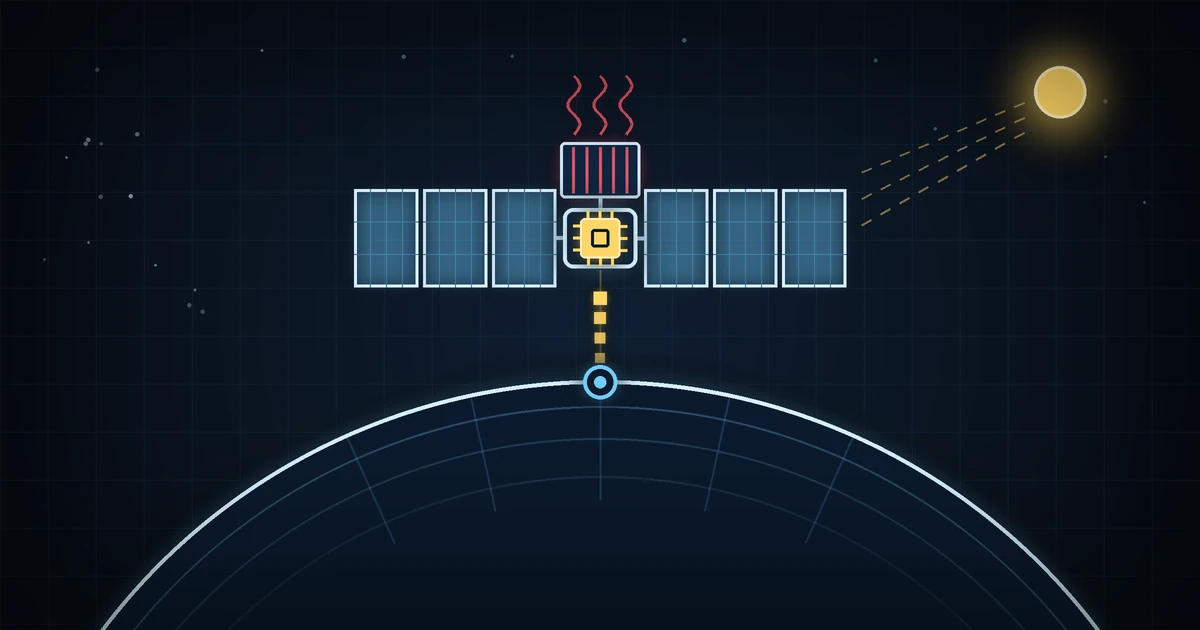
Starcloud, an Nvidia-backed startup based in Redmond, Washington, plans to run Bitcoin mining in space with ASIC miners aboard its Starcloud-2 satellite.
CEO Philip Johnston revealed the payload in an interview with Documenting Bitcoin and declared Starcloud would be “the first to mine Bitcoin in space.”
Johnston first promised activation before 2026 ended, and the launch target now sits in early 2027, pushing the mining test into next year.
$30,000 / $1,000
Price of a 1 kW Nvidia B200 GPU vs. a 1 kW ASIC.
88,000
Satellites in Starcloud’s FCC application (February 2026)
3.125 BTC
Block reward since the April 2024 halving.
Starcloud Adds ASICs to Its Second Satellite
Founded in 2024, Starcloud launched its first satellite, Starcloud-1, in November 2025 with an Nvidia H100 GPU, about 60 kilograms of hardware built to test AI workloads outside the atmosphere. The company reports the spacecraft trained an AI model in orbit.
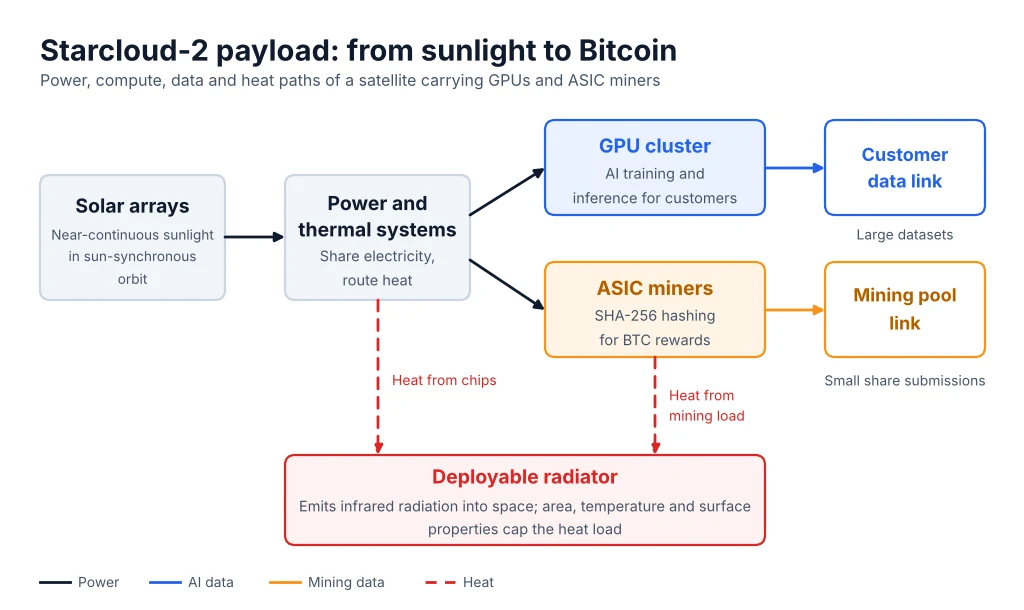
Starcloud-2 is the second of four planned satellite missions and the first commercial flight, with a GPU cluster, persistent storage, and dedicated power and thermal systems in sun-synchronous orbit.
Johnston added the mining hardware to the payload list during the interview, and the official Starcloud-2 page did not mention ASICs or Bitcoin.
Coverage of the company’s $170 million Series A on March 30, 2026 later listed a Bitcoin mining computer beside an Nvidia Blackwell GPU and an AWS server blade.
Mining also works without a customer contract, so ASICs can earn BTC whenever GPU capacity sits idle, a fallback if AI demand arrives slowly for a first commercial mission.
Crusoe, which Starcloud lists as an early customer, plans to offer limited GPU capacity from space in early 2027, and Johnston calls Bitcoin mining one of the most attractive uses of space computing.
Hardware Cost per Kilowatt Separates ASICs From GPUs
An Nvidia B200 GPU consuming 1 kW costs about $30,000, and an ASIC with the same draw costs about $1,000, which makes mining chips roughly 30 times cheaper per kilowatt. A GPU trains models, runs inference and serves many customers, whereas an ASIC executes only the SHA-256 hashing routine behind Bitcoin’s proof-of-work.
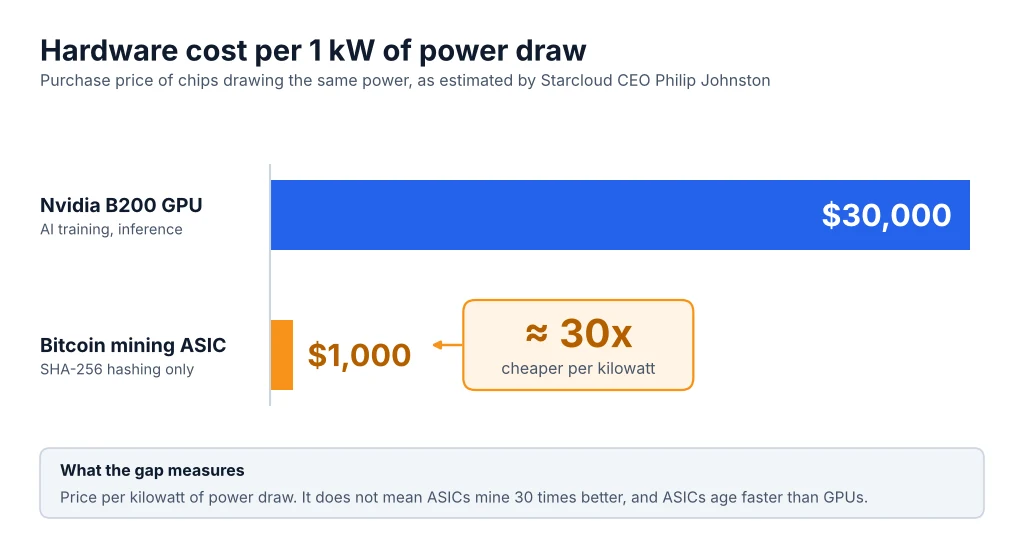
Johnston acknowledged faster ASIC obsolescence, which shortens the window for recovering hardware costs, and noted terrestrial miners already use flare gas to generate electricity at two to three cents per kilowatt-hour.
Terrestrial miners are moving in the opposite direction from Starcloud: CoinShares counts more than $70 billion in AI and high-performance computing contracts across listed miners, and Core Scientific and TeraWulf each reported more than half of first-quarter 2026 revenue from AI services.
Solar Power and Cooling Define Bitcoin Mining in Space
Electricity is the largest recurring expense in mining, and Bitcoin mining in space replaces grid power with near-continuous sunlight in sun-synchronous orbit, removing fuel bills and grid fees from the cost model.
Johnston estimates the Bitcoin network draws about 20 gigawatts continuously and expects the load to leave Earth eventually.
Starcloud filed with the FCC in February 2026 for a constellation of up to 88,000 satellites, though the Starcloud-2 mining payload remains a single-spacecraft test.
Johnston describes mining as suited to unconventional or variable power sources, and miners tolerate interruptions because hashing pauses and resumes without data loss.
A satellite can shed the ASIC load during a power dip and keep GPU customers online, which makes Bitcoin mining in space a flexible outlet for surplus electricity.
Bandwidth matters less for mining than for AI customers, because ASICs return small share submissions to a mining pool while GPU clients move large datasets, lowering the communication load the ASIC payload places on the spacecraft.
Cooling sets the physical limit of Bitcoin mining in space, because a vacuum offers no air for convection. The satellite must move heat from chips to radiators, which emit infrared radiation, and radiator area, operating temperature and surface properties define the radiative cooling limit.
Starcloud-2 will carry what the company calls the largest deployable radiator flown on a private satellite, and the mission will show how the design performs under sustained load.
Launch Costs and Delays Test the Business Case
Bitcoin mining in space must cover expenses missing from a chip price comparison: the launch slot, radiator mass, power electronics, communications links and ground operations.
The block reward stands at 3.125 BTC since the April 2024 halving, and difficulty adjusts every 2,016 blocks, so revenue per terahash falls whenever rival miners add hashrate. A satellite cannot swap a failed ASIC, which turns every defect into lost output for the rest of the mission.
Terrestrial benchmarks set a demanding bar for orbital hardware, since CoinDesk reported a post-halving hashprice low of $28 to $30 per petahash per day in early March 2026.
Miners running mid-generation machines needed electricity below five cents per kilowatt-hour to stay cash-profitable, and Bitcoin mining in space must clear the same revenue floor while carrying launch and cooling costs absent from grid-connected sites.
Schedule risk adds pressure to the economics, because Starcloud-2 targeted October 2026 when the company closed its Series A and the date has since slipped to early 2027.
Starcloud added a $250 million extension to the round in August at a $2.3 billion valuation, yet Johnston has described launch capacity as constrained, which complicates booking rideshare slots for the remaining planned missions.
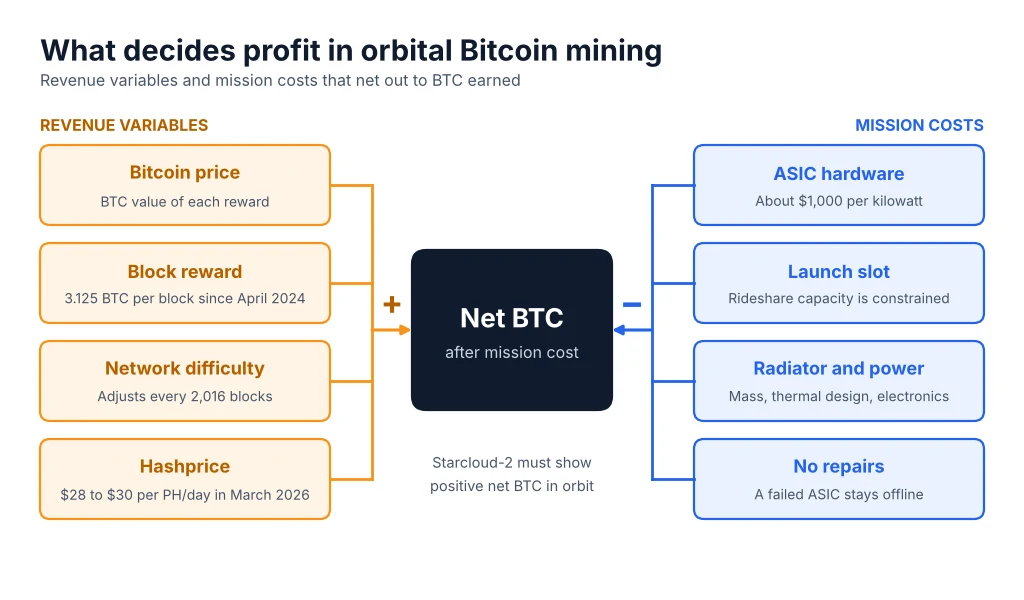
What Starcloud-2 Will Prove About Orbital Mining
What we like
- Nearly continuous sunlight in sun-synchronous orbit.
- ASICs about 30 times cheaper per kilowatt than a GPU.
- Backup revenue source if AI demand is slow.
What to watch out for
- No repairs: a failed ASIC is out of service.
- ASICs age faster than GPUs.
- Radiative cooling limits power density.
Four measurements will decide the result: hashrate per kilowatt, ASIC failure rates under radiation and temperature swings, radiator performance under continuous load, and net BTC earned after mission cost.
Orbital computing rivals give the experiment a wider frame: Google launched its first Project Suncatcher TPU satellite in 2026, and SpaceX has said it expects to deploy orbital AI compute satellites as early as 2028.
Starcloud designed Starcloud-3, a larger spacecraft, around Starship launches, so Bitcoin mining in space joins a race to move power-hungry computing off the terrestrial grid.
FAQ
What is Bitcoin mining in space?
It is the operation of ASIC miners on a satellite powered by solar panels. Starcloud plans the first announced test aboard Starcloud-2, which targets launch in early 2027.
Why does Starcloud choose ASICs over GPUs for mining?
Johnston estimates a 1 kW ASIC costs about $1,000, against about $30,000 for a 1 kW Nvidia B200 GPU. The gap compares hardware price per kilowatt and does not measure mining efficiency.
How does a satellite cool mining hardware?
A vacuum blocks convection, so heat moves from the chips to radiators that emit infrared radiation. Starcloud-2 carries a deployable radiator the company describes as the largest flown on a private satellite.
When will Starcloud-2 launch?
The target moved from October 2026 to early 2027. Starcloud-2 is the second of four planned satellite missions and the first commercial flight.
How much BTC will Starcloud-2 mine?
No reliable estimate exists yet, because public materials list no ASIC count, power draw or hashrate. Profit will depend on launch cost, hardware life, network difficulty and the Bitcoin price.

Isai Alexei is a journalist and financial analyst covering cryptocurrency markets and traditional securities for Blockchaindose. He has spent ten years analyzing digital assets, trading activity, and market structure.