Blockchains come in many forms, each solving different problems. Layer 1 blockchains (L1s) like Ethereum, Solana, and Avalanche handle transactions and smart contracts. Some focus on speed, like Aptos and Hedera, while others, like Cosmos and Polkadot, connect multiple networks. Layer 2 solutions (L2s), such as Arbitrum and Optimism, reduce congestion by processing transactions off-chain. Layer 3 blockchains (L3s) take it further, offering specialized rollups for gaming, DeFi, and business needs. Moving assets between blockchains? Cross-chain bridges like Wormhole and Synapse make it happen. Choosing the right network means better security, speed, and flexibility.
Metaverse development has become a broad category that covers everything from browser-based virtual spaces to large-scale multiplayer environments, immersive training platforms, digital showrooms, social worlds, and blockchain-enabled ecosystems. That breadth creates an obvious problem for companies looking for a development partner: almost every agency that works with 3D technology, virtual reality, blockchain, or interactive applications ...
Atomic swaps enable trustless peer-to-peer cryptocurrency exchanges across different blockchains. The protocol guarantees a binary outcome: either both parties receive their assets or both receive refunds. Three distinct mechanisms have emerged in this domain: Hash Time-Locked Contracts (HTLCs), Point Time-Locked Contracts (PTLCs), and Taproot-enabled PTLCs. Each represents a successive layer of cryptographic optimization, moving contract logic from on-chain scripts ...
Hedera Hashgraph operates a public distributed ledger that does not rely on a blockchain. The network implements a directed acyclic graph (DAG) data structure combined with the Hashgraph consensus algorithm, a combination that distinguishes it from conventional blockchain architectures. This design delivers ~10,000 transactions per second (TPS) on the mainnet with 3–5 second absolute finality, compared to Ethereum’s ~15–30 TPS and ~13-minute ...
Multiple Layer-1 networks are now building infrastructure designed exclusively for autonomous AI agents, eliminating the human from the transaction loop entirely. Neo co-founder Da Hongfei formalized this direction in March 2026 with a strategy document positioning Neo X as a “Humanless Blockchain“. BNB Chain followed in July 2026 with plans for a dedicated Layer-1 targeting ...
EIP-4844 activated in Ethereum’s March 2024 Dencun upgrade, introducing blob transactions as a new data type for Layer 2 rollups. The upgrade created a separate fee market for temporary data blobs, decoupling rollup data availability costs from Ethereum’s execution gas market. Each blob stores approximately 128 KB of data and is pruned after roughly 18 days. The network maintains a target of 3 blobs per ...
zkSync Era implements a custom zero-knowledge virtual machine (zkVM) that diverges from the Ethereum Virtual Machine (EVM) bytecode format. Matter Labs selects this design to reduce proving time and lower per‑transaction cost. The approach replaces direct EVM execution with a compilation pipeline that converts Solidity and Vyper source code into zkEVM bytecode. Developers gain faster block finality but incur ...
The Move programming language, originally developed at Meta for the Diem project, has been widely regarded as a technical advancement over Solidity. Its resource-oriented programming model treats digital assets as first-class resources that cannot be copied or implicitly discarded, eliminating entire classes of vulnerabilities at the language level. Sui’s implementation of Move introduces an object-centric data model that enables ...
Cross-chain Maximal Extractable Value (MEV) has transitioned from a theoretical concern to a systematically quantified economic leakage across blockchain interoperability protocols. Researchers from Flashbots and the Technical University of Munich conducted the first large-scale empirical study of executed cross-chain arbitrage, identifying 242,535 executed cross-chain arbitrages totaling $868.64 million in volume and generating $8.65 million in net profit across nine blockchains over ...
Zero-knowledge proof systems have reached production maturity in 2026, with Groth16, PLONK, and Cairo-based STARKs powering billions in daily transaction volume across Ethereum Layer 2 networks. The selection of a proving system directly determines on-chain gas costs, end-user latency, and security assumptions for any ZK-powered application. This article presents production benchmarks for the three dominant systems as ...
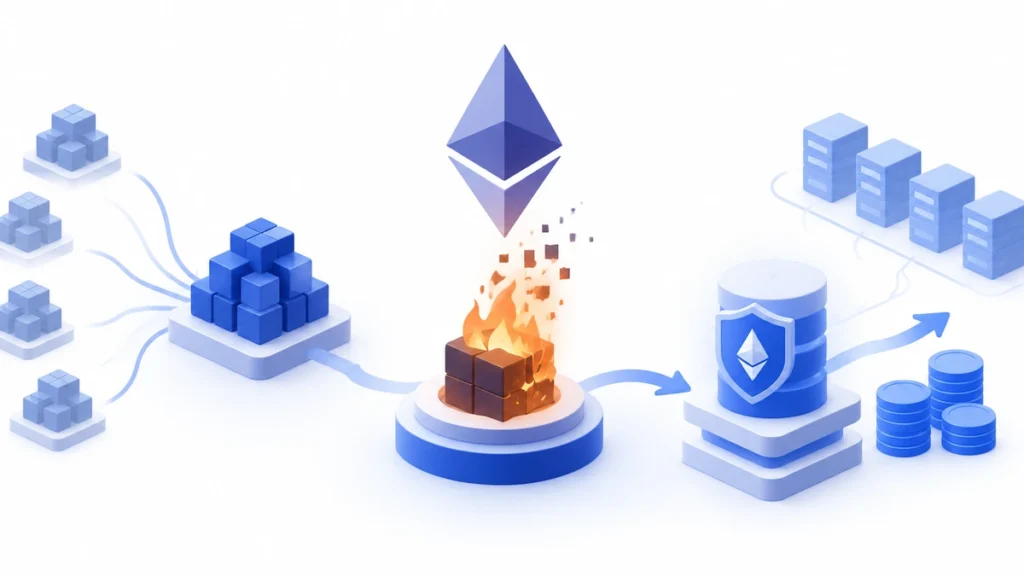
The Ethereum research community has advanced MEV-Burn from a theoretical concept to a protocol-near implementation. Current client software contains the necessary infrastructure to enable MEV-Burn as early as the Glamsterdam upgrade, according to analysis published on Ethereum Research. The mechanism redirects builder auction payments from validators to protocol-level burning, fundamentally altering the economic structure of ...
To enhance your experience, we use cookies. Consent helps us process data like browsing behavior. Denying may affect site features.
Functional
Always active
The technical storage or access is strictly necessary for the legitimate purpose of enabling the use of a specific service explicitly requested by the subscriber or user, or for the sole purpose of carrying out the transmission of a communication over an electronic communications network.
Preferences
The technical storage or access is necessary for the legitimate purpose of storing preferences that are not requested by the subscriber or user.
Statistics
The technical storage or access that is used exclusively for statistical purposes.The technical storage or access that is used exclusively for anonymous statistical purposes. Without a subpoena, voluntary compliance on the part of your Internet Service Provider, or additional records from a third party, information stored or retrieved for this purpose alone cannot usually be used to identify you.
Marketing
The technical storage or access is required to create user profiles to send advertising, or to track the user on a website or across several websites for similar marketing purposes.