
The Symbol blockchain launched in 2021 with features most layer 1 networks were still drafting proposals about: native multisignature, atomic transaction bundles, and tokens that need no smart contract. Five years later, almost nobody uses it. That gap between engineering and adoption is what makes Symbol worth studying.
Key Takeaways
- Symbol (XYM) trades roughly 99.6% below its March 2021 peak of $0.7715, with a market cap near $18.7 million.
- Daily trading volume sits around $65,000 to $130,000 across roughly six exchanges, which is thin enough that single orders move the price.
- The network reached its all-time low in February 2026 – five years after launch, not during a market crash.
- Symbol offers tokens without smart contracts, removing an entire category of exploits but also removing composability.
- Binance delisted sister token XEM in June 2024, and the official block explorer went offline, leaving dead links across exchange listings.
This guide examines what Symbol built, why the market never followed, what the community says about the decline, and what developers evaluating any chain can learn from it.
What the Symbol Blockchain Looks Like Today
The numbers frame everything else. Symbol reached an all-time high of $0.7715 on 21 March 2021, days after mainnet launch. According to CoinGecko market data, it now trades around $0.0029 – a decline of roughly 99.6%. A $1,000 position at launch would be worth about $4 today.
Market capitalisation sits near $18.7 million, placing Symbol around rank #748 on CoinMarketCap. Daily volume ranges between $65,000 and $130,000 depending on the aggregator and its methodology.
| Metric | Value (July 2026) | What it means |
|---|---|---|
| Price | ~$0.0029 | Down from $0.7715 at peak |
| Change from peak | -99.6% | Five years of sustained decline, not a single crash |
| Market cap | ~$18.7 million | Rank around #748 |
| 24h volume | $65K – $130K | Varies by data source |
| Volume / market cap | ~0.35% | Below 1% signals thin liquidity |
| Active markets | 6 exchanges, 8 pairs | Primarily MEXC, Zaif, CoinEx |
| All-time low | $0.00231 (Feb 2026) | Reached five years after launch |
The last row carries the most weight. A project hitting its all-time low half a decade after launch, across multiple market cycles, is not experiencing a downturn. It is experiencing a sustained absence of demand.
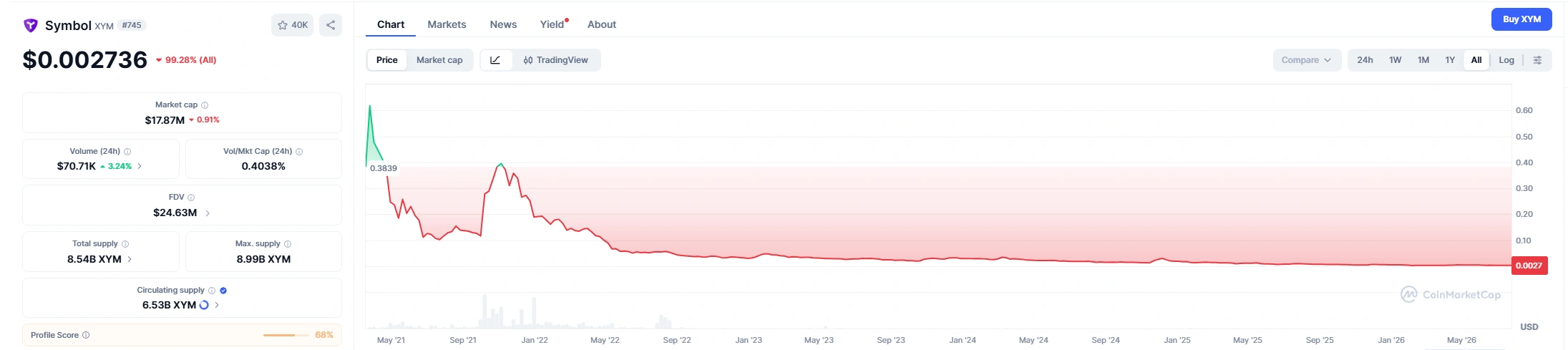
The volume figure deserves attention too. At roughly $70,000 per day spread across a handful of venues, a single order of a few thousand dollars moves the price meaningfully. Institutional participation is effectively zero, and price discovery in this range barely functions.
One clarification matters throughout this article: XEM and XYM are different tokens on different chains. XEM belongs to NEM’s original NIS1 network from 2015. XYM belongs to Symbol, launched in 2021. They run in parallel with separate addresses and separate explorers, and confusing them produces a lot of bad analysis.
What Symbol Actually Built
The interesting part of this case is that the technology is not the failure point. Symbol shipped genuinely well-designed features, several of which other chains spent years catching up to.
Tokens Without Smart Contracts
On Ethereum, issuing a token means deploying a contract: writing Solidity, paying for an audit, and inheriting whatever bugs the code contains. Symbol treats token issuance as a native transaction type. You submit a mosaic definition specifying supply, divisibility, and flags for whether supply can change or the token can be transferred onward. The protocol handles the rest.
The security argument is real. There is no contract to audit because there is no contract. The entire category of token bugs that has cost the industry billions – reentrancy, integer overflow in transfer logic, broken access control – simply does not apply. Anyone who has read a smart contract audit report knows how much of that work exists purely because each issuer writes their own logic.
The trade-off is equally real: you get exactly the features the protocol offers and nothing else. No custom vesting logic, no unusual transfer rules, no composability with DeFi primitives. For a supply chain certificate or a membership token, that constraint is fine. For anything needing programmable behaviour, it is disqualifying.
Aggregate Transactions
Symbol allows several transactions to be bundled so they all succeed or all fail together – atomic execution without a contract. Bonded aggregates go further, sitting in a partial state on-chain for up to 48 hours while signatures are collected.
This is an elegant solution for multi-party workflows. An escrow, an asset swap, or a document requiring three departmental approvals can be expressed directly as a transaction rather than as contract logic that must be written, tested and verified.
Multisignature and Namespaces
Symbol supports up to 25 cosignatories across three levels of nesting, with configurable approval thresholds. Crucially, if one signatory loses their key, the remaining cosignatories can modify the account – a recovery path many smart contract wallets bolt on awkwardly or omit entirely.
Namespaces are rented on-chain names, up to three levels deep, aliasable to accounts or mosaics. Sending to alice rather than a 39-character address. The Ethereum Name Service shipped something comparable, but Symbol had it in the base protocol from day one rather than as a contract layer added later.
Proof-of-Stake-Plus
Block production probability derives from an importance score combining stake with activity – fees paid and past reward frequency both feed in. The stated intent was discouraging concentration of block rewards among the largest accounts, a design goal most proof of stake networks accept as an unavoidable cost.
Delegated harvesting lets an account link a remote key to a node and earn without keeping a wallet online, with the node operator taking a share. This produced an unusually large population of community-run nodes for a network this size – a genuine decentralisation win that survives even now.
Why the Market Never Followed
None of the above is marketing copy. These features work as described. The failure sits elsewhere, and it is instructive.
The Corporate Structure Collapsed Early
Symbol launched under NEM Group, a three-entity structure comprising NEM Software, NEM Trading and NEM Ventures, with enterprise-focused messaging about fintech, healthcare and supply chain. Within months, a community hard fork redirected the project away from that corporate structure toward community governance.
Decentralisation is a virtue. Decentralisation achieved by the collapse of your commercial arm months after mainnet is a different thing. The funded organisation meant to drive enterprise adoption largely stopped performing that function at exactly the moment a new chain most needs business development.
What Holders Say About the Decline
Community discussion adds something the official record does not. Reading through holder conversations at two points – the March 2021 launch and the June 2024 aftermath – produces a consistent explanation that differs from the technical narrative.
At launch, the dominant sentiment was already ambivalent. Holders described the platform as having genuinely capable technology while noting it had, for reasons nobody could articulate, never managed to become popular. Others were blunter, arguing that a project active since 2014 needed to deliver something tangible and usable rather than continuing years of promotional language. Notably, most launch-week discussion focused on airdrop mechanics and exchange listings rather than on anything anyone planned to build.
By 2024, the tone had hardened considerably. Asked directly whether the project could still recover, long-term holders answered almost unanimously that it could not – and they consistently dated the decline to a specific cause: the departure of the founders and original team, not to any technical shortcoming. One recurring formulation captured the whole arc: an amazing project with enormous potential whose creators never realised what they had.
That is a meaningfully different diagnosis from “the technology failed”. It also aligns with what the record shows about the governance transition, which suggests the community read the situation accurately in real time.
The Binance Delisting
On 17 June 2024, Binance delisted NEM (XEM) alongside OMG Network, Waves and Wrapped NXM. CCN reported that XEM fell 30% to $0.02508 following the announcement. Binance cited declining trading volume, project team commitment, development quality and network stability among its criteria.
This hit XEM rather than XYM directly, but the signal reached both. For long-term holders, losing the largest exchange was the moment the situation became unambiguous, and the discussion that followed among them turned openly to whether any future existed at all.
No Developer Ecosystem Formed
This is the decisive failure. A blockchain platform lives or dies on whether developers build on it, and Symbol’s flywheel never started spinning.
- No EVM compatibility. Symbol requires learning a distinct model with its own SDK. Every hour spent learning it is an hour not spent on Solidity, which transfers across dozens of chains.
- No DeFi. Without programmable contracts there is no lending, no AMM, no yield – removing Symbol from the single largest driver of on-chain activity over the past five years.
- No NFT wave. Mosaics can represent non-fungible assets cleanly, but the marketplaces, tooling and audience were all somewhere else.
- Enterprise pitch without enterprise sales. The hybrid public-private architecture targeted businesses, and that sales organisation dissolved.
The chains that won this period were not uniformly the best engineered. They were the ones that made starting cheapest: an existing language, existing tooling, existing tutorials, existing hiring pool. Symbol sits alongside other Ethereum alternatives that solved real technical problems and still lost on distribution.
Geographic Concentration
Symbol’s community is heavily Japanese and Korean, and that community is genuinely active – most ecosystem projects, documentation translations, node operators and technical blog posts originate there. But this produces real activity that stays largely within one language sphere. English-language developer discussion is thin, compounding the discovery problem. A developer in Berlin or Sao Paulo evaluating chains is unlikely to encounter Symbol at all.
Infrastructure Decay: A Warning for Any Chain
The clearest symptom of reduced coordination: the official reference block explorer went offline. It is still listed as the project homepage in the symbol/explorer repository and still linked from exchange listings, price trackers and tutorials across the web.
Anyone following those links from a major exchange or a node-setup guide finds nothing. The community maintains working alternatives, so the capability was not lost – but the canonical piece of read infrastructure lapsed, and nobody updated the thousands of links pointing at it.
| Resource | Status |
|---|---|
| explorer.symbolblockchain.io | Offline – the original official explorer |
| symbol.fyi | Active – now the reference explorer |
| docs.symbol.dev | Active – official developer documentation |
The practical lesson generalises well beyond Symbol. If your application hardcodes a single node endpoint, explorer URL or API gateway, you are one maintainer decision away from breaking. Keep fallback lists. Public infrastructure run by volunteers can disappear without notice, and the links pointing at it will outlive it by years.
What Is Still Happening on Symbol
An honest assessment cuts both ways. Symbol is not abandoned in the way most sub-$20 million market cap tokens are.
- Community developer blogs published regularly through the first half of 2026
- New ecosystem projects launching, including testnet applications and participation in Japanese blockchain trade events
- Node infrastructure maintained by volunteer operators worldwide
- Documentation actively updated with Japanese, Korean and Chinese translations
- The chain producing blocks continuously since March 2021 with no consensus failure
That is more than a dead project has. It is also, in absolute terms, small: a regional developer community keeping a well-built network alive, without the funding, exchange support or developer inflow that would make it competitive.
The distinction matters. Symbol is not a scam, a rug pull, or a chain that stopped producing blocks. It is a competently engineered network with a functioning volunteer community and no meaningful market. Treating those cases identically obscures the more useful lesson.
Should You Build on Symbol Today
For most projects, no – and the reason is not technical.
You would be building on a chain with a small developer community concentrated in one region, limited English-language support, no DeFi to integrate with, thin token liquidity and uncertain long-term maintenance funding. Those are business risks regardless of protocol quality.
Narrow cases still make sense: an existing Japanese-market project already integrated, an application needing Symbol’s specific multisig recovery model, or a private deployment where public token liquidity is irrelevant. The hybrid architecture genuinely supports permissioned chains that talk to the public network, which puts Symbol in the same conversation as other enterprise blockchain platforms.
For everything else, the features Symbol pioneered now exist elsewhere in ecosystems with orders of magnitude more support. Anyone weighing a non-EVM chain should price in the tooling gap before the technical merits, because that gap is what determines whether a project ships.
What the Symbol Blockchain Teaches About Chain Selection
Three lessons transfer to evaluating any network, not just this one.
Technical Merit Does Not Distribute Itself
Symbol’s 2021 feature set was ahead of most of the market. Native multisig with recovery, atomic bundles, contract-free tokens – things people still write specifications about. It did not matter, because those features never reached developers who would have used them.
Constraint-Based Security Has a Cost
Symbol is the cleanest available test of the no-smart-contracts thesis. The security argument holds – you cannot exploit a contract that does not exist. But composability turns out to generate the activity, and a fixed transaction set cannot compose. If you are evaluating a chain marketing safety through constraint, Symbol is the empirical data point.
Governance Transitions Are Dangerous at Launch
The community hard fork gave Symbol genuine decentralisation and removed the entity responsible for business development in the first months of mainnet. There may have been no better option. But the sequence – launch, corporate collapse, community takeover – preserves technical continuity while destroying project momentum, and those are not the same thing.
Frequently Asked Questions
Is the Symbol blockchain dead?
Not technically – the network produces blocks and the community publishes updates. In market terms it is close: 99.6% below peak, roughly $70,000 in daily volume across six exchanges, and an all-time low reached in February 2026. Both statements are true simultaneously.
Can Symbol or NEM still recover?
Recovery would require a developer ecosystem, exchange support and funding that currently do not exist. The community consensus among long-term holders is pessimistic, and the market data supports that reading. Technical capability alone has not reversed the trend in five years.
What is the difference between XEM and XYM?
XEM belongs to NEM’s original NIS1 chain from 2015. XYM belongs to Symbol, launched in 2021. They are separate networks running in parallel with separate addresses, explorers and exchange listings. Binance delisted XEM in June 2024; XYM was never listed there.
Why do exchanges still link to a broken Symbol explorer?
Listing pages are rarely audited after publication. The address was the official reference explorer when those pages were written, and nothing automatically flags a link when the service behind it stops responding.
Can I still access old Symbol transaction data?
Yes. Blockchain records are permanent. Any transaction hash, account address or block height from Symbol’s entire history remains retrievable through a current explorer or directly from a public REST node, regardless of which frontends went offline.
Was Symbol a scam?
No. It was a funded, competently executed technical project whose commercial structure dissolved early and whose ecosystem never formed. That is a different failure mode from fraud, and it is more common than most people assume.

Stefan is the founder of Blockchaindose and a long-time tech enthusiast who first dove into crypto back in 2012, starting out by mining his first coins on graphics cards. Over the years, he shifted gears into active trading and investing. Today, his main focus is driving the platform forward and showing people how crypto can actually be used in the real world—beyond just the speculation.
That blend of early-adopter roots, hands-on market experience, and a practical vision makes his perspective a solid anchor for the team.