
Namada blockchain is a Layer-1 network built to make privacy a shared, cross-chain resource rather than a feature locked to one token or one app, joining a small set of privacy blockchains willing to tackle the problem from scratch.. Instead of shielding just its own native asset, Namada lets users shield tokens from Cosmos, Ethereum, and beyond inside one unified pool, and pays them for doing it.
Key Takeaways
- Namada mainnet launched December 3, 2024 in a fully decentralized genesis event with 180+ independent validators – the Anoma Foundation itself ran none of them.
- Its core innovation, the Multi-Asset Shielded Pool (MASP), uses zk-SNARK circuits derived from Zcash’s Sapling design to shield transfers of any supported asset inside one shared pool.
- Total supply is 1 billion NAM tokens with no lockups, rolled out through a phased launch that only unlocked staking rewards and NAM transfers after later governance votes.
- In June 2026, an exploit drained roughly $600,000 (including 228,517 ATOM) from Namada’s shielded pool, crashing its tracked TVL to under $600 in a single day.
- Namada’s rollout uses five governance-controlled phases, with transfers, staking rewards, and shielding rewards for approved assets each enabled in stages rather than all at once.
The guide explains how Namada’s shielded pool and reward system work, walks through its slow, phased mainnet rollout and recurring airdrop confusion, breaks down the June 2026 security incident in detail, and closes with an assessment of where the project stands today.
What Is Namada Blockchain?
Namada blockchain is a proof-of-stake Layer-1 built by the Anoma Foundation as a “shielded asset hub” – a chain whose entire purpose is providing privacy infrastructure other blockchains can plug into, rather than competing as a general-purpose smart-contract platform. Genesis went live on December 3, 2024, after roughly two and a half years of development, coordinated across 180+ independent validators with none run by the Anoma Foundation itself. The network launched with a total supply of 1 billion NAM tokens and no lockups, distributed to community members, early contributors, and future development initiatives.
The full detail on how Namada’s shielding works — the Multi-Asset Shielded Pool, selective disclosure, and shielding rewards — follows in the next section. For now, the essential point is that Namada isn’t trying to be a private version of Ethereum; it’s trying to be the privacy layer other chains borrow, more infrastructure than an app-competing chain in its own right.
How Namada’s Multi-Asset Shielded Pool Works
At the center of Namada is the Multi-Asset Shielded Pool (MASP) – a single shared pool where deposits of many different token types sit together, encrypted, so that a shielded ATOM transfer and a shielded OSMO transfer look identical from the outside. The zk-SNARK circuits behind it build on Zcash’s Sapling protocol, extended to handle multiple asset types inside one pool instead of Zcash’s single-asset design. Depositing an asset breaks the on-chain link between where it came from and where it later goes, and Namada supports selective disclosure, letting a user reveal specific transaction details to an auditor, employer, or counterparty without exposing everything else.
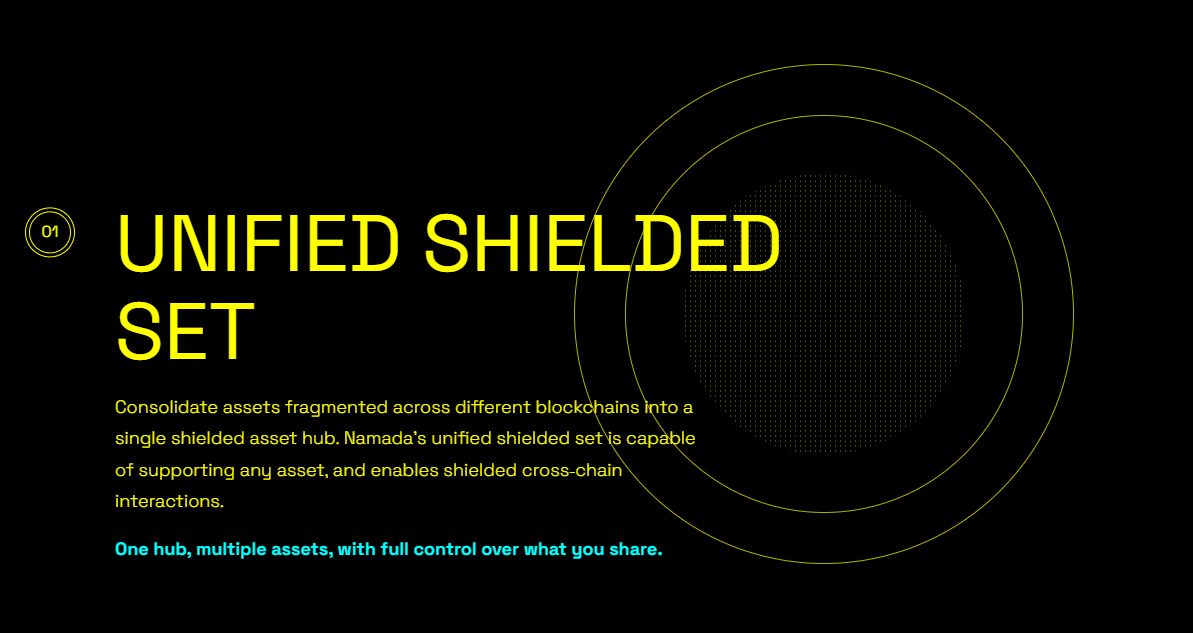
To bootstrap the shielded pool, Namada pays shielding rewards in NAM to anyone who deposits governance-approved assets into the MASP, on the theory that a bigger, more diverse anonymity set makes privacy stronger for everyone using it. Because handing an entirely new privacy system, a native token, staking, and reward mechanics to users all at once is risky, Namada rolled its mainnet out in five governance-controlled phases: transfers and shielding of approved IBC assets first, staking rewards for NAM delegators and validators next, then shielding rewards, and finally open NAM transfers themselves.
Namada vs Other Privacy Blockchains
Namada sits in a small, increasingly crowded field of other privacy-focused crypto projects taking different technical bets on the same problem. Secret Network shields smart-contract execution using Intel SGX hardware enclaves rather than cryptography alone. Monero shields only its own native transactions using ring signatures, with no cross-chain ambitions. Zcash pioneered the zk-SNARK approach Namada’s MASP extends, but keeps privacy limited to its own single asset. Iron Fish takes a similar zk-SNARK route to Namada but, like Zcash, focuses on shielding transfers of its own native asset rather than acting as a shared privacy layer for other chains’ tokens.
|
Project |
Privacy Method |
Multi-Asset Shielding |
Base Chain |
|
Namada |
zk-SNARKs (MASP) |
Yes – any approved IBC asset |
Standalone / Cosmos-adjacent |
|
Secret Network |
Intel SGX (TEE) |
No – native + bridged via secret contracts |
Cosmos SDK |
|
Monero |
Ring signatures, RingCT |
No – native only |
Standalone (PoW) |
|
Zcash |
zk-SNARKs (Sapling) |
No – native only |
Standalone |
|
Iron Fish |
zk-SNARKs |
No – native only |
Standalone |
Namada’s Slow Rollout and the Airdrop Allocation Controversy
Years of Delays and “Is It Dead?” Skepticism
Cosmos‑focused forums contained questions, on multiple occasions, about whether Namada had been abandoned. Gap between its late‑2022 trusted setup ceremony and its December 2024 mainnet, followed by further waits before staking and shielding rewards were switched on, left some long‑time community members admitting they had lost track of project for long stretches. Much of that skepticism reflects broader fatigue with pace of Cosmos ecosystem projects generally rather than anything specific to Namada’s own execution.
Airdrop Allocation Confusion
Users raised concerns about Namada’s claim process. Users comparing notes found that allocations shown in claim interface changed over time – some initial estimates dropped by more than 90% without a clear explanation, alongside warnings circulating in community about phishing clone sites mimicking official claim page during window it was open.
Combined with a broader 65 million NAM Retro Public Goods Funding airdrop spread across thousands of researchers, developers, ATOM and OSMO stakers, and NFT holders, the rollout was messy enough that questions about unfair or inconsistent allocations became a recurring theme, even though most evidence points to unannounced allocation corrections rather than deliberate manipulation. Readers unfamiliar with how these distribution events typically work can find more background in our crypto airdrops guide.
The June 2026 Namada Security Incident
Namada’s most serious test so far came in June 2026, when an attacker exploited a flaw in Namada’s network IBC transfer logic to drain assets from MASP. On-chain data traced 228,517 ATOM moving out via IBC to a Cosmos Hub address before being rapidly forwarded onward, alongside smaller balances of USDC, OSMO, TIA, and NYM that were emptied from the shielded pool entirely. DefiLlama logged the event as roughly $600,000 lost, and Namada’s tracked total value locked fell from about $600,000 to under $600 within a single day.
Independent researchers found that Namada’s block explorer had a stale indexer. Indexer continued showing drained balances as available long after balances were gone. Anyone checking chain through public explorer would not have seen drained state. Namada team confirmed breach, said it was investigating alongside security partners, and asked attacker to return funds if they were a white‑hat researcher.
The timing made the incident sting more: it landed just hours after a separate $4.67 million exploit hit Secret Network, another privacy-focused Cosmos chain, over an unpatched cross-chain validation bug reportedly present in deployed code since 2023. Two incidents occurred back‑to‑back and renewed scrutiny over how much security testing privacy‑focused, cross‑chain infrastructure in Cosmos ecosystem has received relative to how much value and trust it has been asked to hold.
Namada’s Role in the Cosmos and Interoperability Landscape
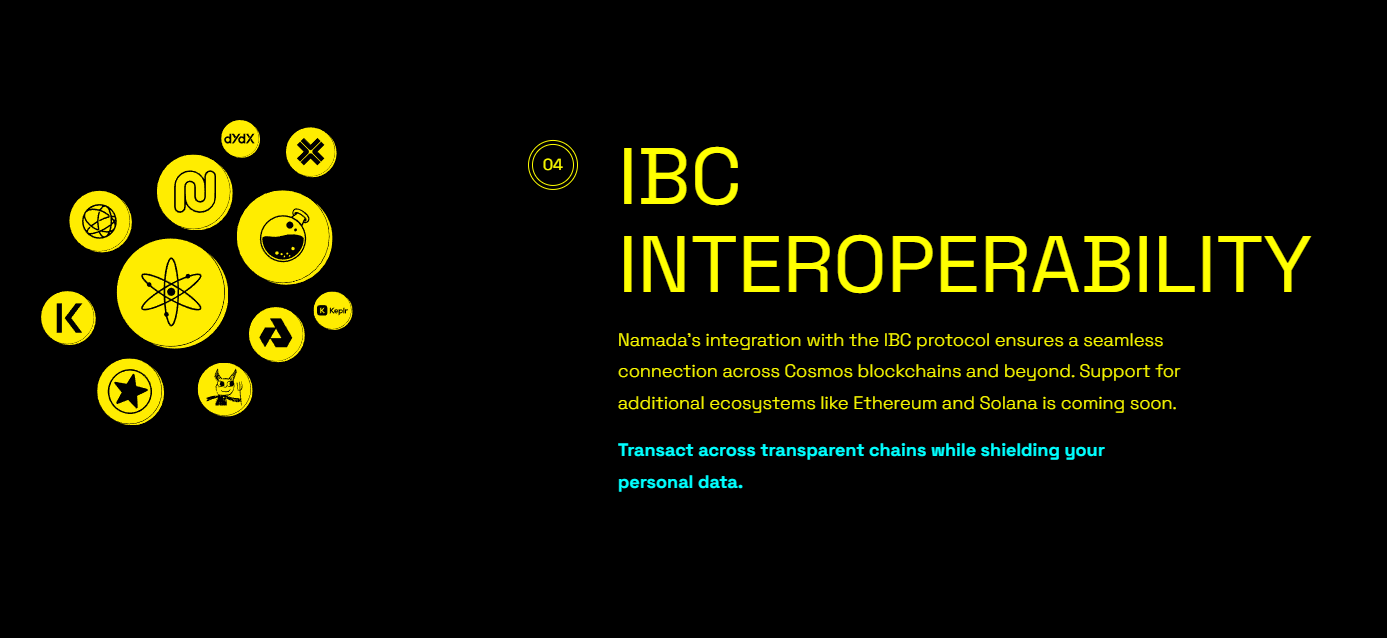
Namada communicates with other chains through the Inter-Blockchain Communication protocol, making it part of the same Cosmos ecosystem puzzle as chains like Osmosis and Cosmos Hub itself, rather than a bolt-on privacy feature for any single chain. Its ambition to extend shielding to include Ethereum and other ecosystems in the future, not only IBC assets, places it among blockchain interoperability category, alongside bridges and cross-chain messaging protocols.
Consensus runs on a Proof of Stake model: NAM holders delegate to validators, who earn staking rewards once governance enables them and can be penalized for downtime, just like on other Cosmos SDK chains. Namada isn’t itself built on the Ethereum Virtual Machine, placing it firmly among non-EVM blockchain projects that prioritize a custom execution environment – in Namada’s case, one designed from the ground up around privacy and asset-agnostic shielding rather than smart-contract flexibility for its own sake.
Is Namada Worth Checking in 2026?
Namada’s pitch – a privacy layer any chain can plug into, rather than a walled-off private chain of its own – is genuinely differentiated among privacy-focused crypto projects, and its MASP design solves a real limitation of single-asset systems like Zcash. But the project’s execution has been slow and uneven: mainnet arrived roughly two and a half years after development began, features rolled out in stages rather than all at once, and its first real test under attack in June 2026 exposed both a contract-level flaw and a monitoring gap serious enough to hide the loss from its own block explorer.
Previous issues do not necessarily make Namada blockchain’s underlying idea wrong, but they do mean prospective users and integrators have real, recent evidence to weigh alongside a theoretical case for asset-agnostic privacy — evidence that, for now, has both positive and negative implications.
FAQ
Is Namada the same as Anoma?
No. The Anoma Foundation is the organization that built and stewards Namada’s software and proposed its initial genesis allocations, but Namada itself is the independent, community-validated blockchain. “Anoma” refers to the broader research project and foundation behind it, not the chain itself.
What happened in the Namada hack?
In June 2026, an attacker exploited a flaw in Namada’s IBC transfer logic to drain roughly $600,000 in assets, including 228,517 ATOM, from its Multi-Asset Shielded Pool. A stale block explorer indexer meant the loss wasn’t immediately visible, and the incident happened hours after a separate, larger exploit hit Secret Network.
Is Namada safe to use after the 2026 exploit?
The team confirmed the breach and said it was investigating with security partners, but as of this writing there is no independently verified confirmation that the underlying vulnerability has been fully patched. Anyone considering depositing significant funds should check Namada’s official channels for the latest security status first.
What is the Multi-Asset Shielded Pool (MASP)?
The MASP is Namada’s core privacy feature: a single shielded pool where deposits of many different token types are held together and encrypted, using zk-SNARK circuits derived from Zcash’s Sapling design, so that transactions involving different assets are indistinguishable from one another.
Why did some users’ Namada airdrop allocations change?
Some users reported their claimable NAM allocation dropping sharply, in some cases by more than 90%, between checking the claim interface at different times. This appears to reflect unannounced corrections to the allocation formula rather than a technical exploit, though the lack of clear communication was a common complaint.
Is Namada built on Cosmos?
Namada uses the Inter-Blockchain Communication protocol and lives within the broader Cosmos ecosystem, but it runs its own independent chain and validator set rather than operating as an application on Cosmos Hub itself, and it is not built on the Ethereum Virtual Machine.

Isai Alexei is a journalist and financial analyst covering cryptocurrency markets and traditional securities for Blockchaindose. He has spent ten years analyzing digital assets, trading activity, and market structure.