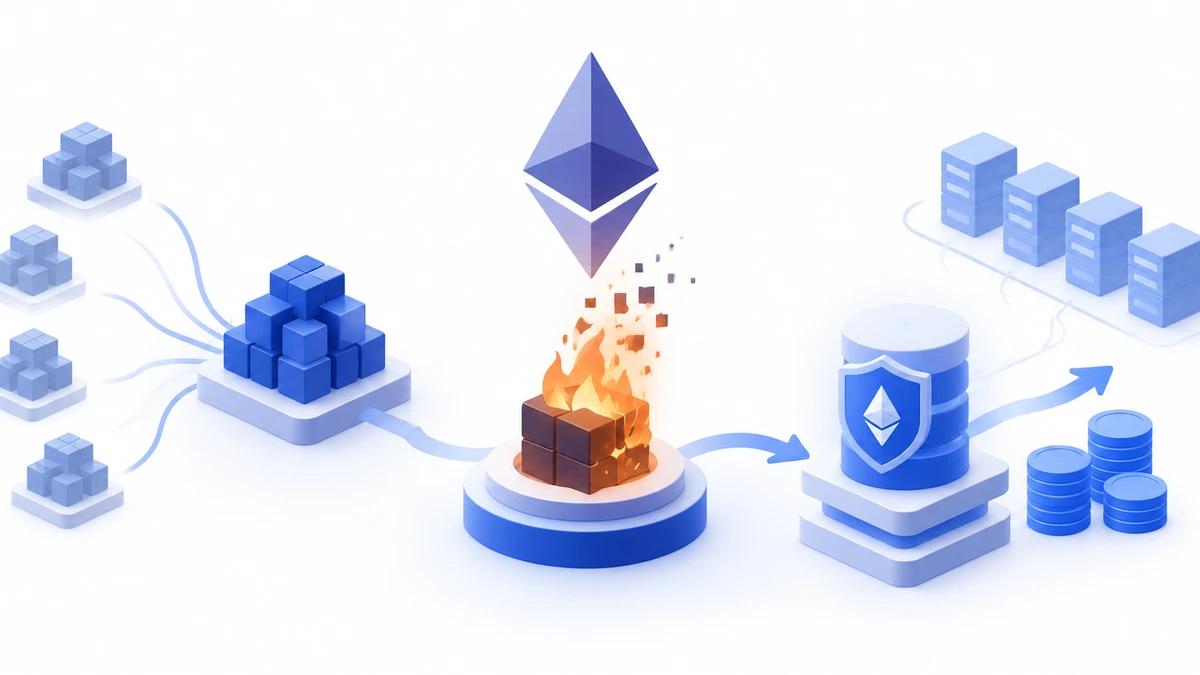
The Ethereum research community has advanced MEV-Burn from a theoretical concept to a protocol-near implementation. Current client software contains the necessary infrastructure to enable MEV-Burn as early as the Glamsterdam upgrade, according to analysis published on Ethereum Research. The mechanism redirects builder auction payments from validators to protocol-level burning, fundamentally altering the economic structure of block production.
Proposer Revenue Under MEV-Burn
MEV-Burn operates through a fixed deadline auction within each slot. Builders submit bids, and the highest bid observed before a protocol-defined deadline becomes the base payload fee, which the protocol burns. The validator receives only the difference between the final highest bid and the burned base fee as a tip. A witness committee enforces compliance by validating that each block burns at least the minimum perceived payload base fee.
Simulations indicate that MEV-Burn would destroy approximately 90% of the profits currently flowing to validators. The median MEV profit per proposed block would decrease from approximately 0.05 ETH to approximately 0.002 ETH, a 96% reduction. This represents a structural shift in validator compensation, moving the majority of execution-layer rewards from validator income to protocol revenue through burning.
Large validator pools (100+ validators) currently enjoy a 12% higher mean return compared to single-validator pools. Under proposed issuance curve reductions without MEV-Burn implementation, this advantage could increase to 13-15%. MEV-Burn eliminates the execution-layer rewards that smaller validators have historically used to partially offset their operational inefficiencies. Elasticity analysis shows solo stakers are particularly sensitive to relative yield decreases, making them the most vulnerable segment under MEV-Burn implementation.
The research concludes that implementing MEV-Burn with gradual issuance adjustments could promote a decentralized, diverse validator set. The economically capped curves currently under discussion may create scenarios where large pools remain profitable while smaller ones incur losses. This underscores the necessity of pairing MEV-Burn with consensus layer issuance modifications to maintain validator diversity.
Builder Market Consolidation and MEV-Burn Effects
The Ethereum block building market exhibits concentration that MEV-Burn must address. As of 2025, two builders produced more than 85% of Ethereum blocks, creating a concerning centralization factor. Data from February 2025 indicates that approximately 80% of Ethereum blocks are proposed by just two entities—large builder-relay coalitions like Flashbots and their peers. Beaverbuild and Titan Builder together produced approximately 86% of mainnet blocks over a two-week period in March 2025.
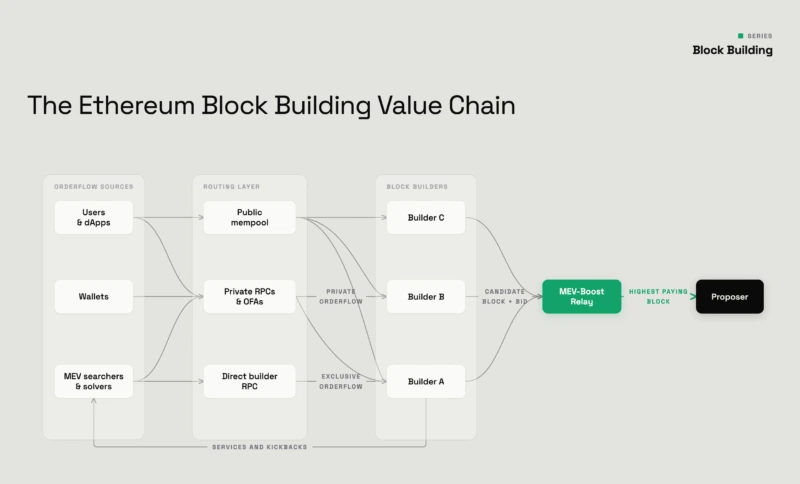
MEV-Burn modifies the incentive structure of builder competition without directly altering market concentration. The mechanism burns the base payload fee, eliminating the ability of dominant builders to use past profits to overbid competitors in an escalating cycle. This removes one amplification mechanism but does not address the structural advantages that drive concentration: latency optimization, exclusive order flow access, and infrastructure scale.
The current PBS architecture assumes honest proposers request the most valuable block from relays at the start of each slot. However, the evolution of bidding has forced a redesign of early MEV-Burn proposals. Early bidding rates have declined by half compared to the second half of 2023, increasing the difficulty for individual bidders and the protocol to predict final block values.
Builder centralization creates measurable proposer losses. Research from Duke University quantifies significant proposer losses within the centralized builder market and challenges the belief that builder centralization is acceptable. These losses, if left uncontrolled, could undermine the goal of PBS. Moreover, MEV mitigation solutions slated for adoption rely on the builder market as an MEV oracle, and centralization makes this oracle inaccurate.
Shapella Upgrade as a Structural Catalyst
The Shanghai/Capella (Shapella) upgrade enabled validator withdrawals, fundamentally altering the competitive of the staking ecosystem. Positive market events like the Shapella upgrade had significantly more positive net effects on the validator counts of larger stakers compared to smaller ones. This asymmetric growth reflects the operational advantages and capital efficiency of large staking operations.
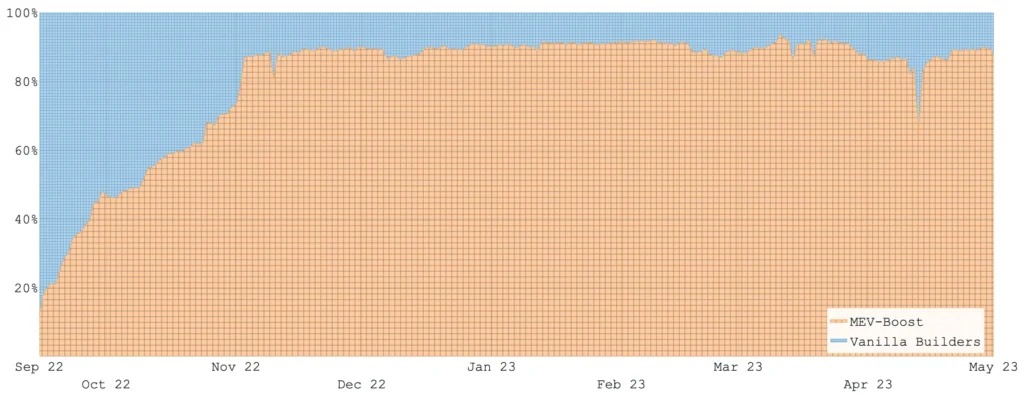
The upgrade also exposed MEV-Boost dependencies. A bug in the Prysm execution client during Shapella, related to MEV-Boost, caused validators to fail to propose blocks. The root cause was identified as a missing field during the unblinding of the builder blinded block. This incident demonstrated that approximately 90% of validators now run MEV-Boost, creating a single point of failure in the block production pipeline.
Post-Shapella, validator mobility has increased as operators can freely enter and exit staking. This liquidity amplifies the economic consequences of MEV-Burn implementation. Validators facing reduced execution-layer rewards may exit staking or consolidate into larger pools, potentially accelerating the centralization trends observed since Shapella.
ePBS Integration and Future Development
Enhanced Proposer-Builder Separation (ePBS) represents the protocol-level implementation of PBS that would natively support MEV-Burn. ePBS implements native MEV mitigation strategies, including burn auctions and reward smoothing, which smooth reward variance and promote economic fairness.
Current client software already contains the infrastructure required for MEV-Burn. The mechanism can be enabled through protocol configuration without requiring extensive new development. However, MEV-Burn alone does not solve builder centralization. The structural issues of latency advantages, order flow exclusivity, and infrastructure scale require complementary mechanisms including crList (anti-censorship lists), encrypted mempools, and decentralized builder proposals.
The trade-off between MEV-Burn and validator economics requires careful calibration. Burning MEV returns value to ETH holders through deflation but reduces validator incentives. The research community emphasizes that a balanced approach combining MEV-Burn implementation with gradual issuance adjustments may best maintain a healthy, diverse validator ecosystem.
MEV-Burn represents a fundamental economic restructuring of Ethereum’s block production market
The mechanism redirects approximately 90% of validator MEV revenue to protocol burning, compressing validator margins while enhancing ETH’s deflationary properties. The asymmetric impact on validator segments—with solo stakers facing the greatest relative income reduction—necessitates complementary issuance adjustments to preserve decentralization.
Builder market concentration, with two entities producing over 85% of blocks, remains structurally unaffected by MEV-Burn. The mechanism removes one amplification cycle but does not address latency advantages, order flow exclusivity, or infrastructure scale. Effective mitigation requires a coordinated package including ePBS, crList, and encrypted mempools.
FAQ
What percentage of validator MEV revenue would MEV-Burn destroy?
Simulations indicate MEV-Burn would destroy approximately 90% of the profits currently flowing to validators. The median MEV profit per proposed block would decrease from approximately 0.05 ETH to approximately 0.002 ETH, a 96% reduction. This represents a structural shift in validator compensation.
How does MEV-Burn affect builder market concentration?
MEV-Burn modifies builder incentives by burning the base payload fee, eliminating the amplification cycle where dominant builders use past profits to overbid competitors. However, it does not address the structural drivers of concentration: latency advantages, exclusive order flow access, and infrastructure scale. The builder market remains highly concentrated, with two entities producing over 85% of blocks.
Why is Shapella relevant to MEV-Burn analysis?
The Shapella upgrade enabled validator withdrawals, increasing validator mobility and amplifying the economic consequences of MEV-Burn. Validators facing reduced execution-layer rewards may exit staking or consolidate into larger pools. The upgrade also demonstrated the dependency on MEV-Boost, with approximately 90% of validators running the middleware, creating a single point of failure exposed during the Shapella Prysm bug.
What is the relationship between MEV-Burn and ePBS?
Enhanced Proposer-Builder Separation (ePBS) represents the protocol-level implementation of PBS that would natively support MEV-Burn. ePBS implements native MEV mitigation strategies including burn auctions and reward smoothing. Current client software already contains the infrastructure required for MEV-Burn, and the mechanism could be enabled through protocol configuration.
Can MEV-Burn be implemented without adjusting consensus issuance?
Research indicates that implementing MEV-Burn without issuance adjustments would likely harm validator decentralization. The economically capped curves currently under discussion may create scenarios where large pools remain profitable while smaller ones incur losses. The research community advocates for a balanced approach combining MEV-Burn implementation with gradual issuance adjustments to maintain a healthy, diverse validator ecosystem.

Isai Alexei is a journalist and financial analyst covering cryptocurrency markets and traditional securities for Blockchaindose. He has spent ten years analyzing digital assets, trading activity, and market structure.