
Ethereum Gas Fees Peak at Hour 12 UTC in a Seven-Firm Dataset
Ethereum gas fees follow an intraday pattern, and the pattern raises costs for operational firms with fixed transaction deadlines. An analysis of 62,142 confirmed Ethereum transactions from seven companies, collected between January and March 2026, places the cost peak at hour 12 UTC (7 AM Eastern Time). Research including Irene Aldridge of Johns Hopkins University’s Carey Business School links the peak to speculative-arbitrage activity and reports a residual cost floor of 40.7% to 92.5% of actual spending, a share which off-peak scheduling does not remove.
The dataset spans seven industries: technology (Coins.ph), finance (Anchorage Digital), healthcare (Solve.Care), supply chain (Morpheus.Network), real estate (Propy), consumer goods (Nike through Ondo) and administrative services (BrainTrust). Coins.ph supplies 54,651 of the 62,142 transactions, or 88% of the sample, which makes the pooled regression of Ethereum gas fees lean on one firm.
EIP-1559 Assumes Symmetric, Myopic Users
The EIP-1559 mechanism raises the base fee when a block exceeds 50% fullness and lowers it below the target, with a 12.5% cap on each per-block change. Tim Roughgarden’s 2021 analysis shows truth-telling is a dominant strategy for myopic agents with independent private values. Ethereum gas fees clear efficiently under the mechanism only for agents who evaluate each block separately and choose freely whether to transact.
Operational firms sit outside four assumptions of the EIP-1559 model, and the gap shows in how each group schedules transactions. Remittance platforms, healthcare coordinators and real-estate settlement systems commit to timing days or weeks ahead under contractual or regulatory constraints, and their demand stays close to price-inelastic inside a scheduling window. MEV bots, DEX routers and liquidation searchers respond to fees and concentrate activity in U.S. and European business hours, pushing block usage above the 50% target and raising the base fee for every concurrent user.
Williamson’s transaction cost economics supplies the framework for classifying the fee each firm pays. The base fee reflects aggregate network demand, and the research treats Ethereum gas fees as an execution cost in timing, which a firm influences by choosing when to submit, and as a maladaptation cost in origin, because third-party demand sets the base fee and the firm cannot renegotiate it.
Hourly Coefficients Locate the Cost Peak and the Evening Window
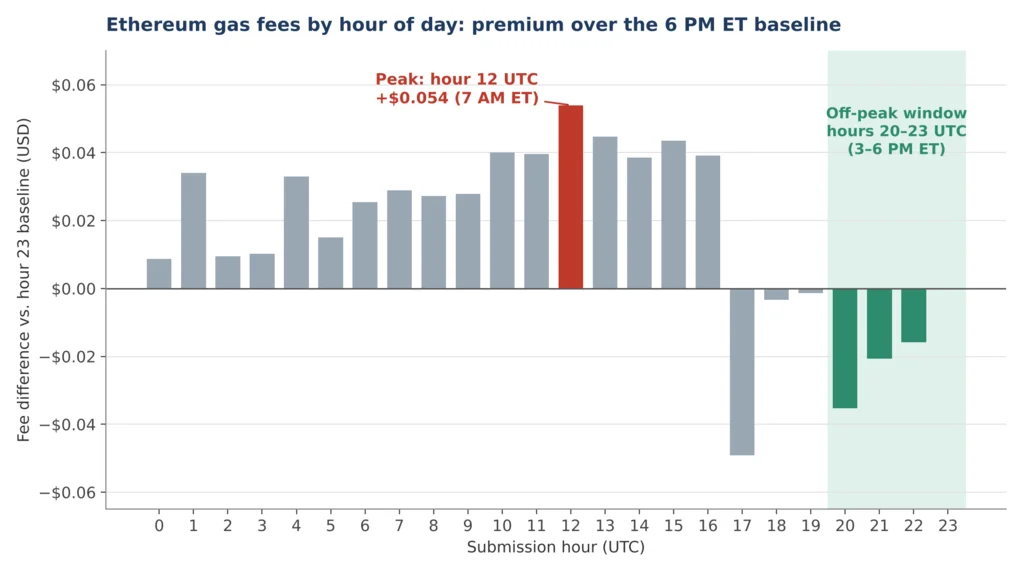
The estimating equation regresses the USD fee of each transaction on hour-of-day indicators, with firm and week fixed effects and HC3-robust standard errors. Hour 23 UTC (6 PM Eastern Time) serves as the omitted baseline, with an intercept of $0.1597. The coefficient at hour 12 UTC reaches $0.054, about 34% above baseline. The peak coincides with the overlap of European trading and the early U.S. session, and Ethereum gas fees concentrate in East Coast morning hours.
A block-reward fullness proxy, built from the validator reward of each block and capped at the 95th percentile, enters as a covariate. Its coefficient of 0.123 (t = 12.45) associates higher fullness with higher fees within an hour. Adjusted R-squared rises from 1.1% to 2.5%, which leaves most fee variation to block-level congestion shocks, and the design supports association, not causal attribution of the peak to speculative demand.
Four hours form the off-peak window: 20, 21, 22 and 23 UTC, equal to 3 PM through 6 PM Eastern Time. Coefficients at hours 20, 21 and 22 equal −$0.035, −$0.021 and −$0.016 against the hour-23 baseline, and all three are significant. The pooled table records −$0.049 at hour 17 UTC (12 PM Eastern Time), the largest negative estimate, while hours 0 through 9 UTC show positive coefficients. The Asian overnight session does not qualify as cheap for Ethereum gas fees.
Peak Shaving Scores Differ Across Seven Industries
The Peak Shaving Score subtracts the 4/24 benchmark, about 16.7%, from the share of a firm’s transactions submitted in the evening window. Solve.Care scores +0.023, and Coins.ph scores +0.003 on 9,284 evening transactions. Nike through Ondo scores 0.000. Morpheus.Network (−0.008), Propy (−0.011), BrainTrust (−0.014) and Anchorage Digital (−0.017) place fewer transactions in the window than uniform timing would.
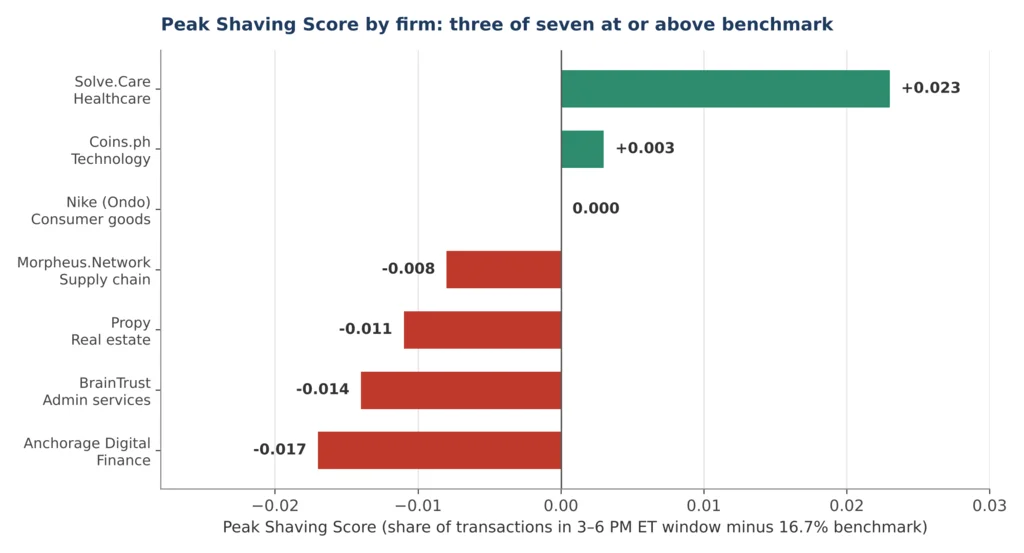
Each negative score matches an external timing constraint on how firms respond to Ethereum gas fees: institutional settlement cycles at Anchorage Digital, property closing deadlines at Propy, governance cycles at BrainTrust and IoT-oracle triggers at Morpheus.Network. Fee savings from evening scheduling range from 60.7% at Nike through Ondo and 59.7% at Anchorage Digital to 5.3% at Coins.ph, while Solve.Care shows −26.4% because high-gas outliers in overnight hours distort the comparison.
Residual Cost Floors Persist at the Cheapest Hour
The residual cost floor equals actual expenditure on Ethereum gas fees minus the transaction count times the mean fee at a firm’s cheapest hour. Floors run from 40.7% at Propy to 92.5% at Nike through Ondo. Coins.ph spent $9,749.62 and carries a floor of $4,209.29, or 43.2%. Solve.Care, the strongest scheduler by score, still carries a floor of 64.1%.
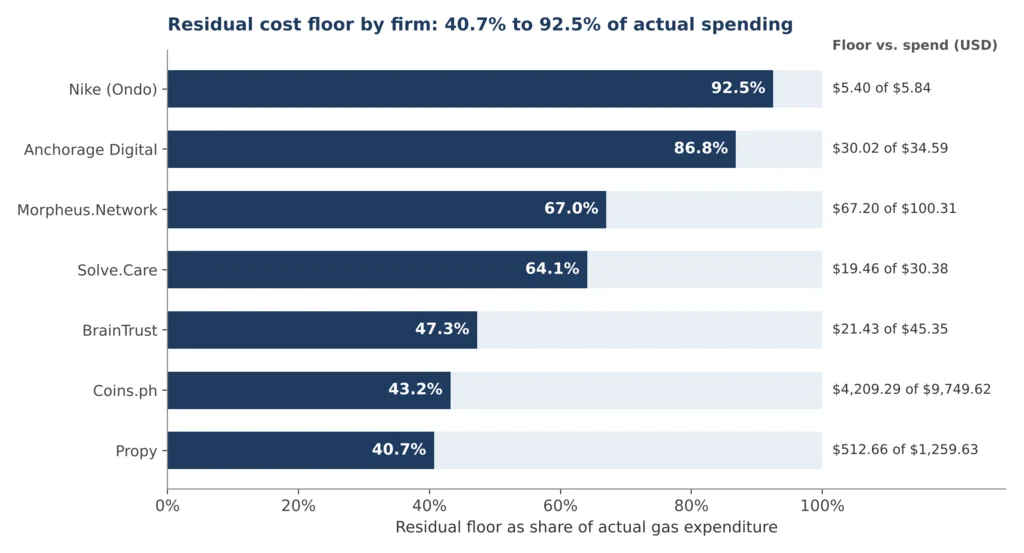
Block-reward fullness at each firm’s cheapest hour ranges from 0.184 at Anchorage Digital to 0.462 at Nike through Ondo, and all seven values sit above zero. Network congestion persists at the lowest-cost hour, which makes the floor a product of network conditions, not timing errors, in the Ethereum gas fees each firm pays. Fullness pass-through varies by firm: Propy records 0.578, Morpheus.Network 0.243, and Anchorage Digital 0.069.
The On-Chain Scheduling Matrix Defines Four Regimes
The On-Chain Scheduling Matrix crosses two variables: deferrability, defined as whether a transaction can be submitted in any block inside a window without breaching a deadline, and gas intensity, the computational weight of the transaction. Regime I (deferrable, high gas) calls for full peak shaving into the 20–23 UTC window, with Morpheus.Network as the exemplar. Regime II (deferrable, low gas) applies selective peak shaving when volume offsets scheduling costs, and Coins.ph illustrates it.
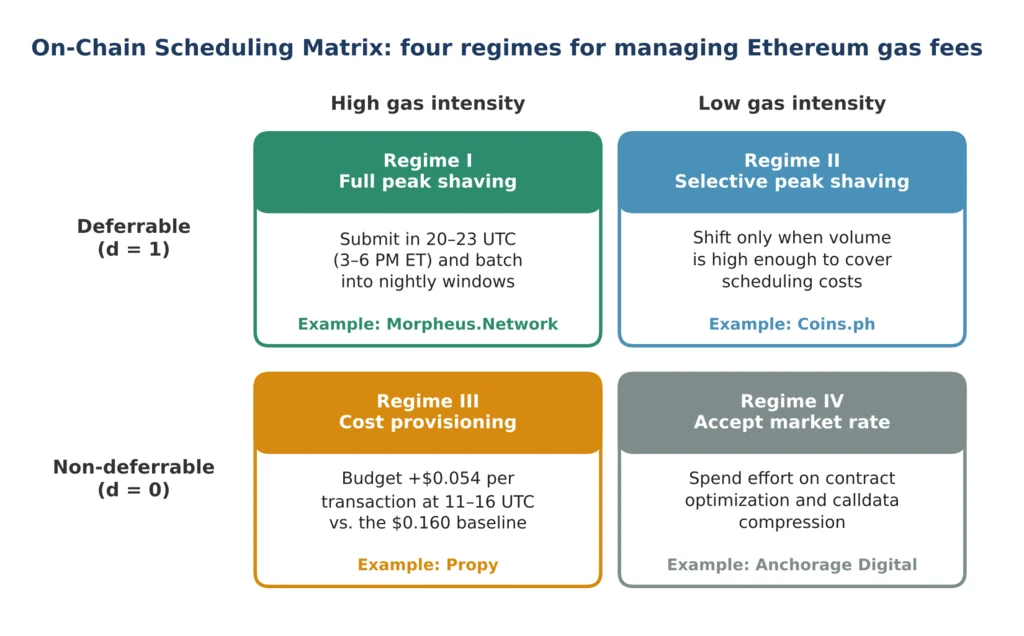
Regime III (non-deferrable, high gas) shifts the task to cost provisioning: firms budget an additional $0.054 per high-gas transaction submitted between 11 and 16 UTC relative to the $0.160 evening baseline, and Propy fits the regime. Regime IV (non-deferrable, low gas) accepts the market rate and directs resources to contract optimization and calldata compression, as Anchorage Digital does. Treasury teams can compare the hourly budget with live gas data before submitting a batch.
Implications for Fee-Market Design and Layer-2 Testing
The results bear on the EIP-1559 mechanism-design literature, because the incentive-compatibility guarantee holds under myopia, symmetry and independent private values, and firms with contractual calendars may not satisfy the three conditions. A base-fee rule conditioned on observable demand-type composition could reduce the residual burden on low-elasticity users of Ethereum gas fees, and whether the rule preserves the myopic incentive guarantee remains open.
Causal identification requires designs including MEV-Boost block classification or exogenous NFT-drop demand shocks. A Layer-2 comparison would test whether the intraday pattern weakens where MEV extraction faces architectural limits, and EIP-4844 already gives rollups a separate fee market for blob data.

Isai Alexei is a journalist and financial analyst covering cryptocurrency markets and traditional securities for Blockchaindose. He has spent ten years analyzing digital assets, trading activity, and market structure.