

Tokenized asset tracking is shifting from a question of size to a question of use, after Denelle Dixon, CEO of the Stellar Development Foundation, proposed a scorecard built on what each asset does not on how much value sits onchain.
Her proposal follows a milestone: real-world assets issued on Stellar have passed $4 billion in tokenized funds and sovereign debt.
Dixon treats the milestone and the trendline as the same flawed reading, as both record where money sits and neither records what it does. Every blockchain publishes a headline balance, and none reports whether a single token performed any work.
Standard tokenized asset tracking stops at the balance and leaves the work of each asset unmeasured.
Tokenized asset tracking
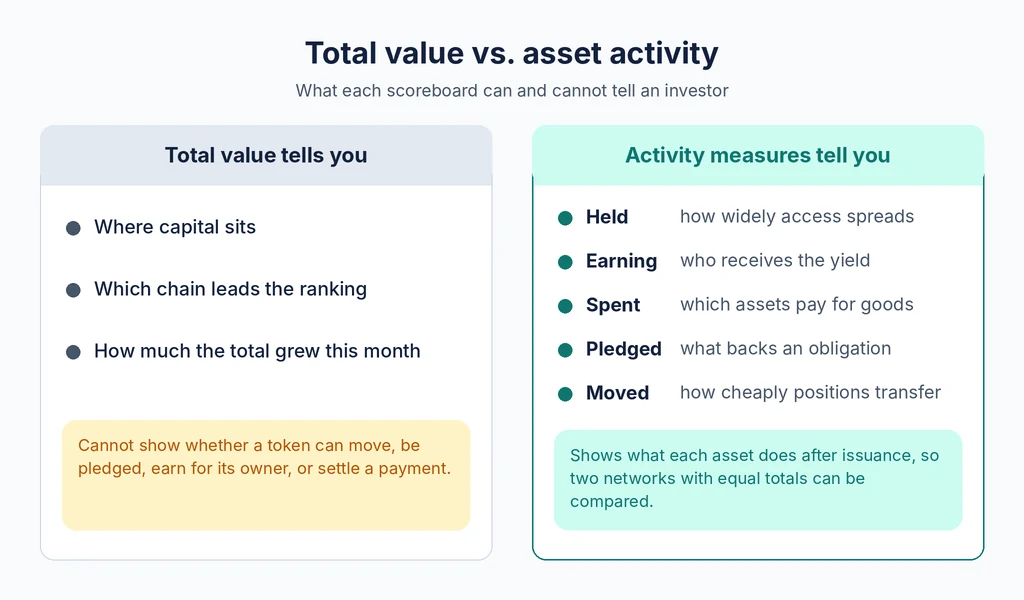
Tokenized asset tracking is the practice of measuring tokenized assets by what each one does, meaning how widely it is held, whether it earns, how often it is spent, whether it is pledged, and how cheaply it moves, instead of by total value alone.
Why Total Value Falls Short in Tokenized Asset Tracking
Public discussion of tokenization revolves around three figures, which are the leading chain, the total value, and the monthly growth rate. A chief investment officer holding a tokenized asset on her own balance sheet asks a different question, meaning what the position does for her, and tokenized asset tracking built on totals leaves the question open.
Idle balances are not always a defect: reserves and pledged collateral exist to stay put. A balance figure alone cannot show whether an asset can move, serve as collateral, or secure a loan.
Tokenization promised to lift the restrictions on movement, pledging, and borrowing, and an asset issued natively onchain can perform each function from the day of issuance. Measuring actual asset use tests the promise directly, and a total-value count only shows how much capital arrived.
Institutional buyers feel the gap first: an allocator comparing two networks with equal totals gets no guidance on which one delivers liquidity, collateral value, or access. A scorecard of behavior supplies the missing comparison and gives issuers a reason to show how their products circulate.
Who Earns the Yield: Stablecoin Reserves vs. Tokenized Funds
A stablecoin issuer keeps the interest earned on the stablecoin reserves behind each coin, and a resting dollar earns for the issuer and nobody else. A tokenized fund pays its yield to the holder.
A total-value count treats both dollars identically and cannot separate balances working for their owners from balances working for their issuers.
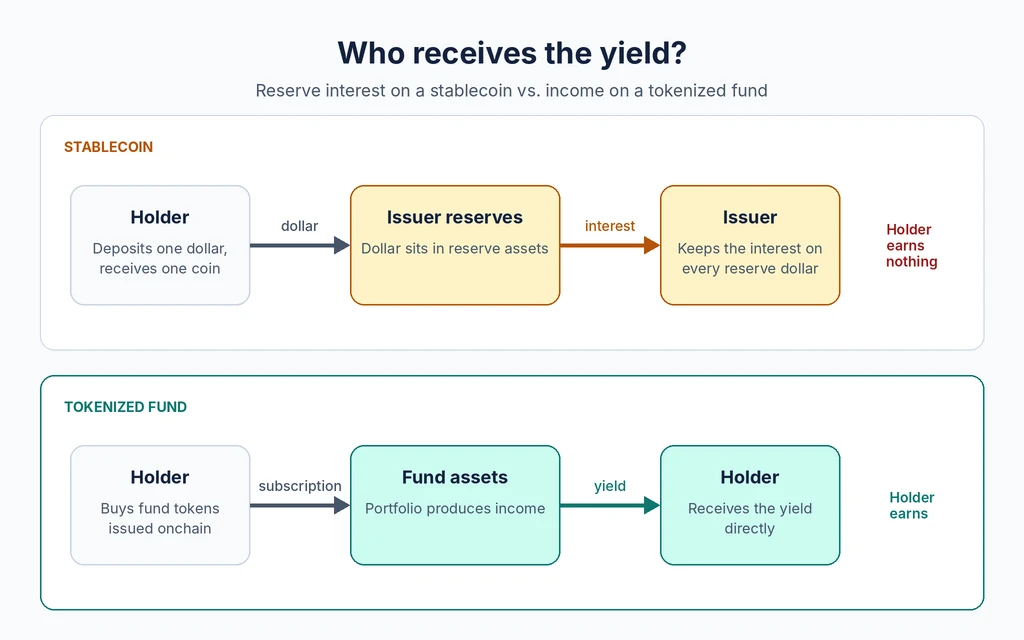
For stablecoins, Dixon drops the real-world asset tally and follows circulation speed, called stablecoin velocity, with issuer-held interest making balance size a weak signal of owner benefit.
Tokenized funds stay inside the asset count, where the yield-to-holder relationship gives balance size more meaning. Allocators using tokenized asset tracking can compare a fund yielding to its holders against a stablecoin yielding to its issuer on equal terms, without adding both to one total.
Five Measures That Define Tokenized Asset Tracking
The framework scores assets on five measures, which are held, earning, spent, pledged, and moved. Each one converts a vague claim about adoption into a figure an issuer can publish and an analyst can check, and each one maps to a question an investor already asks.
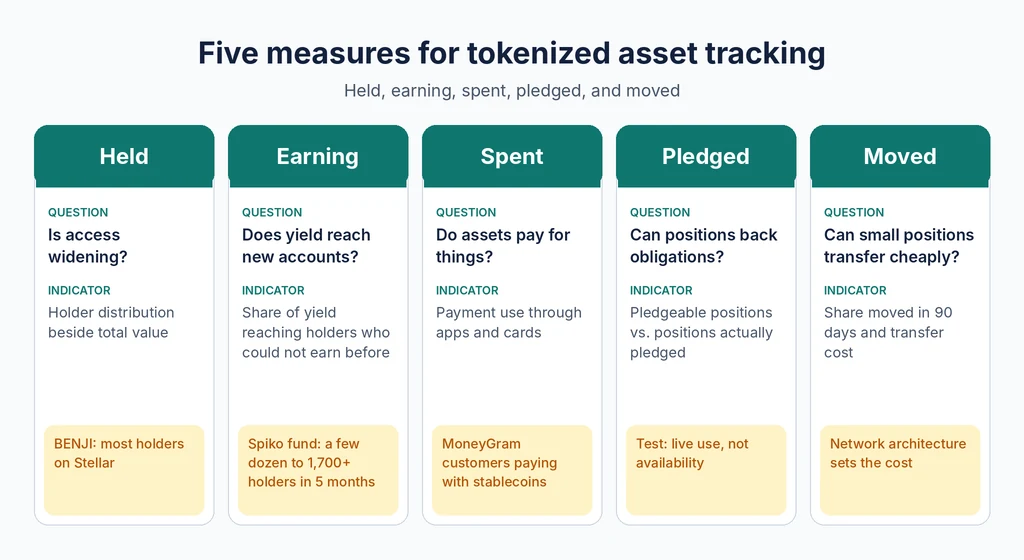
Holder distribution shows whether access widened, as in Franklin Templeton’s BENJI, where most holders sit on Stellar, and other chains can report large volume concentrated among a handful of institutions.
A count of unique holders beside the total exposes the concentration a single balance conceals, and tokenized asset tracking should report holder counts and top-holder share next to totals.
Yield reach tracks whether accounts excluded from earning in the past receive returns today. One of Spiko’s tokenized government-paper funds rose from a few dozen holders to more than 1,700 in five months, the pattern the measure rewards.
Payment use records assets moving whenever people need them to, as stablecoins do when MoneyGram customers pay through an app or card without noticing the underlying chain.
Collateral eligibility asks whether a position can back an obligation in practice, as Stellar is adding the capability onchain and the test is live use, not availability. A listing permitting pledges earns less credit than a position actually pledged.
Transfer cost shows whether a small position gets penalized for moving, and the answer depends on a network’s architecture.
Analysts can divide 90-day transfer volume by circulating supply to build an activity ratio for each asset. Issuers can quantify all five measures, and a chain where assets enter and sit unused scores poorly on every one, which turns tokenized asset tracking into an audit of behavior.
$4 billion+
Real-world assets issued on Stellar in tokenized funds and sovereign debt.
1,700+
Holders of one Spiko tokenized government-paper fund after five months, up from a few dozen.
90 days
Window for the proposed disclosure of how much of each asset moved.
Operational Costs of an Always-On Asset
Round-the-clock operations follow from continuous settlement, a staffing model no bank runs today, and Dixon concedes the industry should state the cost openly.
Most institutions must rely on an outside provider to build the capability, and the technology spans profit-and-loss units banks designed as separate, which complicates ownership inside each firm.
Banking hours supply a precedent, as branches formerly closed at one o’clock on Fridays, customers worked around the gap, and infrastructure caught up later.
Dixon expects a repeat and wants the industry to stop promoting benefits without itemizing the bill, and buyers who learn the cost after adoption lose trust in the next claim. Tokenized asset tracking gains credibility when issuers report the operational cost of round-the-clock service beside adoption numbers.
Four Disclosures Issuers Can Publish in 90 Days
Dixon extends the proposal to competitors as a challenge with four disclosures, starting with holder distribution next to total value. The second reports the share of each asset moving within 90 days, the third compares pledgeable positions with positions actually pledged, and the fourth measures the portion of yield reaching holders who could not earn before.
Standardized disclosures let investors compare issuers on equal terms and let issuers with productive assets prove it.
She asks chains to stop holding idle balances onchain to inflate totals. Stellar’s own onchain assets face the same test, and Dixon says she would make the case even if the results looked poor for Stellar, and rising totals with dormant assets leave a market with strong charts and little utility.

Isai Alexei is a journalist and financial analyst covering cryptocurrency markets and traditional securities for Blockchaindose. He has spent ten years analyzing digital assets, trading activity, and market structure.