

For most of the past year, crypto has told itself one story: Bitcoin dominance is fading and altcoins are about to take over. The numbers now say something simpler, and less comfortable for altcoin bulls. Blockchain dominance, meaning Bitcoin’s share of the whole crypto market, has stopped falling and started to recover. And the most revealing figure is not Bitcoin’s at all. It is hiding in the stablecoin column.
The story everyone believed
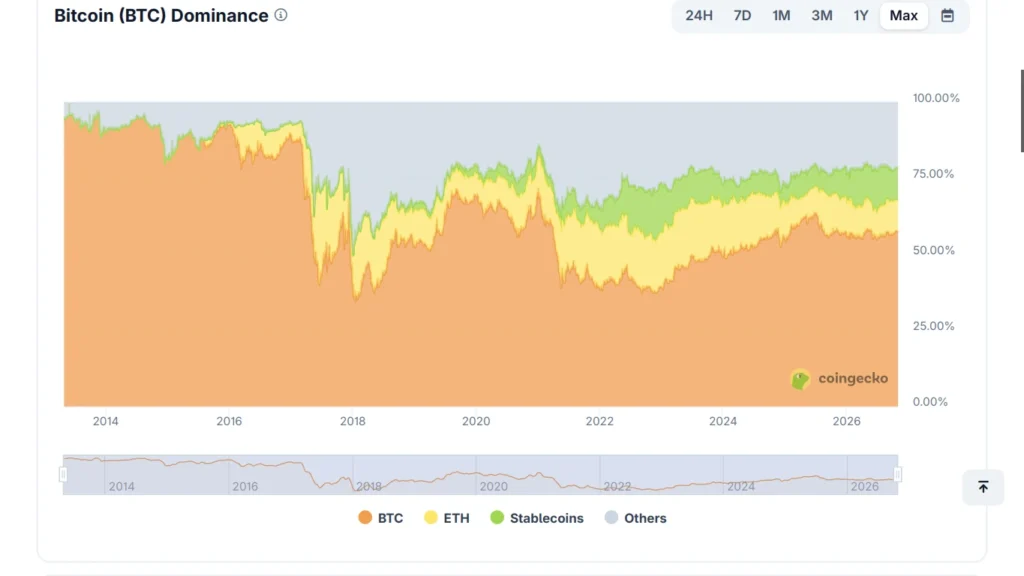
It was a fair story to tell. In the third quarter of 2025, CoinGecko reported that Bitcoin’s share of the market fell 5.2 percentage points to 56.9%, as money rotated into Ether and other large coins. Ether’s own share climbed above 12.5% that quarter, according to coverage of the report.
Then the slide continued. By the end of June 2026, Cryptorank’s Q2 recap put Bitcoin’s dominance at nearly 56%, inside a first-half range of 54% to 59%. Ether, meanwhile, recorded its first-ever three-quarter losing streak.
For anyone betting on a Bitcoin decline, the trend looked like it had legs. Then the third quarter happened.
The turn: four quarters of decline, snapped
CoinGecko’s 2026 Q3 Crypto Industry Report is the cleanest reference point. Bitcoin’s dominance rose 1.4 percentage points to 56.7%, breaking four consecutive quarters of decline and returning to where it started the year. It peaked at 57.9% on August 29.
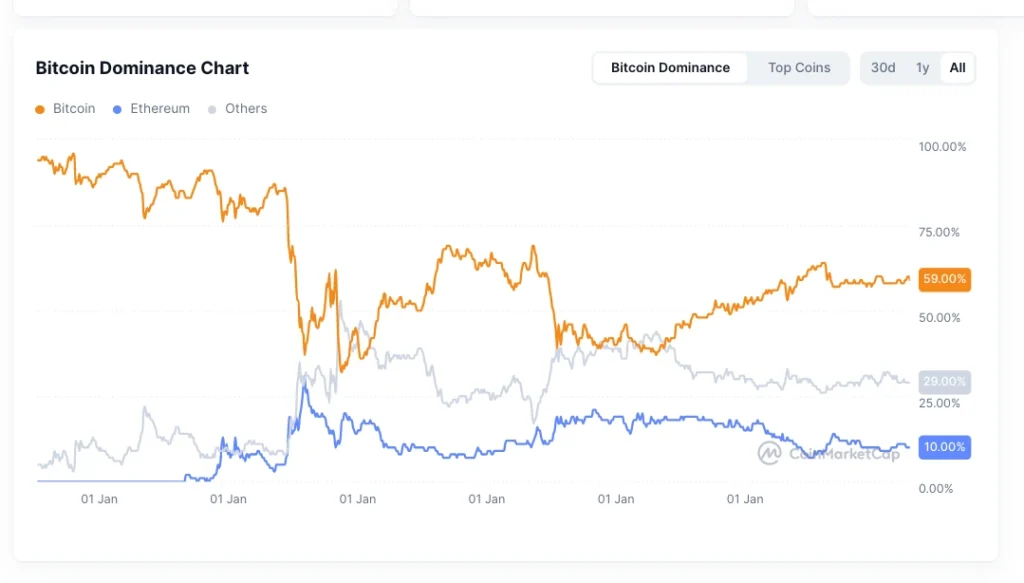
October added to the move. On October 23, CoinMarketCap showed Bitcoin dominance at about 60.1%, up from about 58.5% on September 26 and close to its 2026 high of about 60.6%, set on May 5. The year’s low on that tracker was about 57.3% on June 4.
Why do 56.7% and 60.1% look so different? Different yardsticks. CoinGecko counts a much wider universe of coins, while TradingView’s BTC.D only counts the top 125 coins. On October 13, for example, TradingView showed about 60.4% while CoinMarketCap showed about 59.9%. The direction matters more than the decimal, and every tracker points the same way: up.
The hidden stat: look at the stablecoin column
Here is the number most headlines missed. In Q3, total crypto market cap jumped 39.6% to about $3.0 trillion. Stablecoin supply barely moved: it rose just 0.6% to $300.3 billion, according to CoinGecko.
That has a simple effect. When the whole market grows and stablecoins do not, stablecoins’ share shrinks. Combined USDT and USDC dominance fell from 12.2% to 8.7%, a drop of 3.5 percentage points. Over the same quarter, Bitcoin gained 1.4 points and Ether gained 2.1. Added together, that is 3.5 points. The two moves are a near-perfect mirror image.
In plain terms: a big part of Bitcoin’s Q3 comeback was the market growing around a flat pile of digital dollars, not investors dumping altcoins for Bitcoin.
There is a second layer. Strip stablecoins out and Bitcoin’s true hold looks stronger on one tracker. CoinStats, using CoinMarketCap data, calculated that Bitcoin’s share excluding stablecoins was about 67% on October 23, compared with the 60.1% headline. Stablecoins made up about 10.4% of the market that day, quietly diluting every dominance chart.
One honest caveat. On CoinGecko’s own numbers, my rough arithmetic suggests Bitcoin’s share of the non-stablecoin market was roughly 63% at the end of Q2 and roughly 62% at the end of Q3. In other words, in Q3 Bitcoin did not truly gain on other risky assets. Ether rallied harder, up 71.0% against Bitcoin’s 42.7%. The real gain against altcoins came afterward.
October did the real work
October was the month altcoins gave ground. The market cap on CoinMarketCap slid to about $2.72 trillion by October 23, and CoinStats noted that altcoins fell faster than Bitcoin through the month. One example from CoinGecko data: between October 5 and October 12, Bitcoin dropped 4.6%, from $85,771 to $81,795, while Ether and XRP fell by more.
That is how dominance rises in a down market. Bitcoin does not need to go up. It only needs to fall less than everything else.
Kaiko’s research points to the same pattern beneath the price. Bitcoin’s share of crypto trading volume held around 40% to 50% and has trended gradually higher from 2025 into 2026, and Kaiko describes the market as structurally Bitcoin-centric. Altcoin derivatives showed investors cutting position sizes, a sign of de-risking rather than rotation.
Three claims, three checks
Claim: Bitcoin dominance is fading. Not at the moment. It broke a four-quarter losing streak in Q3 and sat near its 2026 high in late October.
Claim: Altseason is around the corner. Not yet. Blockchaincenter’s Altcoin Season Index read 53 on October 23, a neutral score. A formal altseason needs 75. Even the strongest 2026 reading, about 64 in late September, fell short.
Claim: Altcoins have collapsed. Also not quite. In Q3, CoinGecko says nearly every tracked token rallied, led by PUMP (+318.5%), ENA (+267.5%) and NEAR (+199.8%). The “Others” category’s share of the market only eased 0.5 points to 14.6%. Altcoins did not die. They surged in the summer and then handed back ground in October.
The Ethereum footnote
Ether is the asset to watch inside this story. It gained 2.1 percentage points of market share in Q3 as US spot Ether ETFs took in $3.1 billion, but it also fell harder than Bitcoin in October’s pullback, and its share sits around 10% to 11% depending on the tracker, versus more than 12.5% a year ago.
The ETF numbers show how far Bitcoin still leads. US spot Bitcoin ETFs took in $6.4 billion in Q3 and now hold about $108 billion in assets. Ether ETFs hold about $18 billion, roughly one-sixth as much.
Why this data matters
Dominance is a mood gauge, but only if you read it correctly. A rising number can mean money is leaving altcoins, or it can simply mean stablecoins are shrinking as a share of a growing market. The difference changes how you read the market: one is a risk-off signal, the other is just arithmetic. Check dominance with and without stablecoins, compare more than one tracker, and watch Ether’s share alongside Bitcoin’s. Right now the evidence says Bitcoin is regaining ground, but the fight with altcoins is far from over.

Dan is a seasoned crypto writer for Blockchaindose who got his start in the space back in 2019. Over the past four years, he’s built a solid grasp of how the industry moves, focusing heavily on DeFi, NFTs, GameFi, and promising new projects.
Off the clock, you’ll usually find him buried in a good book or kicking back with a movie. His blend of hands-on market experience and straightforward commentary makes him a clear, trusted voice across the platform.