


Ask most people about Bluesky’s growth and you’ll hear about sign-ups: the post-election rush, the millions of people leaving X, the latest user milestone. But a sign-up is just a name on a list. A post is someone actually showing up.
That makes the 2025 posting figure a better measure of the platform than the user count. It’s also easy to misread.
The number, in plain terms
Bluesky’s own 2025 transparency report is the source. Users created 1.41 billion posts, 61% of all posts ever made on Bluesky, and shared 235 million media items, 62% of total media posts to date. Spread across the calendar, that works out to about 3.86 million posts per day.
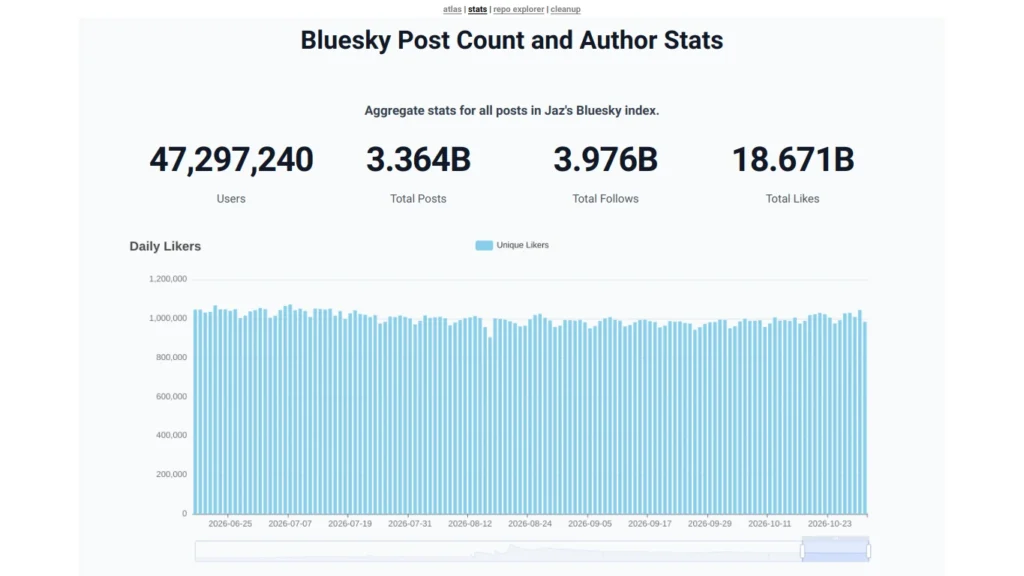
Another independent source, Jaz, tracks the stats associated with the blockchain social media network Bluesky. As of October 31 2026, there were over 47 million users.
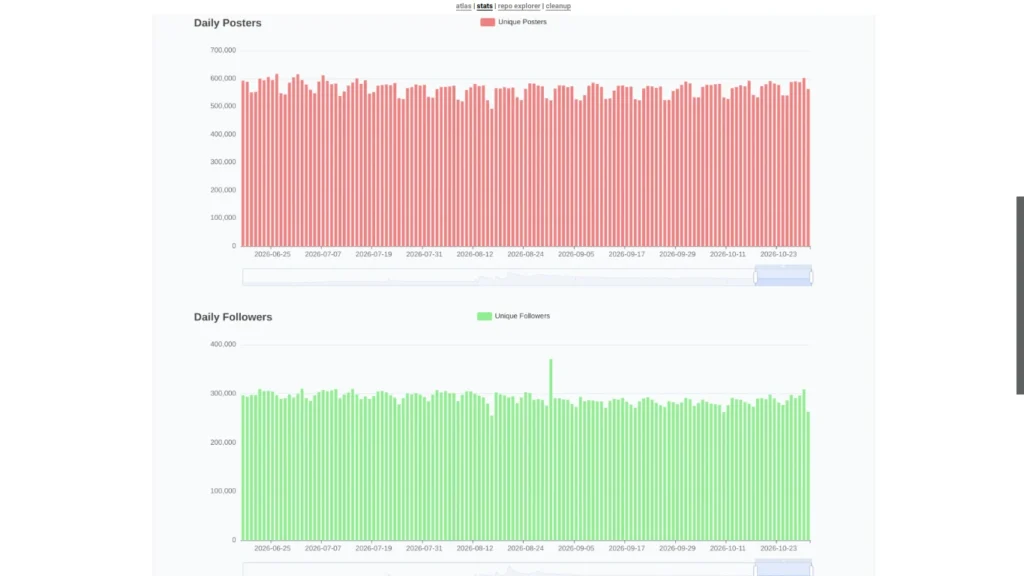
Jaz also tracks other key data like daily posters and daily followers.
Here is some simple arithmetic of my own. If 1.41 billion is 61% of the total, the platform’s lifetime output at the end of 2025 was roughly 2.3 billion posts. Everything posted before January 1, 2025 adds up to only about 900 million. So in twelve months, Bluesky users wrote around one and a half times as much as in all the years before combined.
Why it happened: the user base exploded
The easiest explanation is that there were simply far more people. The number of Bluesky users rose by about 60%, from 25.94 million to 41.41 million, during 2025. That is 59.6% growth, or 15.47 million new registered users.
TechCrunch reported that Bluesky itself described the jump in posts as closely tracking its 57% user growth over the same period. In other words, more people meant more posts.
That is the first piece of the puzzle, and it takes some of the mystery out of the headline. The 61% figure doesn’t mean every user suddenly became a posting machine. It means a platform that grew very fast will, by definition, have most of its history in its most recent year.
Any fast-growing network behaves this way. When a platform’s audience grows by about 60% each year, its latest year will always hold a big share of everything ever posted. The stat is real and impressive, but it says as much about growth as about enthusiasm.
The media numbers tell the same story
The photo and video figures follow the same pattern. Of the year’s posts, media-rich posts (photos, videos and other attachments) numbered 235 million, which is 62% of all media posts in Bluesky’s history. The platform also reported that users upload more than 500,000 media posts every 24 hours.
The media share is almost identical to the overall share (62% versus 61%). People weren’t just typing more. They were using the platform the way they use any mature social app, with images and video mixed in.
Now the complication: who is actually posting?
Here the story gets less rosy. A big pile of posts is not the same as a big, loyal audience.
Bluesky does not publish an official daily active user figure. All DAU numbers are third-party estimates. The estimates are still worth a look. Daily active users peaked at roughly 4.1 million in June 2025. By autumn, SimilarWeb data showed DAU down 40% year over year through October 2025, even as registered user counts kept climbing.
That is the part of the picture that rarely makes the headlines. Registered accounts kept going up, while the number of people showing up each day was well below its peak.
The gap between sign-ups and daily users is wide. One analysis put the DAU-to-registered-user ratio at about 8–10%. Run the numbers on 41.41 million accounts and a few million daily users, and you get the same answer: most accounts are quiet on any given day.
So who writes the 3.86 million posts a day? Probably a smaller, more committed group than the user count suggests. Bluesky’s own blog makes a similar point about bad behavior, noting that a small percentage of people contribute disproportionately to the toxicity problem on large social apps. The same pattern usually holds for ordinary posting. A minority writes most of the content.
A reality check from the usage data
Other numbers support the idea of a dedicated core. According to SimilarWeb, bsky.app ranked #228 among all websites globally and #148 in the US as of August 2026, with a bounce rate of 42.61%. Sessions are not short either: the average bsky.app session lasts 7 minutes and 37 seconds. A large share of visitors also arrive on purpose, with direct traffic at about 77.5% of all visits, up from 44.1% in late 2024.
That points to people who know where they’re going. It looks like a smaller, more habitual crowd, not a flood of casual visitors.
Moderation data fits the picture too. Moderation reports came from 1.24 million users, about 3% of Bluesky’s user base. Even the act of flagging content comes from a thin slice of the network.
So, is the stat “hidden”?
Partly. The 61% figure is true, it’s well sourced, and it shows how quickly Bluesky’s activity ramped up. But it isn’t proof that the network is becoming steadily more addictive. Two things are true at once:
- The thesis holds: a huge share of Bluesky’s content history was written in 2025, and posting volume rose in step with users.
- The thesis needs a caveat: much of that jump is the arithmetic of rapid growth, and daily activity cooled during the very same year.
A quick note on the crypto angle
Many readers expect Bluesky to show up next to blockchain-based social apps. It doesn’t belong there. As one explainer puts it, Bluesky is decentralized through DNS, not blockchain. That is why crypto data aggregators like Glassnode, Cryptorank and Kaiko don’t track it, and I found no Bluesky charts from them.
The crypto-native comparison is Farcaster, whose activity is tracked on Dune. One researcher reported that Farcaster’s DAU fell from roughly 70,000 in July 2024 to about 40,000 by October. A decline like that would be hard to hide on a Dune chart, and it’s a useful contrast with Bluesky’s open, public numbers.
Why this matters
Sign-ups are easy to count and easy to inflate. Posts and daily activity show whether a network is really being used. The 1.41 billion figure says Bluesky has real content momentum, while the cooling DAU says that momentum depends on keeping people coming back. If you’re a creator, brand or investor, watch daily activity, not registrations. That is where the platform will be won or lost.

Dan is a seasoned crypto writer for Blockchaindose who got his start in the space back in 2019. Over the past four years, he’s built a solid grasp of how the industry moves, focusing heavily on DeFi, NFTs, GameFi, and promising new projects.
Off the clock, you’ll usually find him buried in a good book or kicking back with a movie. His blend of hands-on market experience and straightforward commentary makes him a clear, trusted voice across the platform.