
A number that keeps going around crypto is that blockchain games draw 7 million daily active wallets. It’s real, but it’s probably a year older than people think.
If you read about blockchain games this year, you probably ran into one number: more than 7 million daily active wallets, usually “in early 2026.” It’s a great headline. It also suggests a sector hiding in plain sight, with millions of daily users and tokens worth very little.
The trouble starts when you try to find the source.
Where the 7 million actually comes from
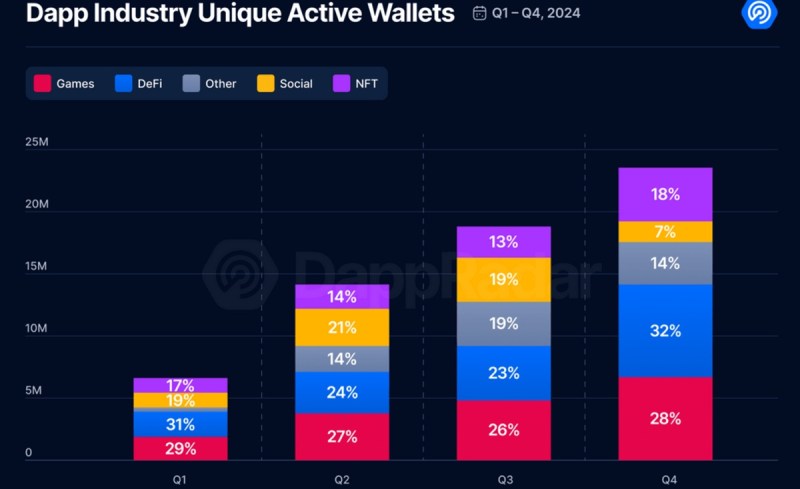
The figure comes from DappRadar. The firm reported 7 million daily unique active wallets in Web3 gaming in January, up 386% from January 2024. That report covered January 2025. Several roundups in 2026 repeat the number as if it were new, and one calls it the level reached “by early 2026.”
The numbers after January 2025 don’t show a steady climb. Daily wallets fell 16% the next month to around 5.8 million. By the third quarter, gaming wallets had slipped 4.4% from the previous quarter to 4.66 million, and DappRadar noted that the first quarter’s 5.8 million a day had been dropping ever since.
In short, 7 million was a peak, and the sector spent most of 2025 below it.
The data source disappeared
Part of the confusion is that the best source of this data is gone. DappRadar announced its shutdown on November 17, 2025, citing financial unsustainability. It had tracked 18,111 dapps across 93 blockchains. Any figure for early 2026 has to come from somewhere else, and none of the roundups I found pointed to a replacement dataset.
One more number shows how thin the funding was. Gaming drew only $293 million in venture money through the third quarter of 2025, compared with more than $1.8 billion in all of 2024.
A wallet is not a player
Even if 7 million were current, it wouldn’t mean 7 million players. DappRadar’s metric counts a wallet once per day if it touches a game’s smart contract. It doesn’t prove a human is behind it, and it doesn’t filter out bots or reward farmers. One person can run many wallets.
Look at where the activity sits. opBNB recorded 1.62 million daily unique active wallets, by far the most of any gaming chain. And World of Dypians reported 135 million wallets in Q3 2025. Numbers like that usually come from cheap, simple actions, not from people playing for hours.
Retention points the same way. One industry roundup puts monthly retention at 12%, about half the rate of traditional mobile games. That is a secondary source, so treat it as a rough guide.
The “tiny market cap” part
The second half of the claim says the game-token sector is worth very little compared with its usage. That part holds up better, with caveats.
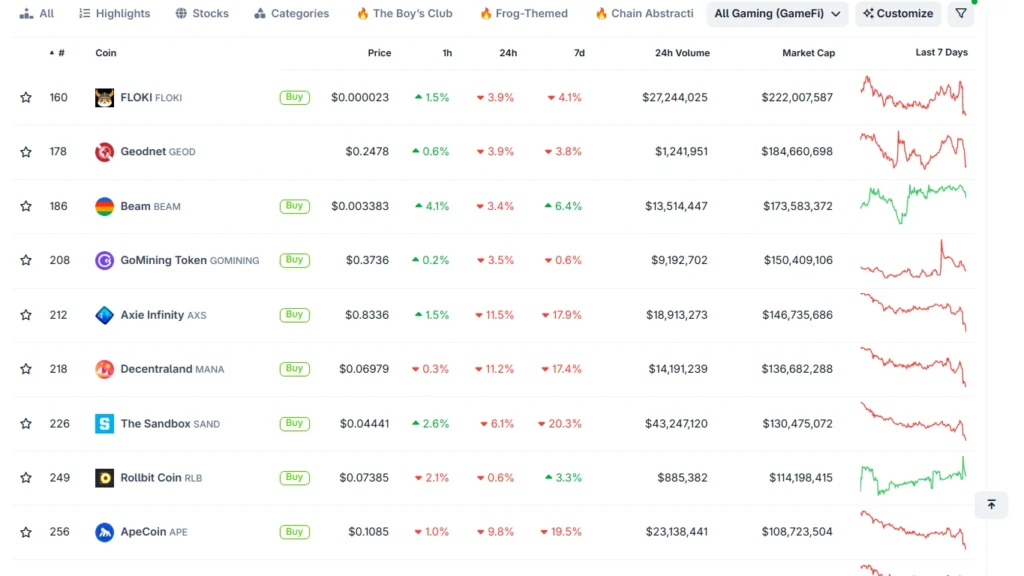
CoinGecko’s gaming category, as mirrored on rankings pages, has shown values in a range: about $3.63 billion in one snapshot and about $3.98 billion in another. That is small next to the whole crypto market.
Divide that by 7 million wallets and you get roughly $520 to $570 of token value per wallet. Divide by the more realistic 4.66 million and it rises to roughly $780 to $850. Either way, game tokens look cheap compared with their reported activity.
Two warnings apply:
- The total depends on definitions. Estimates for GameFi vary widely because providers disagree on category definitions and methods. One article in the search results even mentioned a $45 billion figure, which it said lacked verification.
- A few tokens carry the total. In one snapshot, a single token, BEAT, made up $521 million of the $3.98 billion. The same token was down more than 74% on the week, so the sector’s size can swing sharply.
What survives the fact-check
Taking the claims in turn:
- “7 million daily wallets in early 2026.” Not supported. The figure belongs to January 2025.
- “Up 50% from Q3 2025.” Not supported. Q3 2025 was 4.66 million, and DappRadar had stopped reporting by then. The 55% figure that circulates belongs to Ronin’s wallets in that quarter, not the whole sector.
- “Tokens are small compared with usage.” Mostly supported, with the caveats above.
- “Wallets overstate players.” Supported, by how the metric is built.
One bright spot is worth including. In October 2025, blockchain gaming was the only dapp sector that grew, reaching a record 27.9% share of dapp activity while the broader market contracted. That says gaming held up better than the rest of crypto, not that it boomed.
Why this matters
Numbers like this shape where money and attention go. A sector that looks like it has 7 million daily users in 2026 attracts different decisions than one that peaked a year earlier and has been flat or falling since. Check the date and the definition before you repeat a crypto statistic, and note whether the source still exists.

Dan is a seasoned crypto writer for Blockchaindose who got his start in the space back in 2019. Over the past four years, he’s built a solid grasp of how the industry moves, focusing heavily on DeFi, NFTs, GameFi, and promising new projects.
Off the clock, you’ll usually find him buried in a good book or kicking back with a movie. His blend of hands-on market experience and straightforward commentary makes him a clear, trusted voice across the platform.