
Here is a number that rarely makes the headlines: privacy coins returned 288% in 2025, according to sector data from Artemis. That made them the best-performing sector in all of crypto last year. For comparison, exchange tokens, another big category, rose 22% over the same period.
It is a strange result for a corner of the market that spent years being pushed out. Between 2023 and 2025, major exchanges removed privacy coins one after another. Regulators saw them as a compliance headache. Yet the group that was supposed to be dying ended up on top.
This article walks through the claim in plain terms: what the data says, what holds up, and what does not.
First, what are privacy coins?
Privacy coins are cryptocurrencies built to hide details of a transaction, such as who sent it, who received it, or how much moved. The best known are Monero (XMR), Zcash (ZEC) and Dash (DASH).
They work differently. Monero hides transaction details for everyone by default. Zcash lets users choose between a transparent transfer and a shielded one. That small difference turned out to matter a great deal, as we will see below.
The claim: 288% and the top spot
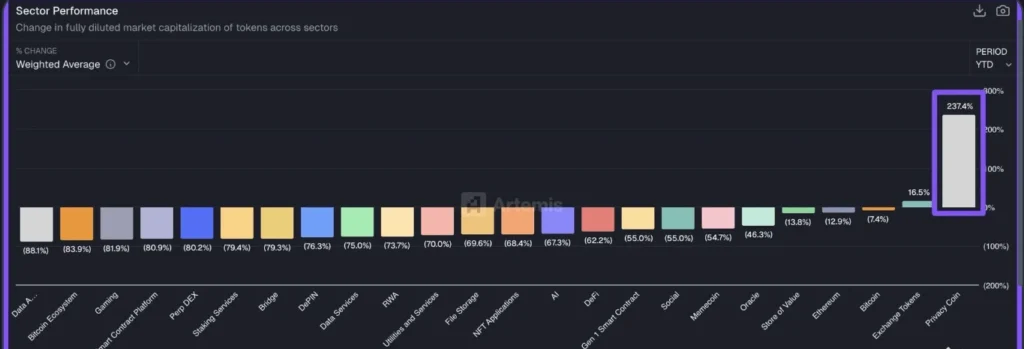
The 288% figure comes from sector performance data published by Artemis and reported by Cointelegraph in January 2026. It covers calendar-year 2025. The same report put the Andreessen Horowitz view in context: the venture firm expects privacy to be one of crypto’s strongest long-term themes.
Other trackers point the same way, even if their numbers differ:
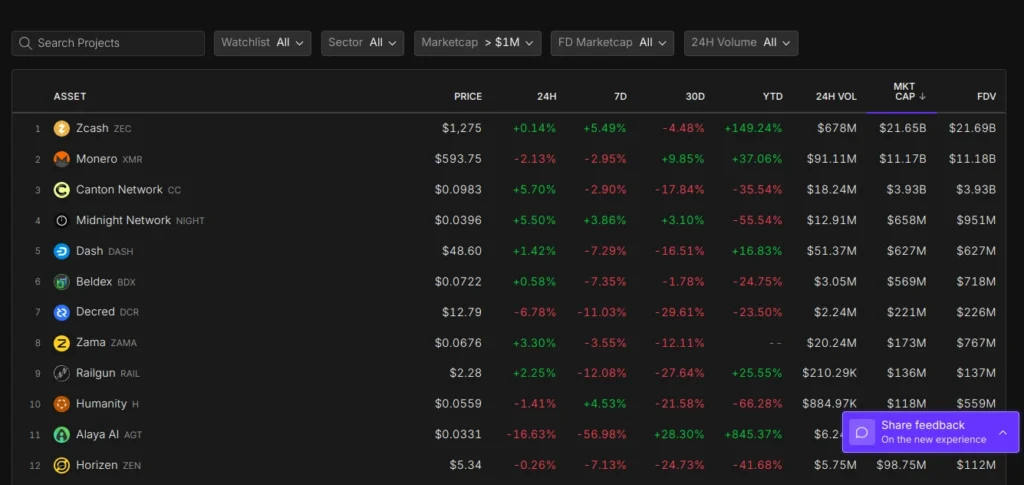
- Glassnode found that privacy coins were up 213% from Bitcoin’s record high on October 6, 2025 (above $126,000) to early September 2026. Bitcoin itself was still below that peak. Privacy coins were the sector standing above it.
- Messari counted a 36.7% rise in the total market cap of 151 privacy tokens in the first weeks of October 2025 alone, pushing the group past $7 billion.
- A Criptonoticias report put the sector’s 2025 market-cap growth at about 240%, above $19 billion.
The exact percentage changes depending on which coins a tracker includes and which dates it uses. But the direction is the same in every dataset: privacy coins won the year.
The twist: it happened while the doors were closing
This is the part that makes the stat hidden in plain sight. The rally did not come after good news. It came after years of bad news.
Kaiko, the market data firm, tracked the pain closely:
- Privacy tokens saw nearly 60 exchange delistings in 2024, a record since 2021. Monero suffered the most, with a sixfold jump in delistings.
- Binance fully delisted Monero in 2025’s run-up, and Kraken removed XMR pairs for European users. Kaiko reported that XMR lost close to 40% of its value in a single day when Binance announced its delisting.
- Liquidity, measured by how much can be traded within 1% of the price, fell to an all-time low of about $5 million across XMR, ZEC, DASH and ROSE after OKX removed several pairs. (This low was reported in January 2024, not in 2026. Some summaries online get the date wrong.)
- Trading moved to lightly regulated venues. Poloniex and Yobit grew from 18% to nearly 40% of volume in top privacy tokens between 2021 and 2024.
In plain words, the coins became harder to buy, harder to sell, and harder to trust. And then, in 2025, they took off anyway.
It was not just one coin… but it was mostly one coin
The honest version of this story has two halves.
The Zcash half. Zcash did the heavy lifting. Glassnode’s data shows ZEC rising more than 25-fold over a year and jumping from 82nd to 7th place by market cap. In November 2025, Zcash passed Monero to become the largest privacy coin for the first time in seven years, with a market cap above $10 billion at its peak, according to CoinMarketCap data reported by Cointelegraph. Glassnode estimates Zcash made up about 62% of the whole privacy sector.
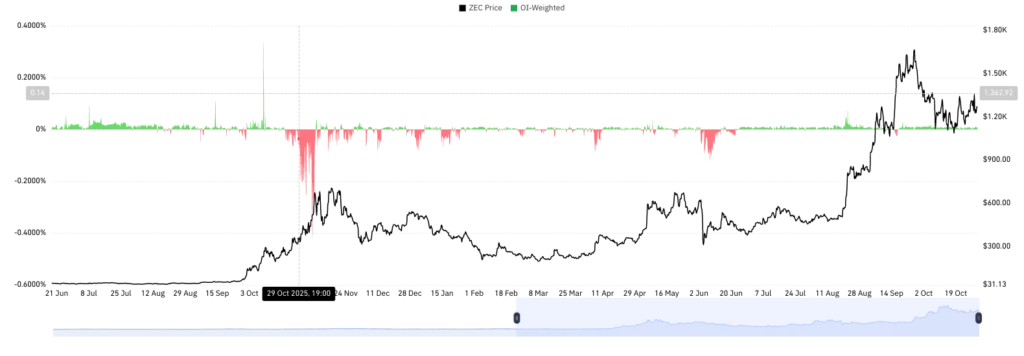
That is a big caveat. When people say “privacy coins rose 288%,” they are really saying “Zcash rose a lot, and the rest helped.”
The broader half. Even with Zcash removed, Glassnode’s privacy basket gained roughly 85% in a year, and Monero roughly doubled. That is still far ahead of most of the market. So the rally is real beyond a single token, but a smaller one.
Why did it happen?
Nobody can prove one cause, but the data points to a few likely ones.
A new pitch. Zcash’s optional privacy gave it a “regulated privacy” angle, privacy with the ability to disclose when needed. Cointelegraph reported that market participants read the inflows as an early sign of exactly that trade. The Zcash Foundation’s executive director said the rise reflected broader worry about government overreach on user privacy.
Real usage, not just price. According to CryptoSlate, over 30% of all ZEC supply now sits in shielded pools, a sign that people actually use the privacy feature. TRM Labs found Monero transaction volumes in 2024 and 2025 stayed far above 2020 and 2021 levels. Tornado Cash, a separate privacy tool, climbed to about 3,900 monthly active users by December 2025.
A weak market. Privacy coins rallied while Bitcoin and Ether were drifting. Money that wants a story in a flat market tends to find one.
What the stat does not prove
It is worth being careful here.
- It is not a safe trend. Monero fell almost 40% in one day on a delisting. These coins move fast in both directions.
- It is concentrated. Take Zcash out and the gain shrinks a lot.
- Different tables, different numbers. 288%, 240%, 213% and 85% all appear in credible reports, because each measures a different basket and period. Anyone quoting one figure should name the source.
- Liquidity is still thin. A coin that is hard to sell can look better on a chart than it feels in a wallet.
Why this matters
The 288% figure is a reminder that regulation and price are not the same thing. Privacy coins lost exchange access and still outperformed the whole sector. Whatever you think of them, readers of crypto news should know the data. It shows that demand for financial privacy is real, measurable, and bigger than the delisting headlines made it look. It also shows how much of the story rests on a single coin.

Dan is a seasoned crypto writer for Blockchaindose who got his start in the space back in 2019. Over the past four years, he’s built a solid grasp of how the industry moves, focusing heavily on DeFi, NFTs, GameFi, and promising new projects.
Off the clock, you’ll usually find him buried in a good book or kicking back with a movie. His blend of hands-on market experience and straightforward commentary makes him a clear, trusted voice across the platform.